Wyoming: Hazards and emergencies — Part 4 Practice Test
Questions in this part include: “When should you always test your brakes?” · “What should be checked regularly to help avoid carbon monoxide poisoning?”
Independent educational site · not affiliated with any government agency or DMV
Ready? Test yourself
Answer to start, or tap Start below:
When should you always test your brakes?
- Instant feedback with an explanation
- Every answer cites its source in the manual
- Your best score is saved on this device
- Keyboard: press 1 to 4 to answer and Enter for the next question
Questions are original and based on the official manual "Rules of the Road: State of Wyoming Driver License Manual" (2021 (August 2021)), Wyoming Department of Transportation (WYDOT), Driver Services.
All 16 questions in this practice test
Take the test above first, then use this list to study. Tap “Show answer” to see the correct answer and explanation.
Show the questions and answersHide the questions
-
After running off the road, what should you do once your speed has been reduced?
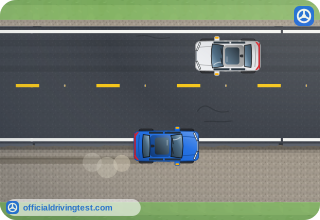
- Check behind and ahead for oncoming traffic
- Speed up along the shoulder to rejoin traffic
- Brake hard to stop completely
- Stop on the shoulder and wait
Show answer
Correct answer: Check behind and ahead for oncoming traffic
After slowing down you check behind and ahead for traffic, then turn sharply onto the pavement.
Source: Rules of the Road: State of Wyoming Driver License Manual (2021 (August 2021)), page 83 · Open this page in the manual (Manual page 83)
-
After your speed is reduced and you have checked for traffic, how does the manual say to return to the pavement?
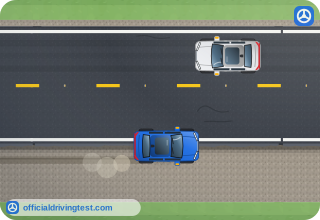
- Turn gradually onto the pavement
- Brake hard as you turn
- Turn sharply onto the pavement
- Wait for the shoulder to end
Show answer
Correct answer: Turn sharply onto the pavement
The last step after running off the road is to turn sharply onto the pavement.
Source: Rules of the Road: State of Wyoming Driver License Manual (2021 (August 2021)), page 83 · Open this page in the manual (Manual page 83)
-
When should you always test your brakes?
- After driving on dry pavement
- After driving through deep water
- Before every turn
- After every long downhill
Show answer
Correct answer: After driving through deep water
Wet brakes may pull to one side or not hold, so test them after deep water.
Source: Rules of the Road: State of Wyoming Driver License Manual (2021 (August 2021)), page 84 · Open this page in the manual (Manual page 84)
-
How do you dry your brakes after driving through deep water?
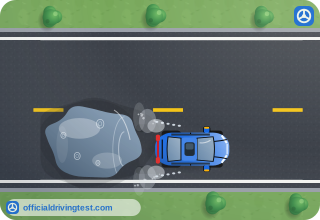
- Press the brake pedal once and hold it
- Drive without braking for a few miles
- Pull the parking brake and wait
- Brake gently several times until they are dry
Show answer
Correct answer: Brake gently several times until they are dry
Brake gently several times until your brakes are dry and work properly.
Source: Rules of the Road: State of Wyoming Driver License Manual (2021 (August 2021)), page 84 · Open this page in the manual (Manual page 84)
-
If your vehicle is not working properly and you need to stop, where should you stop?
- With two wheels on the shoulder and two on the pavement
- In the nearest traffic lane
- With all four wheels on the shoulder
- In the center of the road
Show answer
Correct answer: With all four wheels on the shoulder
You stop with all four wheels on the shoulder, then turn on your flashers.
Source: Rules of the Road: State of Wyoming Driver License Manual (2021 (August 2021)), page 84 · Open this page in the manual (Manual page 84)
-
What color cloth should you tie to an antenna or door handle to indicate vehicle problems?
- Red
- White
- Orange
- Green
Show answer
Correct answer: White
A white cloth tied to an antenna or door handle shows others that your vehicle has problems.
Source: Rules of the Road: State of Wyoming Driver License Manual (2021 (August 2021)), page 84 · Open this page in the manual (Manual page 84)
-
If your vehicle breaks down on the Interstate, what should you NOT do?
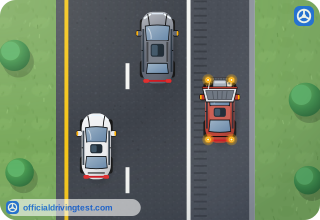
- Turn on your flashers
- Get out of the side away from traffic
- Walk for help
- Tie a white cloth to the antenna
Show answer
Correct answer: Walk for help
The manual says not to walk for help if you are on the Interstate.
Source: Rules of the Road: State of Wyoming Driver License Manual (2021 (August 2021)), page 84 · Open this page in the manual (Manual page 84)
-
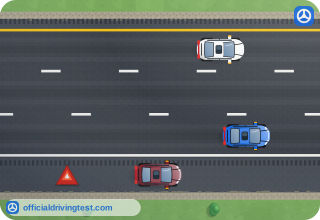
If you see a disabled vehicle parked on the shoulder, what should you do if possible?
- Stop behind it to help
- Move to the left lane
- Slow to a crawl in the right lane
- Honk to warn the driver
Show answer
Correct answer: Move to the left lane
The driver might not have seen you and may open the door or pull onto the road, so move to the left lane if possible.
Source: Rules of the Road: State of Wyoming Driver License Manual (2021 (August 2021)), page 84 · Open this page in the manual (Manual page 84)
-
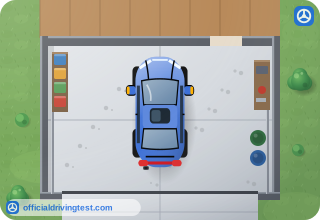
How does the manual describe carbon monoxide?
- A visible gas with a strong smell
- A harmless gas from the heater
- A gas that smells like gasoline
- A colorless, odorless and poisonous gas
Show answer
Correct answer: A colorless, odorless and poisonous gas
Carbon monoxide cannot be seen or smelled and is poisonous.
Source: Rules of the Road: State of Wyoming Driver License Manual (2021 (August 2021)), page 84 · Open this page in the manual (Manual page 84)
-
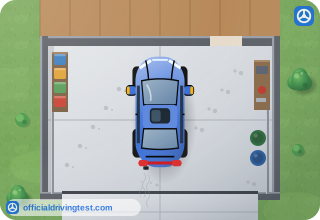
If you feel signs of carbon monoxide poisoning, what should you do?
- Turn on the heater
- Close the windows and keep driving
- Stop your engine and open the windows
- Drive faster to reach help
Show answer
Correct answer: Stop your engine and open the windows
Stop the engine and open the windows to get fresh air.
Source: Rules of the Road: State of Wyoming Driver License Manual (2021 (August 2021)), page 84 · Open this page in the manual (Manual page 84)
-
What should be checked regularly to help avoid carbon monoxide poisoning?
- The exhaust system
- The brake system
- The tire pressure
- The steering system
Show answer
Correct answer: The exhaust system
Have the exhaust system checked regularly for any leakage.
Source: Rules of the Road: State of Wyoming Driver License Manual (2021 (August 2021)), page 84 · Open this page in the manual (Manual page 84)
-
Where should you never start your vehicle or warm up the engine?
- In your driveway
- In a closed garage
- In an open parking lot
- On the shoulder
Show answer
Correct answer: In a closed garage
Starting or warming up an engine in a closed garage risks carbon monoxide poisoning.
Source: Rules of the Road: State of Wyoming Driver License Manual (2021 (August 2021)), page 84 · Open this page in the manual (Manual page 84)
-
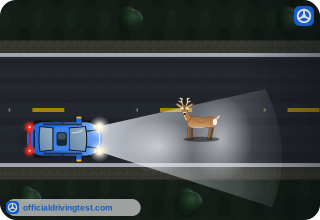
According to the manual, what may be the safest thing for you and nearby drivers when an animal is in the road and avoiding it could cost you control?
- Swerving into the next lane
- Turning sharply onto the shoulder
- Hitting the animal
- Stopping in the road
Show answer
Correct answer: Hitting the animal
Losing control is the greater hazard, so the safest thing may be hitting the animal.
Source: Rules of the Road: State of Wyoming Driver License Manual (2021 (August 2021)), page 86 · Open this page in the manual (Manual page 86)
-
When an animal is in the road, what should you concentrate on before, during and after a collision?
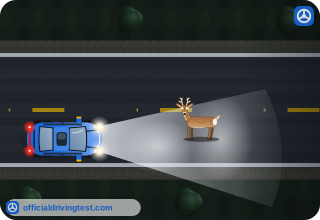
- Keeping control of your vehicle
- Steering around the animal at any cost
- Stopping in the lane
- Honking until the animal leaves
Show answer
Correct answer: Keeping control of your vehicle
Concentrate on keeping control of your vehicle before, during and after the collision.
Source: Rules of the Road: State of Wyoming Driver License Manual (2021 (August 2021)), page 86 · Open this page in the manual (Manual page 86)
-
What kinds of surface may a road shoulder have?
- Either hard surfaced or gravel
- Only hard surfaced
- Only sand or loose soil
- Only grass, never paved or gravel
Show answer
Correct answer: Either hard surfaced or gravel
The shoulder, beside the traveled highway, may be either hard surfaced or gravel.
Source: Rules of the Road: State of Wyoming Driver License Manual (2021 (August 2021)), page 94 · Open this page in the manual (Manual page 94)
-
What is the road shoulder used for?
- Vehicles passing other vehicles and merging traffic
- Pedestrian crossings and parking for local businesses
- Driver testing and vehicle inspections
- Stopped vehicles and proper drainage of the highway
Show answer
Correct answer: Stopped vehicles and proper drainage of the highway
The shoulder is used by stopped vehicles and helps provide proper drainage of the highway.
Source: Rules of the Road: State of Wyoming Driver License Manual (2021 (August 2021)), page 94 · Open this page in the manual (Manual page 94)