Virginia: Seat belts and child safety — Part 2 Practice Test
Questions in this part include: “Who must carry the physician’s signed statement for a child who has a child restraint waiver?” · “Before driving with children, what should you make sure about all car doors?”
Independent educational site · not affiliated with any government agency or DMV
Ready? Test yourself
- Instant feedback with an explanation
- Every answer cites its source in the manual
- Your best score is saved on this device
- Keyboard: press 1 to 4 to answer and Enter for the next question
Questions are original and based on the official manual "Virginia Driver's Manual" (DMV 39 (April 27, 2026)), Virginia Department of Motor Vehicles (DMV).
All 16 questions in this practice test
Take the test above first, then use this list to study. Tap “Show answer” to see the correct answer and explanation.
Show the questions and answersHide the questions
-
Which is one of the criteria for a child to sit without a booster seat?
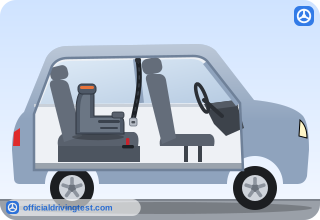
- Lap belt lies across the stomach
- Shoulder belt rests across the neck
- Lap belt lies snugly across the upper thighs
- Feet are able to dangle above the floor
Show answer
Correct answer: Lap belt lies snugly across the upper thighs
One criterion is that the lap belt lies snugly across the upper thighs.
Source: Virginia Driver's Manual (DMV 39 (April 27, 2026)), page 27 · Open this page in the manual (Manual page 27)
-
To sit without a booster seat, where must a child be able to keep his or her knees naturally bent?
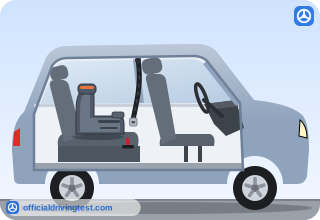
- Against the back of the front seat
- Over the edge of the seat
- Under the dashboard in front of them
- Behind the lap belt across the thighs
Show answer
Correct answer: Over the edge of the seat
A child must be able to keep knees naturally bent over the edge of the vehicle seat.
Source: Virginia Driver's Manual (DMV 39 (April 27, 2026)), page 27 · Open this page in the manual (Manual page 27)
-
A licensed physician may grant a waiver of the child restraint law when using a restraint would be unreasonable because of:
- The length of the trip or the time of day
- The child’s dislike of the restraint or seat type
- The number of passengers or the type of vehicle
- The child’s weight, physical fitness or medical reasons
Show answer
Correct answer: The child’s weight, physical fitness or medical reasons
The waiver covers cases where a restraint is unreasonable due to the child’s weight, physical fitness or other medical reasons.
Source: Virginia Driver's Manual (DMV 39 (April 27, 2026)), page 27 · Open this page in the manual (Manual page 27)
-
Who must carry the physician’s signed statement for a child who has a child restraint waiver?
- The person transporting the child
- The licensed physician who signed it
- The child’s school, in the student file
- The DMV, which keeps it on file
Show answer
Correct answer: The person transporting the child
The person responsible for transporting the child must carry the signed statement naming the child and the grounds for the waiver.
Source: Virginia Driver's Manual (DMV 39 (April 27, 2026)), page 27 · Open this page in the manual (Manual page 27)
-
Who is responsible for making sure that children in a vehicle are properly secured?
- The adult sitting next to the child
- The child’s parents, even if not in the vehicle
- The driver
- The person who owns the child safety seat
Show answer
Correct answer: The driver
The manual says the driver is responsible for making sure children are properly secured.
Source: Virginia Driver's Manual (DMV 39 (April 27, 2026)), page 27 · Open this page in the manual (Manual page 27)
-
What is the fine if you are convicted of violating the child restraint law?
- $25
- $50
- $75
- $150
Show answer
Correct answer: $50
A conviction for violating the child restraint law brings a $50 fine.
Source: Virginia Driver's Manual (DMV 39 (April 27, 2026)), page 27 · Open this page in the manual (Manual page 27)
-
For a second or subsequent child restraint law offense, what penalty could you face?
- $150
- $300
- $750
- $500
Show answer
Correct answer: $500
A second or subsequent offense could mean a $500 penalty.
Source: Virginia Driver's Manual (DMV 39 (April 27, 2026)), page 27 · Open this page in the manual (Manual page 27)
-
Where is the safest place to install a child safety seat?
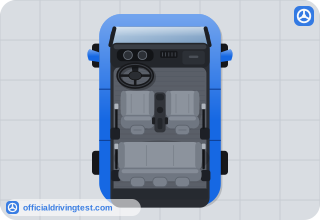
- In the center of the back seat
- In the front passenger seat
- Behind the driver
- Behind the front passenger
Show answer
Correct answer: In the center of the back seat
The manual says the center of the back seat is the safest place for a child safety seat.
Source: Virginia Driver's Manual (DMV 39 (April 27, 2026)), page 27 · Open this page in the manual (Manual page 27)
-
What does the manual suggest to make sure your child’s safety seat is installed correctly?
- Ask a driver training school instructor
- Have it inspected at a DMV customer service center
- Attend a child safety seat check held in your area
- Install it again after every trip
Show answer
Correct answer: Attend a child safety seat check held in your area
Child safety seat checks are held in localities across Virginia, and the manual urges attending one to confirm correct installation.
Source: Virginia Driver's Manual (DMV 39 (April 27, 2026)), page 27 · Open this page in the manual (Manual page 27)
-
What may happen to a child you hold in your lap during a crash?
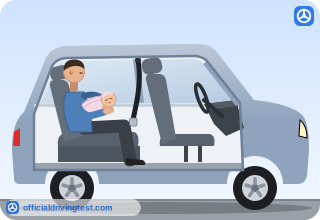
- The child may be thrown out by the safety belt
- The child may be crushed against the dashboard or seat
- The child is protected as long as an air bag is present
- The child is safe if you wear your lap belt around both
Show answer
Correct answer: The child may be crushed against the dashboard or seat
The manual says never to hold a child in your lap because the child may be crushed between your body and the dashboard or the back of the seat.
Source: Virginia Driver's Manual (DMV 39 (April 27, 2026)), page 27 · Open this page in the manual (Manual page 27)
-
Before driving with children, what should you make sure about all car doors?
- They are closed but left unlocked
- They are unlocked in case of an emergency
- They are open a few inches for fresh air
- They are securely closed and locked
Show answer
Correct answer: They are securely closed and locked
All car doors should be securely closed and locked before driving.
Source: Virginia Driver's Manual (DMV 39 (April 27, 2026)), page 27 · Open this page in the manual (Manual page 27)
-
If your car is equipped with a child safety lock, what should you do?
- Turn it on
- Leave it off so doors open easily
- Use it only on long trips
- Use it only with children in front
Show answer
Correct answer: Turn it on
The manual says to turn the child safety lock on.
Source: Virginia Driver's Manual (DMV 39 (April 27, 2026)), page 27 · Open this page in the manual (Manual page 27)
-
If you must open a door while traveling with children, what should you do?
- Slow down and open it while the vehicle rolls
- Ask an adult passenger to open it while you drive on
- Pull the vehicle off the road and come to a complete stop
- Turn on your flashers and open it at a low speed
Show answer
Correct answer: Pull the vehicle off the road and come to a complete stop
You must pull off the road and stop completely before a door is opened.
Source: Virginia Driver's Manual (DMV 39 (April 27, 2026)), page 27 · Open this page in the manual (Manual page 27)
-
Where should children never be allowed to ride?
- In a child safety seat in the back seat
- In the luggage area of a hatchback, station wagon or van
- In a booster seat in the center of the back seat
- In the back seat wearing a safety belt
Show answer
Correct answer: In the luggage area of a hatchback, station wagon or van
The manual says never to let children ride in the luggage area of hatchbacks, station wagons or vans.
Source: Virginia Driver's Manual (DMV 39 (April 27, 2026)), page 27 · Open this page in the manual (Manual page 27)
-
What should you never do when a child is riding in the back seat of a hatchback?
- Close the hatchback
- Lock the doors
- Turn on the child safety lock
- Leave the hatchback open
Show answer
Correct answer: Leave the hatchback open
The manual says never to leave a hatchback open when a child is riding in the back seat.
Source: Virginia Driver's Manual (DMV 39 (April 27, 2026)), page 27 · Open this page in the manual (Manual page 27)
-
Under what age is it illegal to transport children in the bed of a pickup truck, even if it has a camper shell?
- Age 16
- Age 12
- Age 14
- Age 18
Show answer
Correct answer: Age 16
It is illegal to transport children under age 16 in a pickup truck bed, even with a camper shell.
Source: Virginia Driver's Manual (DMV 39 (April 27, 2026)), page 27 · Open this page in the manual (Manual page 27)