Vermont: Seat belts and child safety Practice Test
Vermont’s safety belt law, car seats and booster seats by age, and air bags.
Independent educational site · not affiliated with any government agency or DMV
Ready? Test yourself
- Instant feedback with an explanation
- Every answer cites its source in the manual
- Your best score is saved on this device
- Keyboard: press 1 to 4 to answer and Enter for the next question
Questions are original and based on the official manual "Vermont Driver's Manual" (2025 edition (VN-007 07/2024)), Vermont Department of Motor Vehicles.
All 18 questions in this practice test
Take the test above first, then use this list to study. Tap “Show answer” to see the correct answer and explanation.
Show the questions and answersHide the questions
-
What happens if the vehicle you bring for the road test does not have safety belts?
- The test is given with a lower score
- You may sign a waiver and take the test
- No road test will be given
- The test is given only on low-speed roads
Show answer
Correct answer: No road test will be given
A vehicle without safety belts cannot be used; no road test is given in it.
Source: Vermont Driver's Manual (2025 edition (VN-007 07/2024)), page 19 · Open this page in the manual (Manual page 19)
-
What should you do with the safety belt before you drive your vehicle?
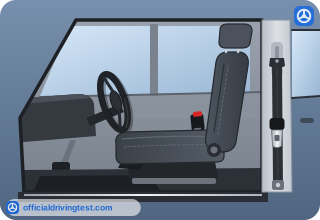
- Adjust it and fasten it
- Leave it loose until you reach a highway
- Fasten it only if a passenger is in the vehicle
- Adjust it for the rear seat passengers only
Show answer
Correct answer: Adjust it and fasten it
Adjusting and fastening the safety belt is one of the readiness steps to do before driving.
Source: Vermont Driver's Manual (2025 edition (VN-007 07/2024)), page 25 · Open this page in the manual (Manual page 25)
-
According to the manual, who is required by law to be restrained?
- All occupants of a motor vehicle
- Only the driver and front-seat passengers
- Only passengers under 18 years of age
- Only the driver
Show answer
Correct answer: All occupants of a motor vehicle
The law requires every occupant to be restrained with a safety belt or a federally approved child passenger restraining system.
Source: Vermont Driver's Manual (2025 edition (VN-007 07/2024)), page 62 · Open this page in the manual (Manual page 62)
-
What is the effect of wearing a safety belt in a collision?
- You are more likely to be thrown clear of the vehicle
- You are less likely to be injured or killed
- Your vehicle is less likely to be damaged
- You are less likely to be held responsible
Show answer
Correct answer: You are less likely to be injured or killed
Belted occupants are less likely to be injured or killed in a collision.
Source: Vermont Driver's Manual (2025 edition (VN-007 07/2024)), page 62 · Open this page in the manual (Manual page 62)
-
Where should a lap belt fit?
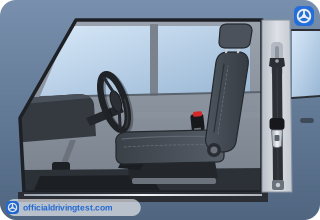
- Snugly across the stomach, not over the hips
- Loosely across the waist so you can move freely
- Snugly across the lower ribs
- Snugly across the hips, not over the stomach
Show answer
Correct answer: Snugly across the hips, not over the stomach
A lap belt should fit snugly across the hips rather than over the stomach.
Source: Vermont Driver's Manual (2025 edition (VN-007 07/2024)), page 62 · Open this page in the manual (Manual page 62)
-
Where should a shoulder belt go?
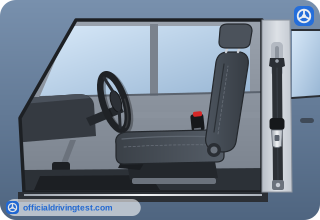
- Over the shoulder and across the center of the chest
- Over the shoulder and diagonally across the stomach
- Under the arm and across the ribs and back
- Behind the back and across the lower hips
Show answer
Correct answer: Over the shoulder and across the center of the chest
A shoulder belt goes over the shoulder and across the center of the chest.
Source: Vermont Driver's Manual (2025 edition (VN-007 07/2024)), page 62 · Open this page in the manual (Manual page 62)
-
Where are seatbelt extensions available from?
- Any DMV office
- A state police barracks
- The vehicle manufacturer
- A licensed inspection station
Show answer
Correct answer: The vehicle manufacturer
The manual says seatbelt extensions can be obtained from the vehicle manufacturer.
Source: Vermont Driver's Manual (2025 edition (VN-007 07/2024)), page 62 · Open this page in the manual (Manual page 62)
-
What should you never do with a shoulder belt?
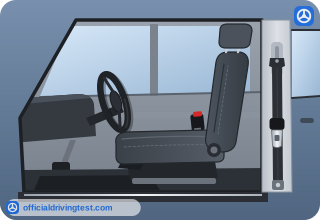
- Tuck it under your arm or behind your back
- Wear it across the center of your chest
- Wear it with the lap belt fastened
- Wear it over the shoulder
Show answer
Correct answer: Tuck it under your arm or behind your back
A shoulder belt must never be tucked under your arm or behind your back, because it only protects you when worn correctly.
Source: Vermont Driver's Manual (2025 edition (VN-007 07/2024)), page 62 · Open this page in the manual (Manual page 62)
-
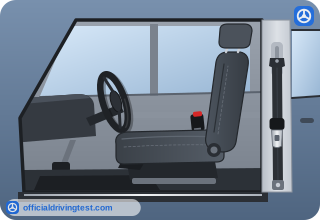
Safety belts are designed to cross your body at which points?
- Its most flexible points
- Its lowest points
- Its strongest points
- Its softest points
Show answer
Correct answer: Its strongest points
Belts cross the body at its strongest points to keep you safe in a crash.
Source: Vermont Driver's Manual (2025 edition (VN-007 07/2024)), page 62 · Open this page in the manual (Manual page 62)
-
In a crash, where are the instances of death and serious injury much greater?
- Inside the vehicle, held in place by a belt
- Outside the vehicle, after being thrown out of it
- In the back seat, compared with the front
- Inside a vehicle with working air bags
Show answer
Correct answer: Outside the vehicle, after being thrown out of it
Safety belts keep you inside the vehicle, where death and serious injury are much less likely than after being thrown out.
Source: Vermont Driver's Manual (2025 edition (VN-007 07/2024)), page 62 · Open this page in the manual (Manual page 62)
-
What does LATCH stand for in a vehicle's child seat system?
- Lap Anchors and Tethers for Children
- Locking Anchors and Tie-downs for Children
- Latches and Tethers for Child Harnesses
- Lower Anchors and Tethers for Children
Show answer
Correct answer: Lower Anchors and Tethers for Children
LATCH is the Lower Anchors and Tethers for Children system built into many vehicles.
Source: Vermont Driver's Manual (2025 edition (VN-007 07/2024)), page 62 · Open this page in the manual (Manual page 62)
-
How must a child under two years of age be secured?
- In a federally approved forward-facing car seat with a harness
- In a booster seat with a lap and shoulder belt
- With a seat belt in the back seat
- In a federally approved rear-facing car seat with a harness
Show answer
Correct answer: In a federally approved rear-facing car seat with a harness
A child under two must ride in a federally approved rear-facing car seat with a harness.
Source: Vermont Driver's Manual (2025 edition (VN-007 07/2024)), page 62 · Open this page in the manual (Manual page 62)
-
Where must a child in a rear-facing car seat not ride?
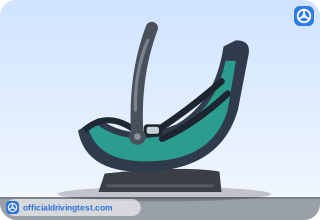
- In the back seat behind the driver
- In front of an active airbag
- In the middle of the back seat
- Next to another child in the back seat
Show answer
Correct answer: In front of an active airbag
A rear-facing car seat must never be placed in front of an active airbag.
Source: Vermont Driver's Manual (2025 edition (VN-007 07/2024)), page 62 · Open this page in the manual (Manual page 62)
-
Which restraint must a child over 2 but under five years of age be properly secured in?
- A federally approved forward-facing car seat with a harness, never rear-facing
- A seat belt in the back seat, with no car seat needed
- A federally approved rear-facing or forward-facing car seat with a harness
- A federally approved rear-facing car seat only, until the child turns five
Show answer
Correct answer: A federally approved rear-facing or forward-facing car seat with a harness
A child over 2 but under five may use a federally approved rear-facing or forward-facing car seat with a harness.
Source: Vermont Driver's Manual (2025 edition (VN-007 07/2024)), page 62 · Open this page in the manual (Manual page 62)
-
What must a child under eight years of age who is not properly secured in a harnessed car seat be properly secured in?
- A booster seat
- A lap belt only
- A shoulder belt only
- A seat belt adjusted by the driver
Show answer
Correct answer: A booster seat
A child under eight who is not in a harnessed car seat must be in a booster seat.
Source: Vermont Driver's Manual (2025 edition (VN-007 07/2024)), page 63 · Open this page in the manual (Manual page 63)
-
Where must a child under 13 years of age ride, if practical?
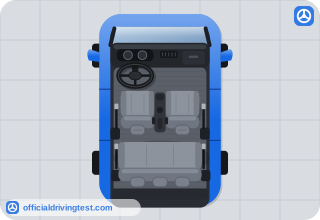
- In the front passenger seat
- In the back seat
- Directly behind the driver only
- Wherever the child prefers
Show answer
Correct answer: In the back seat
A child under 13 must ride in the back seat if it is practical.
Source: Vermont Driver's Manual (2025 edition (VN-007 07/2024)), page 63 · Open this page in the manual (Manual page 63)
-
A child under 18 years of age who is not properly secured in a harnessed car seat or booster seat must be doing what?
- Riding in a rear-facing seat
- Sitting beside an adult
- Sitting on an adult’s lap
- Wearing a seat belt
Show answer
Correct answer: Wearing a seat belt
A child under 18 who is not in a harnessed seat or booster must wear a seat belt.
Source: Vermont Driver's Manual (2025 edition (VN-007 07/2024)), page 63 · Open this page in the manual (Manual page 63)
-
In the manual’s “4 Steps for Kids”, which child restraint is the first step?
- Forward-facing seat
- Booster seat
- Rear-facing seat
- Seat belt
Show answer
Correct answer: Rear-facing seat
The four steps in order are rear-facing seat, forward-facing seat, booster seat, then seat belt.
Source: Vermont Driver's Manual (2025 edition (VN-007 07/2024)), page 63 · Open this page in the manual (Manual page 63)