Vermont: Distracted and drowsy driving
Vermont’s portable electronic device law, the rules for junior operators, dealing with distractions, and drowsy driving. Split into 2 shorter tests so you're not stuck in one long quiz.
Independent educational site · not affiliated with any government agency or DMV
Choose a part
Distracted and drowsy driving — Part 1
Questions in this part include: “Who is banned from using a portable electronic device while operating a motor vehicle?”
StartDistracted and drowsy driving — Part 2
Questions in this part include: “What does the manual suggest you do if you find yourself “lost in thought” while driving?”
StartAll 34 Distracted and drowsy driving questions with answers
Choose a part above to take a practice test, or study every question and answer here.
Show the questions and answersHide the questions
-
Who is banned from using a portable electronic device while operating a motor vehicle?
- Only Junior Driver’s License holders
- Only drivers under age 21
- Any person
- Only commercial drivers
Show answer
Correct answer: Any person
The rule is written for any person operating a motor vehicle, not a particular age group.
Source: Vermont Driver's Manual (2025 edition (VN-007 07/2024)), page 15 · Open this page in the manual (Manual page 15)
-
Which electronic communications does the ban on using a portable electronic device while operating a motor vehicle include composing or sending?
- Only text messages sent from a cellular telephone
- Only emails sent from a tablet or laptop computer
- Only voice mail and voice call messages
- Text messages, instant messages and emails
Show answer
Correct answer: Text messages, instant messages and emails
The ban covers reading and the manual composing or sending of texts, instant messages and emails.
Source: Vermont Driver's Manual (2025 edition (VN-007 07/2024)), page 15 · Open this page in the manual (Manual page 15)
-
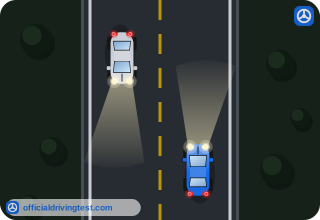
How may drowsy drivers appear to other people, according to the manual?
- They drive unusually slowly and carefully
- They drive with both hands tightly on the wheel
- They stay in the right lane at all times
- They can drive so poorly that they appear to be drunk
Show answer
Correct answer: They can drive so poorly that they appear to be drunk
The manual says drowsy drivers can drive so poorly they may appear to be drunk.
Source: Vermont Driver's Manual (2025 edition (VN-007 07/2024)), page 54 · Open this page in the manual (Manual page 54)
-
Which of these is a sign of drowsy driving?
- Not remembering the last few miles you drove
- Feeling hungry while you drive
- Checking your mirrors more often than usual
- Driving faster than the traffic around you
Show answer
Correct answer: Not remembering the last few miles you drove
Not remembering the last few miles you drove is one of the signs of drowsy driving listed in the manual.
Source: Vermont Driver's Manual (2025 edition (VN-007 07/2024)), page 54 · Open this page in the manual (Manual page 54)
-
Which of these warns you that you may be getting too drowsy to drive?
- Talking with passengers
- Turning on your headlights
- Yawning repeatedly
- Slowing down for curves
Show answer
Correct answer: Yawning repeatedly
Repeated yawning is one of the signs of drowsy driving named in the manual.
Source: Vermont Driver's Manual (2025 edition (VN-007 07/2024)), page 54 · Open this page in the manual (Manual page 54)
-
Who is most at risk of drowsy driving, according to the manual?
- Only people who drive for more than ten hours
- Only drivers who have had a drink
- Only drivers over 65 years old
- People who drive after not having enough sleep
Show answer
Correct answer: People who drive after not having enough sleep
The manual says those most at risk are people who drive after not having enough sleep, such as young people and shift workers.
Source: Vermont Driver's Manual (2025 edition (VN-007 07/2024)), page 54 · Open this page in the manual (Manual page 54)
-
What should you do if you become drowsy while you are on the road?
- Open your window and turn up the radio
- Find a safe place to pull over and stop
- Drive faster to reach your destination sooner
- Keep driving until you feel the drowsiness pass
Show answer
Correct answer: Find a safe place to pull over and stop
The manual says to pull over and stop in a safe place, because an open window or loud radio will not keep you awake.
Source: Vermont Driver's Manual (2025 edition (VN-007 07/2024)), page 54 · Open this page in the manual (Manual page 54)
-
According to the manual, what is a sure sign that you need to stop and rest?
- You feel hungry or thirsty after a long drive
- You have been driving for more than one hour
- You start trying to find a way to stay awake
- You pass a sign for a rest area ahead
Show answer
Correct answer: You start trying to find a way to stay awake
The manual says that when you begin looking for ways to stay awake, that is a sure sign you need to stop and rest.
Source: Vermont Driver's Manual (2025 edition (VN-007 07/2024)), page 54 · Open this page in the manual (Manual page 54)
-
How do distractions affect the way drivers react to traffic conditions or events?
- They react more slowly
- They react more quickly but less carefully
- They react in the same way as other drivers
- They stop reacting to vehicles ahead only
Show answer
Correct answer: They react more slowly
The manual says distractions cause drivers to react more slowly to traffic conditions or events.
Source: Vermont Driver's Manual (2025 edition (VN-007 07/2024)), page 54 · Open this page in the manual (Manual page 54)
-
Which of these do distracted drivers fail more often to recognize, according to the manual?
- Potential hazards such as pedestrians and bicyclists
- Traffic signals that are showing a red light
- The speed limit posted on the road they are driving
- The route they are taking to their destination
Show answer
Correct answer: Potential hazards such as pedestrians and bicyclists
Distracted drivers more often miss potential hazards like pedestrians, bicyclists and debris in the road.
Source: Vermont Driver's Manual (2025 edition (VN-007 07/2024)), page 55 · Open this page in the manual (Manual page 55)
-
What does the manual say distracted drivers decrease, leading them to take risks they might not otherwise take?
- Their reaction distance
- Their following gap
- Their “margin of safety”
- Their braking time
Show answer
Correct answer: Their “margin of safety”
Distracted drivers decrease their margin of safety, which leads to risks such as turning left in front of oncoming traffic.
Source: Vermont Driver's Manual (2025 edition (VN-007 07/2024)), page 55 · Open this page in the manual (Manual page 55)
-
Which risk does the manual give as an example of what distracted drivers may do after decreasing their margin of safety?
- Stopping completely at a green light
- Turning left in front of oncoming traffic
- Pulling over to let other vehicles pass
- Driving below the posted speed limit
Show answer
Correct answer: Turning left in front of oncoming traffic
The manual gives turning left in front of oncoming traffic as an example of a risk a distracted driver may take.
Source: Vermont Driver's Manual (2025 edition (VN-007 07/2024)), page 55 · Open this page in the manual (Manual page 55)
-
How loud should you keep your stereo while driving, according to the manual?
- Loud enough to keep you alert on long highway trips at night
- Loud enough to cover the noise from other traffic outside
- Only as loud as the sound of your engine and road noise
- Low enough that you can hear a siren, horn or train whistle outside
Show answer
Correct answer: Low enough that you can hear a siren, horn or train whistle outside
The manual says to keep the stereo low enough that you can hear sirens, horns or a train whistle outside your vehicle.
Source: Vermont Driver's Manual (2025 edition (VN-007 07/2024)), page 55 · Open this page in the manual (Manual page 55)
-
What does the manual suggest doing to avoid fumbling with maps or navigation systems?
- Look at the map each time you stop at a red light
- Designate a front-seat passenger as a “co-pilot”
- Place the map on the dashboard where you can see it
- Ask the driver ahead of you for directions
Show answer
Correct answer: Designate a front-seat passenger as a “co-pilot”
The manual recommends a front-seat passenger acting as a co-pilot, and mapping out destinations in advance if you drive alone.
Source: Vermont Driver's Manual (2025 edition (VN-007 07/2024)), page 55 · Open this page in the manual (Manual page 55)
-
If you are driving alone, what does the manual say to do about destinations?
- Look up the route while driving slowly
- Ask a passing driver for directions
- Rely on road signs alone
- Map out your destinations in advance
Show answer
Correct answer: Map out your destinations in advance
When you drive alone, the manual says to map out your destinations in advance instead of handling maps while driving.
Source: Vermont Driver's Manual (2025 edition (VN-007 07/2024)), page 55 · Open this page in the manual (Manual page 55)
-
What does the manual say about eating and drinking while driving?
- Avoid it, and secure food and drinks
- Do it only when traffic is light
- Do it only on straight, flat roads
- Do it only at speeds under 25 miles per hour
Show answer
Correct answer: Avoid it, and secure food and drinks
The manual advises avoiding eating and drinking while driving and securing food and drinks if you do have them in the vehicle.
Source: Vermont Driver's Manual (2025 edition (VN-007 07/2024)), page 55 · Open this page in the manual (Manual page 55)
-
What does the manual say about children in the vehicle?
- They are not a distraction when buckled in
- They are only distracting when they are under five years old
- Do not underestimate how distracting they can be
- They should be given toys to keep them busy while you drive
Show answer
Correct answer: Do not underestimate how distracting they can be
The manual warns that children can be very distracting and says to teach them good behavior in a vehicle.
Source: Vermont Driver's Manual (2025 edition (VN-007 07/2024)), page 55 · Open this page in the manual (Manual page 55)
-
What does the manual suggest you do if you find yourself “lost in thought” while driving?
- Turn on the radio louder
- Drive faster to get there sooner
- Look at the scenery
- Take a break
Show answer
Correct answer: Take a break
The manual says to take a break if you find yourself lost in thought while driving.
Source: Vermont Driver's Manual (2025 edition (VN-007 07/2024)), page 55 · Open this page in the manual (Manual page 55)
-
Where does the manual say you should do your personal grooming?
- At red lights only
- At home, not in the vehicle
- In the vehicle when parked on a hill
- In the vehicle on straight roads
Show answer
Correct answer: At home, not in the vehicle
Grooming takes your attention off driving, so the manual says to do it at home rather than in the vehicle.
Source: Vermont Driver's Manual (2025 edition (VN-007 07/2024)), page 55 · Open this page in the manual (Manual page 55)
-
Where should a pet be while you are driving, according to the manual?
- In your lap with a leash on
- On the front passenger seat
- In a carrier, not in your lap or free to move
- Loose in the back so it can move around
Show answer
Correct answer: In a carrier, not in your lap or free to move
The manual says pets can be distracting and should be kept in a carrier, not in your lap or loose in the vehicle.
Source: Vermont Driver's Manual (2025 edition (VN-007 07/2024)), page 55 · Open this page in the manual (Manual page 55)
-
What does the manual say about smoking while driving?
- It is a distraction; avoid it while driving
- It helps keep drivers alert
- It is acceptable if you use only one hand
- It is a distraction only on highways
Show answer
Correct answer: It is a distraction; avoid it while driving
The manual lists smoking as a distraction and says to avoid it while driving.
Source: Vermont Driver's Manual (2025 edition (VN-007 07/2024)), page 55 · Open this page in the manual (Manual page 55)
-
Which of these may keep you from driving well, according to the manual?
- Being overly worried, angry or depressed
- Being calm and relaxed
- Having plenty of time for your trip
- Having planned your route ahead
Show answer
Correct answer: Being overly worried, angry or depressed
The manual says you may not drive well if you are overly worried, excited, afraid, angry or depressed.
Source: Vermont Driver's Manual (2025 edition (VN-007 07/2024)), page 55 · Open this page in the manual (Manual page 55)
-
What does the manual suggest is a good way to cool off and calm down?
- Driving faster for a few miles
- Turning the radio up
- Taking a walk
- Taking a short nap while driving
Show answer
Correct answer: Taking a walk
The manual says to give yourself time to cool off and calm down, and that taking a walk is a good way to do this.
Source: Vermont Driver's Manual (2025 edition (VN-007 07/2024)), page 55 · Open this page in the manual (Manual page 55)
-
According to the manual, why should you give yourself extra time for a driving trip and leave a few minutes early?
- You will be able to use the passing lane more often
- You are less likely to speed or break laws or crash
- You will not need to use your turn signals as often
- You will get better fuel economy
Show answer
Correct answer: You are less likely to speed or break laws or crash
The manual says that with plenty of time you are less likely to speed, break laws or crash.
Source: Vermont Driver's Manual (2025 edition (VN-007 07/2024)), page 55 · Open this page in the manual (Manual page 55)
-
In Vermont, what is against the law for drivers to do while driving?
- Listen to the radio
- Check the time on a wristwatch
- Talk with a passenger
- Read or send messages
Show answer
Correct answer: Read or send messages
The manual states it is against the law for drivers to read or send messages while driving.
Source: Vermont Driver's Manual (2025 edition (VN-007 07/2024)), page 55 · Open this page in the manual (Manual page 55)
-
When is it against the law in Vermont to use a portable electronic device on a public highway?
- Only while the vehicle is in motion on the road
- While operating a vehicle, even if stationary
- Only while driving on an interstate highway
- Only while driving through a work zone
Show answer
Correct answer: While operating a vehicle, even if stationary
The law covers operating a motor vehicle on a public highway in Vermont, and it applies even while the vehicle is stationary.
Source: Vermont Driver's Manual (2025 edition (VN-007 07/2024)), page 55 · Open this page in the manual (Manual page 55)
-
What is the fine for a first violation of Vermont’s law against using a portable electronic device while driving?
- Not less than $50 and not more than $100
- Not less than $500 and not more than $1,000
- Not less than $25 and not more than $75
- Not less than $100 and not more than $200
Show answer
Correct answer: Not less than $100 and not more than $200
A first violation carries a fine of at least $100 and at most $200.
Source: Vermont Driver's Manual (2025 edition (VN-007 07/2024)), page 55 · Open this page in the manual (Manual page 55)
-
What is the fine for a second or subsequent violation of Vermont’s law against using a portable electronic device while driving?
- Not less than $250 and not more than $500
- Not less than $100 and not more than $200
- Not less than $1,000 and not more than $2,000
- Not less than $50 and not more than $150
Show answer
Correct answer: Not less than $250 and not more than $500
A second or later violation carries a fine of at least $250 and at most $500.
Source: Vermont Driver's Manual (2025 edition (VN-007 07/2024)), page 55 · Open this page in the manual (Manual page 55)
-
How many points are assessed against your driving record for a first conviction of using a portable electronic device in a properly designated work zone with workers present?
- One point
- Six points
- Two points
- Eight points
Show answer
Correct answer: Two points
A first conviction in a designated work zone where construction, maintenance or utility personnel are present adds two points.
Source: Vermont Driver's Manual (2025 edition (VN-007 07/2024)), page 55 · Open this page in the manual (Manual page 55)
-
How many points are assessed against your driving record for a second or subsequent conviction of using a portable electronic device in a properly designated work zone with workers present?
- Three points
- Seven points
- Ten points
- Five points
Show answer
Correct answer: Five points
A second or later conviction in such a work zone adds five points to the driving record.
Source: Vermont Driver's Manual (2025 edition (VN-007 07/2024)), page 55 · Open this page in the manual (Manual page 55)
-
Points for using a portable electronic device are assessed in a properly designated work zone in which who is present?
- Only police officers and tow truck drivers
- Construction, maintenance, or utility personnel
- Only school bus drivers and their students
- Only pedestrians crossing the road ahead
Show answer
Correct answer: Construction, maintenance, or utility personnel
The points apply to a conviction in a designated work zone where construction, maintenance, or utility personnel are present.
Source: Vermont Driver's Manual (2025 edition (VN-007 07/2024)), page 55 · Open this page in the manual (Manual page 55)
-
If a call needs to be made while you are driving, what does the manual say to do?
- Make the call quickly when stopped at a red light
- Use the speaker phone only while the vehicle is moving
- Ask a passenger to place it or stop in a safe place
- Keep the call very short and drive slowly
Show answer
Correct answer: Ask a passenger to place it or stop in a safe place
The manual advises asking a passenger to place the call or stopping at a safe place before calling.
Source: Vermont Driver's Manual (2025 edition (VN-007 07/2024)), page 55 · Open this page in the manual (Manual page 55)
-
What does the manual say to do about your phone when it rings while you are driving?
- Don’t answer it; return calls when stopped at a safe location
- Answer it quickly and keep the call as short as possible
- Answer it only if you recognize the number calling you
- Answer it only while driving on straight, flat roads
Show answer
Correct answer: Don’t answer it; return calls when stopped at a safe location
The manual says not to answer, let the caller leave a message, and return calls when stopped at a safe location.
Source: Vermont Driver's Manual (2025 edition (VN-007 07/2024)), page 56 · Open this page in the manual (Manual page 56)
-
Why does the manual say to secure your phone in the vehicle?
- So it does not become a projectile in a crash
- So it does not ring while you are driving
- So it stays charged during the trip
- So it cannot be seen from outside the vehicle
Show answer
Correct answer: So it does not become a projectile in a crash
A loose phone can fly through the vehicle in a crash, so the manual says to secure it.
Source: Vermont Driver's Manual (2025 edition (VN-007 07/2024)), page 56 · Open this page in the manual (Manual page 56)