Pavement markings in Utah
The Utah Driver Handbook shows or names everything on this page: 12 in all, on pages 31–32, 39, 41, 43–44, 74.
Independent educational site · not affiliated with any government agency or DMV
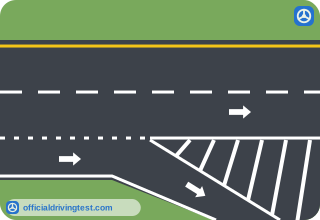
GORE AREA
It is against the law to cross over or to drive in the “gore area.” The gore area is between the solid white lines of a lane of traffic and a lane used to either enter or exit from that traffic lane. The gore area can also appear when two highways merge or split. Do not cross over the solid white line.
Manual page 31 · Open this page in the manual (Manual page 31)
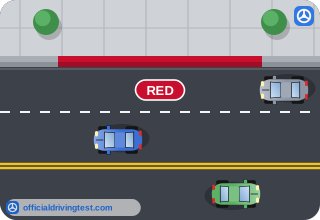
Red Curb
In the interest of public safety, there are several places where you are not allowed to park: ... Red-painted curbs or red zones. (p32) / Check for signs or painted curbs that may ban or limit parking. Colored curb markings indicate some no-parking zones. (p33)
Manual page 32 · Open this page in the manual (Manual page 32)
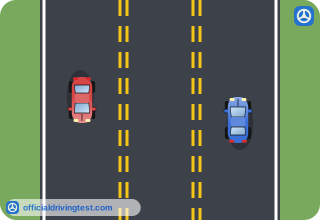
Flex Lane (Double Dashed Yellow Lines)
A flex lane may be used during rush hours. The lanes may have double-dashed yellow lines to either side.
Manual page 39 · Open this page in the manual (Manual page 39)
Dashed Guide Lines Through an Interchange
Dash lines have been added to these interchanges to guide drivers into the proper lanes.
Manual page 41 · Open this page in the manual (Manual page 41)
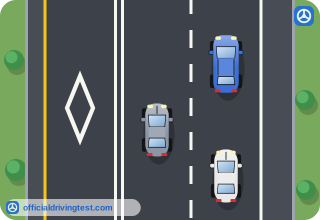
Express Lane Separator (Crossing Prohibited)
One direction roadway, separating express lane or carpool lane from general lanes - crossing prohibited (p43) / It is illegal to cross a double white line. Moving in and out of the carpool lane is not allowed except in specific locations (called access points) with white dotted striping rather than solid lines. (p40)
Manual page 43 · Open this page in the manual (Manual page 43)
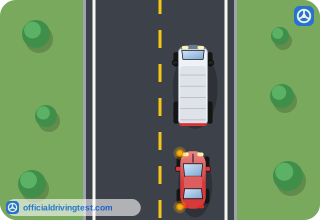
Passing Permitted (Broken Yellow Center Line)
Two direction roadway passing permitted
Manual page 43 · Open this page in the manual (Manual page 43)
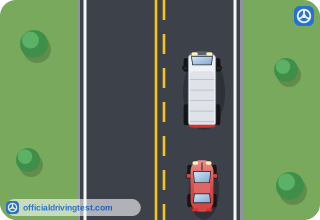
Passing Permitted When Dashed Line Is on Your Side
Two direction roadway, passing permitted when dashed line is on your side
Manual page 43 · Open this page in the manual (Manual page 43)
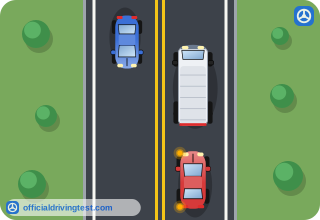
Passing Prohibited in Both Directions
Two direction roadway, passing prohibited in both directions
Manual page 43 · Open this page in the manual (Manual page 43)
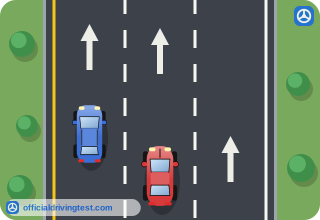
One-Way Road, Passing Permitted (Broken White Line)
One direction roadway passing permitted
Manual page 43 · Open this page in the manual (Manual page 43)
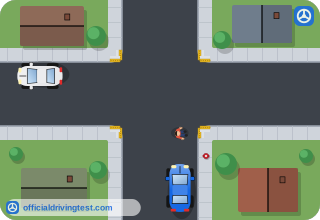
UNMARKED CROSSWALK
Crosswalks show where pedestrians may cross the road. At a stop sign or signal, you must stop behind the stop line or crosswalk. If crosswalks are not marked, you must stop before the intersection or stop sign. You must yield to pedestrians entering or in a crosswalk, even if it is not marked.
Manual page 44 · Open this page in the manual (Manual page 44)
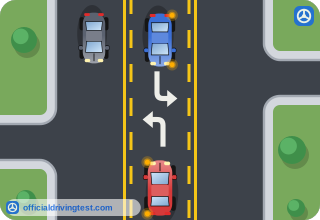
Center Left-Turn Lane
There is a shared left turn lane in the middle of the roadway on many streets, use caution to turn left safely. When using a shared left turn lane, check your mirrors; for vehicles ahead, signal left and check your left blind spot. Steer smoothly into the shared left turn lane; when traffic is clear, make your left turn. When making a left turn from a shared turn lane, you may not enter the lane more than 500 feet before making the turn unless the last car is more than 500 feet from the intersection.
Manual page 44 · Open this page in the manual (Manual page 44)
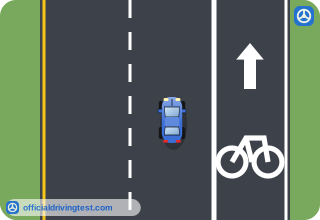
Bicycle Lane
Do not stop, park, or drive on a designated bicycle path or lane unless you are entering or leaving an alley or driveway, performing official duties directed by a police officer, or an emergency exists. Dedicated bicycle lanes are marked with solid white lines.
Manual page 74 · Open this page in the manual (Manual page 74)