Texas: Speed & following distance — Part 1 Practice Test
Questions in this part include: “According to the Texas Driver Handbook, how should you generally drive in relation to other traffic on the road?” · “At 40 mph, to about what fraction is a driver's field of vision reduced, according to the handbook?”
Independent educational site · not affiliated with any government agency or DMV
Ready? Test yourself
- Instant feedback with an explanation
- Every answer cites its source in the manual
- Your best score is saved on this device
Questions are original and based on the official manual "Texas Driver Handbook" (Revised January 2026), Texas Department of Public Safety (DPS).
All 16 questions in this practice test
Take the test above first, then use this list to study. Tap “Show answer” to see the correct answer and explanation.
Show the questions and answersHide the questions
-
According to the Texas Driver Handbook, how should you generally drive in relation to other traffic on the road?
- As fast as possible without going over the speed limit
- At the same speed as the main stream of traffic while always obeying the speed limit
- At least 10 mph slower than the traffic around you
- At the posted maximum speed limit no matter how other traffic is moving
Show answer
Correct answer: At the same speed as the main stream of traffic while always obeying the speed limit
The handbook advises drivers to generally travel at the same speed as the main stream of traffic and to always be aware of their speed while obeying the posted speed limit.
Source: Texas Driver Handbook (Revised January 2026), page 45
-
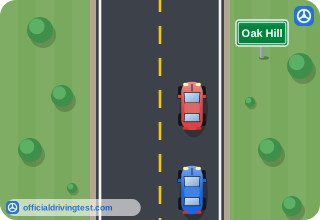
For speeds of 30 mph or less, what is the minimum following time you should keep between your car and the vehicle ahead of you in good road conditions?
- 1 second
- 2 seconds
- 3 seconds
- 4 seconds
Show answer
Correct answer: 2 seconds
The handbook states that for speeds of 30 mph or less, the minimum following time in good road conditions is 2 seconds.
Source: Texas Driver Handbook (Revised January 2026), page 45
-
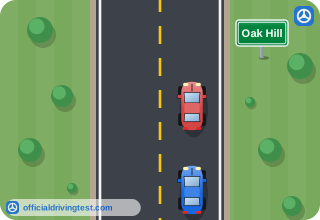
For speeds above 30 mph, what following time gap should you maintain behind the vehicle ahead during good road conditions?
- 2-second gap
- 3-second gap
- 4-second gap
- 6-second gap
Show answer
Correct answer: 4-second gap
For speeds above 30 mph, the handbook instructs drivers to maintain a 4-second gap during good road conditions.
Source: Texas Driver Handbook (Revised January 2026), page 45
-
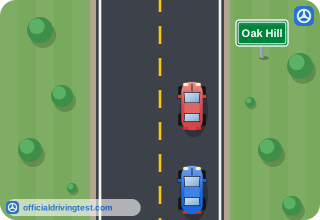
Which following interval does the handbook recommend as the best practice for a beginning or less experienced driver?
- 2-second interval
- 3-second interval
- 4-second interval
- 6-second interval
Show answer
Correct answer: 4-second interval
The handbook notes that using a four-second following interval is the best practice for a beginning or less experienced driver.
Source: Texas Driver Handbook (Revised January 2026), page 45
-
According to the handbook's stopping distance table, about how long does it take the average person to think, react, and apply the brakes?
- 1 second
- 1.5 seconds
- 2 seconds
- 3 seconds
Show answer
Correct answer: 1.5 seconds
The Approximate Stopping Distances table states it takes the average person about 1-1/2 seconds to think, react, and apply the brakes.
Source: Texas Driver Handbook (Revised January 2026), page 45
-
According to the Approximate Stopping Distances table, about how many feet does it take to stop from 40 mph, including thinking and reaction time, on dry, level pavement with good brakes and tires?
- 109 feet
- 164 feet
- 229 feet
- 303 feet
Show answer
Correct answer: 164 feet
The table shows that going 40 mph takes about 164 feet to stop under good conditions, with good brakes and tires on dry, level pavement.
Source: Texas Driver Handbook (Revised January 2026), page 45
-
What does the handbook advise if you are tired or not feeling well?
- Drive more slowly than usual
- Do not drive; never force yourself to drive
- Only increase your following distance
- Drink coffee and continue driving
Show answer
Correct answer: Do not drive; never force yourself to drive
The handbook states that if you are tired or not feeling well, you should not drive, and you should never force yourself to drive.
Source: Texas Driver Handbook (Revised January 2026), page 45
-
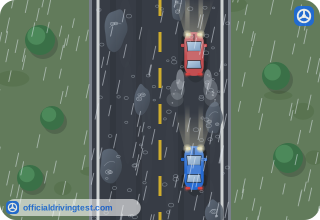
Why does the handbook say you should slow down and increase your following distance when the road is wet?
- Because tires wear out faster on wet roads
- Because roads become slippery, making the car harder to control
- Because posted speed limits automatically decrease in rain
- Because wet roads improve visibility
Show answer
Correct answer: Because roads become slippery, making the car harder to control
The handbook explains that roads become slippery when wet, making the car harder to control, so drivers should slow down and increase following distance.
Source: Texas Driver Handbook (Revised January 2026), page 45
-
Besides wet roads, which other roadway condition does the handbook say requires you to slow down and increase your following distance?
- When the vehicle is new
- When there are passengers in the car
- When the road is crowded
- When driving uphill
Show answer
Correct answer: When the road is crowded
The handbook lists a crowded road as another condition in which drivers should slow down and increase their following distance.
Source: Texas Driver Handbook (Revised January 2026), page 45
-
What rule does the handbook give about driving when your vision is limited, such as at night or in bad weather?

- You should use your high beams at all times
- You should follow other cars more closely to see better
- You should increase your speed to get through the area quickly
- You should always be able to stop within the distance you can see
Show answer
Correct answer: You should always be able to stop within the distance you can see
The handbook states that you should always be able to stop within the distance you can see ahead, and should not over-drive your range of vision in the dark or bad weather.
Source: Texas Driver Handbook (Revised January 2026), page 45
-
According to the 'Speed Reduces Your Field of Vision' section, what is a driver's field of vision when the vehicle is stationary?
- 90 degrees
- 120 degrees
- 180 degrees or more
- 360 degrees
Show answer
Correct answer: 180 degrees or more
The handbook states that when stationary, a driver's field of vision is 180 degrees or more.
Source: Texas Driver Handbook (Revised January 2026), page 45
-
At 20 mph, to about what fraction is a driver's field of vision reduced, according to the handbook?
- About 1/5
- About 2/5
- About 2/3
- It is not reduced at 20 mph
Show answer
Correct answer: About 2/3
The handbook shows that at 20 mph, field of vision is reduced to about 2/3 of the stationary field of vision.
Source: Texas Driver Handbook (Revised January 2026), page 45
-
At 40 mph, to about what fraction is a driver's field of vision reduced, according to the handbook?
- About 2/3
- About 2/5
- About 1/5
- About 1/2
Show answer
Correct answer: About 2/5
At 40 mph, the handbook shows field of vision is reduced to about 2/5 of the stationary field of vision.
Source: Texas Driver Handbook (Revised January 2026), page 45
-
At 60 mph, to about what fraction is a driver's field of vision reduced, according to the handbook?
- About 2/3
- About 2/5
- About 1/5
- About 3/5
Show answer
Correct answer: About 1/5
At 60 mph, the handbook shows field of vision is reduced to about 1/5 of the stationary field of vision, illustrating how speed narrows what a driver can see.
Source: Texas Driver Handbook (Revised January 2026), page 45
-
What does the Texas Driver Handbook say about posted speed limits?
- Only maximum speed limits must be obeyed
- Drivers must obey posted minimum and maximum speed limits
- Minimum speed limits only apply to trucks
- Speed limits are recommendations, not requirements
Show answer
Correct answer: Drivers must obey posted minimum and maximum speed limits
The handbook states that drivers are required to obey posted minimum and maximum speed limits, which are designed to provide for the orderly flow of traffic.
Source: Texas Driver Handbook (Revised January 2026), page 46
-
When a city, county, or other entity establishes or alters a speed limit in Texas, what must be true about that limit?
- It may be lower at night than during the day
- It must be the same for daytime and nighttime
- It must always increase after sunset
- It only applies to commercial vehicles
Show answer
Correct answer: It must be the same for daytime and nighttime
The handbook states that entities that establish or alter a speed limit must set the same speed limit for daytime and nighttime.
Source: Texas Driver Handbook (Revised January 2026), page 46