South Dakota: Health and driving Practice Test
How vision, hearing, medication and conditions such as diabetes or heart trouble can affect your driving.
Independent educational site · not affiliated with any government agency or DMV
Ready? Test yourself
- Instant feedback with an explanation
- Every answer cites its source in the manual
- Your best score is saved on this device
- Keyboard: press 1 to 4 to answer and Enter for the next question
Questions are original and based on the official manual "South Dakota Driver License Manual" (Revised 11/2024), South Dakota Department of Public Safety.
All 14 questions in this practice test
Take the test above first, then use this list to study. Tap “Show answer” to see the correct answer and explanation.
Show the questions and answersHide the questions
-
What does good side vision let you do while you look ahead?
- Read road signs from much farther down the road
- See clearly in the dark without using headlights
- Avoid the need to use your side mirrors
- Spot vehicles and other trouble on either side of you
Show answer
Correct answer: Spot vehicles and other trouble on either side of you
Side vision lets you notice vehicles and other possible trouble beside you while still looking ahead.
Source: South Dakota Driver License Manual (Revised 11/2024), page 18
-
Why must you also use your side mirrors and glance to the side when necessary?
- Side vision stops working at night
- Your eyes cannot see anything beside you
- You cannot focus on things to the side
- Mirrors are needed only for backing up
Show answer
Correct answer: You cannot focus on things to the side
Because you cannot focus on things at the side, mirrors and glances are needed to check them.
Source: South Dakota Driver License Manual (Revised 11/2024), page 18
-
Which skill is especially important when judging safe gaps for merging and for passing on two lane roads?
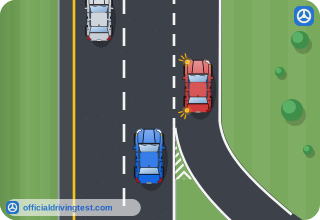
- Judging distances and speeds
- Recognizing colors quickly
- Reading small print on signs
- Hearing horns and sirens
Show answer
Correct answer: Judging distances and speeds
Knowing how far away other vehicles are and how fast they go is needed to pick safe gaps when merging and passing.
Source: South Dakota Driver License Manual (Revised 11/2024), page 18
-
What does the manual say to do if you have problems seeing at night?
- Drive only on interstate highways after dark
- Wear dark or tinted lenses to cut the glare
- Drive with the dome light on so you can see the road better
- Don't drive more than necessary and be very careful when you do
Show answer
Correct answer: Don't drive more than necessary and be very careful when you do
Drivers who see poorly at night should limit night driving and take extra care when they must drive.
Source: South Dakota Driver License Manual (Revised 11/2024), page 18
-
Why should you avoid dark or tinted corrective lenses at night?
- They make oncoming headlights look brighter
- They cut down the light you need to see clearly
- They are illegal for drivers to wear
- They slow down your reaction time
Show answer
Correct answer: They cut down the light you need to see clearly
Dark or tinted lenses reduce the light reaching your eyes, which you need to see well at night.
Source: South Dakota Driver License Manual (Revised 11/2024), page 18
-
What does the manual suggest keeping in your vehicle if you wear corrective lenses?
- A tinted pair of glasses
- A pair of sunglasses
- A written eye test result
- An extra pair of glasses
Show answer
Correct answer: An extra pair of glasses
A spare pair lets you keep driving safely if your regular glasses are broken or lost.
Source: South Dakota Driver License Manual (Revised 11/2024), page 18
-
According to the manual, how do the driving records of hearing-impaired drivers compare with those of drivers with good hearing?
- They are just as good
- They are somewhat worse
- They are slightly better
- They cannot be compared
Show answer
Correct answer: They are just as good
Studies cited in the manual found hearing-impaired drivers' records just as good as those of drivers with good hearing.
Source: South Dakota Driver License Manual (Revised 11/2024), page 18
-
What do drivers who know they are deaf or have hearing problems learn to do?
- Drive only at night when roads are quiet
- Rely on other drivers to warn them of danger
- Rely more on their vision and stay more alert
- Use the horn more often than other drivers
Show answer
Correct answer: Rely more on their vision and stay more alert
These drivers adjust by depending more on what they see and tend to stay more alert.
Source: South Dakota Driver License Manual (Revised 11/2024), page 18
-
If you are not feeling well and need to go somewhere, what does the manual say to do?
- Drive slowly on side roads
- Let someone else drive
- Drive only during daylight
- Drive with the windows open
Show answer
Correct answer: Let someone else drive
Many health problems, even small ones, can affect driving, so let someone else drive.
Source: South Dakota Driver License Manual (Revised 11/2024), page 22
-
According to the manual, when is epilepsy generally not dangerous for driving?
- Only when you drive during the day
- Only when you drive alone
- Only when you drive at low speeds
- So long as it is under medical control
Show answer
Correct answer: So long as it is under medical control
Epilepsy under medical control is generally not dangerous.
Source: South Dakota Driver License Manual (Revised 11/2024), page 22
-
When should diabetics who take insulin not drive?
- When there is any chance of an insulin reaction or blackout
- Only when they have not eaten any food for more than 24 hours
- Only when driving more than 100 miles
- Whenever they have taken any insulin
Show answer
Correct answer: When there is any chance of an insulin reaction or blackout
Insulin users should not drive if there is any chance of a reaction, blackout, convulsion, or shock.
Source: South Dakota Driver License Manual (Revised 11/2024), page 22
-
What could cause an insulin reaction while driving?
- Driving with the windows closed
- Skipping a meal or snack, or taking the wrong amount of insulin
- Driving for more than two hours on a highway without a rest stop
- Taking an over-the-counter cold drug
Show answer
Correct answer: Skipping a meal or snack, or taking the wrong amount of insulin
Skipping a meal or snack or taking the wrong amount of insulin can lead to a reaction.
Source: South Dakota Driver License Manual (Revised 11/2024), page 22
-
What should a person with diabetes have checked regularly?
- Their hearing, for possible loss over time
- Their reaction time, with a timed test at each license renewal
- Their eyes, for possible night blindness or other vision problems
- Their blood pressure at each license renewal
Show answer
Correct answer: Their eyes, for possible night blindness or other vision problems
People with diabetes should have their eyes checked regularly for night blindness and other vision problems.
Source: South Dakota Driver License Manual (Revised 11/2024), page 22
-
Who should not get behind the wheel, according to the manual's heart condition guidance?
- People in danger of a blackout, fainting, or a heart attack
- People who take any medication at all
- People who drink coffee or tea before a long drive on the highway
- People who have had a cold in the last month
Show answer
Correct answer: People in danger of a blackout, fainting, or a heart attack
People with heart diseases, high blood pressure, circulation problems, or danger of a blackout, fainting, or heart attack should not drive.
Source: South Dakota Driver License Manual (Revised 11/2024), page 22