South Dakota: Seat belts and child safety — Part 1 Practice Test
Questions in this part include: “In South Dakota, who may not be in the front seat without wearing a seatbelt?” · “Children of what age and younger should sit in the rear seat to avoid injury from an air bag?”
Independent educational site · not affiliated with any government agency or DMV
Ready? Test yourself
- Instant feedback with an explanation
- Every answer cites its source in the manual
- Your best score is saved on this device
- Keyboard: press 1 to 4 to answer and Enter for the next question
Questions are original and based on the official manual "South Dakota Driver License Manual" (Revised 11/2024), South Dakota Department of Public Safety.
All 22 questions in this practice test
Take the test above first, then use this list to study. Tap “Show answer” to see the correct answer and explanation.
Show the questions and answersHide the questions
-
In South Dakota, who may not be in the front seat without wearing a seatbelt?
- Only the driver
- Only passengers under 18
- Only front-seat passengers under age 5
- The driver and front-seat passengers
Show answer
Correct answer: The driver and front-seat passengers
The manual says it is illegal to drive or to be a front-seat passenger without wearing a seatbelt.
Source: South Dakota Driver License Manual (Revised 11/2024), page 25
-
What do seatbelts help you do in a crash?
- Stop the vehicle in a shorter distance
- Stay in the vehicle and keep control
- Avoid the other vehicle
- Keep the engine running
Show answer
Correct answer: Stay in the vehicle and keep control
Seatbelts keep you from being thrown from the vehicle and help you keep control.
Source: South Dakota Driver License Manual (Revised 11/2024), page 25
-
How should the shoulder harness be worn?
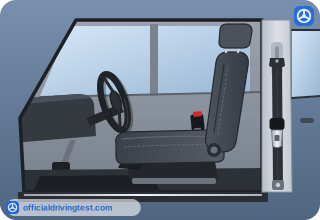
- Under the arm with some slack
- Behind the back with the lap belt
- Across the shoulder and chest with minimal slack
- Across the neck, loose enough to allow movement
Show answer
Correct answer: Across the shoulder and chest with minimal slack
The shoulder harness goes across the shoulder and chest with minimal, if any, slack.
Source: South Dakota Driver License Manual (Revised 11/2024), page 25
-
What could wearing the shoulder harness the wrong way cause in a crash?
- Serious internal injuries
- A broken windshield
- A jammed buckle
- Air bag failure at low speeds
Show answer
Correct answer: Serious internal injuries
Wearing the shoulder harness the wrong way could cause serious internal injuries in a crash.
Source: South Dakota Driver License Manual (Revised 11/2024), page 25
-
How should the lap belt be adjusted?
- Snug and low across your hips
- Loose across your stomach
- Snug across your ribs
- Loose across your chest
Show answer
Correct answer: Snug and low across your hips
The lap belt should be snug and lie low across the hips, otherwise you could slide out of it in a crash.
Source: South Dakota Driver License Manual (Revised 11/2024), page 25
-
In which situation do air bags NOT protect you, according to the manual?
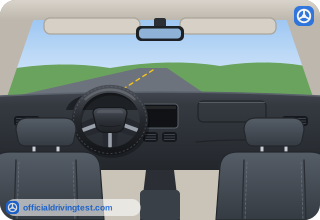
- If you hit the steering wheel or dashboard in a head-on crash
- If you hit the windshield
- If you are hit from the side or rear or the vehicle rolls over
- If you are wearing your seatbelt
Show answer
Correct answer: If you are hit from the side or rear or the vehicle rolls over
Air bags protect against hitting the steering wheel, dashboard or windshield, but not in side or rear hits or rollovers.
Source: South Dakota Driver License Manual (Revised 11/2024), page 25
-
Who is required by law to wear appropriate safety restraints while the vehicle is in motion?
- Only operators and passengers in the rear seat
- Operators, front seat passengers and children under 18
- Only operators and passengers over 18 in the front seat
- Only front seat passengers over 18
Show answer
Correct answer: Operators, front seat passengers and children under 18
The manual says all operators, front seat passengers and children under 18 must wear appropriate restraints while the vehicle moves.
Source: South Dakota Driver License Manual (Revised 11/2024), page 26
-
Where should you never secure a child, especially if your vehicle has an air bag?
- In the center of the rear seat
- Behind the driver
- Behind the front passenger seat
- In the front passenger seat
Show answer
Correct answer: In the front passenger seat
A child in the front passenger seat could be severely injured if the air bag deploys.
Source: South Dakota Driver License Manual (Revised 11/2024), page 26
-
What does the manual say about a child safety device you cannot afford?
- The state gives one free at the exam station
- You may go without one
- Insurance companies must pay for one
- Several organizations will loan you one
Show answer
Correct answer: Several organizations will loan you one
The manual says several organizations will loan you a child safety device if you cannot afford one.
Source: South Dakota Driver License Manual (Revised 11/2024), page 26
-
Under South Dakota Codified Law 32-38-1, the driver must secure a seatbelt on any front seat passenger of what age?
- Younger than five
- At least five but younger than eighteen
- At least twelve but younger than sixteen
- Eighteen or older
Show answer
Correct answer: At least five but younger than eighteen
The law makes the driver responsible for seatbelts on front seat passengers who are at least five and younger than eighteen.
Source: South Dakota Driver License Manual (Revised 11/2024), page 26
-
How does South Dakota Codified Law 32-38-1 classify a violation of its front seat seatbelt requirement?
- It is a moving traffic offense
- It is a felony
- It is not a moving traffic offense
- It is a Class 1 misdemeanor
Show answer
Correct answer: It is not a moving traffic offense
The law states that a violation of this section is not a moving traffic offense.
Source: South Dakota Driver License Manual (Revised 11/2024), page 26
-
How are air bags designed to work best?
- In combination with seatbelts
- Instead of seatbelts in newer cars
- Only in head-on crashes
- Only at highway speeds
Show answer
Correct answer: In combination with seatbelts
Air bags are supplemental restraints that work best together with seatbelts.
Source: South Dakota Driver License Manual (Revised 11/2024), page 26
-
Children of what age and younger should sit in the rear seat to avoid injury from an air bag?
- 12
- 6
- 8
- 16
Show answer
Correct answer: 12
The manual says children age 12 and younger should sit in the rear seat to avoid air bag injury.
Source: South Dakota Driver License Manual (Revised 11/2024), page 26
-
Where should a rear-facing child safety seat never be placed?
- In the rear seat
- Behind the front passenger seat, facing back
- In front of an active passenger air bag
- Behind the driver’s seat
Show answer
Correct answer: In front of an active passenger air bag
A rear-facing child safety seat must never be placed in front of an active passenger air bag.
Source: South Dakota Driver License Manual (Revised 11/2024), page 26
-
In which direction does a child ride in an infant car carrier?
- Forward
- Backwards
- Sideways
- Whichever way the child prefers
Show answer
Correct answer: Backwards
In an infant car carrier the child rides facing backwards with the head and body cushioned.
Source: South Dakota Driver License Manual (Revised 11/2024), page 26
-
How is an infant car carrier securely attached to the vehicle’s seat?
- By a tether bolted to the floor
- By the parent holding it
- By the head restraint
- By the lap belt
Show answer
Correct answer: By the lap belt
The carrier is attached to the vehicle’s seat with the lap belt, while its built-in harness holds the baby.
Source: South Dakota Driver License Manual (Revised 11/2024), page 26
-
What does the manual say about baby seats in a vehicle?
- They are fine for short trips only
- They are safe when the baby is strapped in firmly
- They are safe if they are secured to the seat with the lap belt only
- They are not made to protect a baby in a vehicle and should not be used there
Show answer
Correct answer: They are not made to protect a baby in a vehicle and should not be used there
Baby seats are meant for the house, not to protect a baby in a vehicle.
Source: South Dakota Driver License Manual (Revised 11/2024), page 27
-
Until about what age should an infant car carrier be used?
- About 3 months, when the child can hold up its head
- About 9 months, when the child can sit well alone
- About 15 months, when the child can walk
- About 24 months, when the child is two years old
Show answer
Correct answer: About 9 months, when the child can sit well alone
The carrier is used from birth until the child can sit well alone, at about 9 months.
Source: South Dakota Driver License Manual (Revised 11/2024), page 27
-
Why should you never put a belt around yourself and a child on your lap?
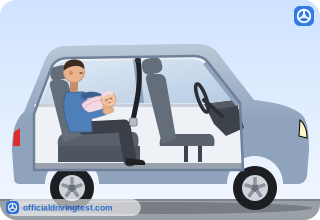
- The belt would be too short to reach around both of you in normal driving
- The belt would tear in a crash and the child would be thrown free
- Your weight, increased by collision forces, would press the belt deeply into the child
- The child could not see out of the windows
Show answer
Correct answer: Your weight, increased by collision forces, would press the belt deeply into the child
In a collision your own weight, greatly increased by the forces, would press the belt into the child’s body and could cause fatal injuries.
Source: South Dakota Driver License Manual (Revised 11/2024), page 27
-
When should a baby first be carried in an approved safety restraint?
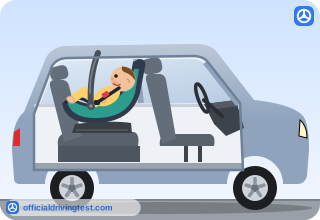
- From the very first ride, the drive home from the hospital
- Once the baby can sit well alone and no longer needs a carrier
- At about age 1
- Only on trips of more than 25 miles
Show answer
Correct answer: From the very first ride, the drive home from the hospital
The baby should be in an approved safety restraint beginning with the very first ride home from the hospital.
Source: South Dakota Driver License Manual (Revised 11/2024), page 27
-
Which seating position is safer for a passenger, as a rule?
- The back seat, and the center of the vehicle over the sides
- The front seat, and the sides over the center
- The front seat, and the center of the vehicle over the sides
- The back seat, and the sides over the center
Show answer
Correct answer: The back seat, and the center of the vehicle over the sides
The manual says the back seat is safer than the front, and the center is safer than the sides.
Source: South Dakota Driver License Manual (Revised 11/2024), page 27
-
Why should you insist that every passenger buckle up?
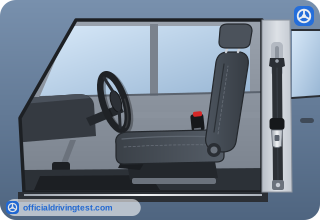
- Belted passengers are never injured by loose passengers
- It lets the driver go faster
- Unrestrained passengers often injure others who are belted in
- It keeps the doors from opening
Show answer
Correct answer: Unrestrained passengers often injure others who are belted in
Besides their own risk, unrestrained passengers often injure other passengers who are belted in.
Source: South Dakota Driver License Manual (Revised 11/2024), page 27