South Dakota: Parking rules Practice Test
Where you may not park, parallel, perpendicular and angle parking, and turning the wheels when you park on a hill.
Independent educational site · not affiliated with any government agency or DMV
Ready? Test yourself
- Instant feedback with an explanation
- Every answer cites its source in the manual
- Your best score is saved on this device
- Keyboard: press 1 to 4 to answer and Enter for the next question
Questions are original and based on the official manual "South Dakota Driver License Manual" (Revised 11/2024), South Dakota Department of Public Safety.
All 23 questions in this practice test
Take the test above first, then use this list to study. Tap “Show answer” to see the correct answer and explanation.
Show the questions and answersHide the questions
-
When parking along the roadway, where should you park the vehicle?
- As close to the flow of traffic as is safe
- Angled slightly into the travel lane for visibility
- At least one car length from the curb
- As far away from the flow of traffic as possible
Show answer
Correct answer: As far away from the flow of traffic as possible
The manual says to park as far away from the flow of traffic as possible.
Source: South Dakota Driver License Manual (Revised 11/2024), page 43
-
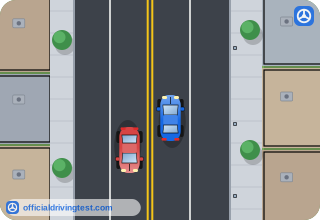
When parking along the roadway where there is a curb, how close should you park to it?
- About 2 feet away
- Halfway between the curb and the lane
- As close as possible
- Far enough away to open the doors easily
Show answer
Correct answer: As close as possible
If there is a curb, you park as close to it as possible.
Source: South Dakota Driver License Manual (Revised 11/2024), page 43
-
Which of these does the manual tell you to do when you park?
- Set the parking brake
- Leave the engine running
- Turn the front wheels toward traffic
- Leave the transmission in neutral
Show answer
Correct answer: Set the parking brake
The manual says to always set the parking brake when you park (with a possible cold-weather exception).
Source: South Dakota Driver License Manual (Revised 11/2024), page 43
-
Which position do you leave a parked vehicle with an automatic transmission in?
- Neutral
- Reverse
- Drive
- Park
Show answer
Correct answer: Park
The manual says to leave an automatic transmission vehicle in “park”.
Source: South Dakota Driver License Manual (Revised 11/2024), page 43
-
In cold weather, why might you choose to leave the parking brake off?
- It could wear down the brake pads
- It could freeze in the “on” position
- It could drain the battery
- It could lock the steering wheel
Show answer
Correct answer: It could freeze in the “on” position
In cold weather the parking brake could freeze on, so you may choose to leave it off but keep the vehicle in gear or park.
Source: South Dakota Driver License Manual (Revised 11/2024), page 43
-
If you park on a rural highway, how much road width must be left for other traffic to pass your vehicle?
- At least 10 feet
- At least 15 feet
- At least 20 feet
- At least 25 feet
Show answer
Correct answer: At least 15 feet
There must be at least 15 feet of road width for other traffic to pass a vehicle parked on a rural highway.
Source: South Dakota Driver License Manual (Revised 11/2024), page 43
-
If you park on a rural highway, how far in either direction must your vehicle be visible?
- At least 100 feet
- At least 300 feet
- At least 1,000 feet
- At least 500 feet
Show answer
Correct answer: At least 500 feet
The vehicle must be visible for at least 500 feet in either direction.
Source: South Dakota Driver License Manual (Revised 11/2024), page 43
-
What must be on when you are parked on a rural highway and it is dark outside?
- The parking lights and taillights
- The high-beam headlights
- The interior dome light
- Only the hazard flashers and dome light
Show answer
Correct answer: The parking lights and taillights
The parking lights and taillights must be on if it is dark outside.
Source: South Dakota Driver License Manual (Revised 11/2024), page 43
-
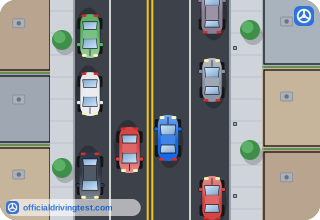
When getting out of a parked vehicle, which side should you use if possible?
- The street side
- The side nearest traffic
- The curb side
- The driver’s side only
Show answer
Correct answer: The curb side
You should get out on the curb side if possible, and check traffic before opening the door if you must use the street side.
Source: South Dakota Driver License Manual (Revised 11/2024), page 43
-
Which of these should you never do with a parked vehicle?
- Lock the doors
- Park in a designated area
- Set the parking brake
- Leave the ignition key in it
Show answer
Correct answer: Leave the ignition key in it
The manual says never to leave the ignition key in a parked vehicle.
Source: South Dakota Driver License Manual (Revised 11/2024), page 43
-
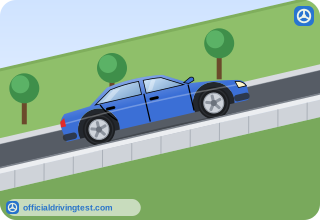
When parking facing uphill next to a curb, which way do you turn the wheels?
- Sharply to the right
- Sharply to the left
- Straight ahead
- Slightly to the right
Show answer
Correct answer: Sharply to the left
If there is a curb and you face uphill, you turn the wheels sharply to the left.
Source: South Dakota Driver License Manual (Revised 11/2024), page 43
-
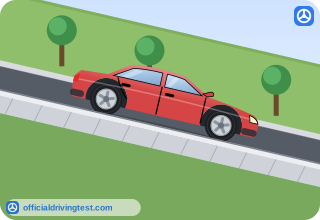
When parking facing downhill, which way do you turn the wheels?
- Sharply to the left
- Straight ahead
- Sharply to the right
- Slightly to the left
Show answer
Correct answer: Sharply to the right
Facing downhill, you turn the wheels sharply to the right.
Source: South Dakota Driver License Manual (Revised 11/2024), page 43
-
When parking facing uphill with no curb, which way do you turn the wheels?
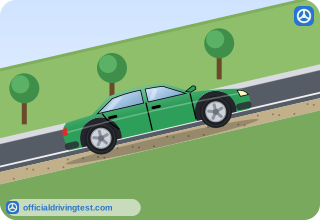
- Sharply to the right
- Sharply to the left
- Straight ahead
- Slightly to the left
Show answer
Correct answer: Sharply to the right
With no curb, you turn the wheels sharply to the right so the vehicle will roll away from traffic.
Source: South Dakota Driver License Manual (Revised 11/2024), page 43
-
Why do you turn the wheels sharply when parking on a hill?
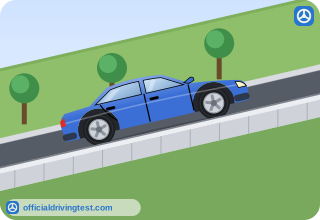
- So it rolls away from traffic if it starts to roll
- So the vehicle can pull out of the space faster
- So the brakes do not have to be set as firmly
- So the tires wear evenly on the downhill side
Show answer
Correct answer: So it rolls away from traffic if it starts to roll
Turned wheels make the vehicle roll away from traffic if it starts to roll.
Source: South Dakota Driver License Manual (Revised 11/2024), page 43
-
With a manual transmission, which gear do you shift into when parking uphill?
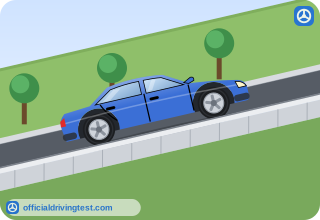
- Fourth gear
- Neutral
- The lowest gear
- The highest gear
Show answer
Correct answer: The lowest gear
On a hill, a manual transmission goes into the lowest gear when parking uphill.
Source: South Dakota Driver License Manual (Revised 11/2024), page 43
-
With a manual transmission, which gear do you shift into when parking downhill?
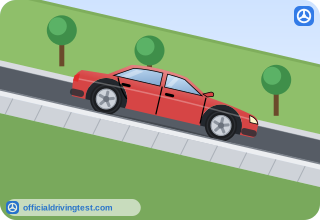
- Neutral
- Reverse
- Third gear
- Drive
Show answer
Correct answer: Reverse
A manual transmission is shifted into reverse when parking downhill.
Source: South Dakota Driver License Manual (Revised 11/2024), page 43
-
When entering a perpendicular or angle parking space, you move forward slowly until your vehicle reaches what?
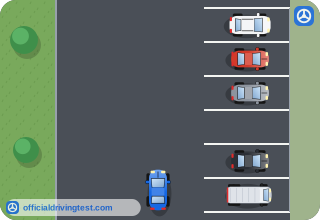
- The back of the space
- The line marking the next space
- The middle of the space
- The center of the traffic lane
Show answer
Correct answer: The middle of the space
You move forward slowly until the vehicle reaches the middle of the space, then center it.
Source: South Dakota Driver License Manual (Revised 11/2024), page 44
-
When backing out of a perpendicular or angle parking space, you move straight back until what happens?
- Your front bumper clears the vehicle beside you
- Your rear bumper reaches the center of the lane
- Your mirrors are even with the vehicle beside you
- Your rear wheels reach the traffic lane
Show answer
Correct answer: Your front bumper clears the vehicle beside you
You move straight back until the front bumper clears the vehicle parked beside you, then turn the wheel sharply.
Source: South Dakota Driver License Manual (Revised 11/2024), page 44
-
When starting to parallel park, how far away from the vehicle in the parking space ahead should you stop?
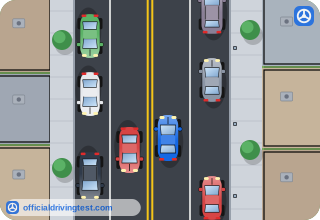
- About 6 inches
- About 4 feet
- About 8 feet
- About 2 feet
Show answer
Correct answer: About 2 feet
You stop even with the vehicle in the space ahead and about 2 feet away from it.
Source: South Dakota Driver License Manual (Revised 11/2024), page 44
-
While backing into a parallel parking space, when do you straighten the wheels and back straight?
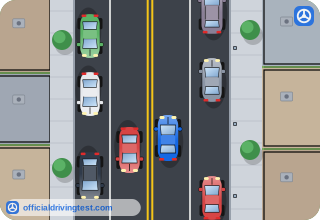
- When your front bumper clears the vehicle ahead
- As your front door passes the back bumper of the vehicle ahead
- As your rear door passes the front bumper of the vehicle behind
- Once your rear bumper is even with the back of the space
Show answer
Correct answer: As your front door passes the back bumper of the vehicle ahead
The wheels are straightened as the front door passes the back bumper of the vehicle in the space ahead.
Source: South Dakota Driver License Manual (Revised 11/2024), page 44
-
In parallel parking, which way do you turn the wheels once you are clear of the vehicle in the space ahead?
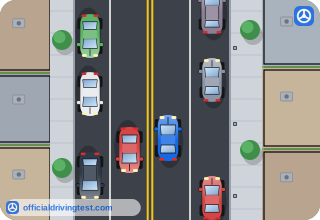
- Sharply to the right
- Sharply to the left
- Straight ahead
- Not at all
Show answer
Correct answer: Sharply to the left
When clear of the vehicle ahead, you turn the wheels sharply to the left and back slowly toward the vehicle behind.
Source: South Dakota Driver License Manual (Revised 11/2024), page 44
-
When you finish parallel parking, how close should the vehicle be to the curb or edge of the road?
- Within 6 inches
- Within 24 inches
- Within 36 inches
- Within 12 inches
Show answer
Correct answer: Within 12 inches
The finished vehicle should be within 12 inches of the curb or edge of the road.
Source: South Dakota Driver License Manual (Revised 11/2024), page 44
-
You want to parallel park and traffic is coming from behind. What should you do?
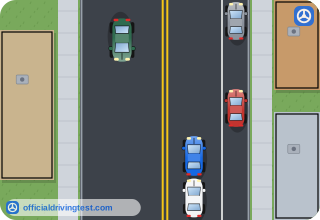
- Signal, pull next to the space, and let traffic behind pass
- Stop in the lane with no signal and back into the space
- Park quickly before the traffic reaches you
- Pull to the left and wait for traffic to clear
Show answer
Correct answer: Signal, pull next to the space, and let traffic behind pass
You put on the turn signal, pull next to the space and allow vehicles behind you to pass before you park.
Source: South Dakota Driver License Manual (Revised 11/2024), page 52