South Carolina: Highway driving and the zipper merge Practice Test
Entering a multi-lane highway from the acceleration lane, exiting by the deceleration lane, and the zipper (late) merge when a lane is closed.
Independent educational site · not affiliated with any government agency or DMV
Ready? Test yourself
- Instant feedback with an explanation
- Every answer cites its source in the manual
- Your best score is saved on this device
- Keyboard: press 1 to 4 to answer and Enter for the next question
Questions are original and based on the official manual "South Carolina Driver's Manual" (2026 (posted April 2026)), South Carolina Department of Motor Vehicles.
All 12 questions in this practice test
Take the test above first, then use this list to study. Tap “Show answer” to see the correct answer and explanation.
Show the questions and answersHide the questions
-
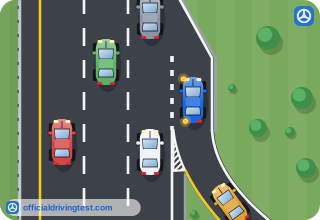
When entering a multi-lane highway, what is the purpose of the acceleration lane?
- To stop and wait for a gap in traffic on the main roadway
- To pass slower vehicles that are traveling on the main roadway ahead of you
- To reach the speed of other vehicles before pulling onto the roadway
- To slow down before you leave the highway at the next ramp
Show answer
Correct answer: To reach the speed of other vehicles before pulling onto the roadway
You use the acceleration lane beside the main roadway to reach the speed of other traffic before you merge.
Source: South Carolina Driver's Manual (2026 (posted April 2026)), page 7-14 · Open this page in the manual (Manual page 7-14)
-
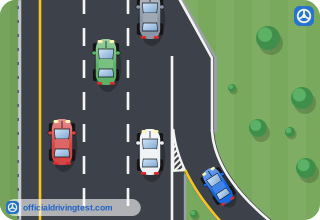
When entering a multi-lane highway, what do you do once you identify a gap in traffic and merge?
- Turn on your hazard lights
- Cancel your turn signal
- Slow down to the speed of the lane
- Stay in the acceleration lane
Show answer
Correct answer: Cancel your turn signal
After merging with the traffic flow, you cancel your turn signal.
Source: South Carolina Driver's Manual (2026 (posted April 2026)), page 7-14 · Open this page in the manual (Manual page 7-14)
-
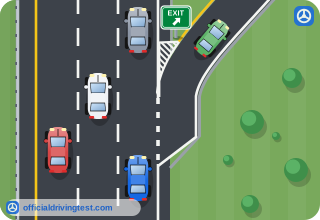
When you plan to exit a roadway, when should you move to the lane closest to your exit point?
- At the last moment, once you see the ramp
- Only after you enter the deceleration lane
- Only after slowing well below traffic speed
- Early, to avoid a quick lane change
Show answer
Correct answer: Early, to avoid a quick lane change
The manual says to move early to the lane closest to your exit so you do not need a quick lane change.
Source: South Carolina Driver's Manual (2026 (posted April 2026)), page 7-15 · Open this page in the manual (Manual page 7-15)
-
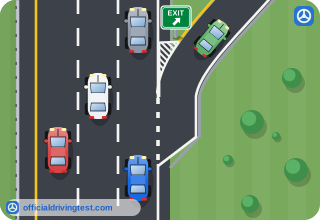
When exiting a roadway, how long should you maintain your vehicle speed?
- As long as you are on the main roadway
- Until you see the exit sign
- Only until you signal your intention
- Until you reach the end of the ramp
Show answer
Correct answer: As long as you are on the main roadway
You keep your speed while still on the main roadway, then slow once you are in the deceleration lane.
Source: South Carolina Driver's Manual (2026 (posted April 2026)), page 7-15 · Open this page in the manual (Manual page 7-15)
-
Where is the deceleration lane when you exit a roadway?
- To the left of the roadway, after you pass the ramp
- In the median between the two directions of travel
- To the right of the roadway, before you reach the ramp
- In the left-most lane of the main roadway, for drivers who are exiting
Show answer
Correct answer: To the right of the roadway, before you reach the ramp
The deceleration lane is on the right of the roadway, ahead of the ramp.
Source: South Carolina Driver's Manual (2026 (posted April 2026)), page 7-15 · Open this page in the manual (Manual page 7-15)
-
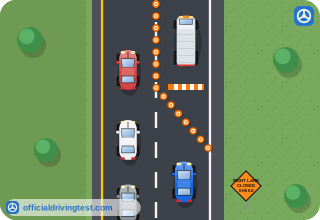
You see a "lane closed ahead" sign and traffic is backing up. What does the zipper merge (late merge) tell you to do?
- Move into the open lane as soon as you see the sign
- Stay in your current lane until you reach the point of merge
- Drive on the shoulder to the front of the line
- Stop in the closing lane and wait for a gap
Show answer
Correct answer: Stay in your current lane until you reach the point of merge
The zipper merge keeps both lanes in use until the point of merge, where drivers take turns entering the open lane.
Source: South Carolina Driver's Manual (2026 (posted April 2026)), page 7-17 · Open this page in the manual (Manual page 7-17)
-
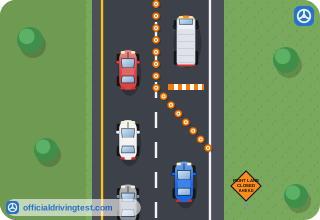
At the point of merge in a zipper merge, how do drivers enter the open lane?
- The faster vehicles go first
- The vehicles in the closing lane have the right of way
- They merge together at the same moment
- They take turns with the other drivers
Show answer
Correct answer: They take turns with the other drivers
At the merge point drivers take turns, easing safely and smoothly into the open lane.
Source: South Carolina Driver's Manual (2026 (posted April 2026)), page 7-17 · Open this page in the manual (Manual page 7-17)
-
Does the law require drivers to use the zipper merge?
- No, but it is a best practice, especially in a construction zone
- Yes, in every construction zone
- Yes, whenever traffic is backed up
- No, and it is discouraged when a lane is closed in a construction zone
Show answer
Correct answer: No, but it is a best practice, especially in a construction zone
The law does not require it, but it is called a best practice, especially for a lane closed in a construction zone.
Source: South Carolina Driver's Manual (2026 (posted April 2026)), page 7-17 · Open this page in the manual (Manual page 7-17)
-
According to the manual, what can merging early lead to?
- Faster travel for every driver in the closing lane and the open lane
- Fewer collisions and less road rage at the point of merge
- Unexpected and dangerous lane switching, collisions, and road rage
- A longer line of traffic in the open lane only, after the merge
Show answer
Correct answer: Unexpected and dangerous lane switching, collisions, and road rage
Merging early can cause unexpected, dangerous lane switching, collisions, and road rage.
Source: South Carolina Driver's Manual (2026 (posted April 2026)), page 7-17 · Open this page in the manual (Manual page 7-17)
-
Why does the zipper merge make changing lanes easier and safer?
- It lets drivers in the closing lane go faster than the open lane
- It reduces the difference in speeds between the two lanes
- It slows all traffic to a stop before the merge
- It lets drivers merge earlier at higher speeds
Show answer
Correct answer: It reduces the difference in speeds between the two lanes
Using both lanes up to the merge point reduces the speed difference between lanes, so changing lanes at about the same speed is easier and safer.
Source: South Carolina Driver's Manual (2026 (posted April 2026)), page 7-17 · Open this page in the manual (Manual page 7-17)
-
Which benefit of the zipper merge is listed in the manual?
- It lets drivers in the right lane travel faster than the drivers in the left lane
- It allows drivers to avoid using turn signals
- It removes the need for lane closed signs
- It creates a sense of fairness that all lanes are moving at the same rate
Show answer
Correct answer: It creates a sense of fairness that all lanes are moving at the same rate
The manual lists a sense of fairness, with all lanes moving at the same rate, among the benefits.
Source: South Carolina Driver's Manual (2026 (posted April 2026)), page 7-17 · Open this page in the manual (Manual page 7-17)
-
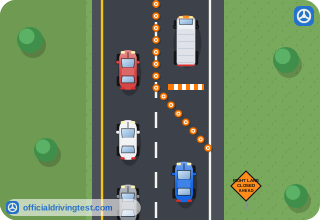
When does it make sense to move sooner to the lane that will remain open instead of using the zipper merge?
- When traffic is moving at highway speeds and there are no backups
- When traffic is heavy and slow
- When a "lane closed ahead" sign appears and traffic is backing up for a long way
- When the lane is closed in a construction zone
Show answer
Correct answer: When traffic is moving at highway speeds and there are no backups
With traffic at highway speeds and no backups, moving sooner to the open lane makes sense. In every case, merge when it is safe.
Source: South Carolina Driver's Manual (2026 (posted April 2026)), page 7-18 · Open this page in the manual (Manual page 7-18)