South Carolina: Parking rules Practice Test
Angle, perpendicular and parallel parking, leaving a parking space, and turning the wheels when you park on a hill.
Independent educational site · not affiliated with any government agency or DMV
Ready? Test yourself
- Instant feedback with an explanation
- Every answer cites its source in the manual
- Your best score is saved on this device
- Keyboard: press 1 to 4 to answer and Enter for the next question
Questions are original and based on the official manual "South Carolina Driver's Manual" (2026 (posted April 2026)), South Carolina Department of Motor Vehicles.
All 23 questions in this practice test
Take the test above first, then use this list to study. Tap “Show answer” to see the correct answer and explanation.
Show the questions and answersHide the questions
-
A vehicle with a disability license plate or placard may park in a designated space for people with disabilities only under what condition?
- The vehicle is driven by or carrying the person named on the registration
- The vehicle is registered in the same county as the designated parking space
- The driver remains inside the vehicle the entire time it is parked there
- The vehicle is parked for no more than two hours at a time
Show answer
Correct answer: The vehicle is driven by or carrying the person named on the registration
Such parking is allowed only when the vehicle is driven by or transporting the person with the disability whose name is on the registration.
Source: South Carolina Driver's Manual (2026 (posted April 2026)), page 7-10 · Open this page in the manual (Manual page 7-10)
-
What are you responsible for making sure of when you park your vehicle?
- That it is parked facing the flow of traffic
- That it is parked within 36 inches of the curb
- That it is not an obstruction
- That its parking lights are turned on
Show answer
Correct answer: That it is not an obstruction
Drivers are responsible for making sure a parked vehicle does not become an obstruction.
Source: South Carolina Driver's Manual (2026 (posted April 2026)), page 7-10 · Open this page in the manual (Manual page 7-10)
-
Where should you always park?
- On the shoulder of the roadway
- In a designated parking area
- Beside any curb that is not painted
- On any street wide enough for two lanes
Show answer
Correct answer: In a designated parking area
The manual says to always park in a designated parking area.
Source: South Carolina Driver's Manual (2026 (posted April 2026)), page 7-10 · Open this page in the manual (Manual page 7-10)
-
When you park along the roadway, where should you place your vehicle?
- In the middle of the parking lane
- Close to the flow of traffic so you can leave quickly
- Partly on the shoulder and partly in the lane
- As far away from the flow of traffic as possible
Show answer
Correct answer: As far away from the flow of traffic as possible
Parking as far as possible from the flow of traffic keeps the vehicle from obstructing it.
Source: South Carolina Driver's Manual (2026 (posted April 2026)), page 7-10 · Open this page in the manual (Manual page 7-10)
-
How far from the curb or edge of pavement may you park along the roadway?
- No more than 18 inches
- No more than 6 inches
- No more than 36 inches
- No more than 5 feet
Show answer
Correct answer: No more than 18 inches
The manual says not to park more than 18 inches from the curb or edge of pavement.
Source: South Carolina Driver's Manual (2026 (posted April 2026)), page 7-11 · Open this page in the manual (Manual page 7-11)
-
How can you tell that parking is not allowed or is limited in an area?
- Only signs posted at the nearest intersection show it
- Only the color of the pavement and the width of the lane shows it
- Check for signs or painted curbs that prohibit or limit parking
- Parking is never limited on a road without a center line
Show answer
Correct answer: Check for signs or painted curbs that prohibit or limit parking
The manual tells drivers to check for signs or painted curbs, because some restrictions are shown by colored curb markings.
Source: South Carolina Driver's Manual (2026 (posted April 2026)), page 7-11 · Open this page in the manual (Manual page 7-11)
-
When entering a perpendicular or angle parking space, what do you do right after you identify the space and check traffic?
- Back into the space quickly
- Signal your intentions
- Stop and set the parking brake
- Turn the wheel sharply toward the space
Show answer
Correct answer: Signal your intentions
The step after identifying the space and checking traffic is to signal your intentions.
Source: South Carolina Driver's Manual (2026 (posted April 2026)), page 7-11 · Open this page in the manual (Manual page 7-11)
-
When entering a perpendicular or angle parking space, how far forward do you move while turning the steering wheel?
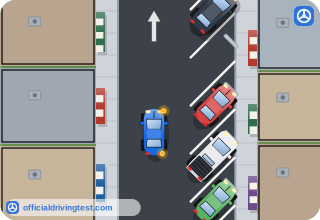
- Quickly, until the front bumper touches the curb
- Quickly, until your front wheels touch the painted line
- Quickly, until you have passed the space and are ready to back in
- Slowly, until the vehicle reaches the middle of the space
Show answer
Correct answer: Slowly, until the vehicle reaches the middle of the space
You move forward slowly and turn the wheel as needed until the vehicle reaches the middle of the space, then center it.
Source: South Carolina Driver's Manual (2026 (posted April 2026)), page 7-11 · Open this page in the manual (Manual page 7-11)
-
When you leave a perpendicular or angle parking space, how far do you move straight back after checking traffic?
- Until your front bumper clears the vehicle parked beside you
- Until your rear bumper reaches the center of the lane behind you
- Until your vehicle is at a 45-degree angle
- Until you can see the whole street behind you
Show answer
Correct answer: Until your front bumper clears the vehicle parked beside you
You keep checking traffic and move straight back until your front bumper clears the vehicle parked beside you.
Source: South Carolina Driver's Manual (2026 (posted April 2026)), page 7-11 · Open this page in the manual (Manual page 7-11)
-
When backing out of a perpendicular or angle parking space, once your front bumper clears the vehicle beside you, how do you turn the steering wheel?
- Gently toward the curb
- Sharply in the direction the front of your vehicle should move
- Sharply in the direction the rear of your vehicle should move
- Not at all until you have shifted to drive
Show answer
Correct answer: Sharply in the direction the rear of your vehicle should move
After the front bumper clears the neighboring vehicle, you turn the wheel sharply in the direction the rear should move.
Source: South Carolina Driver's Manual (2026 (posted April 2026)), page 7-12 · Open this page in the manual (Manual page 7-12)
-
When your vehicle clears the parking space as you leave a perpendicular or angle space, what do you do?
- Accelerate immediately in reverse
- Stop and shift to drive
- Turn off the engine and check the mirrors
- Shift to park and set the brake
Show answer
Correct answer: Stop and shift to drive
Once the vehicle is clear of the space, you stop, shift to drive, then accelerate smoothly while straightening the wheels.
Source: South Carolina Driver's Manual (2026 (posted April 2026)), page 7-12 · Open this page in the manual (Manual page 7-12)
-
When you start to enter a parallel parking space, what do you do after identifying the space, checking traffic, and signaling?
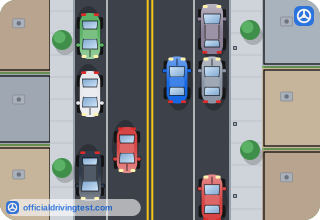
- Shift to neutral and let the vehicle roll back into the space slowly
- Turn on your hazard flashers, then pull forward past the open space to wait for traffic
- Pull alongside the space and turn your wheels sharply to the left
- Shift to reverse and look to the rear, in the direction the vehicle will move
Show answer
Correct answer: Shift to reverse and look to the rear, in the direction the vehicle will move
With traffic clear, you shift to reverse and look to the rear in the direction the vehicle will be moving.
Source: South Carolina Driver's Manual (2026 (posted April 2026)), page 7-12 · Open this page in the manual (Manual page 7-12)
-
In parallel parking, how long do you keep backing up while turning the wheel rapidly before you start to center the vehicle in the space?
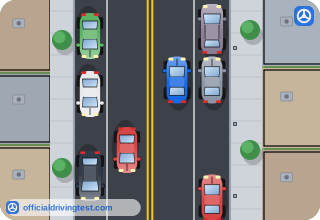
- Until your front bumper lines up with the rear bumper of the car you park behind
- Until your rear bumper touches the bumper of the vehicle behind you
- Until your rear wheels reach the curb and the car is at a slight angle to it
- Until your car is at a right angle to the curb and the lane
Show answer
Correct answer: Until your front bumper lines up with the rear bumper of the car you park behind
You continue backing until your front bumper lines up with the rear bumper of the vehicle you are parking behind.
Source: South Carolina Driver's Manual (2026 (posted April 2026)), page 7-12 · Open this page in the manual (Manual page 7-12)
-
At the end of parallel parking, what must you do before the bumper of your vehicle touches the vehicle to the rear?
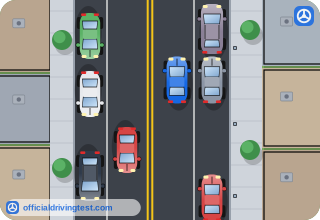
- Turn off the engine
- Open the door to check
- Stop
- Sound your horn
Show answer
Correct answer: Stop
The last step says to stop before touching the bumper of the vehicle behind, then shift to drive and adjust in the space.
Source: South Carolina Driver's Manual (2026 (posted April 2026)), page 7-12 · Open this page in the manual (Manual page 7-12)
-
To leave a parallel parking space, what do you do first after checking traffic in all directions, placing your foot on the brake, and shifting to reverse?
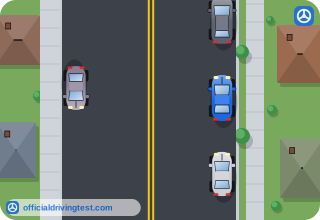
- Turn the wheels sharply left and pull out into the lane right away
- Back up as much as possible to the vehicle parked behind you
- Back up only a few inches to save room behind you
- Pull forward until you touch the vehicle ahead of you
Show answer
Correct answer: Back up as much as possible to the vehicle parked behind you
You back up as much as possible toward the vehicle parked behind to gain room to pull out.
Source: South Carolina Driver's Manual (2026 (posted April 2026)), page 7-13 · Open this page in the manual (Manual page 7-13)
-
When leaving a parallel parking space, what should you do if the front bumper of your vehicle will not clear the vehicle ahead?
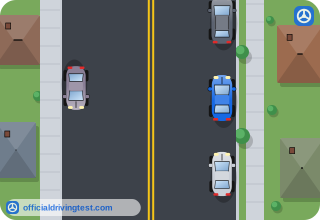
- Continue forward and turn sharply
- Sound your horn and pull out anyway
- Shift to park and wait for traffic
- Reverse and correct the steering
Show answer
Correct answer: Reverse and correct the steering
If the front bumper will not clear the vehicle ahead, you reverse and correct your steering.
Source: South Carolina Driver's Manual (2026 (posted April 2026)), page 7-13 · Open this page in the manual (Manual page 7-13)
-
When leaving a parallel parking space, when do you move forward into the appropriate lane of traffic?
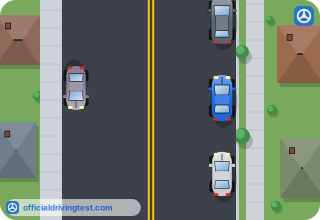
- When your door clears the rear bumper of the vehicle parked ahead
- When your front bumper has cleared the rear of the vehicle parked ahead
- As soon as your rear wheels leave the curb behind you
- When the vehicle parked behind you has moved away
Show answer
Correct answer: When your door clears the rear bumper of the vehicle parked ahead
You move into the lane of traffic once your vehicle's door clears the rear bumper of the vehicle parked ahead.
Source: South Carolina Driver's Manual (2026 (posted April 2026)), page 7-13 · Open this page in the manual (Manual page 7-13)
-
You are parked headed downhill, with or without a curb. Which way should you turn your wheels?
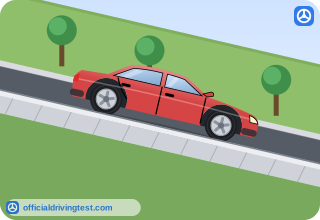
- To the left, away from the curb and toward the traffic lane
- Straight ahead, so the wheels are parallel to the curb
- To the right (except when parking left on a one-way street)
- In whichever direction is easier, as long as the brake is set
Show answer
Correct answer: To the right (except when parking left on a one-way street)
When headed downhill, you turn the wheels to the right, except when parking on the left side of a one-way street.
Source: South Carolina Driver's Manual (2026 (posted April 2026)), page 7-13 · Open this page in the manual (Manual page 7-13)
-
You are parked headed uphill with a curb. How should you turn your wheels?
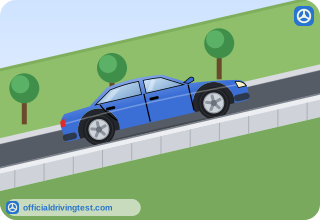
- To the right, toward the curb, with the wheels straight ahead of the vehicle
- Toward the center of the street, with the back of the front tire against the curb
- Straight ahead, with the front tire clear of the curb and the brake set
- Toward the curb, with the front tire pressed firmly against the curb itself at all times
Show answer
Correct answer: Toward the center of the street, with the back of the front tire against the curb
Headed uphill with a curb, you turn the wheels to the center of the street with the back of the front tire against the curb.
Source: South Carolina Driver's Manual (2026 (posted April 2026)), page 7-13 · Open this page in the manual (Manual page 7-13)
-
You are parked headed uphill without a curb. How should you turn your wheels, and why?
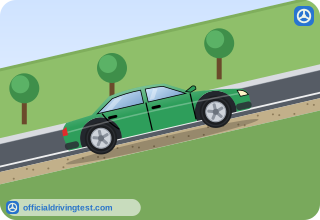
- To the left, so the vehicle rolls into traffic and stops
- Straight ahead, so the vehicle does not roll
- To the center of the street, so that the vehicle is easy to see at night
- To the right, so the vehicle rolls off the road if the brakes fail
Show answer
Correct answer: To the right, so the vehicle rolls off the road if the brakes fail
Headed uphill with no curb, you turn the wheels to the right so the vehicle rolls off the road if the brakes fail.
Source: South Carolina Driver's Manual (2026 (posted April 2026)), page 7-13 · Open this page in the manual (Manual page 7-13)
-
When you park on a hill with a manual transmission, in what gear should the car be set?
- First or reverse
- Neutral
- Second
- Any forward gear
Show answer
Correct answer: First or reverse
For a manual transmission, the car should be left in first or reverse.
Source: South Carolina Driver's Manual (2026 (posted April 2026)), page 7-13 · Open this page in the manual (Manual page 7-13)
-
When you park on a hill, what should you do in addition to turning your wheels?
- Leave the engine running and keep your foot on the brake pedal
- Set the parking brake and leave the vehicle in neutral with the engine still on
- Set the parking brake, use the proper gear or park, and turn off the engine
- Turn on your hazard flashers and leave the engine running for safety
Show answer
Correct answer: Set the parking brake, use the proper gear or park, and turn off the engine
In every hill-parking case, the parking brake is set, the vehicle is in the proper gear or park, and the engine is off.
Source: South Carolina Driver's Manual (2026 (posted April 2026)), page 7-13 · Open this page in the manual (Manual page 7-13)
-
What should you do when you leave a parking space on a hill?
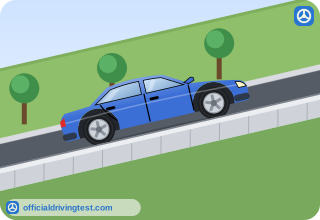
- Sound your horn and move out ahead of the traffic behind you
- Signal, use your mirrors, look over your shoulder, and yield right of way
- Roll back into the lane with the engine off and the brake free
- Back out with your hazard flashers on and your foot lifted off the brake pedal
Show answer
Correct answer: Signal, use your mirrors, look over your shoulder, and yield right of way
When leaving a parking space you signal, use mirrors, look over your shoulder to check traffic, and yield right of way.
Source: South Carolina Driver's Manual (2026 (posted April 2026)), page 7-13 · Open this page in the manual (Manual page 7-13)