Rhode Island: Pedestrians Practice Test
Yielding to pedestrians, crosswalks and children, and pedestrians who are visually impaired.
Independent educational site · not affiliated with any government agency or DMV
Ready? Test yourself
- Instant feedback with an explanation
- Every answer cites its source in the manual
- Your best score is saved on this device
- Keyboard: press 1 to 4 to answer and Enter for the next question
Questions are original and based on the official manual "Rhode Island Driver’s Manual" (April 2024), Rhode Island Division of Motor Vehicles (DMV).
All 18 questions in this practice test
Take the test above first, then use this list to study. Tap “Show answer” to see the correct answer and explanation.
Show the questions and answersHide the questions
-
What should a pedestrian do on arriving at a roundabout crosswalk?
- Look right for oncoming vehicles and bicycles
- Cross at once if the crosswalk is marked
- Look left for oncoming vehicles and bicycles
- Wait for the traffic signal to turn green
Show answer
Correct answer: Look left for oncoming vehicles and bicycles
On arriving, pedestrians should look left in search of oncoming vehicles and bicycles.
Source: Rhode Island Driver’s Manual (April 2024), page 41
-
Where should pedestrians cross to first at a roundabout?
- The center island of the roundabout
- The raised or painted splitter or refuge
- The nearest entry lane
- The far sidewalk without stopping
Show answer
Correct answer: The raised or painted splitter or refuge
Pedestrians cross to the splitter or refuge, then look right and finish crossing to the opposite sidewalk.
Source: Rhode Island Driver’s Manual (April 2024), page 41
-
What should pedestrians never do at a roundabout?
- Use the crosswalk to cross the road
- Look left on arrival at the crosswalk
- Use the splitter or refuge to cross
- Walk through it or cross the center island
Show answer
Correct answer: Walk through it or cross the center island
Pedestrians should never walk through a roundabout or cross the center island.
Source: Rhode Island Driver’s Manual (April 2024), page 41
-
Besides helping with glare, what does looking to the side of the roadway at night help you do?
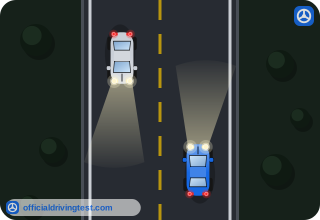
- Judge the speed of oncoming vehicles more accurately
- Stay centered in your lane without looking at the lines
- See traffic signs earlier
- Detect pedestrians walking close to the edge of the road
Show answer
Correct answer: Detect pedestrians walking close to the edge of the road
Looking toward the roadside helps with glare and lets you spot pedestrians near the edge.
Source: Rhode Island Driver’s Manual (April 2024), page 53
-
A pedestrian crosses the street carelessly. What must the driver do?
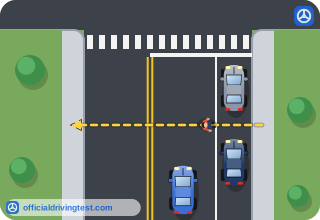
- Always yield
- Sound the horn and keep going
- Yield only if the pedestrian is in a marked crosswalk
- Yield only if the pedestrian has a Walk signal
Show answer
Correct answer: Always yield
Even when pedestrians cross carelessly, the driver must always yield.
Source: Rhode Island Driver’s Manual (April 2024), page 53
-
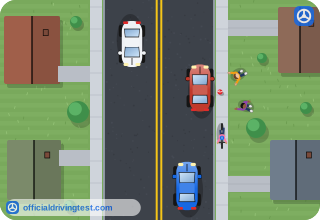
Why should you use caution when children are playing in or near the street?
- They always stay on the sidewalk until an adult crosses
- They tend to move slowly and stop often before crossing
- They often move quickly and may not check for traffic
- They are required to wait for a signal before crossing
Show answer
Correct answer: They often move quickly and may not check for traffic
Children often move quickly and may not check for traffic.
Source: Rhode Island Driver’s Manual (April 2024), page 53
-
Why should you use caution in the presence of elderly pedestrians?
- They are required to cross only at marked crosswalks and traffic signals
- They may not notice traffic dangers, may move slowly and may react more slowly
- They always travel in groups that fill the whole crosswalk
- They are not permitted to cross at intersections with signals
Show answer
Correct answer: They may not notice traffic dangers, may move slowly and may react more slowly
Elderly pedestrians may not notice traffic dangers, may move at a slower pace and may react more slowly.
Source: Rhode Island Driver’s Manual (April 2024), page 53
-
When may a driver stop to pick up hitchhikers, according to the manual's suggestions for pedestrian safety?
- Only during the daytime
- Only on a quiet rural road
- Only if the hitchhiker is standing on the right shoulder
- At no time
Show answer
Correct answer: At no time
The manual says not to stop to pick up hitchhikers at any time.
Source: Rhode Island Driver’s Manual (April 2024), page 53
-
A pedestrian is facing a yellow or red light. When should the pedestrian cross, according to the manual?
- Only if a "Walk" signal is showing
- Whenever there are no vehicles in sight
- After looking both ways
- Only if the vehicles have stopped
Show answer
Correct answer: Only if a "Walk" signal is showing
A pedestrian facing a yellow or red light should cross only when a Walk signal is showing.
Source: Rhode Island Driver’s Manual (April 2024), page 53
-
Where should pedestrians walk if there are no sidewalks?
- On the right side of the road, with their backs to traffic
- In the middle of the traffic lane
- On the left side of the road, facing traffic
- On the center line
Show answer
Correct answer: On the left side of the road, facing traffic
Without sidewalks, pedestrians should walk on the left side of the road facing traffic.
Source: Rhode Island Driver’s Manual (April 2024), page 53
-
According to the manual, what is a legal crosswalk?

- Only a place with painted crosswalk lines across the road
- Any intersection of public roads, marked or not
- Only an intersection with a working traffic light
- Only a crossing that has a pedestrian sign
Show answer
Correct answer: Any intersection of public roads, marked or not
The manual states that any intersection of public roads is a legal crosswalk whether marked or not.
Source: Rhode Island Driver’s Manual (April 2024), page 53
-
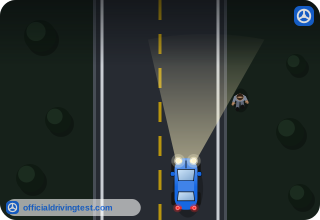
What should pedestrians wear when walking at dusk or at night?
- Dark clothing that blends into the road
- Bright red clothing only, with no reflective parts
- Clothing with a hood to cover their heads
- Light colored or reflective clothing
Show answer
Correct answer: Light colored or reflective clothing
Light colored or reflective clothing helps drivers see pedestrians in the dark.
Source: Rhode Island Driver’s Manual (April 2024), page 53
-
What may a pedestrian with a visual impairment use to travel along or across a street?
- A flashing flag or light
- A reflective vest only
- A white cane or a guide dog
- A whistle blown loudly
Show answer
Correct answer: A white cane or a guide dog
The manual says pedestrians who are visually impaired may use a white cane or a guide dog.
Source: Rhode Island Driver’s Manual (April 2024), page 54
-
Failing to yield to a pedestrian with a visual impairment may result in a fine of up to how much?
- $100
- $1,000
- $300
- $2,000
Show answer
Correct answer: $1,000
The manual says the fine may be up to $1,000.
Source: Rhode Island Driver’s Manual (April 2024), page 54
-
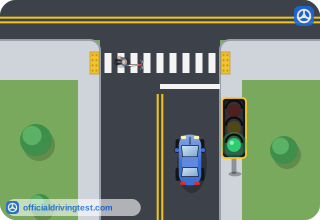
A pedestrian using a white cane or a guide dog is crossing or attempting to cross the street ahead of you. What must you do?
- Slow down and sound your horn to warn the pedestrian first
- Drive around the pedestrian carefully, leaving a wide gap
- Stop only if the pedestrian is in a marked crosswalk ahead
- Stop completely before the intersection and yield the right-of-way
Show answer
Correct answer: Stop completely before the intersection and yield the right-of-way
You must come to a complete stop before the intersection and yield the right-of-way to the pedestrian.
Source: Rhode Island Driver’s Manual (April 2024), page 54
-
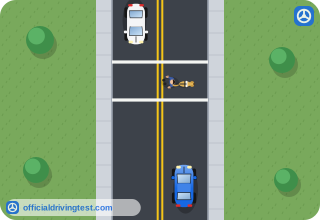
What do pedestrians who are visually impaired use as a guide to decide when it is safe to cross a street?
- The sound of traffic, including your engine
- The color of the traffic light
- The brightness of vehicle headlights
- The horns of nearby drivers
Show answer
Correct answer: The sound of traffic, including your engine
They rely on the sound of traffic, your engine included, to judge when it is safe to cross.
Source: Rhode Island Driver’s Manual (April 2024), page 54
-
You are stopped at a red light and a pedestrian who is visually impaired is at the intersection. What should you never assume?
- That the pedestrian will be using a guide dog or cane
- That the pedestrian will cross against the signal light
- That the pedestrian expects you to make a right turn on red
- That the pedestrian relies on the sound of traffic
Show answer
Correct answer: That the pedestrian expects you to make a right turn on red
These pedestrians listen to traffic, so they may not expect a car to turn right on red after stopping.
Source: Rhode Island Driver’s Manual (April 2024), page 54
-
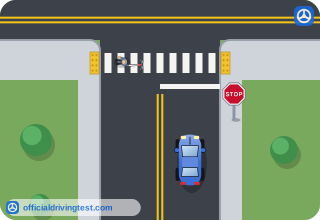
Why should you be especially alert for pedestrians who are visually impaired if you drive an electric or hybrid vehicle?
- It is wider than most other vehicles on the road
- It is quieter than most other vehicles on the road
- It has larger blind spots than other vehicles
- It has brighter headlights than other vehicles do
Show answer
Correct answer: It is quieter than most other vehicles on the road
A quieter vehicle gives these pedestrians less sound to hear.
Source: Rhode Island Driver’s Manual (April 2024), page 54