Rhode Island: Freeway driving Practice Test
Entering and leaving a freeway, lanes and speed on limited-access highways, the breakdown lane and safe highway driving.
Independent educational site · not affiliated with any government agency or DMV
Ready? Test yourself
- Instant feedback with an explanation
- Every answer cites its source in the manual
- Your best score is saved on this device
- Keyboard: press 1 to 4 to answer and Enter for the next question
Questions are original and based on the official manual "Rhode Island Driver’s Manual" (April 2024), Rhode Island Division of Motor Vehicles (DMV).
All 22 questions in this practice test
Take the test above first, then use this list to study. Tap “Show answer” to see the correct answer and explanation.
Show the questions and answersHide the questions
-
What does the term "limited access" mean?
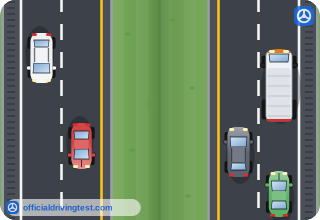
- There are no speed limits on these roads
- There are no intersections on these roads
- Only certain drivers may use these roads
- There are no entrances or exits on these roads
Show answer
Correct answer: There are no intersections on these roads
The manual says "limited access" means there are no intersections on these roads.
Source: Rhode Island Driver’s Manual (April 2024), page 35
-
Which description of freeways matches the manual?
- They have traffic lights and parked vehicles along the roadway
- They have lower speed limits and many crossroads where drivers must stop
- They have frequent stop signs and are used mainly for travel inside cities
- They have higher speed limits and minimal traffic control between cities
Show answer
Correct answer: They have higher speed limits and minimal traffic control between cities
Freeways have higher speed limits and minimal traffic control, which makes travel between cities faster.
Source: Rhode Island Driver’s Manual (April 2024), page 34
-
On a freeway, when you want to pass, how should you use your turn signals?
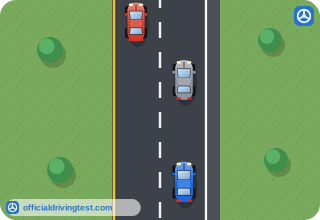
- Briefly before beginning your lane change
- Only after you have moved into the new lane
- Not at all if no vehicle is behind you
- Continuously for at least a mile before the lane change
Show answer
Correct answer: Briefly before beginning your lane change
The manual says to use your turn signals briefly before beginning your lane change.
Source: Rhode Island Driver’s Manual (April 2024), page 35
-
If you must stop on a freeway because of a mechanical or other emergency, what should you do?
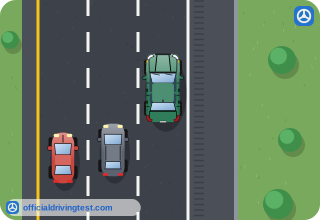
- Stop in the far-left lane so others see you
- Stop in the lane you are in and wait
- Signal and move into the breakdown lane if possible
- Back up to the last exit
Show answer
Correct answer: Signal and move into the breakdown lane if possible
You should signal and move your vehicle into the breakdown lane if possible.
Source: Rhode Island Driver’s Manual (April 2024), page 35
-
What should you beware of when you move into the breakdown lane of a freeway?
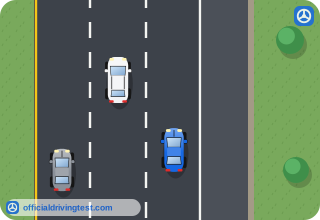
- Road signs telling you to stay out of the breakdown lane
- Vehicles that might be traveling wrongfully in the lane
- Pedestrians walking along the pavement
- Wide trucks that are prohibited from using the lane
Show answer
Correct answer: Vehicles that might be traveling wrongfully in the lane
The manual warns about vehicles that might be traveling wrongfully in the breakdown lane.
Source: Rhode Island Driver’s Manual (April 2024), page 35
-
As you approach a freeway exit, what must you do?
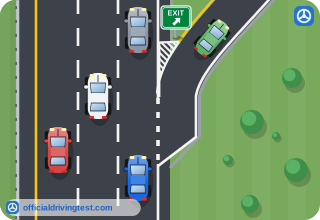
- Reduce speed and return to normal driving conditions
- Hold your freeway speed until you reach the ramp
- Move to the far-left lane before the ramp
- Brake hard just before the exit
Show answer
Correct answer: Reduce speed and return to normal driving conditions
The manual says you must reduce speed and return to normal driving conditions as you approach the exit.
Source: Rhode Island Driver’s Manual (April 2024), page 35
-
What is highway hypnosis?
- A condition caused by driving after drinking alcohol
- A condition caused by looking at bright lights at night
- A condition caused by long periods of driving
- A condition caused by driving at very high speeds for a short time
Show answer
Correct answer: A condition caused by long periods of driving
The manual describes highway hypnosis as a condition caused by long periods of driving.
Source: Rhode Island Driver’s Manual (April 2024), page 35
-
On a long freeway trip, where should you pull off the road to rest?
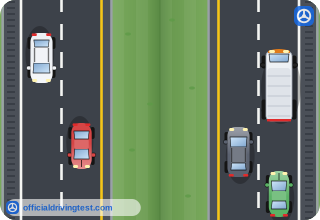
- In the breakdown lane, with the hazard lights on
- In a designated safe area, not in the breakdown lane
- On the shoulder just past the next exit ramp
- In the right lane, at a reduced speed
Show answer
Correct answer: In a designated safe area, not in the breakdown lane
You should rest in a designated safe area, not in the breakdown lane.
Source: Rhode Island Driver’s Manual (April 2024), page 35
-
What is the purpose of an acceleration lane?
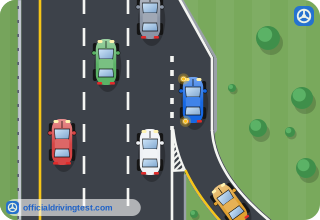
- To let motorists about to exit a freeway slow down
- To let slow vehicles stay out of the flow of traffic
- To let motorists entering a freeway accelerate to the speed of traffic
- To let motorists stop and check for traffic before entering
Show answer
Correct answer: To let motorists entering a freeway accelerate to the speed of traffic
Acceleration lanes let motorists entering freeways speed up to match traffic.
Source: Rhode Island Driver’s Manual (April 2024), page 35
-
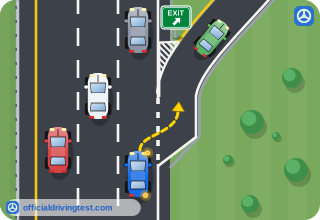
What is the purpose of a deceleration lane?
- To let motorists entering a freeway speed up to the speed of traffic
- To let motorists about to exit a freeway slow down to the exit ramp speed
- To let motorists stop and wait for traffic to clear
- To let trucks and buses pass slower vehicles
Show answer
Correct answer: To let motorists about to exit a freeway slow down to the exit ramp speed
Deceleration lanes let motorists who are leaving the freeway slow down to the speed of the exit ramp.
Source: Rhode Island Driver’s Manual (April 2024), page 35
-
On a freeway, what is the merging area?
- The area beside the exit ramp where motorists slow down to ramp speed
- The area of the breakdown lane where motorists may stop to rest
- The area where two freeways cross each other without intersections
- The area beyond the acceleration lane where motorists merge into traffic
Show answer
Correct answer: The area beyond the acceleration lane where motorists merge into traffic
The merging area is the part beyond the acceleration lane where motorists enter the flow of traffic.
Source: Rhode Island Driver’s Manual (April 2024), page 35
-
On a freeway, what is the far-left lane for?
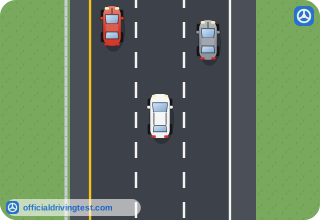
- Passing other vehicles
- Slower moving traffic
- Motorists entering and exiting the freeway
- Stopping in an emergency
Show answer
Correct answer: Passing other vehicles
The far-left lane is the one meant for passing other vehicles.
Source: Rhode Island Driver’s Manual (April 2024), page 35
-
Which vehicles are prohibited from traveling in the far-left freeway lane where it is posted?
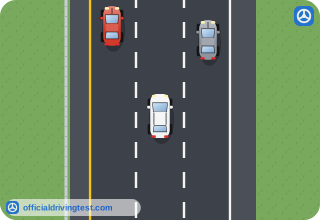
- Motorcycles and mopeds
- Vehicles with fewer than two passengers
- Trucks, buses, and other special vehicles
- Vehicles going slower than 65 miles per hour
Show answer
Correct answer: Trucks, buses, and other special vehicles
Where posted, trucks, buses, and other special vehicles may not use the far-left lane.
Source: Rhode Island Driver’s Manual (April 2024), page 35
-
On a freeway, what are the middle lane(s) for?
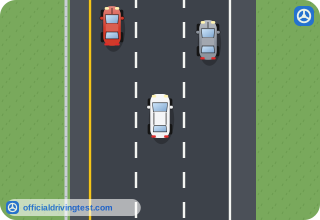
- Passing other vehicles
- Through traffic
- Motorists entering the freeway
- Slower moving traffic only
Show answer
Correct answer: Through traffic
The middle lane or lanes are for through traffic.
Source: Rhode Island Driver’s Manual (April 2024), page 35
-
On a freeway, which lane is for slower moving traffic and for motorists entering and exiting?
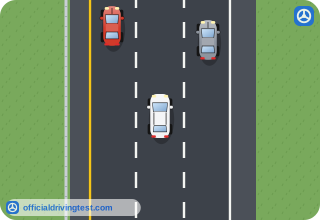
- The far-left lane
- The middle lane
- The breakdown lane
- The right lane
Show answer
Correct answer: The right lane
The right lane is meant for slower traffic and for vehicles entering or leaving the freeway.
Source: Rhode Island Driver’s Manual (April 2024), page 35
-
What does the manual say about driving at the same speed for a long time on a long trip?
- Hold one steady speed to stay alert
- Do not; change your speed occasionally
- Do it only in the left lane
- Do it only at night
Show answer
Correct answer: Do not; change your speed occasionally
The manual advises changing your speed occasionally on long trips.
Source: Rhode Island Driver’s Manual (April 2024), page 35
-
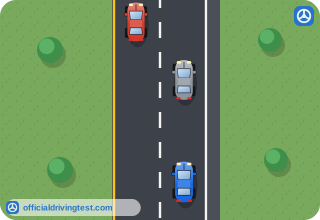
Before you pass a vehicle on the highway, what should you be sure of?
- That the vehicle ahead has its turn signal on and is slowing
- That you are in the far-right lane of the road
- That your headlights are on high beam at night
- That no one is coming up behind you in the passing lane
Show answer
Correct answer: That no one is coming up behind you in the passing lane
You should never pass until you are sure no one is coming up behind you in the passing lane.
Source: Rhode Island Driver’s Manual (April 2024), page 36
-
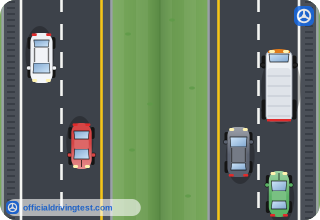
On a highway, when should you stop in the traffic lane?
- Whenever the traffic ahead of you slows down
- When you need to read a road sign ahead
- Never; stop on a highway only if you must
- When you are waiting for a gap to merge
Show answer
Correct answer: Never; stop on a highway only if you must
The manual says never to stop in the traffic lane and to stop on a highway only if you must.
Source: Rhode Island Driver’s Manual (April 2024), page 36
-
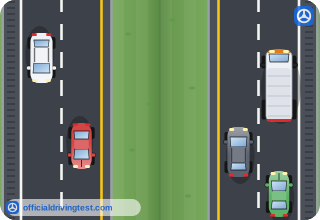
On a highway, which lane should you drive in unless it is otherwise posted or you are passing another vehicle?
- The left lane
- The right lane
- The breakdown lane
- The lane with the least traffic
Show answer
Correct answer: The right lane
The manual says to drive in the right lane unless posted otherwise or when passing.
Source: Rhode Island Driver’s Manual (April 2024), page 36
-
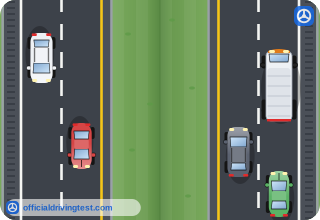
On a highway, which lane must slow traffic always keep to?
- The left
- The middle
- Whichever has less traffic
- The right
Show answer
Correct answer: The right
Slow traffic must always keep to the right.
Source: Rhode Island Driver’s Manual (April 2024), page 36
-
What should you do when you feel drowsy while driving?
- Stop and rest
- Keep driving until the next rest area, 100 miles away
- Drive a little faster to finish the trip sooner
- Keep driving in the right lane at a reduced speed
Show answer
Correct answer: Stop and rest
The manual says to stop and rest when drowsy, because drowsy driving is a major cause of serious collisions.
Source: Rhode Island Driver’s Manual (April 2024), page 36
-
What should you do if you miss your exit ramp?
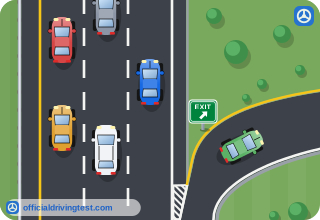
- Stop and back up to the missed exit
- Make a U-turn across the median
- Go on to the next exit
- Pull onto the shoulder and wait for a gap in traffic
Show answer
Correct answer: Go on to the next exit
The manual says to go on to the next exit and never stop and back up to the missed exit.
Source: Rhode Island Driver’s Manual (April 2024), page 36