Rhode Island: Parking rules Practice Test
Where you may not park or stop, the distances from hydrants and crosswalks, parking on hills and pulling away from the curb.
Independent educational site · not affiliated with any government agency or DMV
Ready? Test yourself
- Instant feedback with an explanation
- Every answer cites its source in the manual
- Your best score is saved on this device
- Keyboard: press 1 to 4 to answer and Enter for the next question
Questions are original and based on the official manual "Rhode Island Driver’s Manual" (April 2024), Rhode Island Division of Motor Vehicles (DMV).
All 19 questions in this practice test
Take the test above first, then use this list to study. Tap “Show answer” to see the correct answer and explanation.
Show the questions and answersHide the questions
-
Before you signal and enter a parking space (parallel parking), which traffic lane should you move into?
- The traffic lane farthest from the parking space
- The traffic lane nearest the parking space
- The center of the roadway
- Any lane, as long as you signal
Show answer
Correct answer: The traffic lane nearest the parking space
The first step is to move into the traffic lane that is nearest the parking space.
Source: Rhode Island Driver’s Manual (April 2024), page 32
-
After you enter a parking space, what does the manual say to do?
- Shift to neutral, leave the key in the ignition, and turn on the hazard lights
- Turn off the headlights, leave the engine idling, and release the parking brake
- Remove the key and leave the parking brake off so the car can roll
- Stop the engine, lock the ignition switch, remove the key, and set the parking brake
Show answer
Correct answer: Stop the engine, lock the ignition switch, remove the key, and set the parking brake
Once in the space, the manual lists stopping the engine, locking the ignition, removing the key and setting the parking brake.
Source: Rhode Island Driver’s Manual (April 2024), page 32
-
Before you enter a traffic lane from a parked position, how should you position the vehicle?
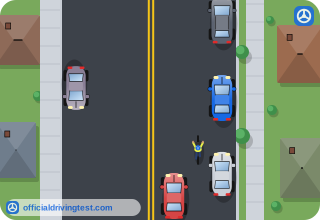
- So that re-entry into the traffic lane can be made in one motion
- Pointing toward the center of the road, with the front wheels turned left
- As close to the vehicle behind you as possible
- Straight against the curb, with the wheels turned toward the curb
Show answer
Correct answer: So that re-entry into the traffic lane can be made in one motion
The manual says to maneuver to a position from which you can re-enter the traffic lane in one motion.
Source: Rhode Island Driver’s Manual (April 2024), page 32
-
When you pull out from a parked position, which shoulder should you look over to cover the blind spots?
- Your right shoulder
- Neither shoulder, mirrors are enough
- Your left shoulder
- Your right shoulder, but only at night
Show answer
Correct answer: Your left shoulder
Besides checking the mirrors, you look over your left shoulder to cover the blind spots.
Source: Rhode Island Driver’s Manual (April 2024), page 32
-
When you leave a parking spot, which driving lane should you enter?
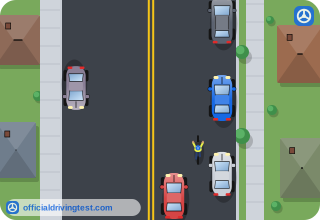
- The driving lane that is farthest from the parking space
- The driving lane that is closest to the parking space
- The center lane of the road
- Whichever lane has the least traffic
Show answer
Correct answer: The driving lane that is closest to the parking space
After signaling, you enter the driving lane closest to the parking space.
Source: Rhode Island Driver’s Manual (April 2024), page 32
-
When you leave a parking spot, when should you signal?
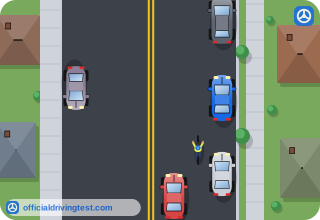
- After you are already in the traffic lane
- Only if another vehicle is close behind you
- Only if you are pulling out on a one-way road
- Before you drive out of the spot
Show answer
Correct answer: Before you drive out of the spot
The steps say to signal first and then drive from the parking spot carefully.
Source: Rhode Island Driver’s Manual (April 2024), page 32
-
You park facing downhill, with or without a curb. How should the front wheels be turned?
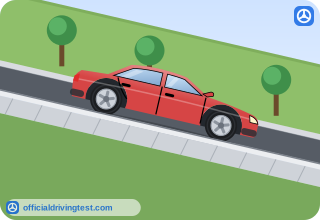
- Turned to the right
- Turned to the left
- Left pointing straight ahead
- Turned to the left only when there is no curb
Show answer
Correct answer: Turned to the right
When parking facing downhill, with or without a curb, the manual shows the wheels turned to the right.
Source: Rhode Island Driver’s Manual (April 2024), page 32
-
You park facing uphill next to a curb. How should the front wheels be turned?
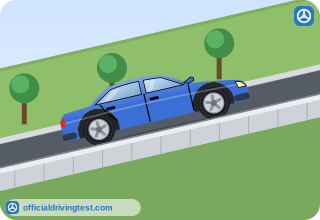
- Turned to the right
- Left pointing straight ahead
- Turned to the left
- Turned to the right only when there is no curb
Show answer
Correct answer: Turned to the left
When parking facing uphill with a curb, the manual shows the wheels turned to the left.
Source: Rhode Island Driver’s Manual (April 2024), page 32
-
You park facing uphill with no curb. How should the front wheels be turned?
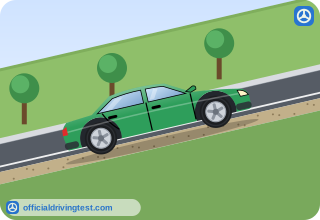
- Turned to the left
- Turned to the right
- Left pointing straight ahead
- Turned to the left, as with a curb
Show answer
Correct answer: Turned to the right
When parking facing uphill without a curb, the manual shows the wheels turned to the right.
Source: Rhode Island Driver’s Manual (April 2024), page 32
-
How close to a fire hydrant may you NOT park or stop?
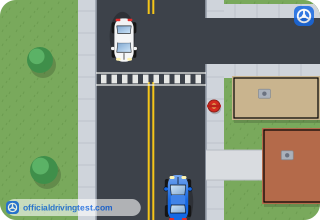
- Within 4 feet
- Within 15 feet
- Within 10 feet
- Within 8 feet
Show answer
Correct answer: Within 8 feet
The manual lists within 8 feet of a fire hydrant as a place you may not park or stop.
Source: Rhode Island Driver’s Manual (April 2024), page 33
-
How close to a crosswalk at an intersection may you NOT park or stop?
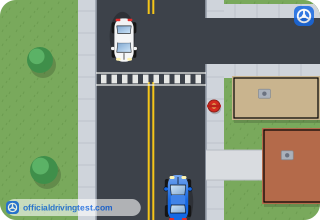
- Within 20 feet
- Within 10 feet
- Within 15 feet
- Within 40 feet
Show answer
Correct answer: Within 20 feet
The manual lists within 20 feet of a crosswalk at an intersection as a no parking or stopping zone.
Source: Rhode Island Driver’s Manual (April 2024), page 33
-
How close to a flashing red or yellow light, a stop sign, or a traffic light may you NOT park or stop?
- Within 10 feet
- Within 15 feet
- Within 30 feet
- Within 40 feet
Show answer
Correct answer: Within 30 feet
The manual says not to park or stop within 30 feet of those lights or a stop sign.
Source: Rhode Island Driver’s Manual (April 2024), page 33
-
Where there are signs, how close across the street from a fire station driveway may you NOT park or stop?
- Within 30 feet of the driveway
- Within 75 feet of the driveway
- Within 50 feet of the driveway
- Within 100 feet of the driveway
Show answer
Correct answer: Within 75 feet of the driveway
Across the street from a fire station driveway, where signs are posted, the limit is 75 feet.
Source: Rhode Island Driver’s Manual (April 2024), page 33
-
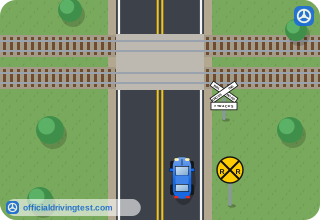
How close to the nearest rail of a railroad crossing may you NOT park or stop, unless you stop just a short time to load or unload passengers or packages?
- Within 10 feet
- Within 25 feet
- Within 100 feet
- Within 50 feet
Show answer
Correct answer: Within 50 feet
The manual says not to park or stop within 50 feet of the nearest rail, except for a short stop to load or unload.
Source: Rhode Island Driver’s Manual (April 2024), page 33
-
What is it called when you stop or park beside a vehicle that is already stopped or parked at the side of a street?
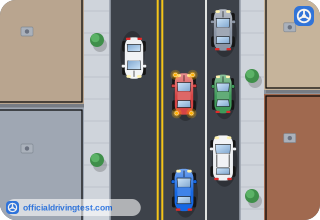
- Double parking
- Parallel parking
- Angle parking
- Curb cutting
Show answer
Correct answer: Double parking
The manual labels parking beside a vehicle stopped at the side of the street as double parking, and it is not allowed.
Source: Rhode Island Driver’s Manual (April 2024), page 33
-
Unless a law prohibits parking, how far may the right wheels of a vehicle parked on a two-lane road be from the right side of the road or curb?
- A maximum of 6 inches
- A maximum of 18 inches
- A maximum of 12 inches
- A maximum of 24 inches
Show answer
Correct answer: A maximum of 12 inches
A vehicle parked on a two-lane road must have its right wheels no more than 12 inches from the right side of the road or curb.
Source: Rhode Island Driver’s Manual (April 2024), page 33
-
On a one-way road, how may a vehicle be parked (unless a law prohibits parking)?
- With only the right wheels up to 12 inches from the curb and headed the way traffic goes
- With either wheel up to 12 inches from the side of the road and headed the way traffic goes
- With either wheel up to 12 inches from the side of the road and headed in either direction
- With either wheel up to 24 inches from the side of the road and headed the way traffic goes
Show answer
Correct answer: With either wheel up to 12 inches from the side of the road and headed the way traffic goes
On a one-way road either wheel may be within 12 inches of the side, and the vehicle must face the same way traffic goes.
Source: Rhode Island Driver’s Manual (April 2024), page 33
-
Which of these is a place where you may NOT park or stop?
- On a two-lane road with the right wheels within 12 inches of the curb, where no law prohibits parking
- On a one-way road headed the way traffic goes with a wheel within 12 inches of the side, where no law prohibits parking
- Beside a curb where you stop only to load or unload at a spot where no sign prohibits stopping
- On a bridge or in a tunnel
Show answer
Correct answer: On a bridge or in a tunnel
A bridge or tunnel is on the manual's list of places where you may not park or stop.
Source: Rhode Island Driver’s Manual (April 2024), page 33
-
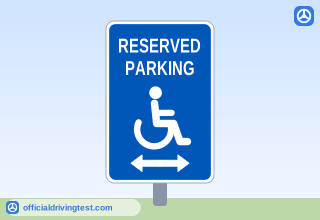
A blue sign or pavement marking shows a white wheelchair symbol. What does it mean?
- Parking for any vehicle for 15 minutes
- Loading zone for deliveries
- Disabled parking with a permit only
- Parking reserved for emergency vehicles
Show answer
Correct answer: Disabled parking with a permit only
The manual pairs the blue wheelchair symbol, on pavement and on signs, with disabled parking with a permit only.
Source: Rhode Island Driver’s Manual (April 2024), page 40