Rhode Island: Emergency vehicles, police stops and work zones — Part 2 Practice Test
Questions in this part include: “Which three items does the manual say you are required by law to carry on your person or in your vehicle?” · “Where are construction signs posted in relation to a work zone?”
Independent educational site · not affiliated with any government agency or DMV
Ready? Test yourself
- Instant feedback with an explanation
- Every answer cites its source in the manual
- Your best score is saved on this device
- Keyboard: press 1 to 4 to answer and Enter for the next question
Questions are original and based on the official manual "Rhode Island Driver’s Manual" (April 2024), Rhode Island Division of Motor Vehicles (DMV).
All 18 questions in this practice test
Take the test above first, then use this list to study. Tap “Show answer” to see the correct answer and explanation.
Show the questions and answersHide the questions
-
Which three items does the manual say you are required by law to carry on your person or in your vehicle?
- License, birth certificate, and vehicle title
- License, registration, and insurance card
- License, vehicle title, and inspection report
- Social Security card, registration, and insurance card
Show answer
Correct answer: License, registration, and insurance card
The manual says the officer will ask for your license, registration and insurance card, and you are required by law to carry each of them.
Source: Rhode Island Driver’s Manual (April 2024), page 67
-
What does the manual say about electronic proof of insurance during a traffic stop?
- A paper card is required
- It is accepted only for drivers under 21
- It is allowed
- It is accepted only if the officer agrees
Show answer
Correct answer: It is allowed
The manual notes that electronic proof of insurance is allowed.
Source: Rhode Island Driver’s Manual (April 2024), page 67
-
How should you hand your license and other documents to an officer?
- Take them out of any holder first
- Leave them inside their holder
- Place them on the dashboard
- Hand them over through the rear window
Show answer
Correct answer: Take them out of any holder first
The manual says not to hand over documents in a holder, but to take them out.
Source: Rhode Island Driver’s Manual (April 2024), page 67
-
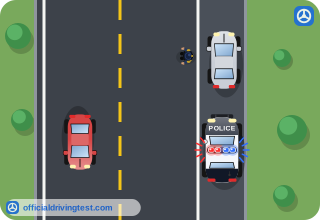
When the officer returns to the patrol car after getting your documents, what should you do?
- Follow the officer to the patrol car
- Step out and stand beside your vehicle
- Wait in your vehicle unless asked to follow
- Drive away slowly
Show answer
Correct answer: Wait in your vehicle unless asked to follow
The manual says not to follow the officer to the patrol car unless asked to do so.
Source: Rhode Island Driver’s Manual (April 2024), page 67
-
According to the manual, what does signing a citation mean?
- You are only acknowledging that you received it
- You admit that you committed the violation
- You agree to pay the fine at once
- You give up your right to a hearing
Show answer
Correct answer: You are only acknowledging that you received it
The manual says signing a citation is not an admission of the violation, only an acknowledgment that you received it.
Source: Rhode Island Driver’s Manual (April 2024), page 67
-
What effect does agreeing to sign, or refusing to sign, a citation have on the outcome of the stop?
- Refusing to sign leads to an immediate arrest
- Refusing to sign raises the fine
- Signing reduces the penalty
- It will not change the outcome
Show answer
Correct answer: It will not change the outcome
The manual states that whether you sign or refuse, the outcome of the stop is not changed.
Source: Rhode Island Driver’s Manual (April 2024), page 67
-
According to the manual, how is the use by police officers of race, ethnicity, or national origin solely in deciding who is subject to traffic stops viewed?
- It is permitted when a supervisor approves
- It is improper
- It is permitted only at night
- It is permitted in stops but not in searches
Show answer
Correct answer: It is improper
The manual says that using race, ethnicity or national origin solely to decide whom to stop, search or seize is improper.
Source: Rhode Island Driver’s Manual (April 2024), page 67
-
Which of these is one of the high visibility colors used for construction signs?
- Orange
- Purple
- Gray
- Maroon
Show answer
Correct answer: Orange
Construction signs use high visibility colors: fluorescent yellow-green, orange, or pink.
Source: Rhode Island Driver’s Manual (April 2024), page 72
-
Where are construction signs posted in relation to a work zone?
- Only at the beginning of the work zone
- Only within the work zone itself
- Before, within, and after the work zone
- Only after the work zone has ended
Show answer
Correct answer: Before, within, and after the work zone
Construction signs are posted prior to, within, and after the work zone.
Source: Rhode Island Driver’s Manual (April 2024), page 72
-
In a posted construction speed zone, what happens to the fine for a speeding ticket?
- It is doubled only when workers are present
- It is doubled, 24 hours a day
- It is doubled only during daytime hours
- It is waived if no workers are visible
Show answer
Correct answer: It is doubled, 24 hours a day
Fines are doubled for speeding tickets in these designated areas twenty-four hours a day.
Source: Rhode Island Driver’s Manual (April 2024), page 73
-
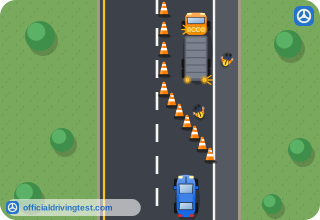
Which two factors does the manual name as among the most common causes of work zone crashes?
- Weather and poor lighting
- Flaggers and warning signs
- Narrow lanes and detours
- Speed and inattention
Show answer
Correct answer: Speed and inattention
The manual says speed and inattention are two of the most common causes of work zone crashes.
Source: Rhode Island Driver’s Manual (April 2024), page 73
-
What does the manual say about changing lanes within a work zone?
- Change lanes freely if there is a gap in traffic
- Change lanes only to pass slower vehicles
- Do not change lanes within the work zone
- Change lanes only when no workers are visible
Show answer
Correct answer: Do not change lanes within the work zone
Drivers should follow directions from officers and flaggers and not change lanes within the work zone.
Source: Rhode Island Driver’s Manual (April 2024), page 73
-
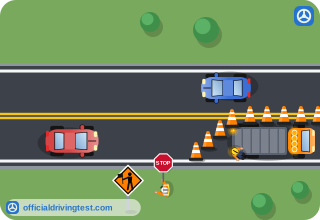
What legal authority do flaggers have in a work zone?
- Their signals are advice that drivers may choose to ignore
- They have the legal authority to control traffic
- They can direct traffic only when a police officer is present
- They can only warn drivers and cannot make them stop
Show answer
Correct answer: They have the legal authority to control traffic
Flaggers have the legal authority to control traffic, so drivers must follow their directions.
Source: Rhode Island Driver’s Manual (April 2024), page 73
-
How do flaggers or law enforcement officers tell motorists in a work zone to slow down or stop?
- Only with sirens and flashing lights
- Only with horn blasts
- Only with radio announcements
- With hand signals or signs
Show answer
Correct answer: With hand signals or signs
Flaggers and officers use hand signals or signs to instruct motorists to slow down or stop.
Source: Rhode Island Driver’s Manual (April 2024), page 73
-
According to the manual, which type of crash accounts for most work zone crashes?
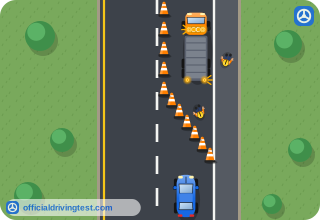
- Rear-end collisions
- Head-on collisions
- Side-impact collisions
- Rollover crashes
Show answer
Correct answer: Rear-end collisions
The manual says most work zone crashes are rear-end collisions, which is why drivers should not tailgate.
Source: Rhode Island Driver’s Manual (April 2024), page 73
-
When approaching a work zone where lanes merge, what does the manual advise?
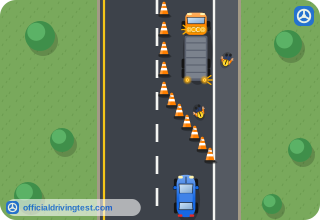
- Stay in the ending lane until the last moment
- Speed up to pass traffic before the lane ends
- Merge early, when it is safe
- Stop and wait for traffic to open a gap
Show answer
Correct answer: Merge early, when it is safe
Moving to the appropriate lane at first notice, when it is safe, helps maintain traffic flow.
Source: Rhode Island Driver’s Manual (April 2024), page 73
-
How often does the manual say work zones change?
- Daily
- Hourly
- Weekly
- Monthly
Show answer
Correct answer: Hourly
The manual warns to expect the unexpected because work zones change hourly.
Source: Rhode Island Driver’s Manual (April 2024), page 73
-
Which of these is named as a warning device used in work zones?
- Parking meters
- Mile marker posts
- Street name signs
- Barricades
Show answer
Correct answer: Barricades
The manual lists cones, barrels, tubes, panels, barricades, flashing arrow boards and temporary roadway markings as work zone warning devices.
Source: Rhode Island Driver’s Manual (April 2024), page 73