Rhode Island: Distractions, drowsiness and emotions — Part 2 Practice Test
Questions in this part include: “Which of these is listed as an additional cause of distraction inside the vehicle?” · “If you find your mind wandering while driving, what should you do?”
Independent educational site · not affiliated with any government agency or DMV
Ready? Test yourself
- Instant feedback with an explanation
- Every answer cites its source in the manual
- Your best score is saved on this device
- Keyboard: press 1 to 4 to answer and Enter for the next question
Questions are original and based on the official manual "Rhode Island Driver’s Manual" (April 2024), Rhode Island Division of Motor Vehicles (DMV).
All 20 questions in this practice test
Take the test above first, then use this list to study. Tap “Show answer” to see the correct answer and explanation.
Show the questions and answersHide the questions
-
Which of these is listed as an additional cause of distraction inside the vehicle?
- Scanning ahead
- Checking blind spots
- Signaling a lane change
- Grooming
Show answer
Correct answer: Grooming
Eating, drinking, grooming, adjusting climate controls and attending to pets are all internal distractions.
Source: Rhode Island Driver’s Manual (April 2024), page 18
-
Reducing speed and diverting attention to a nearby crash scene is sometimes referred to as what?
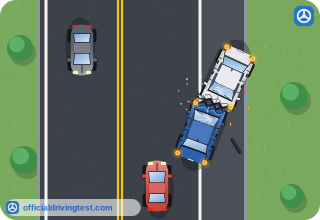
- Accident gawking
- Road hypnosis
- Tunnel vision
- Highway fatigue
Show answer
Correct answer: Accident gawking
The manual uses the term "accident gawking" for slowing down and staring at a nearby crash scene.
Source: Rhode Island Driver’s Manual (April 2024), page 19
-
What may construction zones contain that can also divert a driver’s attention?
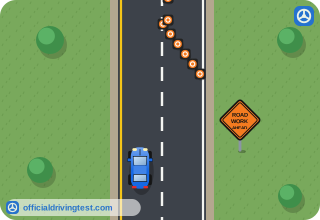
- Extra traffic signals at every corner
- Pedestrian-only crossings
- Unusual vehicles or machinery
- Unusually bright pavement markings
Show answer
Correct answer: Unusual vehicles or machinery
The manual notes that unusual vehicles or machinery in construction zones can draw a driver's attention away.
Source: Rhode Island Driver’s Manual (April 2024), page 19
-
Even if there is no risk of colliding with an animal near the road, what may it still do?
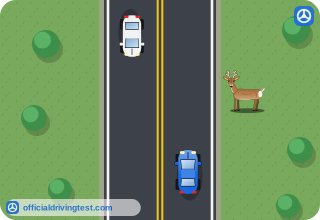
- Reduce the driver’s need to slow down
- Draw a driver’s attention away from the roadway
- Improve the driver’s awareness of the road
- Warn the driver of an upcoming crossing
Show answer
Correct answer: Draw a driver’s attention away from the roadway
An animal can pull a driver's attention off the road even when no collision is likely.
Source: Rhode Island Driver’s Manual (April 2024), page 19
-
Which of these does the manual list as other roadway users that could attract a driver’s attention?
- Aircraft overhead
- Boats on a nearby river
- Hot-air balloons
- Horse-drawn buggies
Show answer
Correct answer: Horse-drawn buggies
The manual lists horse-drawn buggies, motorcycles, scooters, bicycles and pedestrians as other roadway users that may distract.
Source: Rhode Island Driver’s Manual (April 2024), page 19
-
According to the manual, what is the key to preventing becoming distracted?
- Prepare as much as possible before you drive
- Drive only on roads that you know very well
- Keep the radio turned off at all times
- Drive only during the daylight hours
Show answer
Correct answer: Prepare as much as possible before you drive
The manual says the key is to prepare ahead and deal with likely distractions before getting behind the wheel.
Source: Rhode Island Driver’s Manual (April 2024), page 19
-
Which of these is a technique the manual lists for preventing and managing distractions?
- Adjust the radio and climate control while merging onto a highway
- Read maps only while driving on straight roads
- Preset radio stations, podcast app playlist, and climate control
- Eat and drink only when stopped at red lights
Show answer
Correct answer: Preset radio stations, podcast app playlist, and climate control
Presetting the radio, playlist and climate control before driving is one of the listed techniques.
Source: Rhode Island Driver’s Manual (April 2024), page 19
-
What does the manual advise doing with items that may move around when the car is in motion?
- Keep them within reach on the seat
- Secure them
- Hold them in your lap
- Place them on the dashboard
Show answer
Correct answer: Secure them
Securing loose items before driving prevents them from becoming a distraction.
Source: Rhode Island Driver’s Manual (April 2024), page 19
-
Which of these does the manual say to avoid while driving?
- Using a mirror to check the traffic
- Using the turn signal to change lanes
- Keeping both hands on the steering wheel
- Smoking, eating, drinking, and reading
Show answer
Correct answer: Smoking, eating, drinking, and reading
The manual advises avoiding smoking, eating, drinking and reading while driving.
Source: Rhode Island Driver’s Manual (April 2024), page 19
-
What does the manual say to do when you need to attend to children or passengers?
- Pull safely off the road and out of traffic
- Reach back with one hand while keeping your eyes ahead
- Slow down by 10 mph and turn to look at them
- Stop in the nearest traffic lane with your hazard lights on
Show answer
Correct answer: Pull safely off the road and out of traffic
Attending to children or passengers should be done after pulling safely out of traffic.
Source: Rhode Island Driver’s Manual (April 2024), page 19
-
Who does the manual suggest you ask to help with activities that may be distracting?
- The driver behind you
- A police officer
- A passenger
- The next driver at a light
Show answer
Correct answer: A passenger
Asking a passenger to handle distracting tasks keeps the driver's attention on the road.
Source: Rhode Island Driver’s Manual (April 2024), page 19
-
If you find your mind wandering while driving, what should you do?
- Turn up the radio to stay alert
- Remind yourself to stay focused on the road
- Take both hands off the wheel to stretch
- Begin a conversation on the phone
Show answer
Correct answer: Remind yourself to stay focused on the road
The manual says to remind yourself to stay focused on the road when your mind wanders.
Source: Rhode Island Driver’s Manual (April 2024), page 19
-
What is the manual’s first tip about wireless communication devices?
- Use a device only for calls shorter than one minute
- Use a device only in light traffic
- Keep the device on your lap while driving
- Do not use a wireless communication device while driving
Show answer
Correct answer: Do not use a wireless communication device while driving
The first tip is to avoid using a wireless communication device at all while driving.
Source: Rhode Island Driver’s Manual (April 2024), page 19
-
When does the manual say you should use message-taking functions and return calls?
- When you are stopped at a safe location
- When traffic is light
- When you are below the speed limit
- When you are driving on a highway
Show answer
Correct answer: When you are stopped at a safe location
Calls should be returned only after stopping at a safe location.
Source: Rhode Island Driver’s Manual (April 2024), page 19
-
When does the manual say to limit casual conversations on a wireless communication device?
- To times when you are driving on straight roads
- To times when traffic is light
- To times when you are not operating a motor vehicle
- To times when you are using a headset
Show answer
Correct answer: To times when you are not operating a motor vehicle
The manual says to use the device only when necessary and keep casual conversations for when you are not driving.
Source: Rhode Island Driver’s Manual (April 2024), page 20
-
In which conditions is it especially important to keep a necessary phone conversation short?
- Light traffic in daylight
- Inclement weather or heavy traffic
- Straight, empty roads
- While stopped in a parking lot
Show answer
Correct answer: Inclement weather or heavy traffic
The manual says to plan the call in advance and keep it short, especially in hazardous conditions such as bad weather or heavy traffic.
Source: Rhode Island Driver’s Manual (April 2024), page 20
-
What does the manual say to do before continuing an emotional phone conversation?
- Switch to a headset
- Slow down to a lower speed
- Ask passengers to stay silent
- Pull off the road to a safe spot
Show answer
Correct answer: Pull off the road to a safe spot
Emotions can affect safe driving, so the manual says to pull off the road to a safe spot before such a conversation continues.
Source: Rhode Island Driver’s Manual (April 2024), page 20
-
Who does the manual suggest could place a call for you and, if possible, speak in your place?
- A passenger in the car
- The driver of the next car
- A pedestrian
- Nobody, a call must always be made by the driver
Show answer
Correct answer: A passenger in the car
Asking a passenger to place the call and speak for you keeps the driver's attention on driving.
Source: Rhode Island Driver’s Manual (April 2024), page 20
-
Why does the manual say to secure your wireless communication device in the car?
- So it stays within easy reach of the driver’s hand
- So its battery stays charged during the trip
- So it does not become a projectile object in a crash
- So it can be used hands-free more easily
Show answer
Correct answer: So it does not become a projectile object in a crash
An unsecured device can fly around the car in a crash.
Source: Rhode Island Driver’s Manual (April 2024), page 20
-
According to the manual, drowsiness can affect what?
- Only the driver’s reaction time
- Every process involved in safe driving
- Only the driver’s ability to see signs and lights
- Only the driver’s judgment of speed
Show answer
Correct answer: Every process involved in safe driving
The manual says drowsiness can affect every process involved in safe driving, from seeing and processing to deciding.
Source: Rhode Island Driver’s Manual (April 2024), page 20