Pennsylvania: Road signs — Part 4 Practice Test
Questions in this part include: “Besides posted signs, what is another clue that a road is one-way?”
Independent educational site · not affiliated with any government agency or DMV
Ready? Test yourself
- Instant feedback with an explanation
- Every answer cites its source in the manual
- Your best score is saved on this device
Questions are original and based on the official manual "Pennsylvania Driver's Manual" (Pub 95), Pennsylvania Department of Transportation (PennDOT), Bureau of Driver Licensing.
All 18 questions in this practice test
Take the test above first, then use this list to study. Tap “Show answer” to see the correct answer and explanation.
Show the questions and answersHide the questions
-
If a SCHOOL sign is accompanied by a downward-pointing arrow, it means:
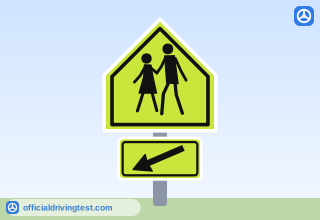
- the school zone has ended
- you are at the school zone crosswalk
- the school is closed
- the arrow points to the nearest exit route
Show answer
Correct answer: you are at the school zone crosswalk
A downward-pointing arrow on a SCHOOL sign means you are at the school zone crosswalk; slow down, watch for children crossing, and stop if necessary.
Source: Pennsylvania Driver's Manual (Pub 95), page 17 · Open this page in the manual (Manual page 17)
-
Roadside object markers (for hazards like underpass supports or guiderails) have stripes angled down in the direction you need to move to avoid the hazard. A Right Hazard marker tells you to:
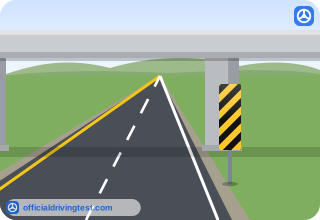
- keep to the right
- keep to either the left or right
- stop before the object
- keep to the left
Show answer
Correct answer: keep to the left
A Right Hazard marker (for an object on the right side of the road) tells you to keep to the left.
Source: Pennsylvania Driver's Manual (Pub 95), page 17 · Open this page in the manual (Manual page 17)
-
A Center Hazard object marker tells you to:
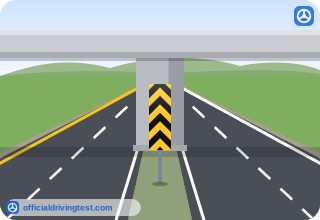
- keep to the left or right
- keep to the left only
- keep to the right only
- stop and wait for oncoming traffic to clear
Show answer
Correct answer: keep to the left or right
A Center Hazard marker tells you that you may keep to the left or to the right to avoid the object.
Source: Pennsylvania Driver's Manual (Pub 95), page 17 · Open this page in the manual (Manual page 17)
-
A Left Hazard marker tells you to:
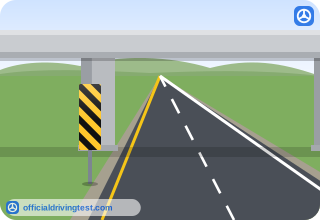
- keep to the left
- keep to the right
- keep to the left or right
- reverse direction
Show answer
Correct answer: keep to the right
A Left Hazard marker (for an object on the left side of the road) tells you to keep to the right.
Source: Pennsylvania Driver's Manual (Pub 95), page 17 · Open this page in the manual (Manual page 17)
-
Guide signs, which provide information about intersecting roads, direct you to cities and towns, and point out hospitals, gas stations and other services, are usually shaped like:
- A diamond
- A horizontal rectangle
- An octagon
- A downward-pointing triangle
Show answer
Correct answer: A horizontal rectangle
Guide signs are usually horizontal rectangles.
Source: Pennsylvania Driver's Manual (Pub 95), page 19 · Open this page in the manual (Manual page 19)
-
Highway and expressway guide signs (such as exit signs) are:
- Yellow with black letters
- Orange with black letters
- Green with white letters
- Blue with white letters
Show answer
Correct answer: Green with white letters
Highway and expressway guide signs are green with white letters.
Source: Pennsylvania Driver's Manual (Pub 95), page 19 · Open this page in the manual (Manual page 19)
-
Highway and expressway guide signs for an exit are usually posted more than once - two advance signs plus one at the exit itself - mainly because:
- State law requires exactly three signs per exit
- Each sign shows a different exit number
- Only the third sign is official; the first two are advisory
- High speed and heavy traffic can make drivers miss a single sign
Show answer
Correct answer: High speed and heavy traffic can make drivers miss a single sign
Several signs are necessary because the high speed and heavy traffic on highways can cause drivers to miss seeing a single sign, and motorists may need to make one or more lane changes to exit.
Source: Pennsylvania Driver's Manual (Pub 95), page 19 · Open this page in the manual (Manual page 19)
-
The sign shown, displaying only the number 22, is a:
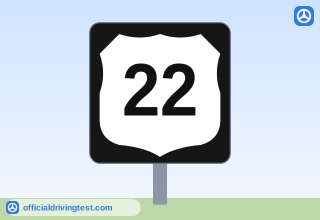
- Keystone route marker
- Junction plate
- Direction plate
- U.S. Traffic Route marker
Show answer
Correct answer: U.S. Traffic Route marker
The route marker shows you the road is a U.S. Traffic Route.
Source: Pennsylvania Driver's Manual (Pub 95), page 21 · Open this page in the manual (Manual page 21)
-
A keystone-shaped route marker sign identifies:
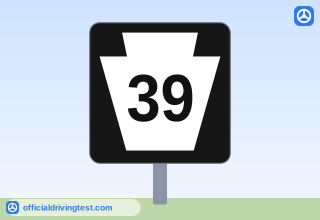
- A Pennsylvania Traffic Route
- A U.S. Traffic Route
- An interstate highway
- A tourist attraction route
Show answer
Correct answer: A Pennsylvania Traffic Route
The keystone marker shows you the road is a Pennsylvania Traffic Route.
Source: Pennsylvania Driver's Manual (Pub 95), page 21 · Open this page in the manual (Manual page 21)
-
A 'JCT' plate above a route marker tells you that you are:
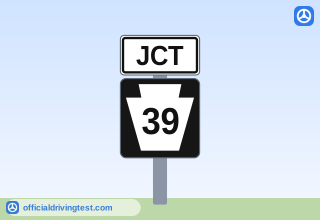
- Leaving the numbered route permanently
- Approaching the intersection of that route
- Entering a construction zone
- Approaching a toll plaza
Show answer
Correct answer: Approaching the intersection of that route
The junction plate on a route marker shows you are approaching the intersection of that Traffic Route.
Source: Pennsylvania Driver's Manual (Pub 95), page 21 · Open this page in the manual (Manual page 21)
-
A plate reading 'WEST' (or another compass direction) attached to a route marker tells you:
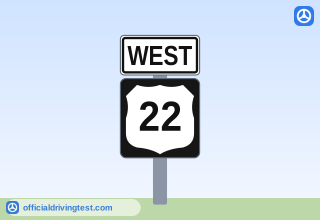
- The direction of the nearest rest area
- That the route is one-way westbound only
- The direction you are traveling on that route
- The direction to the state capital
Show answer
Correct answer: The direction you are traveling on that route
The direction plate on a route marker shows you the direction you are traveling on that Traffic Route.
Source: Pennsylvania Driver's Manual (Pub 95), page 21 · Open this page in the manual (Manual page 21)
-
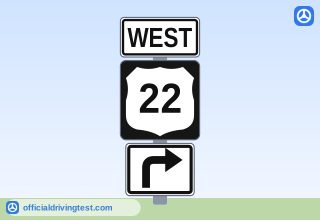
A supplemental arrow shown with a route marker assembly, such as one pointing right under a 'Route 22 West' sign, indicates:
- A detour is in effect
- The route number is about to change
- Passing is not allowed ahead
- A turn is ahead to continue on that route
Show answer
Correct answer: A turn is ahead to continue on that route
The supplemental arrow on a route marker assembly means you are approaching a turn to continue on that route.
Source: Pennsylvania Driver's Manual (Pub 95), page 21 · Open this page in the manual (Manual page 21)
-
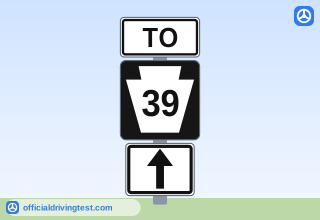
A route marker combined with a 'TO' trailblazer sign and a supplemental arrow means that to reach that numbered route, you must:
- Continue ahead
- Turn around immediately
- Exit at the next available ramp
- Stop and wait for a gap in traffic
Show answer
Correct answer: Continue ahead
The route marker sign and 'TO' trailblazer sign with the supplemental arrow mean that to gain access to that route, you must continue ahead.
Source: Pennsylvania Driver's Manual (Pub 95), page 21 · Open this page in the manual (Manual page 21)
-
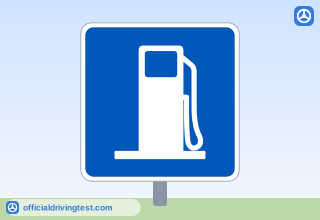
Signs that are blue with white letters or symbols and show services such as hospitals, food, gas, diesel and lodging located at the next exit are called:
- Regulatory signs
- Service signs
- Route markers
- Warning signs
Show answer
Correct answer: Service signs
Service signs are square or rectangular, blue with white letters or symbols, and show the location of services at the next exit.
Source: Pennsylvania Driver's Manual (Pub 95), page 21 · Open this page in the manual (Manual page 21)
-
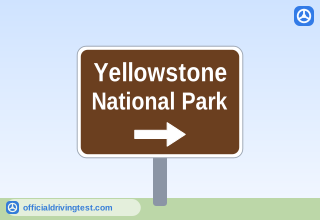
Square or rectangular signs, colored blue or brown with white lettering, that direct motorists to museums, historical landmarks, or state or national parks are called:
- Service signs
- Interstate shields
- Tourist-oriented directional signs
- Regulatory signs for parks and museums
Show answer
Correct answer: Tourist-oriented directional signs
Tourist-oriented directional signs are square or rectangular and may be blue or brown with white lettering, directing motorists to tourist attractions.
Source: Pennsylvania Driver's Manual (Pub 95), page 21 · Open this page in the manual (Manual page 21)
-
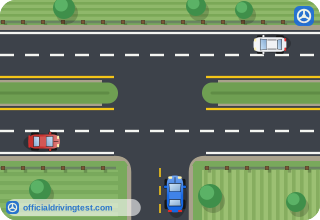
What sign will you typically see posted on your road as you approach an intersection with a divided highway?
- YIELD
- NO OUTLET
- MERGE
- DIVIDED HIGHWAY
Show answer
Correct answer: DIVIDED HIGHWAY
You will usually see a DIVIDED HIGHWAY sign on your road as you approach the intersection.
Source: Pennsylvania Driver's Manual (Pub 95), page 49 · Open this page in the manual (Manual page 49)
-
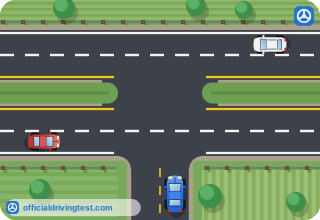
Besides ONE WAY signs, what other signs will you typically see together where a road intersects a divided highway?
- WRONG WAY and DO NOT ENTER signs
- SPEED LIMIT and SCHOOL ZONE signs
- YIELD and STOP signs
- MERGE and LANE ENDS signs
Show answer
Correct answer: WRONG WAY and DO NOT ENTER signs
You will see ONE WAY, WRONG WAY and DO NOT ENTER signs all together at roads intersecting with divided highways.
Source: Pennsylvania Driver's Manual (Pub 95), page 49 · Open this page in the manual (Manual page 49)
-
Besides posted signs, what is another clue that a road is one-way?
- The road has a yellow centerline
- Vehicles parked on both sides all face the same way
- The road has no lane lines or pavement markings
- The road is unusually wide
Show answer
Correct answer: Vehicles parked on both sides all face the same way
Another clue a road is one way is when you see vehicles parked on both sides of the road headed in the same direction.
Source: Pennsylvania Driver's Manual (Pub 95), page 49 · Open this page in the manual (Manual page 49)