Oregon: Speed and following distance — Part 6 Practice Test
Questions in this part include: “Which places freeze first and may be icy when the rest of the road is free of ice?” · “When is a snow or ice-covered road likely to be most slippery?”
Independent educational site · not affiliated with any government agency or DMV
Ready? Test yourself
- Instant feedback with an explanation
- Every answer cites its source in the manual
- Your best score is saved on this device
Questions are original and based on the official manual "Oregon Driver Manual" (2026-2027), Oregon Driver and Motor Vehicle Services (DMV).
All 17 questions in this practice test
Take the test above first, then use this list to study. Tap “Show answer” to see the correct answer and explanation.
Show the questions and answersHide the questions
-
Why can even summer showers make roads slippery?
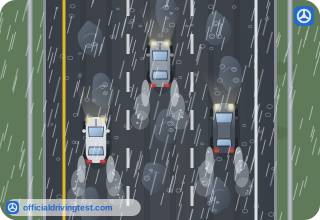
- Rain mixes with oil and dirt on the road
- Rain freezes quickly on the pavement
- Rain lowers the pressure in your tires
- Rain washes the painted markings off the road
Show answer
Correct answer: Rain mixes with oil and dirt on the road
Even summer showers can cause slippery roads when rain mixes with oil and dirt.
Source: Oregon Driver Manual (2026-2027), page 77 · Open this page in the manual (Manual page 77)
-
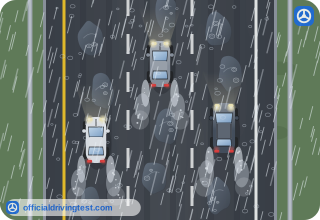
Which of these should you not do in wet conditions?
- Turn on your headlights
- Use cruise control
- Keep windows clear of moisture
- Apply the brakes gently
Show answer
Correct answer: Use cruise control
The manual says not to use cruise control in wet conditions.
Source: Oregon Driver Manual (2026-2027), page 77 · Open this page in the manual (Manual page 77)
-
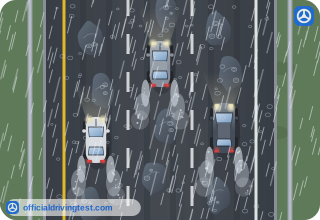
What can happen when vehicle tires hydroplane over a wet road surface?
- The tires grip the wet road better than usual
- The brakes work faster than they normally do
- The engine stalls and the vehicle stops at once
- The ability to steer and stop can be reduced or lost
Show answer
Correct answer: The ability to steer and stop can be reduced or lost
When tires hydroplane (skim or float) over a wet surface, the ability to steer and stop can be reduced or lost.
Source: Oregon Driver Manual (2026-2027), page 78 · Open this page in the manual (Manual page 78)
-
Because tires can hydroplane on wet roads, what does the manual tell you to do?
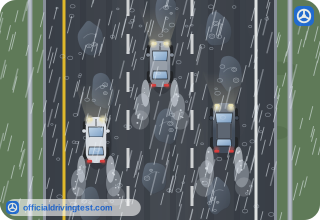
- Slow down when roads are wet
- Brake hard on wet roads
- Use cruise control on wet roads
- Follow the vehicle ahead closely
Show answer
Correct answer: Slow down when roads are wet
Tires can hydroplane (skim or float) on a wet road surface, and the manual says to slow down when roads are wet.
Source: Oregon Driver Manual (2026-2027), page 78 · Open this page in the manual (Manual page 78)
-
How should you drive on snow and ice?
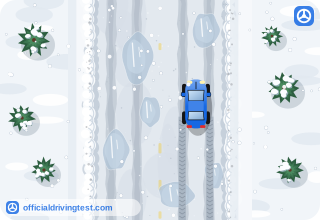
- At normal speeds, leaving more room ahead of your vehicle
- At slower speeds, leaving the same room ahead as usual
- At slower speeds, with cruise control turned on
- At slower speeds, leaving more room ahead of your vehicle
Show answer
Correct answer: At slower speeds, leaving more room ahead of your vehicle
Snow and ice call for slower speeds and more room between your vehicle and the vehicle ahead.
Source: Oregon Driver Manual (2026-2027), page 78 · Open this page in the manual (Manual page 78)
-
What do snow and ice do to the distance needed to stop your vehicle?
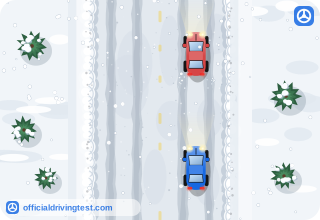
- They increase the braking distance
- They decrease the braking distance
- They have no effect on the braking distance
- They affect it only below freezing
Show answer
Correct answer: They increase the braking distance
Snow and ice impair your ability to see ahead and increase the braking distance needed to stop your vehicle.
Source: Oregon Driver Manual (2026-2027), page 78 · Open this page in the manual (Manual page 78)
-
What should you do when police or highway officials say driving is very hazardous?
- Drive with your hazard lights on
- Drive only in the daytime
- Stay off the road
- Drive at the minimum speed
Show answer
Correct answer: Stay off the road
When police or highway officials say driving is very hazardous, stay off the road.
Source: Oregon Driver Manual (2026-2027), page 78 · Open this page in the manual (Manual page 78)
-
How should you press the gas pedal when driving on snow and ice?
- Firmly
- Gently
- In short, hard bursts
- Fully, to keep the tires turning
Show answer
Correct answer: Gently
Too much power may cause the tires to spin or the vehicle to slide, so gently press the gas pedal.
Source: Oregon Driver Manual (2026-2027), page 78 · Open this page in the manual (Manual page 78)
-
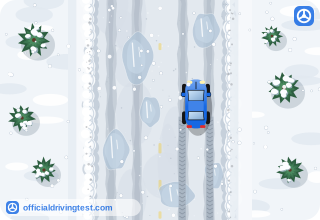
How should you use the brakes on snow and ice?
- Slam on them
- Press them firmly and hold
- Keep your foot resting on them
- Gently press and release them
Show answer
Correct answer: Gently press and release them
If you slam on the brakes, your vehicle will likely skid, so gently press and release them.
Source: Oregon Driver Manual (2026-2027), page 78 · Open this page in the manual (Manual page 78)
-
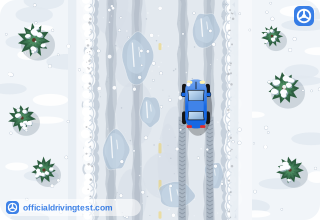
How can you get the “feel” of a snowy or icy road when you start driving?
- Lightly try your brakes away from traffic
- Accelerate hard on a straight, open stretch
- Brake firmly in heavy traffic to test them
- Turn the wheel sharply back and forth in traffic
Show answer
Correct answer: Lightly try your brakes away from traffic
Get the feel of the road away from traffic and try your brakes lightly so you know what to expect.
Source: Oregon Driver Manual (2026-2027), page 78 · Open this page in the manual (Manual page 78)
-
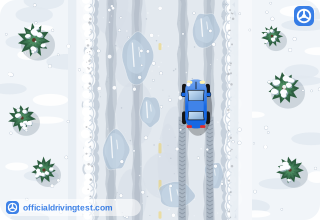
How should you make turns on snow and ice to avoid a skid?
- At a high, steady speed
- While braking through the turn
- At a reduced, steady speed
- While speeding up through the turn
Show answer
Correct answer: At a reduced, steady speed
The manual says to make turns at a reduced, steady speed to avoid a skid.
Source: Oregon Driver Manual (2026-2027), page 78 · Open this page in the manual (Manual page 78)
-
Which places freeze first and may be icy when the rest of the road is free of ice?
- A road with a wide shoulder
- A bridge or a shaded area
- A straight stretch in sunlight
- A freshly paved road
Show answer
Correct answer: A bridge or a shaded area
A bridge or shaded area freezes first and may be icy when the rest of the road is free of ice.
Source: Oregon Driver Manual (2026-2027), page 78 · Open this page in the manual (Manual page 78)
-
How much power should you apply when going uphill on a snow or ice-covered road?
- As much power as possible to climb the hill quickly
- Very little, letting the vehicle roll back a little
- None, coasting up the hill with the gears in neutral
- Just enough to maintain motion without the wheels spinning
Show answer
Correct answer: Just enough to maintain motion without the wheels spinning
Apply just enough power to maintain motion without causing the wheels to spin.
Source: Oregon Driver Manual (2026-2027), page 78 · Open this page in the manual (Manual page 78)
-
When is a snow or ice-covered road likely to be most slippery?
- When the temperature is near the freezing point
- When the temperature is well below the freezing point
- When the temperature is above 50 degrees
- When the temperature is changing quickly
Show answer
Correct answer: When the temperature is near the freezing point
The road is likely to be most slippery when the temperature is near the freezing point rather than below freezing.
Source: Oregon Driver Manual (2026-2027), page 78 · Open this page in the manual (Manual page 78)
-
Which is advised when driving on snow and ice?
- Use cruise control to hold a steady speed
- Leave frost on the side windows
- Keep windows clear of snow, ice, and fog
- Keep your headlights off to avoid glare
Show answer
Correct answer: Keep windows clear of snow, ice, and fog
The manual says to keep windows clear of snow, ice and fog, and not to use cruise control.
Source: Oregon Driver Manual (2026-2027), page 78 · Open this page in the manual (Manual page 78)
-
Which driving habit helps improve gas mileage?
- Accelerating quickly from each stop
- Driving steadily within posted speed limits
- Letting the engine idle while waiting
- Making separate trips for each errand
Show answer
Correct answer: Driving steadily within posted speed limits
Driving steadily and avoiding exceeding posted speed limits improves gas mileage.
Source: Oregon Driver Manual (2026-2027), page 86 · Open this page in the manual (Manual page 86)
-
Which of these helps you save fuel?
- Letting the engine idle before leaving
- Taking separate trips for each errand
- Avoiding rapid starts and sudden stops
- Driving a little over the speed limit
Show answer
Correct answer: Avoiding rapid starts and sudden stops
Avoiding rapid starts and sudden stops is a listed fuel saving technique.
Source: Oregon Driver Manual (2026-2027), page 86 · Open this page in the manual (Manual page 86)