Pavement markings in Oregon
The Oregon Driver Manual shows or names everything on this page: 28 in all, on pages 9, 22–25, 32, 44, 47, 51, 63, 69.
Independent educational site · not affiliated with any government agency or DMV
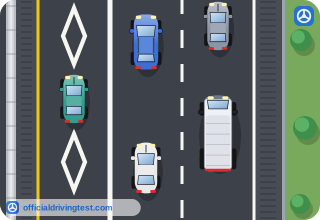
HOV Diamond Marking
This lane is reserved for vehicles carrying at least two or more persons, as noted on the sign. A white diamond may be painted on the lane.
Manual page 9 · Open this page in the manual (Manual page 9)
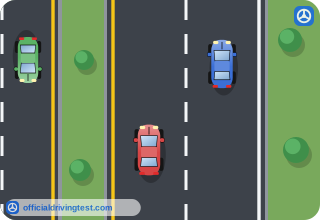
Solid Yellow Line (One-Way Road)
Marks the left edge of one-way roads and ramps.
Manual page 22 · Open this page in the manual (Manual page 22)
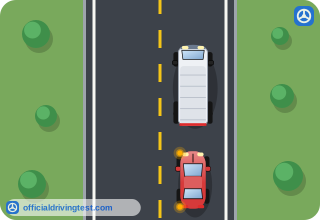
Broken Yellow Center Line
Indicates a two-way road used for traffic traveling in opposite directions. Passing is allowed for both directions of travel.
Manual page 22 · Open this page in the manual (Manual page 22)
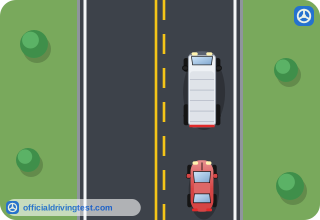
Solid and Broken Yellow Center Line
Indicates where passing is allowed. A broken yellow line on your side of the lane indicates you are allowed to pass. A solid yellow line on your side of the lane indicates you are not allowed to pass.
Manual page 22 · Open this page in the manual (Manual page 22)
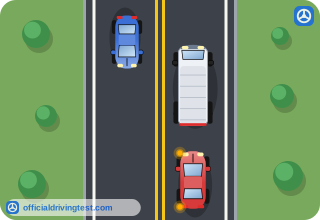
Double Solid Yellow Line
Indicates passing is not allowed for both directions of traffic. You may turn left, to enter or exit a roadway, across double solid yellow lines after waiting for oncoming traffic to clear.
Manual page 22 · Open this page in the manual (Manual page 22)
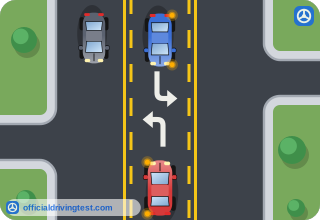
Two-Way Special Left Turn Lane
If a two-way left turn lane has been provided, do not make a left turn from any other lane. It is illegal to travel in a two-way left turn lane, so enter the lane just before you want to make the turn. Wait in the left turn lane until traffic clears and you can complete the turn.
Manual page 23 · Open this page in the manual (Manual page 23)
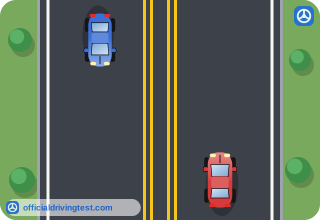
Painted Median
Marks the area between two directions of travel. You may make a left turn across a painted median after waiting for oncoming traffic to clear. You may not use a painted median as a turn lane. It is illegal to travel in a median with double yellow lines.
Manual page 23 · Open this page in the manual (Manual page 23)
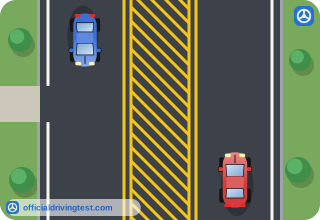
Yellow Diagonal Stripes
Used within a painted median to inform you of fixed objects in the road ahead or areas where vehicle use is not allowed. It is illegal to drive in or make a turn across these stripes.
Manual page 23 · Open this page in the manual (Manual page 23)
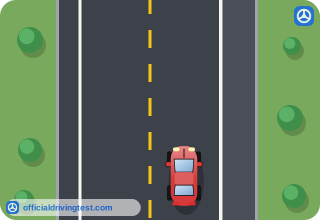
Solid White Line
Used for an edge or fog line to help drivers to stay on the road.
Manual page 23 · Open this page in the manual (Manual page 23)
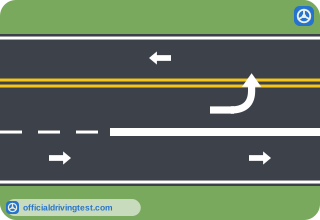
Wide Solid White Line
Used to direct traffic into specific lanes, such as turn lanes, and to separate bike lanes from other traffic lanes. Crossing a wide solid white line is permitted but discouraged.
Manual page 24 · Open this page in the manual (Manual page 24)
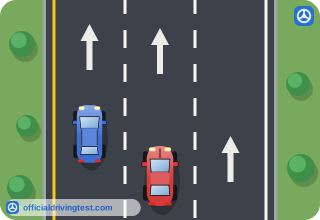
Broken White Line
Separates lanes of traffic going in the same direction. Crossing a broken white line is permitted with caution.
Manual page 24 · Open this page in the manual (Manual page 24)
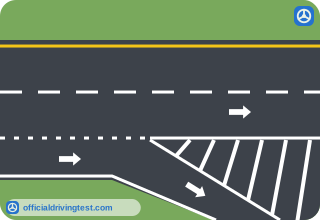
Dotted White Line
Short dotted lines placed closer together than a broken line. Crossing a dotted line is permitted with caution. When used prior to an exit ramp or intersection, it informs you that the lane you are traveling in will not continue on the same route, such as a right-turn only lane or an exit only lane on the freeway. When used at a freeway entrance ramp, it informs you that you are entering the freeway and must merge into traffic. When used within an intersection, it will help guide you through the intersection into the proper lane.
Manual page 24 · Open this page in the manual (Manual page 24)
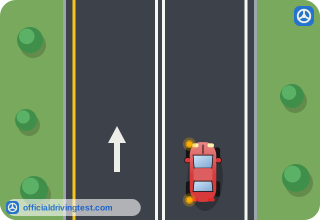
Double Solid White Line
Usually accompanied by a sign prohibiting lane changes for a certain distance. Means you are not allowed to change lanes. Stay in your lane.
Manual page 24 · Open this page in the manual (Manual page 24)
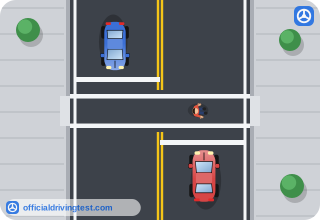
Marked Crosswalk
Noted by white lines in an area where pedestrians cross the road. Stop when a pedestrian is in the crosswalk.
Manual page 24 · Open this page in the manual (Manual page 24)
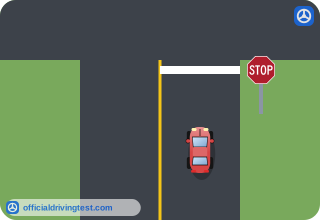
Stop Line
A solid white line across your lane to show the point at which you are required to stop.
Manual page 25 · Open this page in the manual (Manual page 25)
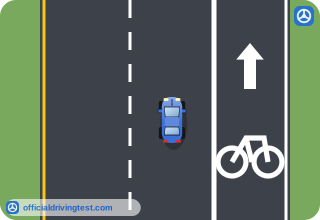
Bike Lane
Identified by a wide white line with a bicycle symbol or a bike lane sign. Bike lanes may be painted green.
Manual page 25 · Open this page in the manual (Manual page 25)
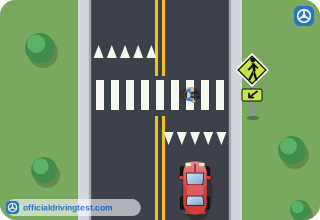
Yield Line
A row of triangles in your lane, pointing toward your vehicle to indicate the point at which you are required to yield.
Manual page 25 · Open this page in the manual (Manual page 25)
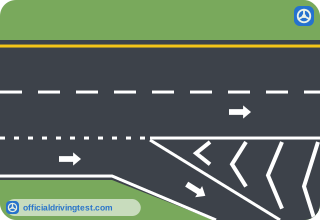
White Chevrons
May be used to inform you of fixed objects in the road ahead or other areas where vehicle use is not allowed.
Manual page 25 · Open this page in the manual (Manual page 25)
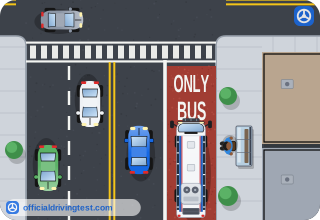
Solid Red Lane
Transit Only lane, not for cars. These may also say "BUS ONLY, BUS BIKE ONLY, or LRT".
Manual page 25 · Open this page in the manual (Manual page 25)
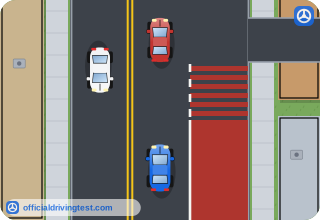
Striped Red Lines
Show where you may enter the Transit Only lane to turn, park or enter a driveway.
Manual page 25 · Open this page in the manual (Manual page 25)
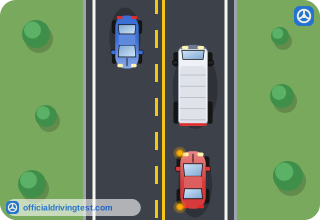
Solid Yellow Line and No Passing Zone
You are in a no-passing zone. Do not attempt to pass a vehicle if you cannot safely return to your lane before entering a no-passing zone.
Manual page 32 · Open this page in the manual (Manual page 32)
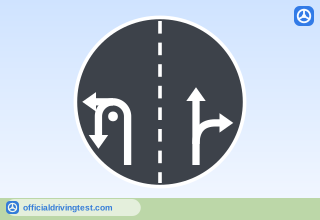
Roundabout Lane Markings
Enter the roundabout using the appropriate lane for your exit. Maintain your lane position until you exit. Avoid lane changes while inside the roundabout, if possible.
Manual page 44 · Open this page in the manual (Manual page 44)
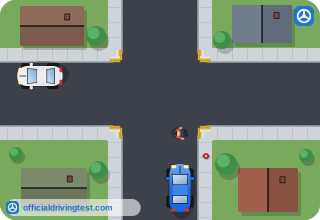
Unmarked Crosswalks
There is a crosswalk at every intersection, even if it is not marked by painted lines. To determine where an unmarked crosswalk is, imagine that a sidewalk or shoulder at the corner extends to the other side. An unmarked crosswalk is at least six feet wide and exists even if there is no sidewalk or shoulder.
Manual page 47 · Open this page in the manual (Manual page 47)
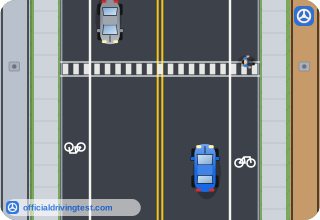
Mid-block Crosswalks
A mid-block crosswalk may have a flashing yellow light that indicates a pedestrian is crossing or about to cross the road.
Manual page 47 · Open this page in the manual (Manual page 47)
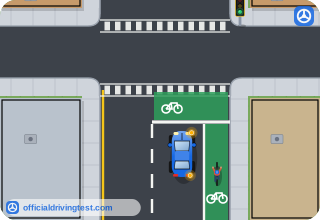
Bike Box
Most bike boxes are a green painted box on the road with a white bicycle symbol. Bike lanes approaching and leaving the box may also be green. As a driver, you must stop for a traffic signal behind the bike box. Do not stop in the box. People riding bicycles will move into the box in front of you at the intersection. No right turns are allowed at these intersections when the traffic signal is red. If turning right on a green light, you must signal and yield to people riding bicycles on the right.
Manual page 51 · Open this page in the manual (Manual page 51)
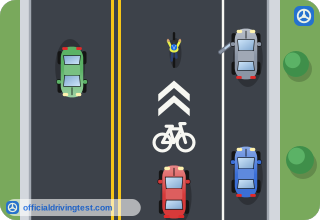
Sharrow
A sharrow indicates that the lane is shared and people riding bicycles may be in the road. It is indicated by two chevrons above a bicycle symbol painted on the road.
Manual page 51 · Open this page in the manual (Manual page 51)
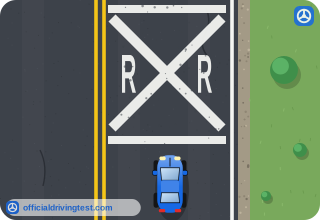
Railroad Crossing Pavement Marking
Railroad crossings have pavement markings that include a large “X” with the letters “RR.”
Manual page 63 · Open this page in the manual (Manual page 63)
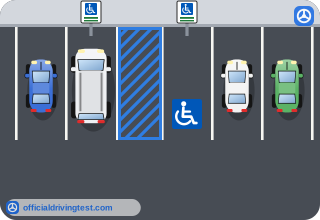
Accessible Parking Pavement Symbol
Spaces may have the disabled symbol on the ground as well as a sign with the symbol placed at the front of each space.
Manual page 69 · Open this page in the manual (Manual page 69)