Oregon: Parking rules
Parallel and hill parking, disabled parking, and the places and distances where you may not stop or park. Split into 2 shorter tests so you're not stuck in one long quiz.
Independent educational site · not affiliated with any government agency or DMV
All 43 Parking rules questions with answers
Choose a part above to take a practice test, or study every question and answer here.
Show the questions and answersHide the questions
-
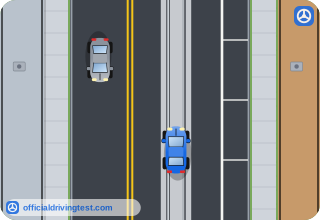
A solid white line separates the parking area from streetcar or train tracks. Where must you park?
- On the track side of the white line
- Straddling the white line
- Behind the solid white line
- On the tracks if no train is near
Show answer
Correct answer: Behind the solid white line
You never park on the tracks; you park behind the solid white line that separates the parking area from the track.
Source: Oregon Driver Manual (2026-2027), page 65 · Open this page in the manual (Manual page 65)
-
There is no white line between the parking area and streetcar tracks. How should you park?
- Wherever there is a gap, as long as no train is near
- As close to the curb as possible, away from the rails
- Beside the rails so your doors do not hit the curb
- Parallel to the rails, with one wheel over the track
Show answer
Correct answer: As close to the curb as possible, away from the rails
If there is no white line, you park as close to the curb as possible away from the rails.
Source: Oregon Driver Manual (2026-2027), page 65 · Open this page in the manual (Manual page 65)
-
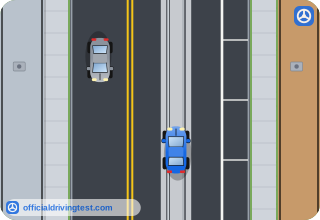
What should you always check for before opening your vehicle door near streetcar or train tracks?
- The time left on the parking meter
- Whether the track signal is red
- Whether a stop line is painted on the road
- Approaching streetcars or trains
Show answer
Correct answer: Approaching streetcars or trains
The manual says to always check for approaching streetcars or trains before opening vehicle doors.
Source: Oregon Driver Manual (2026-2027), page 65 · Open this page in the manual (Manual page 65)
-
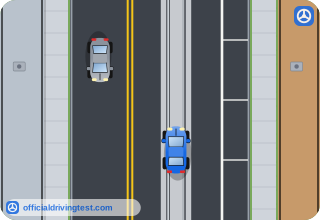
After you park near streetcar or train tracks, what must you make sure of?
- That your car is clear of the tracks so a streetcar or train can pass
- That your front wheels are turned toward the tracks as a safety measure
- That your hazard lights are flashing for as long as you are away
- That your car faces the same direction that the streetcars travel
Show answer
Correct answer: That your car is clear of the tracks so a streetcar or train can pass
Your parked car must be clear of the tracks so a streetcar or train can pass.
Source: Oregon Driver Manual (2026-2027), page 65 · Open this page in the manual (Manual page 65)
-
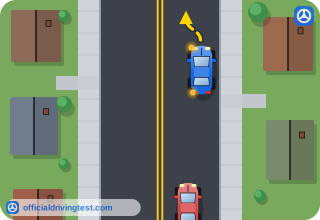
What should you do when you leave a parked or stopped position?
- Check your blind spots and mirrors, and yield to all other traffic
- Signal and pull out, since traffic already in the lane must yield to you
- Check only your rearview mirror, then pull out when the lane looks clear
- Honk your horn once, then merge ahead of the passing traffic
Show answer
Correct answer: Check your blind spots and mirrors, and yield to all other traffic
When leaving a parked or stopped position you check your blind spots and mirrors and yield to all other traffic.
Source: Oregon Driver Manual (2026-2027), page 68 · Open this page in the manual (Manual page 68)
-
When you parallel park, how far from the curb must you be at most?
- 6 inches
- 18 inches
- 12 inches
- 24 inches
Show answer
Correct answer: 12 inches
You must park parallel to the curb and no more than 12 inches from it.
Source: Oregon Driver Manual (2026-2027), page 68 · Open this page in the manual (Manual page 68)
-
If there is no curb where you parallel park, where should you park?
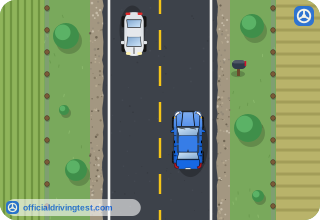
- In the middle of the shoulder, leaving room on both sides
- As close as possible to the edge of the shoulder
- Well off the shoulder, so passing traffic has plenty of room
- At least 12 inches away from the edge of the shoulder
Show answer
Correct answer: As close as possible to the edge of the shoulder
With no curb, you park as close as possible to the edge of the shoulder.
Source: Oregon Driver Manual (2026-2027), page 68 · Open this page in the manual (Manual page 68)
-
Where must your wheels be when you park in a marked parking area?
- On the line on the traffic side of the space
- Touching the line between two spaces
- On the curb side of the space only
- Within the marked space
Show answer
Correct answer: Within the marked space
If parking areas are marked, your wheels must be within the marked space.
Source: Oregon Driver Manual (2026-2027), page 68 · Open this page in the manual (Manual page 68)
-
When you parallel park along a road, in which direction should you park?
- In the direction vehicles are moving in the lane
- Facing oncoming traffic so you can see it approach
- In whichever direction leaves the most room behind you
- Facing the curb at a slight angle
Show answer
Correct answer: In the direction vehicles are moving in the lane
Parallel parking is done in the direction vehicles are moving in the lane.
Source: Oregon Driver Manual (2026-2027), page 68 · Open this page in the manual (Manual page 68)
-
In the parallel parking steps, you pull even with Car A. What is the next step?
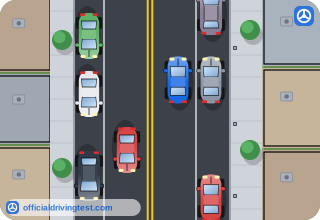
- Pull forward past the space and turn your wheels sharply
- Back quickly into the space with your wheels straight
- Back slowly toward the space and turn your wheels sharply
- Turn your wheels sharply and drive forward into the space
Show answer
Correct answer: Back slowly toward the space and turn your wheels sharply
After pulling even with Car A, you back slowly toward the space and turn your wheels sharply.
Source: Oregon Driver Manual (2026-2027), page 68 · Open this page in the manual (Manual page 68)
-
In the parallel parking steps, what is the last step after you back toward the space with your wheels turned sharply?
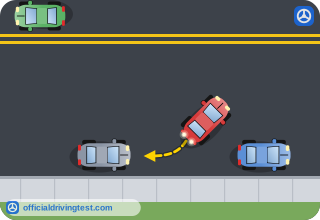
- Shift into neutral and release the brake
- Straighten your wheels
- Turn your wheels sharply the other way
- Back up until you touch the car behind you
Show answer
Correct answer: Straighten your wheels
The third parallel parking step is to straighten your wheels.
Source: Oregon Driver Manual (2026-2027), page 68 · Open this page in the manual (Manual page 68)
-
Where is angle parking common?
- On narrow residential streets and in driveways
- On freeway shoulders and at rest areas
- Beside curbs on one-way streets and in alleys
- In parking lots, shopping centers, and on wide streets
Show answer
Correct answer: In parking lots, shopping centers, and on wide streets
The manual says angle parking is common in parking lots, shopping centers, and on wide streets.
Source: Oregon Driver Manual (2026-2027), page 68 · Open this page in the manual (Manual page 68)
-
What should you do when driving a large vehicle and using angle parking?
- Avoid parking in spaces that obstruct traffic on the road
- Park in the first space you find at the front of the lot
- Back in so the rear of your vehicle sticks into the road
- Use two adjacent spaces to give yourself extra room
Show answer
Correct answer: Avoid parking in spaces that obstruct traffic on the road
Drivers of large vehicles should avoid spaces where the vehicle would obstruct traffic on the road.
Source: Oregon Driver Manual (2026-2027), page 68 · Open this page in the manual (Manual page 68)
-
What may signs posted at an angle parking area indicate?
- That the area is reserved for large vehicles only
- That the area is for loading and unloading only
- That the area is reverse angle or back-in only
- That the area allows forward-in parking only
Show answer
Correct answer: That the area is reverse angle or back-in only
Signs may show that a parking area is reverse angle or back-in only.
Source: Oregon Driver Manual (2026-2027), page 68 · Open this page in the manual (Manual page 68)
-
What should you always do when you park on a hill?
- Leave your engine running
- Set your parking brake
- Leave your lights on
- Keep your front wheels straight
Show answer
Correct answer: Set your parking brake
The manual says to always set your parking brake when parking on a hill.
Source: Oregon Driver Manual (2026-2027), page 69 · Open this page in the manual (Manual page 69)
-
When you park on a hill, how should you leave a vehicle with an automatic transmission?
- In neutral
- In reverse
- In drive
- In park
Show answer
Correct answer: In park
An automatic transmission vehicle is left in park.
Source: Oregon Driver Manual (2026-2027), page 69 · Open this page in the manual (Manual page 69)
-
When you park on a hill, how should you leave a vehicle with a manual transmission?
- In gear
- In neutral
- With the clutch held down
- With the engine running
Show answer
Correct answer: In gear
A manual transmission vehicle is left in gear.
Source: Oregon Driver Manual (2026-2027), page 69 · Open this page in the manual (Manual page 69)
-
Why do you turn your front wheels when you park on a hill?
- To keep the tires from wearing unevenly while the vehicle is parked
- To make it easier to pull out of the parking space later on
- To prevent your vehicle from rolling downhill if the brake fails
- To keep the steering wheel from locking while the engine is off
Show answer
Correct answer: To prevent your vehicle from rolling downhill if the brake fails
Turned wheels keep the vehicle from rolling downhill in case the brake fails.
Source: Oregon Driver Manual (2026-2027), page 69 · Open this page in the manual (Manual page 69)
-
Your vehicle is parked facing downhill against a curb. Which way should you turn your front wheels?
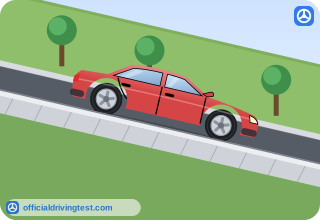
- Toward the travel lane
- Toward the curb
- Straight ahead
- Either way, as long as the brake is set
Show answer
Correct answer: Toward the curb
Downhill against a curb, you turn your wheels toward the curb.
Source: Oregon Driver Manual (2026-2027), page 69 · Open this page in the manual (Manual page 69)
-
Your vehicle is parked facing uphill against a curb. Which way should you turn your front wheels?
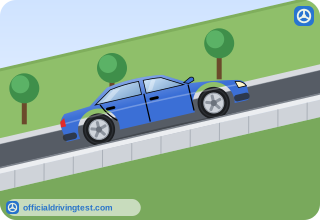
- Toward the curb
- Straight ahead
- Either way, as long as the brake is set
- Toward the travel lane
Show answer
Correct answer: Toward the travel lane
Uphill against a curb, you turn your wheels toward the travel lane.
Source: Oregon Driver Manual (2026-2027), page 69 · Open this page in the manual (Manual page 69)
-
Your vehicle is parked on a hill where there is no curb. Which way should you turn your front wheels?
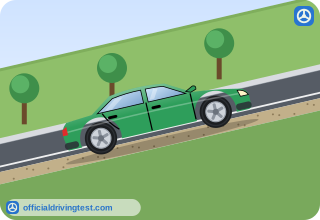
- Toward the edge of the road
- Toward the travel lane
- Straight ahead
- Toward the center of the road
Show answer
Correct answer: Toward the edge of the road
With no curb, you turn your wheels toward the edge of the road.
Source: Oregon Driver Manual (2026-2027), page 69 · Open this page in the manual (Manual page 69)
-
To whom does Oregon issue special parking permits?
- Only drivers who are 65 years of age or older and retired
- Only vehicles that are owned by a state or local agency
- Persons with disabilities and groups that transport them
- Only persons who have lost the use of both of their legs
Show answer
Correct answer: Persons with disabilities and groups that transport them
Oregon issues special parking permits to persons with disabilities or to groups that transport them.
Source: Oregon Driver Manual (2026-2027), page 69 · Open this page in the manual (Manual page 69)
-
How may a parking space for persons with disabilities be marked?
- With a green curb and a number painted on the pavement
- With the disabled symbol on the ground and a sign with the symbol
- With red diagonal stripes and a sign at the rear of the space
- With a blue line and a sign on the nearest traffic signal
Show answer
Correct answer: With the disabled symbol on the ground and a sign with the symbol
Spaces may have the disabled symbol on the ground as well as a sign with the symbol at the front of each space.
Source: Oregon Driver Manual (2026-2027), page 69 · Open this page in the manual (Manual page 69)
-
When is it legal to park in a space marked for persons with disabilities?
- When you stay with your vehicle and leave the engine running
- When you park there for just a few minutes
- When no other parking spaces are available
- Only when you have a valid disabled parking permit
Show answer
Correct answer: Only when you have a valid disabled parking permit
Parking in such a space is illegal unless you have a valid disabled parking permit.
Source: Oregon Driver Manual (2026-2027), page 69 · Open this page in the manual (Manual page 69)
-
What is the range of the fine for parking in a Disabled Person parking space without a permit?
- From $165 up to $1,000
- From $50 up to $250
- From $100 up to $500
- From $250 up to $2,000
Show answer
Correct answer: From $165 up to $1,000
Fines begin at $165 and go up to $1,000 for a driver without a permit, even when parking for just a few minutes.
Source: Oregon Driver Manual (2026-2027), page 70 · Open this page in the manual (Manual page 70)
-
To whom do the rules about parking and stopping apply?
- Only to you while you are in your vehicle
- Only to you when you leave the vehicle unattended
- To you whether you are in your vehicle or not
- Only to you in cities with posted signs
Show answer
Correct answer: To you whether you are in your vehicle or not
The rules apply whether you are in your vehicle or not.
Source: Oregon Driver Manual (2026-2027), page 70 · Open this page in the manual (Manual page 70)
-
When do the rules against stopping or parking in certain places not apply?
- When your hazard lights are on and you stay with the vehicle until help arrives
- When your vehicle breaks down and you cannot get it out of the traffic lanes
- When you are loading or unloading passengers or cargo for a short time
- When you are waiting for another driver to come back to the vehicle
Show answer
Correct answer: When your vehicle breaks down and you cannot get it out of the traffic lanes
The rules do not apply if your vehicle breaks down and you cannot get it out of the traffic lanes, or there is no room on the shoulder.
Source: Oregon Driver Manual (2026-2027), page 70 · Open this page in the manual (Manual page 70)
-
What is double parking?
- Parking in two adjacent parking spaces at once
- Parking in a lot aisle next to another vehicle
- Parking behind a vehicle that is already in a driveway
- Stopping or parking on the road side of any parked vehicle
Show answer
Correct answer: Stopping or parking on the road side of any parked vehicle
The manual names stopping or parking on the road side of any parked vehicle as double parking, which is not allowed.
Source: Oregon Driver Manual (2026-2027), page 70 · Open this page in the manual (Manual page 70)
-
Which of these is a place where you cannot stop or park?
- On a bridge, overpass, or in a tunnel
- Beside the curb in a marked parallel parking space
- On a highway shoulder after a breakdown, if traffic can pass
- Within 12 inches of the curb, in the direction traffic moves
Show answer
Correct answer: On a bridge, overpass, or in a tunnel
Stopping or parking on a bridge, overpass, or in a tunnel is not allowed.
Source: Oregon Driver Manual (2026-2027), page 70 · Open this page in the manual (Manual page 70)
-
Which of these is a place where you cannot stop or park?
- In a marked angle parking space in a shopping center lot
- Parallel to the curb, in the direction vehicles are moving
- On a sidewalk, crosswalk, bicycle lane or path
- In a marked space with your wheels within the lines
Show answer
Correct answer: On a sidewalk, crosswalk, bicycle lane or path
You cannot stop or park on a sidewalk, crosswalk, bicycle lane or path.
Source: Oregon Driver Manual (2026-2027), page 70 · Open this page in the manual (Manual page 70)
-
Which of these is a place where you cannot stop or park?
- In a marked space with your wheels inside the lines
- Between the separate roads of a divided highway
- On a wide street in an angle parking space
- On the shoulder after a breakdown, if passing traffic can get by
Show answer
Correct answer: Between the separate roads of a divided highway
Stopping or parking between the separate roads of a divided highway is not allowed.
Source: Oregon Driver Manual (2026-2027), page 70 · Open this page in the manual (Manual page 70)
-
Which of these is a place where you cannot stop or park?
- In a marked space in a parking lot
- Parallel to the curb, no more than 12 inches from it
- On a wide street in a back-in angle space
- In front of a public or private driveway
Show answer
Correct answer: In front of a public or private driveway
You cannot stop or park in front of a public or private driveway.
Source: Oregon Driver Manual (2026-2027), page 70 · Open this page in the manual (Manual page 70)
-
Which of these is a place where you cannot stop or park?
- Within an intersection
- In a marked parallel parking space on a wide street
- In an angle parking space at a shopping center
- Parallel to the curb, no more than 12 inches from it
Show answer
Correct answer: Within an intersection
Stopping or parking within an intersection is not allowed.
Source: Oregon Driver Manual (2026-2027), page 70 · Open this page in the manual (Manual page 70)
-
Which of these is a place where you cannot stop or park?
- In a marked space with your wheels within the lines
- Parallel to the curb, in the direction traffic is moving
- On any railroad or light rail tracks
- On a shoulder after a breakdown, if traffic can get by
Show answer
Correct answer: On any railroad or light rail tracks
You cannot stop or park on any railroad or light rail tracks.
Source: Oregon Driver Manual (2026-2027), page 70 · Open this page in the manual (Manual page 70)
-
Which of these is a place where you cannot stop or park?
- In a marked space with your wheels within the lines
- Where painted diagonal stripes prohibit parking
- Beside a curb in the direction traffic is moving
- In an angle space in a lot when driving a small car
Show answer
Correct answer: Where painted diagonal stripes prohibit parking
Parking is not allowed where signs, traffic control devices, painted diagonal stripes, or other pavement markings prohibit it.
Source: Oregon Driver Manual (2026-2027), page 70 · Open this page in the manual (Manual page 70)
-
When is it illegal to stop or park near construction or road work?
- Only when workers are present in the work area
- Only when a flagger is directing traffic through the area
- Only when cones have been placed in the lane next to you
- When stopping or parking would interfere with traffic
Show answer
Correct answer: When stopping or parking would interfere with traffic
You cannot stop or park near construction or road work when doing so would interfere with traffic.
Source: Oregon Driver Manual (2026-2027), page 70 · Open this page in the manual (Manual page 70)
-
Within how many feet of a fire hydrant is parking prohibited?
- 10 feet
- 5 feet
- 25 feet
- 30 feet
Show answer
Correct answer: 10 feet
You cannot stop or park within 10 feet of a fire hydrant.
Source: Oregon Driver Manual (2026-2027), page 70 · Open this page in the manual (Manual page 70)
-
Within how many feet of the driveway entrance to a fire station, on the same side of the street, is parking prohibited?
- 5 feet
- 25 feet
- 15 feet
- 30 feet
Show answer
Correct answer: 15 feet
You cannot park within 15 feet of a fire station driveway entrance on the same side of the street.
Source: Oregon Driver Manual (2026-2027), page 71 · Open this page in the manual (Manual page 71)
-
Within how many feet of the driveway entrance to a fire station, on the opposite side of the street, is parking prohibited?
- 25 feet
- 75 feet
- 100 feet
- 150 feet
Show answer
Correct answer: 75 feet
You cannot park within 75 feet of a fire station driveway entrance on the opposite side of the street.
Source: Oregon Driver Manual (2026-2027), page 71 · Open this page in the manual (Manual page 71)
-
Within how many feet of a marked or unmarked crosswalk at an intersection is parking prohibited?
- 5 feet
- 30 feet
- 40 feet
- 20 feet
Show answer
Correct answer: 20 feet
You cannot park within 20 feet of a marked or unmarked crosswalk at an intersection.
Source: Oregon Driver Manual (2026-2027), page 71 · Open this page in the manual (Manual page 71)
-
Within how many feet of a traffic signal or sign is parking prohibited if your vehicle hides it from view?
- 50 feet
- 10 feet
- 25 feet
- 100 feet
Show answer
Correct answer: 50 feet
You cannot park within 50 feet of a signal or sign if your vehicle hides it from view.
Source: Oregon Driver Manual (2026-2027), page 71 · Open this page in the manual (Manual page 71)
-
Within how many feet of the nearest rail of a railroad or light rail crossing is parking prohibited?
- 25 feet
- 75 feet
- 50 feet
- 100 feet
Show answer
Correct answer: 50 feet
You cannot park within 50 feet of the nearest rail of a railroad or light rail crossing.
Source: Oregon Driver Manual (2026-2027), page 71 · Open this page in the manual (Manual page 71)
-
Within how many feet of railroad or light rail tracks is parking prohibited when it interferes with the train?
- 3 1/2 feet
- 7 1/2 feet
- 5 feet
- 12 feet
Show answer
Correct answer: 7 1/2 feet
You cannot park within 7 1/2 feet of railroad or light rail tracks when it interferes with the train.
Source: Oregon Driver Manual (2026-2027), page 71 · Open this page in the manual (Manual page 71)