Oregon: Parking rules — Part 1 Practice Test
Questions in this part include: “There is no white line between the parking area and streetcar tracks. How should you park?” · “What may signs posted at an angle parking area indicate?”
Independent educational site · not affiliated with any government agency or DMV
Ready? Test yourself
- Instant feedback with an explanation
- Every answer cites its source in the manual
- Your best score is saved on this device
Questions are original and based on the official manual "Oregon Driver Manual" (2026-2027), Oregon Driver and Motor Vehicle Services (DMV).
All 22 questions in this practice test
Take the test above first, then use this list to study. Tap “Show answer” to see the correct answer and explanation.
Show the questions and answersHide the questions
-
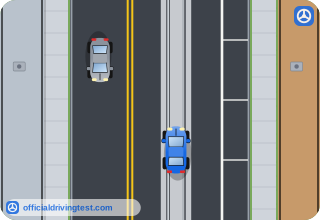
A solid white line separates the parking area from streetcar or train tracks. Where must you park?
- On the track side of the white line
- Straddling the white line
- Behind the solid white line
- On the tracks if no train is near
Show answer
Correct answer: Behind the solid white line
You never park on the tracks; you park behind the solid white line that separates the parking area from the track.
Source: Oregon Driver Manual (2026-2027), page 65 · Open this page in the manual (Manual page 65)
-
There is no white line between the parking area and streetcar tracks. How should you park?
- Wherever there is a gap, as long as no train is near
- As close to the curb as possible, away from the rails
- Beside the rails so your doors do not hit the curb
- Parallel to the rails, with one wheel over the track
Show answer
Correct answer: As close to the curb as possible, away from the rails
If there is no white line, you park as close to the curb as possible away from the rails.
Source: Oregon Driver Manual (2026-2027), page 65 · Open this page in the manual (Manual page 65)
-
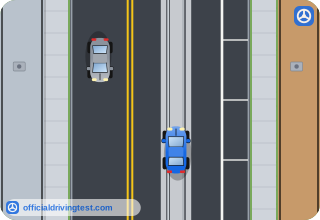
What should you always check for before opening your vehicle door near streetcar or train tracks?
- The time left on the parking meter
- Whether the track signal is red
- Whether a stop line is painted on the road
- Approaching streetcars or trains
Show answer
Correct answer: Approaching streetcars or trains
The manual says to always check for approaching streetcars or trains before opening vehicle doors.
Source: Oregon Driver Manual (2026-2027), page 65 · Open this page in the manual (Manual page 65)
-
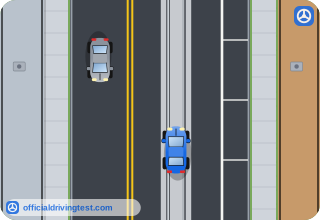
After you park near streetcar or train tracks, what must you make sure of?
- That your car is clear of the tracks so a streetcar or train can pass
- That your front wheels are turned toward the tracks as a safety measure
- That your hazard lights are flashing for as long as you are away
- That your car faces the same direction that the streetcars travel
Show answer
Correct answer: That your car is clear of the tracks so a streetcar or train can pass
Your parked car must be clear of the tracks so a streetcar or train can pass.
Source: Oregon Driver Manual (2026-2027), page 65 · Open this page in the manual (Manual page 65)
-
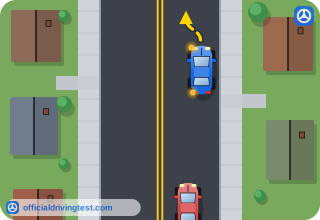
What should you do when you leave a parked or stopped position?
- Check your blind spots and mirrors, and yield to all other traffic
- Signal and pull out, since traffic already in the lane must yield to you
- Check only your rearview mirror, then pull out when the lane looks clear
- Honk your horn once, then merge ahead of the passing traffic
Show answer
Correct answer: Check your blind spots and mirrors, and yield to all other traffic
When leaving a parked or stopped position you check your blind spots and mirrors and yield to all other traffic.
Source: Oregon Driver Manual (2026-2027), page 68 · Open this page in the manual (Manual page 68)
-
When you parallel park, how far from the curb must you be at most?
- 6 inches
- 18 inches
- 12 inches
- 24 inches
Show answer
Correct answer: 12 inches
You must park parallel to the curb and no more than 12 inches from it.
Source: Oregon Driver Manual (2026-2027), page 68 · Open this page in the manual (Manual page 68)
-
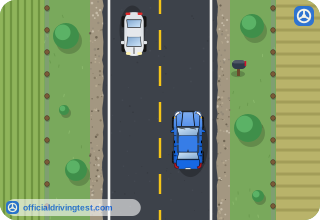
If there is no curb where you parallel park, where should you park?
- In the middle of the shoulder, leaving room on both sides
- As close as possible to the edge of the shoulder
- Well off the shoulder, so passing traffic has plenty of room
- At least 12 inches away from the edge of the shoulder
Show answer
Correct answer: As close as possible to the edge of the shoulder
With no curb, you park as close as possible to the edge of the shoulder.
Source: Oregon Driver Manual (2026-2027), page 68 · Open this page in the manual (Manual page 68)
-
Where must your wheels be when you park in a marked parking area?
- On the line on the traffic side of the space
- Touching the line between two spaces
- On the curb side of the space only
- Within the marked space
Show answer
Correct answer: Within the marked space
If parking areas are marked, your wheels must be within the marked space.
Source: Oregon Driver Manual (2026-2027), page 68 · Open this page in the manual (Manual page 68)
-
When you parallel park along a road, in which direction should you park?
- In the direction vehicles are moving in the lane
- Facing oncoming traffic so you can see it approach
- In whichever direction leaves the most room behind you
- Facing the curb at a slight angle
Show answer
Correct answer: In the direction vehicles are moving in the lane
Parallel parking is done in the direction vehicles are moving in the lane.
Source: Oregon Driver Manual (2026-2027), page 68 · Open this page in the manual (Manual page 68)
-
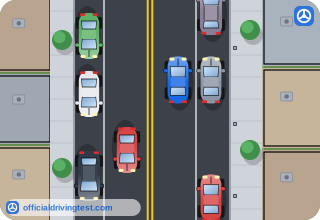
In the parallel parking steps, you pull even with Car A. What is the next step?
- Pull forward past the space and turn your wheels sharply
- Back quickly into the space with your wheels straight
- Back slowly toward the space and turn your wheels sharply
- Turn your wheels sharply and drive forward into the space
Show answer
Correct answer: Back slowly toward the space and turn your wheels sharply
After pulling even with Car A, you back slowly toward the space and turn your wheels sharply.
Source: Oregon Driver Manual (2026-2027), page 68 · Open this page in the manual (Manual page 68)
-
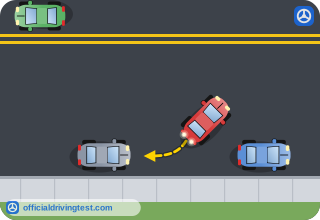
In the parallel parking steps, what is the last step after you back toward the space with your wheels turned sharply?
- Shift into neutral and release the brake
- Straighten your wheels
- Turn your wheels sharply the other way
- Back up until you touch the car behind you
Show answer
Correct answer: Straighten your wheels
The third parallel parking step is to straighten your wheels.
Source: Oregon Driver Manual (2026-2027), page 68 · Open this page in the manual (Manual page 68)
-
Where is angle parking common?
- On narrow residential streets and in driveways
- On freeway shoulders and at rest areas
- Beside curbs on one-way streets and in alleys
- In parking lots, shopping centers, and on wide streets
Show answer
Correct answer: In parking lots, shopping centers, and on wide streets
The manual says angle parking is common in parking lots, shopping centers, and on wide streets.
Source: Oregon Driver Manual (2026-2027), page 68 · Open this page in the manual (Manual page 68)
-
What should you do when driving a large vehicle and using angle parking?
- Avoid parking in spaces that obstruct traffic on the road
- Park in the first space you find at the front of the lot
- Back in so the rear of your vehicle sticks into the road
- Use two adjacent spaces to give yourself extra room
Show answer
Correct answer: Avoid parking in spaces that obstruct traffic on the road
Drivers of large vehicles should avoid spaces where the vehicle would obstruct traffic on the road.
Source: Oregon Driver Manual (2026-2027), page 68 · Open this page in the manual (Manual page 68)
-
What may signs posted at an angle parking area indicate?
- That the area is reserved for large vehicles only
- That the area is for loading and unloading only
- That the area is reverse angle or back-in only
- That the area allows forward-in parking only
Show answer
Correct answer: That the area is reverse angle or back-in only
Signs may show that a parking area is reverse angle or back-in only.
Source: Oregon Driver Manual (2026-2027), page 68 · Open this page in the manual (Manual page 68)
-
What should you always do when you park on a hill?
- Leave your engine running
- Set your parking brake
- Leave your lights on
- Keep your front wheels straight
Show answer
Correct answer: Set your parking brake
The manual says to always set your parking brake when parking on a hill.
Source: Oregon Driver Manual (2026-2027), page 69 · Open this page in the manual (Manual page 69)
-
When you park on a hill, how should you leave a vehicle with an automatic transmission?
- In neutral
- In reverse
- In drive
- In park
Show answer
Correct answer: In park
An automatic transmission vehicle is left in park.
Source: Oregon Driver Manual (2026-2027), page 69 · Open this page in the manual (Manual page 69)
-
When you park on a hill, how should you leave a vehicle with a manual transmission?
- In gear
- In neutral
- With the clutch held down
- With the engine running
Show answer
Correct answer: In gear
A manual transmission vehicle is left in gear.
Source: Oregon Driver Manual (2026-2027), page 69 · Open this page in the manual (Manual page 69)
-
Why do you turn your front wheels when you park on a hill?
- To keep the tires from wearing unevenly while the vehicle is parked
- To make it easier to pull out of the parking space later on
- To prevent your vehicle from rolling downhill if the brake fails
- To keep the steering wheel from locking while the engine is off
Show answer
Correct answer: To prevent your vehicle from rolling downhill if the brake fails
Turned wheels keep the vehicle from rolling downhill in case the brake fails.
Source: Oregon Driver Manual (2026-2027), page 69 · Open this page in the manual (Manual page 69)
-
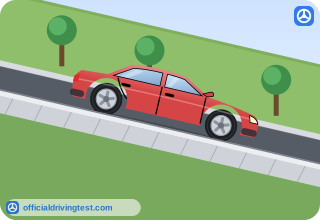
Your vehicle is parked facing downhill against a curb. Which way should you turn your front wheels?
- Toward the travel lane
- Toward the curb
- Straight ahead
- Either way, as long as the brake is set
Show answer
Correct answer: Toward the curb
Downhill against a curb, you turn your wheels toward the curb.
Source: Oregon Driver Manual (2026-2027), page 69 · Open this page in the manual (Manual page 69)
-
Your vehicle is parked facing uphill against a curb. Which way should you turn your front wheels?
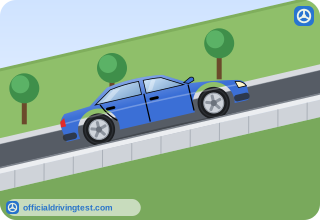
- Toward the curb
- Straight ahead
- Either way, as long as the brake is set
- Toward the travel lane
Show answer
Correct answer: Toward the travel lane
Uphill against a curb, you turn your wheels toward the travel lane.
Source: Oregon Driver Manual (2026-2027), page 69 · Open this page in the manual (Manual page 69)
-
Your vehicle is parked on a hill where there is no curb. Which way should you turn your front wheels?
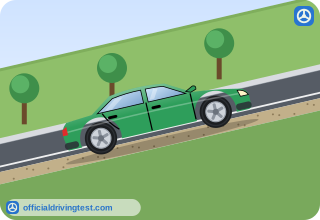
- Toward the edge of the road
- Toward the travel lane
- Straight ahead
- Toward the center of the road
Show answer
Correct answer: Toward the edge of the road
With no curb, you turn your wheels toward the edge of the road.
Source: Oregon Driver Manual (2026-2027), page 69 · Open this page in the manual (Manual page 69)
-
To whom does Oregon issue special parking permits?
- Only drivers who are 65 years of age or older and retired
- Only vehicles that are owned by a state or local agency
- Persons with disabilities and groups that transport them
- Only persons who have lost the use of both of their legs
Show answer
Correct answer: Persons with disabilities and groups that transport them
Oregon issues special parking permits to persons with disabilities or to groups that transport them.
Source: Oregon Driver Manual (2026-2027), page 69 · Open this page in the manual (Manual page 69)