Oregon: Emergency vehicles, work zones and police stops
Yielding to emergency vehicles, moving over for stopped vehicles, work zones and flaggers, and what to do when police stop you. Split into 2 shorter tests so you're not stuck in one long quiz.
Independent educational site · not affiliated with any government agency or DMV
Choose a part
Emergency vehicles, work zones and police stops — Part 1
Questions in this part include: “How do police vehicles attempting to stop a driver signal the driver?”
StartEmergency vehicles, work zones and police stops — Part 2
Questions in this part include: “Where are traffic violations and traffic crimes charged against you decided?”
StartAll 39 Emergency vehicles, work zones and police stops questions with answers
Choose a part above to take a practice test, or study every question and answer here.
Show the questions and answersHide the questions
-
Emergency vehicles are approaching a roundabout. What should you do if you have not entered yet?
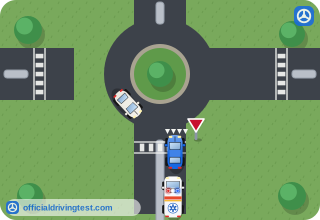
- Enter quickly before the emergency vehicles arrive
- Stop at the entrance, in the lane
- Stop in the center of the roundabout
- Do not enter the roundabout and pull over to the right
Show answer
Correct answer: Do not enter the roundabout and pull over to the right
Do not enter a roundabout when emergency vehicles are approaching. Pull over to the right.
Source: Oregon Driver Manual (2026-2027), page 44 · Open this page in the manual (Manual page 44)
-
You are already inside a roundabout when an emergency vehicle approaches. What should you do?
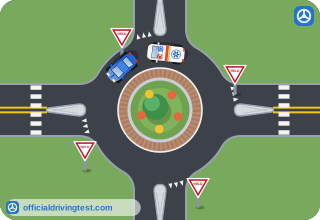
- Stop right where you are inside the roundabout
- Exit the roundabout, then pull over to the right
- Pull over to the left inside the roundabout
- Speed up and stay ahead of the emergency vehicle
Show answer
Correct answer: Exit the roundabout, then pull over to the right
Never stop while inside the roundabout; move through and exit, then pull over to the right shoulder.
Source: Oregon Driver Manual (2026-2027), page 44 · Open this page in the manual (Manual page 44)
-
You are on a road with two or more lanes going your direction and you approach a motor vehicle stopped with its lights flashing. What must you do?
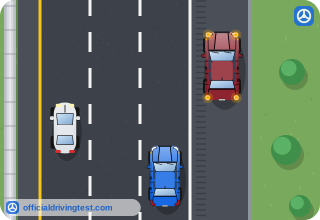
- Stay in your lane and sound your horn at the vehicle
- Stop behind the vehicle until it starts moving again
- Drive next to the vehicle at your normal speed
- Change lanes so you do not drive next to the stopped vehicle
Show answer
Correct answer: Change lanes so you do not drive next to the stopped vehicle
The manual says you must change lanes so you do not drive next to the stopped vehicle.
Source: Oregon Driver Manual (2026-2027), page 57 · Open this page in the manual (Manual page 57)
-
Besides changing lanes, by how much may you also slow down below the posted speed limit when approaching a vehicle stopped with its lights flashing?
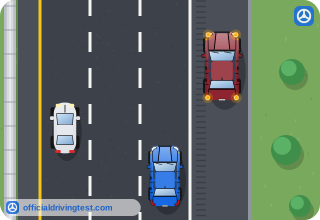
- At least 10 miles per hour under it
- At least 5 miles per hour under it
- At least 15 miles per hour under it
- At least 20 miles per hour under it
Show answer
Correct answer: At least 5 miles per hour under it
The manual says you may also slow down by at least 5 miles per hour under the posted speed limit.
Source: Oregon Driver Manual (2026-2027), page 57 · Open this page in the manual (Manual page 57)
-
How much room should you allow a stopped vehicle with its lights flashing?
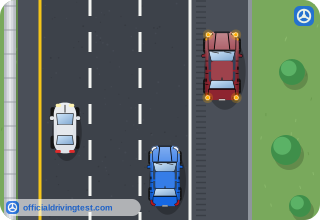
- As much room as safely possible
- Exactly 10 feet, no more
- About 100 feet
- Only enough to pass without touching it
Show answer
Correct answer: As much room as safely possible
The manual says to allow the stopped vehicle as much room as safely possible.
Source: Oregon Driver Manual (2026-2027), page 57 · Open this page in the manual (Manual page 57)
-
What should you do when you approach an emergency scene?
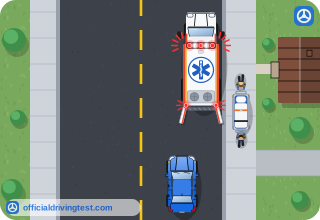
- Keep your speed and watch for officers
- Speed up to clear the area quickly
- Slow down and be prepared to stop
- Stop at once and wait for an officer
Show answer
Correct answer: Slow down and be prepared to stop
The manual says to slow down and be prepared to stop at emergency scenes.
Source: Oregon Driver Manual (2026-2027), page 57 · Open this page in the manual (Manual page 57)
-
When may you drive over fire hoses at an emergency scene?
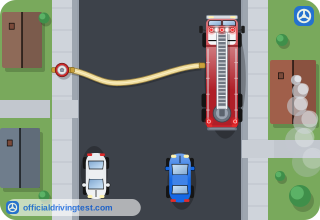
- When no firefighters are close by
- Only when officials at the scene tell you to
- When the hoses are lying flat on the road
- When you drive at a slow speed
Show answer
Correct answer: Only when officials at the scene tell you to
The manual says not to drive over fire hoses unless told to do so by officials at the scene.
Source: Oregon Driver Manual (2026-2027), page 57 · Open this page in the manual (Manual page 57)
-
From which direction must you yield right of way to an emergency vehicle that is using a light or siren?
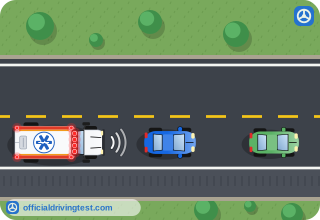
- Only from behind you
- Only from the front
- Only from the side
- Any direction
Show answer
Correct answer: Any direction
You must yield right of way to emergency vehicles approaching from any direction using a light or siren.
Source: Oregon Driver Manual (2026-2027), page 58 · Open this page in the manual (Manual page 58)
-
What must you do when you see or hear an emergency vehicle warning?
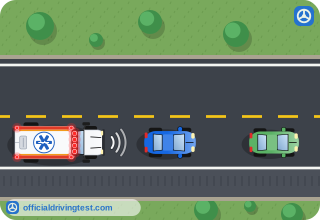
- Slow down and keep driving in your lane until it passes
- Pull to the left side of the road and stop right away
- Immediately move as close as you safely can to the right and stop
- Stop where you are, even if you are in the middle of the road
Show answer
Correct answer: Immediately move as close as you safely can to the right and stop
The manual says to drive as close as safely possible to the right side of the road and stop.
Source: Oregon Driver Manual (2026-2027), page 58 · Open this page in the manual (Manual page 58)
-
An emergency vehicle with a siren approaches while you are at an intersection. What must you not do?
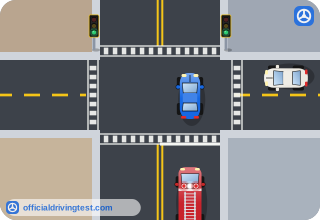
- Stop in the intersection
- Pull to the right side of the road
- Stay stopped until the vehicle has passed
- Wait for an officer to tell you to move
Show answer
Correct answer: Stop in the intersection
The manual says not to stop in an intersection when yielding to an emergency vehicle.
Source: Oregon Driver Manual (2026-2027), page 58 · Open this page in the manual (Manual page 58)
-
You have stopped for an emergency vehicle. How long must you stay stopped?
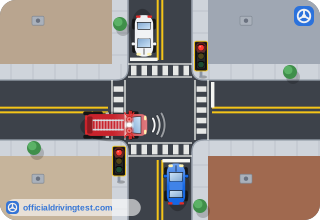
- Until the siren can no longer be heard clearly
- For at least 30 seconds after it passes
- Until the road ahead is clear of all traffic
- Until it passes or an officer tells you to move
Show answer
Correct answer: Until it passes or an officer tells you to move
The manual says to stay stopped until the vehicle has passed or an officer tells you to move.
Source: Oregon Driver Manual (2026-2027), page 58 · Open this page in the manual (Manual page 58)
-
After an emergency vehicle passes you, how far must you stay behind it?
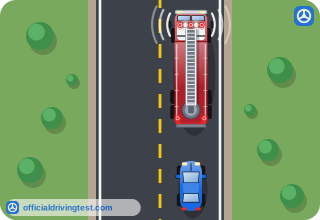
- At least 100 feet
- At least 500 feet
- At least 200 feet
- At least 300 feet
Show answer
Correct answer: At least 500 feet
The manual says you must stay at least 500 feet behind the vehicle after it passes.
Source: Oregon Driver Manual (2026-2027), page 58 · Open this page in the manual (Manual page 58)
-
How do police vehicles attempting to stop a driver signal the driver?
- By turning on flashing lights or a siren
- By honking the horn two times in a row
- By driving alongside you and waving
- By turning on only the headlights
Show answer
Correct answer: By turning on flashing lights or a siren
The manual says police stop drivers by turning on flashing lights or a siren.
Source: Oregon Driver Manual (2026-2027), page 58 · Open this page in the manual (Manual page 58)
-
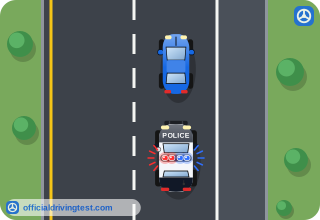
A police vehicle signals you to stop. What should you do?
- Stop in the center median and leave the engine running
- Stop immediately in your lane and get out of your car
- Pull as far right as you safely can, stop and turn off the engine
- Drive to the next intersection and wait for the officer there
Show answer
Correct answer: Pull as far right as you safely can, stop and turn off the engine
The manual says to drive as close as safely possible to the right side of the road, stop and turn off the engine.
Source: Oregon Driver Manual (2026-2027), page 58 · Open this page in the manual (Manual page 58)
-
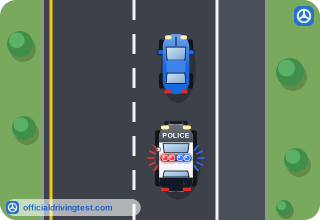
Where must you not stop when a police vehicle signals you to stop?
- On the right shoulder of the road
- In an intersection or the center median
- In a parking lot beside the road
- Behind another vehicle parked ahead
Show answer
Correct answer: In an intersection or the center median
The manual says not to stop in an intersection or pull into the center median of a highway.
Source: Oregon Driver Manual (2026-2027), page 58 · Open this page in the manual (Manual page 58)
-
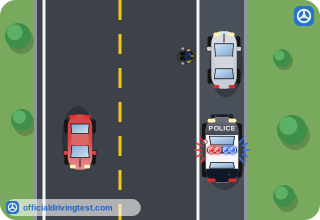
During a police stop, where should you keep your hands?
- Resting in your lap
- On top of the dashboard
- Out of the window
- On the steering wheel
Show answer
Correct answer: On the steering wheel
The manual says to keep your hands on the steering wheel and for passengers to keep theirs in plain view.
Source: Oregon Driver Manual (2026-2027), page 58 · Open this page in the manual (Manual page 58)
-
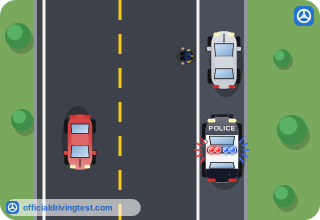
During a police stop, where should your passengers keep their hands?
- On the back of the front seats
- In their pockets
- In plain view
- On the door handles
Show answer
Correct answer: In plain view
Passengers should keep their hands in plain view.
Source: Oregon Driver Manual (2026-2027), page 58 · Open this page in the manual (Manual page 58)
-
During a police stop, when should you show your driving privilege and vehicle registration?
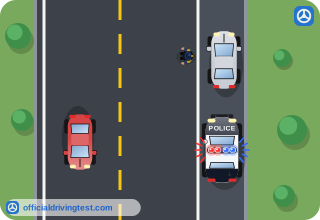
- Only when requested
- Before the officer reaches your vehicle
- As soon as you stop the engine
- Only after you step out of the vehicle
Show answer
Correct answer: Only when requested
The manual says to show them only when requested.
Source: Oregon Driver Manual (2026-2027), page 58 · Open this page in the manual (Manual page 58)
-
During a police stop, what should you do about your movements and those of your passengers?
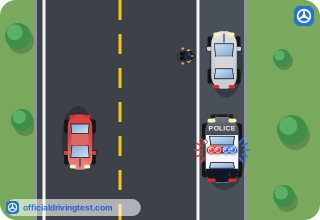
- Reach for your documents right away
- Lean out of the window
- Move around so the officer can see inside
- Limit them
Show answer
Correct answer: Limit them
The manual says to limit your movements and those of any passengers.
Source: Oregon Driver Manual (2026-2027), page 58 · Open this page in the manual (Manual page 58)
-
During a police stop, what should you do about getting out of your vehicle?
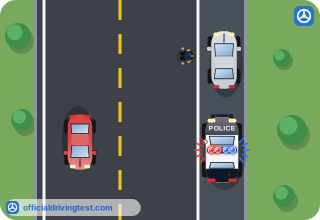
- Get out and walk back to the officer
- Stay in it unless requested to get out
- Get out and wait beside your vehicle
- Get out when you are on a freeway
Show answer
Correct answer: Stay in it unless requested to get out
The manual says to stay in your vehicle and not get out unless requested.
Source: Oregon Driver Manual (2026-2027), page 58 · Open this page in the manual (Manual page 58)
-
If it is dark when you are stopped by a police vehicle, what should you do?
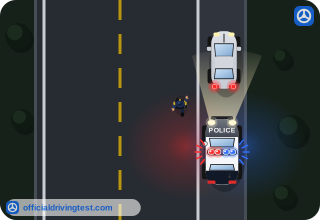
- Turn on the interior light after you stop
- Turn off all lights, including the headlights
- Turn on the high beams until the officer arrives
- Get out and stand in the headlights
Show answer
Correct answer: Turn on the interior light after you stop
The manual says to turn on the interior light after stopping and before the officer approaches when it is dark.
Source: Oregon Driver Manual (2026-2027), page 58 · Open this page in the manual (Manual page 58)
-
Where are traffic violations and traffic crimes charged against you decided?
- At the scene by the officer
- At the DMV
- In court
- By your insurance company
Show answer
Correct answer: In court
The manual says not to argue at the scene because those charges are decided in court.
Source: Oregon Driver Manual (2026-2027), page 58 · Open this page in the manual (Manual page 58)
-
How are work zones defined?
- By yellow warning signs
- By orange traffic control devices
- By white barrels and cones
- By reduced speed limit signs
Show answer
Correct answer: By orange traffic control devices
The manual says work zones are defined by orange traffic control devices.
Source: Oregon Driver Manual (2026-2027), page 59 · Open this page in the manual (Manual page 59)
-
What happens to traffic fines in work zones?
- They are doubled only when workers are present
- They are doubled only on freeways
- They are the same as elsewhere
- They are doubled in all work zones
Show answer
Correct answer: They are doubled in all work zones
The manual says traffic fines are doubled in all work zones.
Source: Oregon Driver Manual (2026-2027), page 59 · Open this page in the manual (Manual page 59)
-
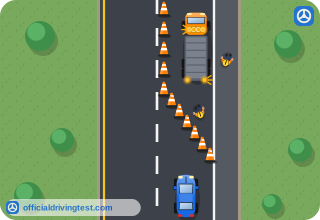
What are you expected to do about workers in a work zone?
- Honk to warn them
- Pass them as quickly as possible
- Yield to them
- Stop only if they signal you
Show answer
Correct answer: Yield to them
The manual says you are expected to yield to workers.
Source: Oregon Driver Manual (2026-2027), page 59 · Open this page in the manual (Manual page 59)
-
What do orange cones in a work zone do?
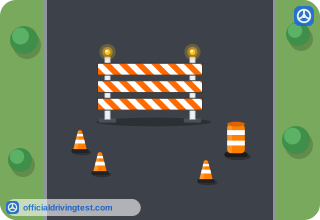
- Guide you away from the road construction
- Warn you that the road ahead is closed
- Show where workers are not present
- Mark where you may park
Show answer
Correct answer: Guide you away from the road construction
The manual says orange signs warn what to expect ahead and orange cones guide you away from the road construction.
Source: Oregon Driver Manual (2026-2027), page 59 · Open this page in the manual (Manual page 59)
-
A work zone has a temporary speed limit posted. When does it apply?
- Only when workers are visible on the road
- Only during the daytime hours
- Only on weekdays when crews work
- At all times, even if workers are not visible
Show answer
Correct answer: At all times, even if workers are not visible
The manual says the temporary speed posted in a work zone applies at all times, even if workers are not visible.
Source: Oregon Driver Manual (2026-2027), page 59 · Open this page in the manual (Manual page 59)
-
Until when does the reduced speed limit in a work zone apply?
- Until you pass the last orange cone
- Until an End Work Zone or other speed limit sign
- Until you no longer see any workers
- Until you drive 500 feet past the first sign
Show answer
Correct answer: Until an End Work Zone or other speed limit sign
The manual says the reduced speed limit applies until an End Work Zone Speed Limit sign or another posted speed limit sign.
Source: Oregon Driver Manual (2026-2027), page 59 · Open this page in the manual (Manual page 59)
-
On which roads in work zones can you expect to be stopped by flaggers or automated devices?
- Two lane roads
- Freeways
- Roads with a painted median
- One-way streets
Show answer
Correct answer: Two lane roads
The manual says you can expect to be stopped by flaggers or automated devices in work zones on two lane roads.
Source: Oregon Driver Manual (2026-2027), page 59 · Open this page in the manual (Manual page 59)
-
What do flaggers use to tell you which direction to travel, to slow down or to stop?
- Flares and sirens
- Traffic cones only
- Signs and hand signals
- Horns and flashing headlights
Show answer
Correct answer: Signs and hand signals
The manual says flaggers use signs and hand signals.
Source: Oregon Driver Manual (2026-2027), page 59 · Open this page in the manual (Manual page 59)
-
What equipment does an automated flagger device have?
- Green and red lights and a bell
- Red and yellow lights and a stop arm
- Only a red light and a sign
- Yellow lights and a gate
Show answer
Correct answer: Red and yellow lights and a stop arm
The manual says automated flagger devices have red and yellow lights and a stop arm.
Source: Oregon Driver Manual (2026-2027), page 59 · Open this page in the manual (Manual page 59)
-
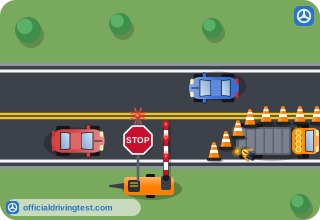
An automated flagger device in a work zone shows a red light and its arm is down. What must you do?
- Slow down and proceed with caution
- Go around the arm when it is safe
- Stop only if workers are visible
- Stop
Show answer
Correct answer: Stop
The manual says to stop when the red light is on and the arm is down.
Source: Oregon Driver Manual (2026-2027), page 59 · Open this page in the manual (Manual page 59)
-
When may you proceed at an automated flagger device?
- When the red light turns off, even if the arm is down
- When the arm is up, even if the red light is on
- When the yellow light is flashing and the arm is up
- When the yellow light is steady and the arm is down
Show answer
Correct answer: When the yellow light is flashing and the arm is up
The manual says to proceed when the yellow light is flashing and the arm is up.
Source: Oregon Driver Manual (2026-2027), page 59 · Open this page in the manual (Manual page 59)
-
What duties do automated flagger devices have compared with a flagger?
- The same duties as a flagger
- Fewer duties than a flagger
- They only warn of work ahead
- They only control one-way traffic
Show answer
Correct answer: The same duties as a flagger
The manual says automated flagger devices have the same duties as a flagger.
Source: Oregon Driver Manual (2026-2027), page 59 · Open this page in the manual (Manual page 59)
-
What can you expect in a freeway work zone?
- To be detoured off the freeway at the first exit
- To wait for a pilot vehicle to lead you through
- To be stopped by a flagger before entering
- To drive through it, maybe in fewer or narrow lanes
Show answer
Correct answer: To drive through it, maybe in fewer or narrow lanes
The manual says that on freeways you remain driving through the work zone and may find fewer, narrow or new lanes.
Source: Oregon Driver Manual (2026-2027), page 60 · Open this page in the manual (Manual page 60)
-
What should you do about construction vehicles in a work zone?
- Follow them closely to stay in the work lane
- Do not follow them
- Pass them on the right shoulder
- Stay beside them to be seen
Show answer
Correct answer: Do not follow them
The manual says not to follow construction vehicles when in a work zone because they may enter the road and cause slowing.
Source: Oregon Driver Manual (2026-2027), page 60 · Open this page in the manual (Manual page 60)
-
In the Work Zone Components picture, what is the Activity Area?
- Where work takes place and workers are present
- Where drivers are warned what to expect
- Where the work zone ends
- Where drivers must take action
Show answer
Correct answer: Where work takes place and workers are present
The picture labels the Activity Area as where work takes place and workers are present.
Source: Oregon Driver Manual (2026-2027), page 60 · Open this page in the manual (Manual page 60)
-
In the Work Zone Components picture, what is the Advance Warning Area?
- The part where work takes place
- The part where drivers must take action
- The part that warns drivers what to expect
- The part marked End Road Work
Show answer
Correct answer: The part that warns drivers what to expect
The picture labels the Advance Warning Area as the part that warns drivers what to expect.
Source: Oregon Driver Manual (2026-2027), page 60 · Open this page in the manual (Manual page 60)
-
In the Work Zone Components picture, what is the Transition Area?
- The part where workers are present
- The part where driver action is required
- The part that warns drivers what to expect
- The part where the work zone ends
Show answer
Correct answer: The part where driver action is required
The picture labels the Transition Area as where driver action is required.
Source: Oregon Driver Manual (2026-2027), page 60 · Open this page in the manual (Manual page 60)