Oregon: Emergency vehicles, work zones and police stops — Part 2 Practice Test
Questions in this part include: “Where are traffic violations and traffic crimes charged against you decided?” · “What equipment does an automated flagger device have?”
Independent educational site · not affiliated with any government agency or DMV
Ready? Test yourself
- Instant feedback with an explanation
- Every answer cites its source in the manual
- Your best score is saved on this device
Questions are original and based on the official manual "Oregon Driver Manual" (2026-2027), Oregon Driver and Motor Vehicle Services (DMV).
All 19 questions in this practice test
Take the test above first, then use this list to study. Tap “Show answer” to see the correct answer and explanation.
Show the questions and answersHide the questions
-
If it is dark when you are stopped by a police vehicle, what should you do?
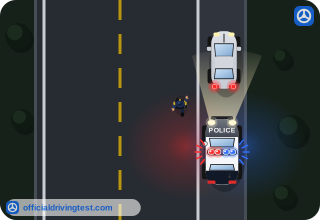
- Turn on the interior light after you stop
- Turn off all lights, including the headlights
- Turn on the high beams until the officer arrives
- Get out and stand in the headlights
Show answer
Correct answer: Turn on the interior light after you stop
The manual says to turn on the interior light after stopping and before the officer approaches when it is dark.
Source: Oregon Driver Manual (2026-2027), page 58 · Open this page in the manual (Manual page 58)
-
Where are traffic violations and traffic crimes charged against you decided?
- At the scene by the officer
- At the DMV
- In court
- By your insurance company
Show answer
Correct answer: In court
The manual says not to argue at the scene because those charges are decided in court.
Source: Oregon Driver Manual (2026-2027), page 58 · Open this page in the manual (Manual page 58)
-
How are work zones defined?
- By yellow warning signs
- By orange traffic control devices
- By white barrels and cones
- By reduced speed limit signs
Show answer
Correct answer: By orange traffic control devices
The manual says work zones are defined by orange traffic control devices.
Source: Oregon Driver Manual (2026-2027), page 59 · Open this page in the manual (Manual page 59)
-
What happens to traffic fines in work zones?
- They are doubled only when workers are present
- They are doubled only on freeways
- They are the same as elsewhere
- They are doubled in all work zones
Show answer
Correct answer: They are doubled in all work zones
The manual says traffic fines are doubled in all work zones.
Source: Oregon Driver Manual (2026-2027), page 59 · Open this page in the manual (Manual page 59)
-
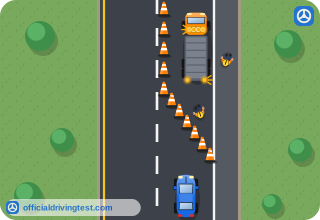
What are you expected to do about workers in a work zone?
- Honk to warn them
- Pass them as quickly as possible
- Yield to them
- Stop only if they signal you
Show answer
Correct answer: Yield to them
The manual says you are expected to yield to workers.
Source: Oregon Driver Manual (2026-2027), page 59 · Open this page in the manual (Manual page 59)
-
What do orange cones in a work zone do?
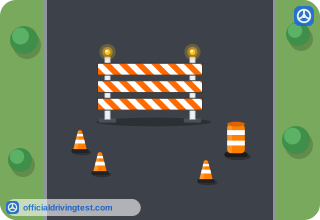
- Guide you away from the road construction
- Warn you that the road ahead is closed
- Show where workers are not present
- Mark where you may park
Show answer
Correct answer: Guide you away from the road construction
The manual says orange signs warn what to expect ahead and orange cones guide you away from the road construction.
Source: Oregon Driver Manual (2026-2027), page 59 · Open this page in the manual (Manual page 59)
-
A work zone has a temporary speed limit posted. When does it apply?
- Only when workers are visible on the road
- Only during the daytime hours
- Only on weekdays when crews work
- At all times, even if workers are not visible
Show answer
Correct answer: At all times, even if workers are not visible
The manual says the temporary speed posted in a work zone applies at all times, even if workers are not visible.
Source: Oregon Driver Manual (2026-2027), page 59 · Open this page in the manual (Manual page 59)
-
Until when does the reduced speed limit in a work zone apply?
- Until you pass the last orange cone
- Until an End Work Zone or other speed limit sign
- Until you no longer see any workers
- Until you drive 500 feet past the first sign
Show answer
Correct answer: Until an End Work Zone or other speed limit sign
The manual says the reduced speed limit applies until an End Work Zone Speed Limit sign or another posted speed limit sign.
Source: Oregon Driver Manual (2026-2027), page 59 · Open this page in the manual (Manual page 59)
-
On which roads in work zones can you expect to be stopped by flaggers or automated devices?
- Two lane roads
- Freeways
- Roads with a painted median
- One-way streets
Show answer
Correct answer: Two lane roads
The manual says you can expect to be stopped by flaggers or automated devices in work zones on two lane roads.
Source: Oregon Driver Manual (2026-2027), page 59 · Open this page in the manual (Manual page 59)
-
What do flaggers use to tell you which direction to travel, to slow down or to stop?
- Flares and sirens
- Traffic cones only
- Signs and hand signals
- Horns and flashing headlights
Show answer
Correct answer: Signs and hand signals
The manual says flaggers use signs and hand signals.
Source: Oregon Driver Manual (2026-2027), page 59 · Open this page in the manual (Manual page 59)
-
What equipment does an automated flagger device have?
- Green and red lights and a bell
- Red and yellow lights and a stop arm
- Only a red light and a sign
- Yellow lights and a gate
Show answer
Correct answer: Red and yellow lights and a stop arm
The manual says automated flagger devices have red and yellow lights and a stop arm.
Source: Oregon Driver Manual (2026-2027), page 59 · Open this page in the manual (Manual page 59)
-
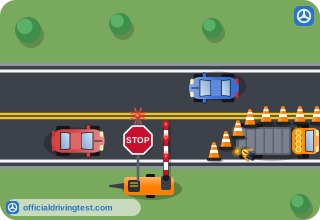
An automated flagger device in a work zone shows a red light and its arm is down. What must you do?
- Slow down and proceed with caution
- Go around the arm when it is safe
- Stop only if workers are visible
- Stop
Show answer
Correct answer: Stop
The manual says to stop when the red light is on and the arm is down.
Source: Oregon Driver Manual (2026-2027), page 59 · Open this page in the manual (Manual page 59)
-
When may you proceed at an automated flagger device?
- When the red light turns off, even if the arm is down
- When the arm is up, even if the red light is on
- When the yellow light is flashing and the arm is up
- When the yellow light is steady and the arm is down
Show answer
Correct answer: When the yellow light is flashing and the arm is up
The manual says to proceed when the yellow light is flashing and the arm is up.
Source: Oregon Driver Manual (2026-2027), page 59 · Open this page in the manual (Manual page 59)
-
What duties do automated flagger devices have compared with a flagger?
- The same duties as a flagger
- Fewer duties than a flagger
- They only warn of work ahead
- They only control one-way traffic
Show answer
Correct answer: The same duties as a flagger
The manual says automated flagger devices have the same duties as a flagger.
Source: Oregon Driver Manual (2026-2027), page 59 · Open this page in the manual (Manual page 59)
-
What can you expect in a freeway work zone?
- To be detoured off the freeway at the first exit
- To wait for a pilot vehicle to lead you through
- To be stopped by a flagger before entering
- To drive through it, maybe in fewer or narrow lanes
Show answer
Correct answer: To drive through it, maybe in fewer or narrow lanes
The manual says that on freeways you remain driving through the work zone and may find fewer, narrow or new lanes.
Source: Oregon Driver Manual (2026-2027), page 60 · Open this page in the manual (Manual page 60)
-
What should you do about construction vehicles in a work zone?
- Follow them closely to stay in the work lane
- Do not follow them
- Pass them on the right shoulder
- Stay beside them to be seen
Show answer
Correct answer: Do not follow them
The manual says not to follow construction vehicles when in a work zone because they may enter the road and cause slowing.
Source: Oregon Driver Manual (2026-2027), page 60 · Open this page in the manual (Manual page 60)
-
In the Work Zone Components picture, what is the Activity Area?
- Where work takes place and workers are present
- Where drivers are warned what to expect
- Where the work zone ends
- Where drivers must take action
Show answer
Correct answer: Where work takes place and workers are present
The picture labels the Activity Area as where work takes place and workers are present.
Source: Oregon Driver Manual (2026-2027), page 60 · Open this page in the manual (Manual page 60)
-
In the Work Zone Components picture, what is the Advance Warning Area?
- The part where work takes place
- The part where drivers must take action
- The part that warns drivers what to expect
- The part marked End Road Work
Show answer
Correct answer: The part that warns drivers what to expect
The picture labels the Advance Warning Area as the part that warns drivers what to expect.
Source: Oregon Driver Manual (2026-2027), page 60 · Open this page in the manual (Manual page 60)
-
In the Work Zone Components picture, what is the Transition Area?
- The part where workers are present
- The part where driver action is required
- The part that warns drivers what to expect
- The part where the work zone ends
Show answer
Correct answer: The part where driver action is required
The picture labels the Transition Area as where driver action is required.
Source: Oregon Driver Manual (2026-2027), page 60 · Open this page in the manual (Manual page 60)