Oklahoma: Railroad crossings — Part 2 Practice Test
Questions in this part include: “What may be painted on the pavement in front of a railroad crossing?” · “While waiting for a passing train, where should you stay in relation to the painted stop line?”
Independent educational site · not affiliated with any government agency or DMV
Ready? Test yourself
- Instant feedback with an explanation
- Every answer cites its source in the manual
- Your best score is saved on this device
- Keyboard: press 1 to 4 to answer and Enter for the next question
Questions are original and based on the official manual "Oklahoma Driver Manual" (2025 (updated November 24, 2025)), Service Oklahoma.
All 16 questions in this practice test
Take the test above first, then use this list to study. Tap “Show answer” to see the correct answer and explanation.
Show the questions and answersHide the questions
-
Under the law, how close to the nearest rail must a driver stop at a railroad grade crossing when a train is approaching or a signal is given?
- Within 50 feet but not less than 15 feet
- Within 100 feet but not less than 50 feet
- Within 30 feet but not less than 5 feet
- Within 25 feet but not less than 10 feet
Show answer
Correct answer: Within 50 feet but not less than 15 feet
The law says to stop within 50 feet but not less than 15 feet from the nearest rail and not to proceed until it is safe.
Source: Oklahoma Driver Manual (2025 (updated November 24, 2025)), page 56 · Open this page in the manual (Manual page 56)
-
Under the law, you must stop at a crossing when an approaching train sounds an audible signal and is an immediate hazard. Within about what distance of the crossing does this apply?
- 500 feet
- 1000 feet
- 1500 feet
- 2500 feet
Show answer
Correct answer: 1500 feet
The law covers a train within approximately 1500 feet of the crossing that sounds a signal and is an immediate hazard by its speed or nearness.
Source: Oklahoma Driver Manual (2025 (updated November 24, 2025)), page 56 · Open this page in the manual (Manual page 56)
-
How are all Oklahoma public highway-rail crossings marked?
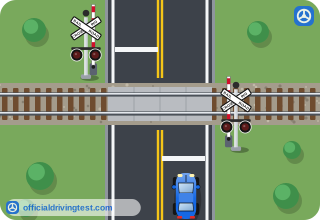
- With a gate at every crossing
- With one or more warning devices
- With flashing lights and bells at every crossing
- Only with painted pavement markings
Show answer
Correct answer: With one or more warning devices
Every public crossing has at least one warning device; over 1,200 also have gates, lights or bells.
Source: Oklahoma Driver Manual (2025 (updated November 24, 2025)), page 56 · Open this page in the manual (Manual page 56)
-
What does an advance warning sign for a highway-rail crossing mean?
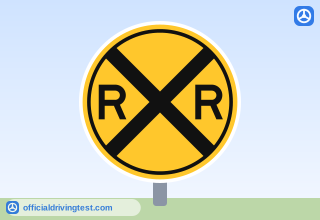
- A train is coming right now
- The crossing is closed
- A stop sign is ahead
- A highway-rail crossing is ahead
Show answer
Correct answer: A highway-rail crossing is ahead
Advance warning signs tell you a highway-rail crossing is ahead.
Source: Oklahoma Driver Manual (2025 (updated November 24, 2025)), page 56 · Open this page in the manual (Manual page 56)
-
Where are advance warning signs for a highway-rail crossing placed?
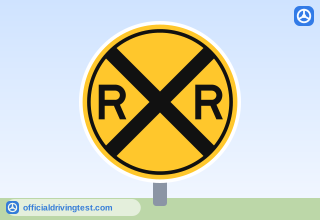
- Far enough back to let you stop before the crossing
- Right beside the rails, where drivers can see them best
- Immediately after the crossing, on the far side
- Only on the far side of the tracks, facing traffic
Show answer
Correct answer: Far enough back to let you stop before the crossing
The signs are placed far enough back that you can stop before the crossing.
Source: Oklahoma Driver Manual (2025 (updated November 24, 2025)), page 56 · Open this page in the manual (Manual page 56)
-
What may be painted on the pavement in front of a railroad crossing?
- A yield triangle and a stop sign
- A railroad arrow and a no-passing zone
- An R X R and a stop line
- A hatched box and a school zone symbol
Show answer
Correct answer: An R X R and a stop line
The manual says an R X R and a stop line may be painted before a crossing.
Source: Oklahoma Driver Manual (2025 (updated November 24, 2025)), page 56 · Open this page in the manual (Manual page 56)
-
While waiting for a passing train, where should you stay in relation to the painted stop line?
- Over the stop line, to see farther down the track
- Behind the stop line
- Right at the rail, to be ready to go
- Beside the R X R marking, off the road
Show answer
Correct answer: Behind the stop line
The manual says to always stay behind the painted stop line while waiting for a passing train.
Source: Oklahoma Driver Manual (2025 (updated November 24, 2025)), page 56 · Open this page in the manual (Manual page 56)
-
How should you treat a railroad crossbuck sign, a white X-shaped sign reading RAIL ROAD CROSSING?
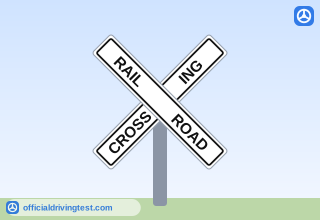
- Like a STOP sign
- Like a speed sign
- Like a no-parking sign
- Like a YIELD sign
Show answer
Correct answer: Like a YIELD sign
Crossbucks are treated like a YIELD sign: slow down and prepare to stop if you see or hear a train approaching.
Source: Oklahoma Driver Manual (2025 (updated November 24, 2025)), page 56 · Open this page in the manual (Manual page 56)
-
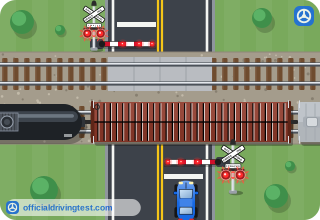
At a flashing-light crossing with more than one track, what must you do before crossing?
- Check only the track nearest to you
- Check only the track the train is on
- Cross as soon as the first train has passed
- Make sure all tracks are clear
Show answer
Correct answer: Make sure all tracks are clear
With more than one track, you must be sure every track is clear before you begin to cross.
Source: Oklahoma Driver Manual (2025 (updated November 24, 2025)), page 56 · Open this page in the manual (Manual page 56)
-
At a crossing with gates and flashing signals, when should you stop?
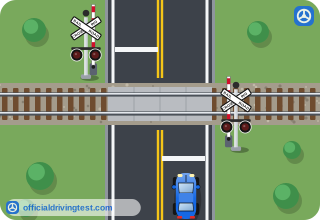
- When the lights begin to flash, before the gate lowers
- Only after the gate has been lowered across your lane
- Once you see the train in the distance
- Only when the train's horn is heard
Show answer
Correct answer: When the lights begin to flash, before the gate lowers
Stop as soon as the lights begin to flash, before the gate is lowered across your lane.
Source: Oklahoma Driver Manual (2025 (updated November 24, 2025)), page 56 · Open this page in the manual (Manual page 56)
-
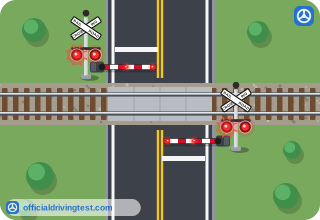
At a crossing with gates and flashing signals, how long must you remain stopped?
- Until the lights stop flashing, even if the gates remain down
- Until the train's engine is out of sight
- Until the gates are raised and the lights have stopped flashing
- Until the gates begin to rise
Show answer
Correct answer: Until the gates are raised and the lights have stopped flashing
You must remain stopped until the gates are up and the lights have stopped flashing.
Source: Oklahoma Driver Manual (2025 (updated November 24, 2025)), page 56 · Open this page in the manual (Manual page 56)
-
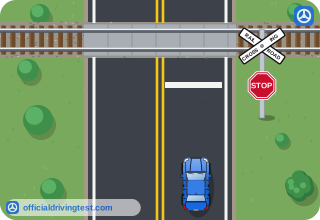
What must you do at a stop sign at a railroad crossing before driving across the tracks?
- Slow down and cross if no train is visible
- Stop completely and look both ways
- Stop only if a train is in view
- Stop and honk before crossing
Show answer
Correct answer: Stop completely and look both ways
A stop sign at a crossing requires a complete stop and a look both ways before you cross.
Source: Oklahoma Driver Manual (2025 (updated November 24, 2025)), page 56 · Open this page in the manual (Manual page 56)
-
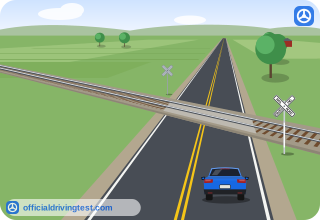
As you approach a highway-railway crossing, what should you do?
- Maintain your speed and sound your horn as you cross
- Speed up so you clear the tracks as quickly as you can
- Move to the shoulder and stop at once
- Slow down, keep alert and watch for the sign or signal
Show answer
Correct answer: Slow down, keep alert and watch for the sign or signal
The manual advises slowing down, staying alert and watching for the crossing sign or signal.
Source: Oklahoma Driver Manual (2025 (updated November 24, 2025)), page 57 · Open this page in the manual (Manual page 57)
-
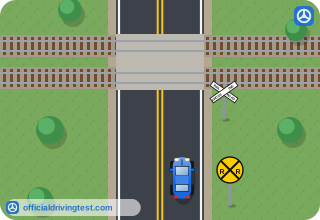
At a highway-railway crossing, on which track should you expect a train?
- Any track at any time
- Only the track nearest to you
- Only tracks that have signals
- Only at times posted on the signs
Show answer
Correct answer: Any track at any time
A train can come on any track at any time, so be ready.
Source: Oklahoma Driver Manual (2025 (updated November 24, 2025)), page 57 · Open this page in the manual (Manual page 57)
-
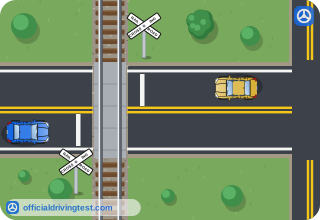
When is it safe to move onto a railroad track?
- Whenever the lights are not flashing at the crossing
- Whenever no train is visible in either direction
- Only when you are certain you can drive across safely
- Whenever the car ahead of you is already crossing
Show answer
Correct answer: Only when you are certain you can drive across safely
The manual says never to move onto a track unless you are certain you can get across, so you do not get trapped.
Source: Oklahoma Driver Manual (2025 (updated November 24, 2025)), page 57 · Open this page in the manual (Manual page 57)
-
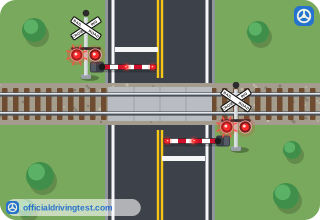
What should you do if the crossing gates are down?
- Drive around it if no train is visible
- Stop behind the gate
- Drive slowly under it
- Go through if the gate looks broken
Show answer
Correct answer: Stop behind the gate
If the gates are down, stop behind the gate and wait until they are raised and the lights have stopped flashing.
Source: Oklahoma Driver Manual (2025 (updated November 24, 2025)), page 57 · Open this page in the manual (Manual page 57)