Oklahoma: Railroad crossings — Part 1 Practice Test
Questions in this part include: “What is a railroad Quiet Zone?” · “Crossings within a Quiet Zone may have supplemental safety measures. Who funds them?”
Independent educational site · not affiliated with any government agency or DMV
Ready? Test yourself
- Instant feedback with an explanation
- Every answer cites its source in the manual
- Your best score is saved on this device
- Keyboard: press 1 to 4 to answer and Enter for the next question
Questions are original and based on the official manual "Oklahoma Driver Manual" (2025 (updated November 24, 2025)), Service Oklahoma.
All 16 questions in this practice test
Take the test above first, then use this list to study. Tap “Show answer” to see the correct answer and explanation.
Show the questions and answersHide the questions
-
After passing a railroad advance warning sign, within what distance of the first track should you be prepared to stop?
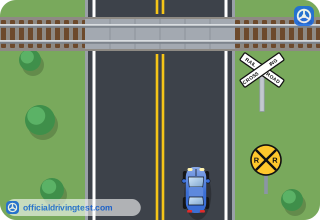
- 5 to 10 feet
- 100 to 200 feet
- 15 to 50 feet
- 50 to 100 feet
Show answer
Correct answer: 15 to 50 feet
Slow down when you see the advance warning sign and be ready to stop 15 to 50 feet from the first track.
Source: Oklahoma Driver Manual (2025 (updated November 24, 2025)), page 22 · Open this page in the manual (Manual page 22)
-
As you approach railroad tracks, your view down the track is blocked in one direction. What should you do?
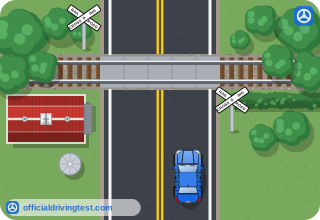
- Speed up so you spend less time on the tracks
- Drive very slowly until you can see down the track
- Sound your horn and cross at your normal speed
- Cross at normal speed if no lights are flashing
Show answer
Correct answer: Drive very slowly until you can see down the track
When your view is blocked either way, creep forward very slowly until you can see down the track.
Source: Oklahoma Driver Manual (2025 (updated November 24, 2025)), page 22 · Open this page in the manual (Manual page 22)
-
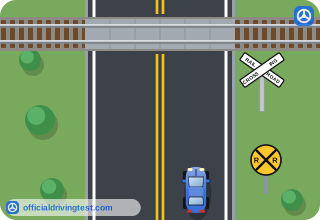
Which of these vehicles is required by law to stop at a railroad crossing?
- A motorcycle
- A pickup towing a trailer
- A farm tractor
- A church bus
Show answer
Correct answer: A church bus
School buses, church buses, motor coaches and vehicles hauling explosives or flammable liquids must stop at railroad crossings by law.
Source: Oklahoma Driver Manual (2025 (updated November 24, 2025)), page 22 · Open this page in the manual (Manual page 22)
-
At a railroad crossing marked with a crossbuck sign, what should you always do?
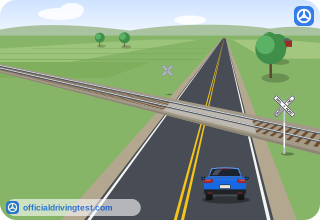
- Slow down, look, listen and be ready to yield
- Come to a full stop even when no train is near
- Speed up so you clear the tracks more quickly
- Keep your speed unless the lights are flashing
Show answer
Correct answer: Slow down, look, listen and be ready to yield
At a crossbuck you slow down, look and listen, and get ready to give the right-of-way to an oncoming train.
Source: Oklahoma Driver Manual (2025 (updated November 24, 2025)), page 22 · Open this page in the manual (Manual page 22)
-
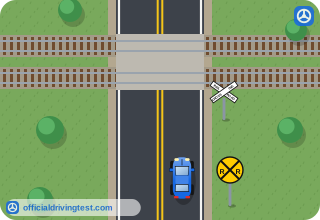
At a railroad crossing with more than one track, what will a sign show?
- The time until the next train
- The number of tracks there
- Which track the next train uses
- The speed limit for trains
Show answer
Correct answer: The number of tracks there
Where there is more than one track, a sign at the crossing shows how many tracks there are.
Source: Oklahoma Driver Manual (2025 (updated November 24, 2025)), page 22 · Open this page in the manual (Manual page 22)
-
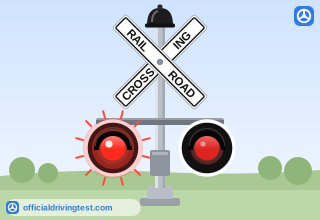
What do flashing red lights on a railroad crossbuck mean?
- Slow down and cross if you see no train
- The crossing is closed for track repairs
- A train has just gone by; cross with care
- A train is coming; you must stop
Show answer
Correct answer: A train is coming; you must stop
Flashing lights on a crossbuck mean a train is coming, and you must always stop while they flash.
Source: Oklahoma Driver Manual (2025 (updated November 24, 2025)), page 23 · Open this page in the manual (Manual page 23)
-
At a crossing with flashing lights and more than one track, what must you be sure of before you cross?
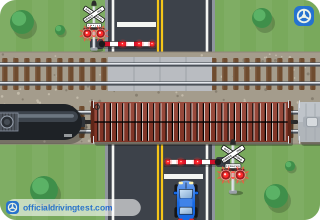
- That every track is clear
- That the nearest track is clear
- That the train's horn has stopped
- That a car ahead has crossed
Show answer
Correct answer: That every track is clear
With more than one track, a second train may be coming, so make sure all tracks are clear before crossing.
Source: Oklahoma Driver Manual (2025 (updated November 24, 2025)), page 23 · Open this page in the manual (Manual page 23)
-
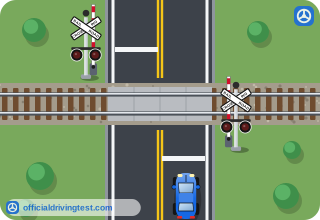
At a crossbuck with flashing lights and a gate, when must you stop?
- Only after the gate has come all the way down
- Only when the train itself comes into your view
- When the lights begin flashing, before the gate is down
- Only when the bells start ringing at the post
Show answer
Correct answer: When the lights begin flashing, before the gate is down
You stop as soon as the lights start flashing, before the gate comes down.
Source: Oklahoma Driver Manual (2025 (updated November 24, 2025)), page 23 · Open this page in the manual (Manual page 23)
-
At a crossbuck with flashing lights and a gate, how long must you remain stopped?
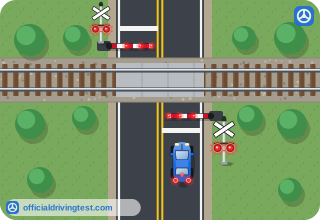
- Until the gates begin to rise, even if lights flash
- Until the gates are up and the lights stop flashing
- Until the bells stop, even if the gates stay down
- Until a driver ahead of you goes around the gate
Show answer
Correct answer: Until the gates are up and the lights stop flashing
Stay stopped until the gates are fully raised and the lights have stopped flashing.
Source: Oklahoma Driver Manual (2025 (updated November 24, 2025)), page 23 · Open this page in the manual (Manual page 23)
-
What is a railroad Quiet Zone?
- Where drivers may not honk near the tracks
- Where trains must slow to a walking pace
- Where trains run only during daylight hours
- Where trains don't sound horns in normal operation
Show answer
Correct answer: Where trains don't sound horns in normal operation
In a Quiet Zone, trains do not blow their horns during normal operation.
Source: Oklahoma Driver Manual (2025 (updated November 24, 2025)), page 23 · Open this page in the manual (Manual page 23)
-
What is the quickest way to recognize an active Quiet Zone?
- A NO TRAIN HORN sign next to the crossing
- Orange gates instead of red and white ones
- A flashing yellow light above the crossbuck
- A double set of gates across the road
Show answer
Correct answer: A NO TRAIN HORN sign next to the crossing
An active Quiet Zone is easiest to spot by the 'No Train Horn' sign posted beside the crossing.
Source: Oklahoma Driver Manual (2025 (updated November 24, 2025)), page 23 · Open this page in the manual (Manual page 23)
-
In a Quiet Zone, may a train still sound its horn?
- No, horns are banned there at all times
- Only at night, between sunset and sunrise
- Yes, for emergencies or other safety reasons
- Only when a train runs late on its schedule
Show answer
Correct answer: Yes, for emergencies or other safety reasons
Even in a Quiet Zone the horn may be sounded in emergencies or for other safety reasons.
Source: Oklahoma Driver Manual (2025 (updated November 24, 2025)), page 23 · Open this page in the manual (Manual page 23)
-
Crossings within a Quiet Zone may have supplemental safety measures. Who funds them?
- Railroad companies
- Local governments
- Service Oklahoma
- The Federal Railroad Administration
Show answer
Correct answer: Local governments
The extra safety measures are funded by local governments that want to reduce train-horn noise.
Source: Oklahoma Driver Manual (2025 (updated November 24, 2025)), page 23 · Open this page in the manual (Manual page 23)
-
How far does a train traveling at 55 mph need to stop?
- About 500 feet
- About a quarter mile
- A mile or more
- About half a mile
Show answer
Correct answer: A mile or more
A train at 55 mph takes a mile or more to stop, which is why you must always yield to trains.
Source: Oklahoma Driver Manual (2025 (updated November 24, 2025)), page 55 · Open this page in the manual (Manual page 55)
-
According to the manual, who is always at fault in a car/train collision?
- The train engineer
- The car driver
- The railroad company
- Whoever reached the crossing first
Show answer
Correct answer: The car driver
The manual states that a train collision is always the fault of the car driver.
Source: Oklahoma Driver Manual (2025 (updated November 24, 2025)), page 55 · Open this page in the manual (Manual page 55)
-
Operation Lifesaver is a program that teaches what?
- Motorcycle safety
- School bus safety
- Safe driving in work zones
- Railroad crossing safety
Show answer
Correct answer: Railroad crossing safety
Operation Lifesaver teaches railroad crossing safety.
Source: Oklahoma Driver Manual (2025 (updated November 24, 2025)), page 55 · Open this page in the manual (Manual page 55)