Oklahoma: Emergency vehicles and work zones — Part 2 Practice Test
Questions in this part include: “An officer signals you to stop while you are driving in the left lane. What must you do?” · “What should you do when passing a stopped vehicle with flashing lights on a smaller or two-lane road?”
Independent educational site · not affiliated with any government agency or DMV
Ready? Test yourself
- Instant feedback with an explanation
- Every answer cites its source in the manual
- Your best score is saved on this device
- Keyboard: press 1 to 4 to answer and Enter for the next question
Questions are original and based on the official manual "Oklahoma Driver Manual" (2025 (updated November 24, 2025)), Service Oklahoma.
All 16 questions in this practice test
Take the test above first, then use this list to study. Tap “Show answer” to see the correct answer and explanation.
Show the questions and answersHide the questions
-
Besides a fine and/or jail, what else can a driver be liable for after failing to obey construction and maintenance signs?
- Damage to property and injury or death of another person
- The cost of towing every vehicle in the work zone
- A required defensive driving course
- Loss of vehicle registration for one year
Show answer
Correct answer: Damage to property and injury or death of another person
The driver also faces liability for damage to property and for injury or death caused to another person.
Source: Oklahoma Driver Manual (2025 (updated November 24, 2025)), page 24 · Open this page in the manual (Manual page 24)
-
What must you do when a police car, fire engine or ambulance approaches sounding a siren or flashing warning lights?
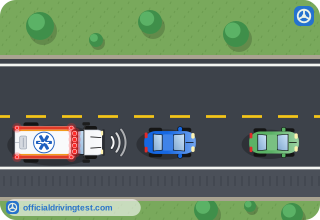
- Pull over to the right and stop, clear of intersections
- Stop in the middle of the intersection to block traffic
- Pull over to the left edge of the roadway and stop
- Slow down and keep driving in your lane
Show answer
Correct answer: Pull over to the right and stop, clear of intersections
You pull over to the right edge, stay out of intersections and stop until the emergency vehicle has passed.
Source: Oklahoma Driver Manual (2025 (updated November 24, 2025)), page 29 · Open this page in the manual (Manual page 29)
-
In heavy traffic, when you cannot pull over for an emergency vehicle, what should you do?
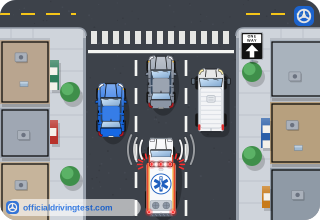
- Stop where you are and wait
- Speed up and stay ahead of it
- Turn on your hazard lights and stay in your lane
- Clear a path for the vehicle
Show answer
Correct answer: Clear a path for the vehicle
When pulling over is impossible in heavy traffic, you make a path for the emergency vehicle.
Source: Oklahoma Driver Manual (2025 (updated November 24, 2025)), page 29 · Open this page in the manual (Manual page 29)
-
An officer signals you to stop while you are driving in the left lane. What must you do?
- Stop in the left lane and turn on your hazard lights
- Pull over to the right shoulder, even across several lanes
- Pull onto the left shoulder, since it is closest
- Drive on to the next exit before pulling over
Show answer
Correct answer: Pull over to the right shoulder, even across several lanes
You must still go to the right shoulder, even if that means crossing several lanes of traffic.
Source: Oklahoma Driver Manual (2025 (updated November 24, 2025)), page 29 · Open this page in the manual (Manual page 29)
-
When do you NOT have to yield to an emergency vehicle?
- When it is a fire engine sounding a siren
- When it has no warning lights or sirens
- When an ambulance is flashing warning lights
- When you are in heavy traffic and cannot pull over
Show answer
Correct answer: When it has no warning lights or sirens
You only have to yield to emergency vehicles that use warning lights or sirens.
Source: Oklahoma Driver Manual (2025 (updated November 24, 2025)), page 29 · Open this page in the manual (Manual page 29)
-
When approaching a stationary vehicle with flashing lights pulled to the side of the road, what are drivers required to do?
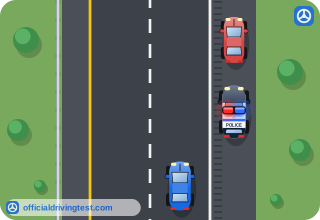
- Stop completely until the vehicle leaves
- Move over a lane and speed up to pass quickly
- Continue at the same speed in the same lane
- Move over if safe, or slow down with caution
Show answer
Correct answer: Move over if safe, or slow down with caution
The law requires you to move over a lane when it is safe, or else to slow down and use caution.
Source: Oklahoma Driver Manual (2025 (updated November 24, 2025)), page 30 · Open this page in the manual (Manual page 30)
-
On a multi-lane road going in your direction, which lane should you move to for a stopped vehicle with flashing lights, if it is safe?
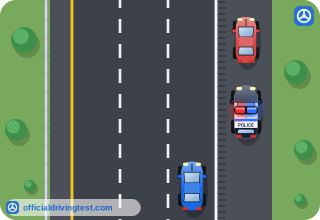
- A lane that is not next to the stopped vehicle
- The lane next to the stopped vehicle
- The same lane, passing at normal speed
- The shoulder on the far side of the road
Show answer
Correct answer: A lane that is not next to the stopped vehicle
The Move Over law has you leave a lane between you and the stopped vehicle when you can do so safely.
Source: Oklahoma Driver Manual (2025 (updated November 24, 2025)), page 30 · Open this page in the manual (Manual page 30)
-
On a multi-lane road, if you cannot safely change lanes away from a stopped vehicle with flashing lights, what should you do?
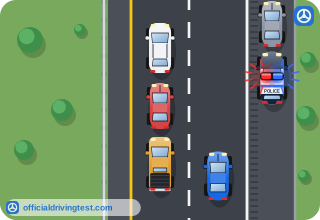
- Stop behind the vehicle
- Pass the vehicle quickly
- Slow down and drive carefully
- Stop in your lane until every lane is clear
Show answer
Correct answer: Slow down and drive carefully
If you cannot move over safely, you slow down and drive carefully.
Source: Oklahoma Driver Manual (2025 (updated November 24, 2025)), page 30 · Open this page in the manual (Manual page 30)
-
What should you do when passing a stopped vehicle with flashing lights on a smaller or two-lane road?
- Speed up to get past it quickly
- Stop until the vehicle leaves
- Use your hazard lights and keep your speed
- Slow down and drive carefully
Show answer
Correct answer: Slow down and drive carefully
On a smaller or two-lane road the manual tells you to slow down and drive carefully.
Source: Oklahoma Driver Manual (2025 (updated November 24, 2025)), page 30 · Open this page in the manual (Manual page 30)
-
Why is it important to move over or slow down around vehicles displaying flashing lights on the side of the road?
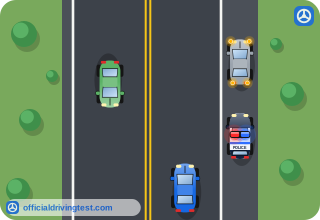
- It keeps the flashing lights from blinding you
- It helps prevent secondary crashes
- It lets tow trucks reach the vehicle sooner
- It gives you a better view of roadside signs
Show answer
Correct answer: It helps prevent secondary crashes
Moving over or slowing down helps prevent secondary crashes.
Source: Oklahoma Driver Manual (2025 (updated November 24, 2025)), page 30 · Open this page in the manual (Manual page 30)
-
What is a secondary crash?
- A crash that involves a vehicle stopped on the shoulder
- A crash involving two or more vehicles in separate lanes
- Any crash that occurs because of another crash or incident
- A minor crash that causes only property damage
Show answer
Correct answer: Any crash that occurs because of another crash or incident
A secondary crash is one caused by an earlier crash or incident.
Source: Oklahoma Driver Manual (2025 (updated November 24, 2025)), page 30 · Open this page in the manual (Manual page 30)
-
Why do secondary crashes often happen?
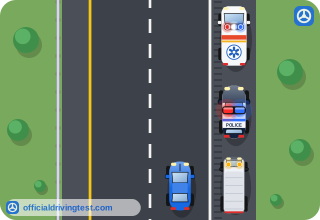
- A driver is distracted by the sight of a crash
- Drivers move over a lane away from the scene
- Drivers slow down and follow responders' directions
- Drivers stay alert near the scene
Show answer
Correct answer: A driver is distracted by the sight of a crash
Drivers who stare at a crash and take their eyes off the road can cause another crash.
Source: Oklahoma Driver Manual (2025 (updated November 24, 2025)), page 30 · Open this page in the manual (Manual page 30)
-
What is a Traffic Incident Management (TIM) scene?
- The area of a roadway incident where responders are actively working to clear it
- A stretch of roadway where law enforcement is checking vehicle speeds
- The roadside area where drivers may pull off to rest or make a phone call
- The area of a crash where only tow operators are permitted to work
Show answer
Correct answer: The area of a roadway incident where responders are actively working to clear it
A TIM scene is where an incident has occurred and responders, law enforcement or tow operators are working to manage and clear it.
Source: Oklahoma Driver Manual (2025 (updated November 24, 2025)), page 31 · Open this page in the manual (Manual page 31)
-
Why do Move Over laws exist?
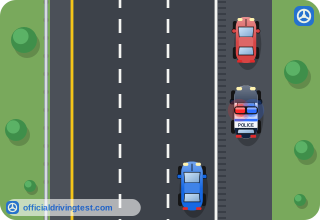
- To keep traffic flowing at the posted speed through an incident area
- To give tow trucks priority on the highway
- To protect responders at risk of being hit by passing vehicles
- To reduce the number of vehicles near a crash scene
Show answer
Correct answer: To protect responders at risk of being hit by passing vehicles
Responders at an incident scene can be hit by passing vehicles, and Move Over laws protect them.
Source: Oklahoma Driver Manual (2025 (updated November 24, 2025)), page 31 · Open this page in the manual (Manual page 31)
-
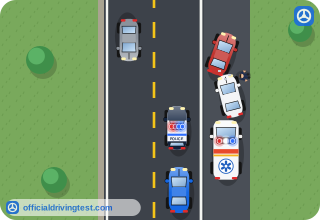
Which of these should a driver do when approaching a TIM scene?
- Keep the same speed through the scene
- Stop and watch from your lane
- Rely on responders to move out of your way
- Follow any directions from emergency responders
Show answer
Correct answer: Follow any directions from emergency responders
A driver approaching a TIM scene should follow any directions the emergency responders give.
Source: Oklahoma Driver Manual (2025 (updated November 24, 2025)), page 31 · Open this page in the manual (Manual page 31)
-
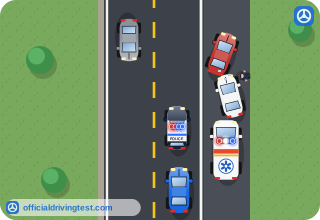
Which of these should you NOT do when approaching a TIM scene?
- Stay alert and aware
- Slow down
- Rubberneck at the scene
- Move over if possible
Show answer
Correct answer: Rubberneck at the scene
The manual lists rubbernecking, or staring at the scene, as something a driver should not do.
Source: Oklahoma Driver Manual (2025 (updated November 24, 2025)), page 31 · Open this page in the manual (Manual page 31)