Oklahoma: Emergency vehicles and work zones
Yielding to emergency vehicles, the Move Over law, traffic incident scenes, school buses, construction zones and flaggers. Split into 2 shorter tests so you're not stuck in one long quiz.
Independent educational site · not affiliated with any government agency or DMV
Choose a part
Emergency vehicles and work zones — Part 1
Questions in this part include: “When are speeding fines doubled in a construction or maintenance zone?”
StartEmergency vehicles and work zones — Part 2
Questions in this part include: “An officer signals you to stop while you are driving in the left lane. What must you do?”
StartAll 33 Emergency vehicles and work zones questions with answers
Choose a part above to take a practice test, or study every question and answer here.
Show the questions and answersHide the questions
-
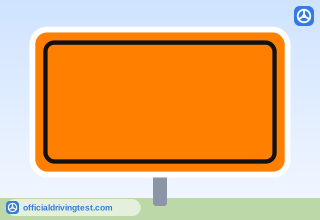
What does the color orange on road signs tell you?
- A school zone is just ahead
- A recreation area is ahead
- A railroad crossing is ahead
- You are nearing or in a work zone
Show answer
Correct answer: You are nearing or in a work zone
Orange is the work zone color: it means you are approaching or already in a construction or maintenance area.
Source: Oklahoma Driver Manual (2025 (updated November 24, 2025)), page 23 · Open this page in the manual (Manual page 23)
-
Why are signs, barricades, cones and barrels placed in a work zone?
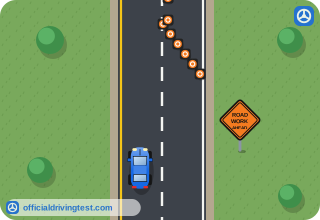
- To guide you through and protect workers
- To mark where drivers may park and wait
- To show the lanes for trucks and buses only
- To close the whole road to every vehicle
Show answer
Correct answer: To guide you through and protect workers
These devices direct traffic safely through the work zone and protect the workers and flagpersons there.
Source: Oklahoma Driver Manual (2025 (updated November 24, 2025)), page 23 · Open this page in the manual (Manual page 23)
-
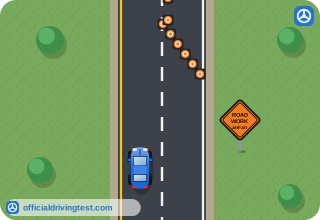
At a construction site, what speed must you slow down to?
- The speed of the traffic around you
- The posted speed
- Half of the usual speed limit
- The highway's minimum speed limit
Show answer
Correct answer: The posted speed
Construction sites can be hazardous, so you must slow down to the speed that is posted there.
Source: Oklahoma Driver Manual (2025 (updated November 24, 2025)), page 23 · Open this page in the manual (Manual page 23)
-
When are speeding fines doubled in a construction or maintenance zone?
- Only between sunset and sunrise
- At all times, even with no one there
- Only on interstate highways
- When workers or equipment are present
Show answer
Correct answer: When workers or equipment are present
Speeding fines double in construction and maintenance zones whenever workers or equipment are present.
Source: Oklahoma Driver Manual (2025 (updated November 24, 2025)), page 23 · Open this page in the manual (Manual page 23)
-
What do flashing arrow panels in a work zone do?
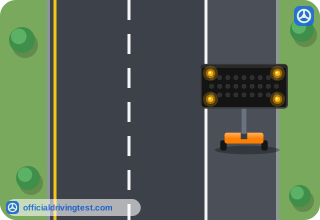
- Guide you into the proper lane
- Warn that a train is approaching
- Show the reduced work zone speed
- Mark the end of the work zone
Show answer
Correct answer: Guide you into the proper lane
Flashing arrow panels direct drivers into the correct traffic lane through the work zone.
Source: Oklahoma Driver Manual (2025 (updated November 24, 2025)), page 23 · Open this page in the manual (Manual page 23)
-
In which situations are flagpersons used?
- In cases of extreme hazards
- At every road construction site
- Only at railroad crossings
- Only when traffic signals are not working
Show answer
Correct answer: In cases of extreme hazards
The manual says flagpersons are used in cases of extreme hazards, standing in the road to direct traffic.
Source: Oklahoma Driver Manual (2025 (updated November 24, 2025)), page 24 · Open this page in the manual (Manual page 24)
-
What do flagpersons wear?
- Bright yellow hard hats and yellow vests or jackets
- White hard hats with green vests or jackets
- Orange hats and orange vests, shirts or jackets
- Red hats and bright red vests, shirts or jackets
Show answer
Correct answer: Orange hats and orange vests, shirts or jackets
Flagpersons wear orange hats and orange vests, shirts or jackets so that drivers can see them.
Source: Oklahoma Driver Manual (2025 (updated November 24, 2025)), page 24 · Open this page in the manual (Manual page 24)
-
What do flagpersons hold to direct traffic?
- Green signs or flags
- Red signs or flags
- Blue signs or flags
- White signs or flags
Show answer
Correct answer: Red signs or flags
A flagperson holds red signs or flags to direct traffic.
Source: Oklahoma Driver Manual (2025 (updated November 24, 2025)), page 24 · Open this page in the manual (Manual page 24)
-
What does the law require of a driver when a flagperson directs traffic?
- You may ignore the flagperson if the road looks clear
- You must obey only if a police officer is present
- You must follow the flagperson only on interstate highways
- You must obey the flagperson
Show answer
Correct answer: You must obey the flagperson
The law demands that drivers obey flagpersons.
Source: Oklahoma Driver Manual (2025 (updated November 24, 2025)), page 24 · Open this page in the manual (Manual page 24)
-
A flagperson tells you to stop. What should you do?
- Stop in your lane and do not veer right or left
- Move onto the shoulder and stop there
- Change lanes to get around the flagperson
- Slow down and keep rolling toward the flagperson
Show answer
Correct answer: Stop in your lane and do not veer right or left
When told to stop, a driver stops in the same lane without veering to either side.
Source: Oklahoma Driver Manual (2025 (updated November 24, 2025)), page 24 · Open this page in the manual (Manual page 24)
-
After you have stopped for a flagperson, when may you move forward?
- As soon as you see no workers in the road
- When the vehicle behind you honks
- Only when the flagperson signals you to go
- After waiting about ten seconds
Show answer
Correct answer: Only when the flagperson signals you to go
A driver must not move forward until the flagperson signals to go.
Source: Oklahoma Driver Manual (2025 (updated November 24, 2025)), page 24 · Open this page in the manual (Manual page 24)
-
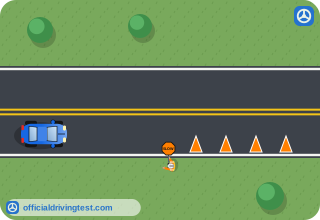
What should you expect when you proceed past a flagperson?
- A clear road with no workers or equipment
- Workers and machinery, so be prepared to slow or stop
- Only passenger cars driving at the posted speed
- Barricades that make you take the next exit
Show answer
Correct answer: Workers and machinery, so be prepared to slow or stop
Drivers should go on with caution, expecting workers and machinery and being ready to slow down or stop.
Source: Oklahoma Driver Manual (2025 (updated November 24, 2025)), page 24 · Open this page in the manual (Manual page 24)
-
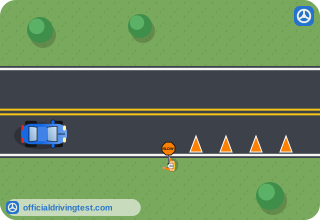
In a work area where a flagperson directs traffic, what should you always watch for in your lane?
- Drivers who are parked on the shoulder
- Pedestrians crossing at every intersection
- Cyclists riding in a bike lane
- Oncoming cars and trucks
Show answer
Correct answer: Oncoming cars and trucks
The manual says to always be on the lookout for oncoming cars and trucks in your lane in such an area.
Source: Oklahoma Driver Manual (2025 (updated November 24, 2025)), page 24 · Open this page in the manual (Manual page 24)
-
What are channeling devices such as barricades, panels, cones and drums used for?
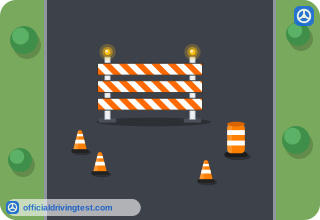
- To direct traffic flow
- To mark legal parking spaces
- To warn of an approaching railroad crossing
- To mark the start of a school zone
Show answer
Correct answer: To direct traffic flow
Channeling devices are placed to direct the flow of traffic.
Source: Oklahoma Driver Manual (2025 (updated November 24, 2025)), page 24 · Open this page in the manual (Manual page 24)
-
What is the fine range on conviction for failing to obey construction and maintenance signs, signals and markings?
- $25 to $250
- $200 to $2,000
- $100 to $1,000
- $500 to $5,000
Show answer
Correct answer: $100 to $1,000
The penalty is a fine between $100 and $1,000 and/or up to 30 days in jail.
Source: Oklahoma Driver Manual (2025 (updated November 24, 2025)), page 24 · Open this page in the manual (Manual page 24)
-
What is the maximum jail time for failing to obey construction and maintenance signs, signals and markings?
- Up to 15 days
- Up to 30 days
- Up to 60 days
- Up to 90 days
Show answer
Correct answer: Up to 30 days
The penalty may include up to 30 days in jail, along with or instead of a fine.
Source: Oklahoma Driver Manual (2025 (updated November 24, 2025)), page 24 · Open this page in the manual (Manual page 24)
-
Failing to obey construction and maintenance signs, signals and markings, on conviction, is what kind of offense?
- A felony
- A civil infraction
- A warning-only offense
- A misdemeanor
Show answer
Correct answer: A misdemeanor
The manual says conviction is a misdemeanor.
Source: Oklahoma Driver Manual (2025 (updated November 24, 2025)), page 24 · Open this page in the manual (Manual page 24)
-
Besides a fine and/or jail, what else can a driver be liable for after failing to obey construction and maintenance signs?
- Damage to property and injury or death of another person
- The cost of towing every vehicle in the work zone
- A required defensive driving course
- Loss of vehicle registration for one year
Show answer
Correct answer: Damage to property and injury or death of another person
The driver also faces liability for damage to property and for injury or death caused to another person.
Source: Oklahoma Driver Manual (2025 (updated November 24, 2025)), page 24 · Open this page in the manual (Manual page 24)
-
What must you do when a police car, fire engine or ambulance approaches sounding a siren or flashing warning lights?
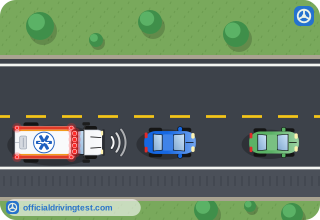
- Pull over to the right and stop, clear of intersections
- Stop in the middle of the intersection to block traffic
- Pull over to the left edge of the roadway and stop
- Slow down and keep driving in your lane
Show answer
Correct answer: Pull over to the right and stop, clear of intersections
You pull over to the right edge, stay out of intersections and stop until the emergency vehicle has passed.
Source: Oklahoma Driver Manual (2025 (updated November 24, 2025)), page 29 · Open this page in the manual (Manual page 29)
-
In heavy traffic, when you cannot pull over for an emergency vehicle, what should you do?
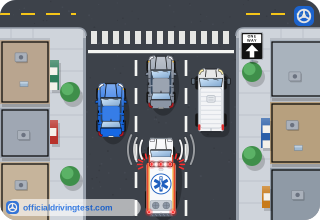
- Stop where you are and wait
- Speed up and stay ahead of it
- Turn on your hazard lights and stay in your lane
- Clear a path for the vehicle
Show answer
Correct answer: Clear a path for the vehicle
When pulling over is impossible in heavy traffic, you make a path for the emergency vehicle.
Source: Oklahoma Driver Manual (2025 (updated November 24, 2025)), page 29 · Open this page in the manual (Manual page 29)
-
An officer signals you to stop while you are driving in the left lane. What must you do?
- Stop in the left lane and turn on your hazard lights
- Pull over to the right shoulder, even across several lanes
- Pull onto the left shoulder, since it is closest
- Drive on to the next exit before pulling over
Show answer
Correct answer: Pull over to the right shoulder, even across several lanes
You must still go to the right shoulder, even if that means crossing several lanes of traffic.
Source: Oklahoma Driver Manual (2025 (updated November 24, 2025)), page 29 · Open this page in the manual (Manual page 29)
-
When do you NOT have to yield to an emergency vehicle?
- When it is a fire engine sounding a siren
- When it has no warning lights or sirens
- When an ambulance is flashing warning lights
- When you are in heavy traffic and cannot pull over
Show answer
Correct answer: When it has no warning lights or sirens
You only have to yield to emergency vehicles that use warning lights or sirens.
Source: Oklahoma Driver Manual (2025 (updated November 24, 2025)), page 29 · Open this page in the manual (Manual page 29)
-
When approaching a stationary vehicle with flashing lights pulled to the side of the road, what are drivers required to do?
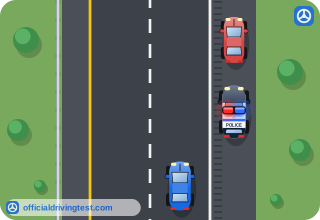
- Stop completely until the vehicle leaves
- Move over a lane and speed up to pass quickly
- Continue at the same speed in the same lane
- Move over if safe, or slow down with caution
Show answer
Correct answer: Move over if safe, or slow down with caution
The law requires you to move over a lane when it is safe, or else to slow down and use caution.
Source: Oklahoma Driver Manual (2025 (updated November 24, 2025)), page 30 · Open this page in the manual (Manual page 30)
-
On a multi-lane road going in your direction, which lane should you move to for a stopped vehicle with flashing lights, if it is safe?
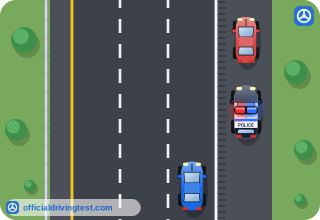
- A lane that is not next to the stopped vehicle
- The lane next to the stopped vehicle
- The same lane, passing at normal speed
- The shoulder on the far side of the road
Show answer
Correct answer: A lane that is not next to the stopped vehicle
The Move Over law has you leave a lane between you and the stopped vehicle when you can do so safely.
Source: Oklahoma Driver Manual (2025 (updated November 24, 2025)), page 30 · Open this page in the manual (Manual page 30)
-
On a multi-lane road, if you cannot safely change lanes away from a stopped vehicle with flashing lights, what should you do?
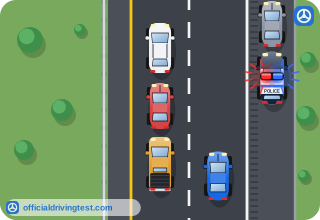
- Stop behind the vehicle
- Pass the vehicle quickly
- Slow down and drive carefully
- Stop in your lane until every lane is clear
Show answer
Correct answer: Slow down and drive carefully
If you cannot move over safely, you slow down and drive carefully.
Source: Oklahoma Driver Manual (2025 (updated November 24, 2025)), page 30 · Open this page in the manual (Manual page 30)
-
What should you do when passing a stopped vehicle with flashing lights on a smaller or two-lane road?
- Speed up to get past it quickly
- Stop until the vehicle leaves
- Use your hazard lights and keep your speed
- Slow down and drive carefully
Show answer
Correct answer: Slow down and drive carefully
On a smaller or two-lane road the manual tells you to slow down and drive carefully.
Source: Oklahoma Driver Manual (2025 (updated November 24, 2025)), page 30 · Open this page in the manual (Manual page 30)
-
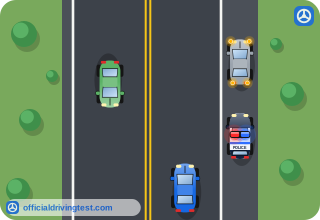
Why is it important to move over or slow down around vehicles displaying flashing lights on the side of the road?
- It keeps the flashing lights from blinding you
- It helps prevent secondary crashes
- It lets tow trucks reach the vehicle sooner
- It gives you a better view of roadside signs
Show answer
Correct answer: It helps prevent secondary crashes
Moving over or slowing down helps prevent secondary crashes.
Source: Oklahoma Driver Manual (2025 (updated November 24, 2025)), page 30 · Open this page in the manual (Manual page 30)
-
What is a secondary crash?
- A crash that involves a vehicle stopped on the shoulder
- A crash involving two or more vehicles in separate lanes
- Any crash that occurs because of another crash or incident
- A minor crash that causes only property damage
Show answer
Correct answer: Any crash that occurs because of another crash or incident
A secondary crash is one caused by an earlier crash or incident.
Source: Oklahoma Driver Manual (2025 (updated November 24, 2025)), page 30 · Open this page in the manual (Manual page 30)
-
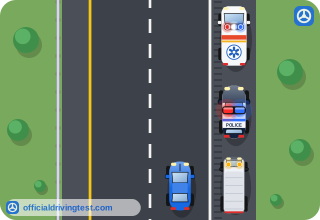
Why do secondary crashes often happen?
- A driver is distracted by the sight of a crash
- Drivers move over a lane away from the scene
- Drivers slow down and follow responders' directions
- Drivers stay alert near the scene
Show answer
Correct answer: A driver is distracted by the sight of a crash
Drivers who stare at a crash and take their eyes off the road can cause another crash.
Source: Oklahoma Driver Manual (2025 (updated November 24, 2025)), page 30 · Open this page in the manual (Manual page 30)
-
What is a Traffic Incident Management (TIM) scene?
- The area of a roadway incident where responders are actively working to clear it
- A stretch of roadway where law enforcement is checking vehicle speeds
- The roadside area where drivers may pull off to rest or make a phone call
- The area of a crash where only tow operators are permitted to work
Show answer
Correct answer: The area of a roadway incident where responders are actively working to clear it
A TIM scene is where an incident has occurred and responders, law enforcement or tow operators are working to manage and clear it.
Source: Oklahoma Driver Manual (2025 (updated November 24, 2025)), page 31 · Open this page in the manual (Manual page 31)
-
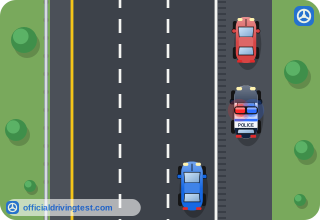
Why do Move Over laws exist?
- To keep traffic flowing at the posted speed through an incident area
- To give tow trucks priority on the highway
- To protect responders at risk of being hit by passing vehicles
- To reduce the number of vehicles near a crash scene
Show answer
Correct answer: To protect responders at risk of being hit by passing vehicles
Responders at an incident scene can be hit by passing vehicles, and Move Over laws protect them.
Source: Oklahoma Driver Manual (2025 (updated November 24, 2025)), page 31 · Open this page in the manual (Manual page 31)
-
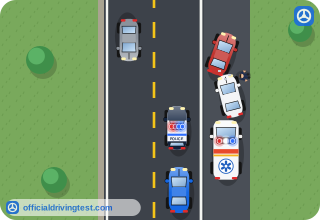
Which of these should a driver do when approaching a TIM scene?
- Keep the same speed through the scene
- Stop and watch from your lane
- Rely on responders to move out of your way
- Follow any directions from emergency responders
Show answer
Correct answer: Follow any directions from emergency responders
A driver approaching a TIM scene should follow any directions the emergency responders give.
Source: Oklahoma Driver Manual (2025 (updated November 24, 2025)), page 31 · Open this page in the manual (Manual page 31)
-
Which of these should you NOT do when approaching a TIM scene?
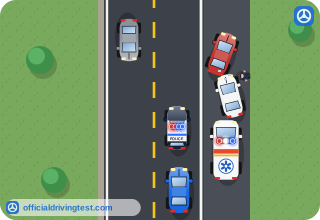
- Stay alert and aware
- Slow down
- Rubberneck at the scene
- Move over if possible
Show answer
Correct answer: Rubberneck at the scene
The manual lists rubbernecking, or staring at the scene, as something a driver should not do.
Source: Oklahoma Driver Manual (2025 (updated November 24, 2025)), page 31 · Open this page in the manual (Manual page 31)