Oklahoma: Emergencies and crashes — Part 1 Practice Test
Questions in this part include: “Which of these describes carbon monoxide gas from your engine?” · “When is carbon monoxide most likely to leak into your car?”
Independent educational site · not affiliated with any government agency or DMV
Ready? Test yourself
- Instant feedback with an explanation
- Every answer cites its source in the manual
- Your best score is saved on this device
- Keyboard: press 1 to 4 to answer and Enter for the next question
Questions are original and based on the official manual "Oklahoma Driver Manual" (2025 (updated November 24, 2025)), Service Oklahoma.
All 18 questions in this practice test
Take the test above first, then use this list to study. Tap “Show answer” to see the correct answer and explanation.
Show the questions and answersHide the questions
-
If you have a breakdown or an emergency on an expressway, where should you pull off?
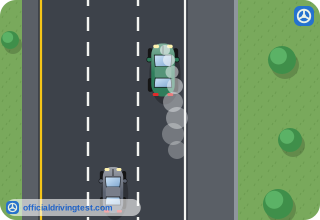
- Onto the grass median between the two directions of traffic
- Onto the left shoulder next to the fastest lane
- To the extreme right shoulder, away from moving traffic
- Into the right lane, close to the exit ramp
Show answer
Correct answer: To the extreme right shoulder, away from moving traffic
After signaling, you move to the extreme right shoulder, as far from moving traffic as is safe.
Source: Oklahoma Driver Manual (2025 (updated November 24, 2025)), page 34 · Open this page in the manual (Manual page 34)
-
After you pull off the road because of a breakdown or an emergency, what should you turn on?
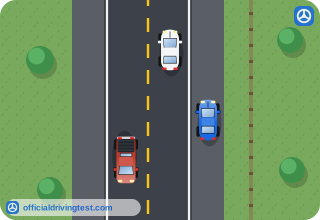
- Your high-beam headlights
- Your emergency flashers
- Your windshield wipers
- Your parking lights only
Show answer
Correct answer: Your emergency flashers
The manual tells a stopped driver to switch on the emergency flashers so others see the vehicle.
Source: Oklahoma Driver Manual (2025 (updated November 24, 2025)), page 34 · Open this page in the manual (Manual page 34)
-
You have stopped because of an emergency and you are out of your car. What should you do?
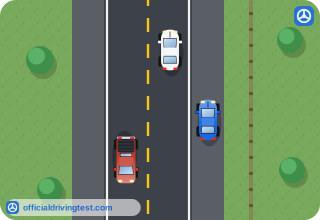
- Walk along the edge of the road to find help
- Stand behind the car on the traffic side to wave down help
- Let children wait beside the road while you check the car
- Never walk near the roadway and keep children away from traffic
Show answer
Correct answer: Never walk near the roadway and keep children away from traffic
The manual says to stay away from the roadway when out of your car and to keep children away from the traffic.
Source: Oklahoma Driver Manual (2025 (updated November 24, 2025)), page 34 · Open this page in the manual (Manual page 34)
-
What should you do if you have a flat tire or blowout?
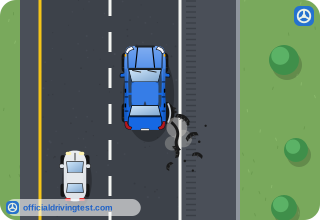
- Take your foot off the gas pedal and apply your brakes cautiously
- Brake hard right away so you stop as quickly as you can
- Press the gas pedal firmly to keep control of the car
- Shift to neutral and let the car coast to a stop
Show answer
Correct answer: Take your foot off the gas pedal and apply your brakes cautiously
The manual says to take your foot off the gas and brake cautiously, and never to brake suddenly.
Source: Oklahoma Driver Manual (2025 (updated November 24, 2025)), page 43 · Open this page in the manual (Manual page 43)
-
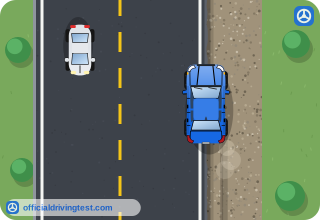
If you run off the pavement, how should you handle the steering wheel and brakes?
- Turn the wheel sharply back onto the pavement and brake hard
- Let go of the wheel and brake hard
- Hold the wheel loosely and apply your brakes suddenly
- Hold the steering wheel firmly and apply your brakes lightly
Show answer
Correct answer: Hold the steering wheel firmly and apply your brakes lightly
You hold the wheel firmly, brake lightly and reduce speed until you can safely return to the pavement.
Source: Oklahoma Driver Manual (2025 (updated November 24, 2025)), page 43 · Open this page in the manual (Manual page 43)
-
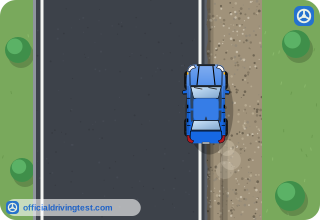
After running off the pavement, what should you do before steering back into your lane?
- Turn on your hazard lights
- Check traffic in both directions
- Come to a full stop on the shoulder
- Accelerate to get back quickly
Show answer
Correct answer: Check traffic in both directions
When it is safe, you steer carefully back into your lane after checking traffic in both directions.
Source: Oklahoma Driver Manual (2025 (updated November 24, 2025)), page 43 · Open this page in the manual (Manual page 43)
-
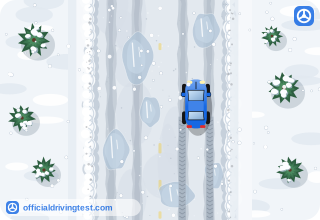
On ice, snow, sleet, gravel, sand and other loose surfaces, how should you brake in a car with standard brakes?
- Tap the brakes slightly, about one second apart
- Press the brake pedal hard and hold it down
- Tap the brakes quickly several times a second
- Tap the brakes about five seconds apart
Show answer
Correct answer: Tap the brakes slightly, about one second apart
On loose or slippery surfaces you tap the brakes about one second apart, because braking suddenly can make the car skid.
Source: Oklahoma Driver Manual (2025 (updated November 24, 2025)), page 43 · Open this page in the manual (Manual page 43)
-
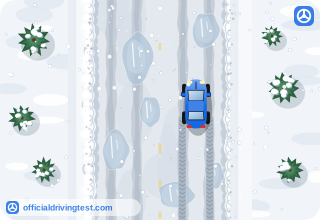
What does the manual say about tapping the brakes on loose or slippery surfaces if your car has antilock brakes?
- Tap them about two seconds apart
- Tap them twice as fast as standard brakes
- Never tap antilock brakes
- Tap them only on snow, not on ice
Show answer
Correct answer: Never tap antilock brakes
The tapping instruction is for standard brakes; the manual cautions never to tap antilock brakes.
Source: Oklahoma Driver Manual (2025 (updated November 24, 2025)), page 43 · Open this page in the manual (Manual page 43)
-
The manual's instructions for braking in an emergency (a blowout, running off the pavement, loose surfaces) are written for which kind of braking system?
- Antilock braking systems only
- Standard braking systems
- Vehicles with a manual transmission only
- Trucks and large vehicles only
Show answer
Correct answer: Standard braking systems
The manual notes that these emergency braking instructions are for standard braking systems.
Source: Oklahoma Driver Manual (2025 (updated November 24, 2025)), page 43 · Open this page in the manual (Manual page 43)
-
What can sudden over-correction do?
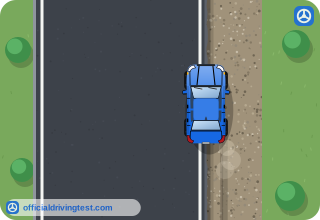
- Help straighten the car out faster
- Increase your traction on the road
- Shorten your stopping distance
- Make you lose control of your car
Show answer
Correct answer: Make you lose control of your car
Sudden over-correction can make you lose control, so changes should be made slowly and carefully.
Source: Oklahoma Driver Manual (2025 (updated November 24, 2025)), page 43 · Open this page in the manual (Manual page 43)
-
What is the best skid control according to the manual?
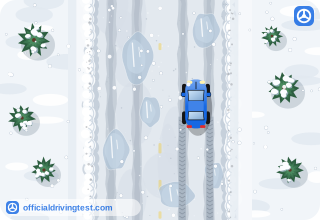
- Prevention
- Braking hard
- Using the clutch
- Steering sharply
Show answer
Correct answer: Prevention
There is very little you can do once a skid starts, so the best skid control is prevention.
Source: Oklahoma Driver Manual (2025 (updated November 24, 2025)), page 43 · Open this page in the manual (Manual page 43)
-
What does the manual say about the clutch when you are on ice and braking?
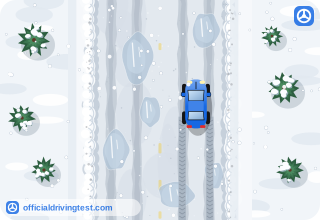
- Don't use the clutch
- Press the clutch to the floor to let the car roll
- Release the clutch slowly while braking
- Use the clutch to downshift as hard as you can
Show answer
Correct answer: Don't use the clutch
The manual says sudden braking increases a skid and not to use the clutch.
Source: Oklahoma Driver Manual (2025 (updated November 24, 2025)), page 43 · Open this page in the manual (Manual page 43)
-
As a general rule, what should you do if your car starts to skid?
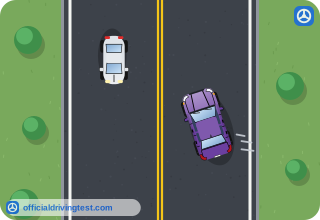
- Brake as hard as you can and steer away from the direction of the skid
- Press the clutch and the brake pedal down at the same time until the car stops
- Take your foot off the brake and steer in the direction of the skid if you safely can
- Accelerate gently and hold the steering wheel straight until it stops
Show answer
Correct answer: Take your foot off the brake and steer in the direction of the skid if you safely can
You take your foot off the brake and steer in the direction of the skid, unless that means leaving the road, hitting something or entering oncoming traffic.
Source: Oklahoma Driver Manual (2025 (updated November 24, 2025)), page 43 · Open this page in the manual (Manual page 43)
-
You are meeting other traffic and the rear of your car skids to the left. What does the manual say about steering into the skid?
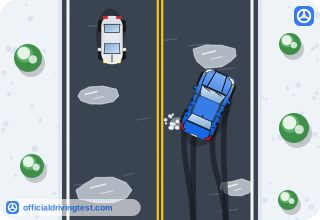
- You should steer left into the oncoming lane to follow the skid
- You would not steer into the oncoming traffic
- You should brake as hard as you can until the car stops
- You should shift to a lower gear and accelerate
Show answer
Correct answer: You would not steer into the oncoming traffic
Steering in the direction of the skid is not always best; if it would take you into oncoming traffic, you do not do it.
Source: Oklahoma Driver Manual (2025 (updated November 24, 2025)), page 43 · Open this page in the manual (Manual page 43)
-
If your vehicle breaks down on a highway, what does the manual say to do?
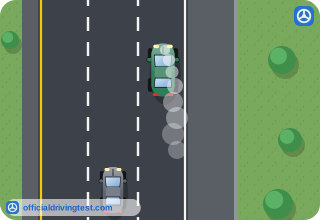
- Leave it in the right lane and turn on your headlights
- Move it onto the pavement edge and wait for traffic to clear
- Stop in place and turn on your parking lights only
- Move it completely off the highway and turn on the emergency flashers
Show answer
Correct answer: Move it completely off the highway and turn on the emergency flashers
A disabled vehicle should be moved fully off the highway with the emergency flashers on.
Source: Oklahoma Driver Manual (2025 (updated November 24, 2025)), page 46 · Open this page in the manual (Manual page 46)
-
Which of these describes carbon monoxide gas from your engine?
- It has a sweet smell you can notice at once
- You cannot see, smell or taste it
- It looks like thin gray smoke
- It leaves a bitter taste in your mouth
Show answer
Correct answer: You cannot see, smell or taste it
Carbon monoxide cannot be seen, smelled or tasted, yet it can kill you.
Source: Oklahoma Driver Manual (2025 (updated November 24, 2025)), page 60 · Open this page in the manual (Manual page 60)
-
When is carbon monoxide most likely to leak into your car?
- When the air conditioner is on high
- When the windows are fully open
- When you drive on an empty highway
- When your exhaust system is faulty
Show answer
Correct answer: When your exhaust system is faulty
A faulty exhaust system is one of the situations the manual names for carbon monoxide leaking into the car.
Source: Oklahoma Driver Manual (2025 (updated November 24, 2025)), page 60 · Open this page in the manual (Manual page 60)
-
A faulty exhaust system can leak poisonous fumes into which part of the car where children may be sitting or sleeping?
- The back seat area
- The glove compartment
- The engine compartment
- The trunk only
Show answer
Correct answer: The back seat area
The manual warns that fumes from a faulty exhaust can reach the back seat area where children may sit or sleep.
Source: Oklahoma Driver Manual (2025 (updated November 24, 2025)), page 60 · Open this page in the manual (Manual page 60)