Oklahoma: Emergencies and crashes
Brake failure, skids, carbon monoxide, flooded roads, animals on the road, the emergency kit and what to do after a crash. Split into 3 shorter tests so you're not stuck in one long quiz.
Independent educational site · not affiliated with any government agency or DMV
Choose a part
Emergencies and crashes — Part 1
Questions in this part include: “Which of these describes carbon monoxide gas from your engine?”
StartEmergencies and crashes — Part 2
Questions in this part include: “Which of these is a symptom of carbon monoxide poisoning?”
StartEmergencies and crashes — Part 3
Questions in this part include: “Which of these must you exchange with the other driver after a crash?”
StartAll 52 Emergencies and crashes questions with answers
Choose a part above to take a practice test, or study every question and answer here.
Show the questions and answersHide the questions
-
If you have a breakdown or an emergency on an expressway, where should you pull off?
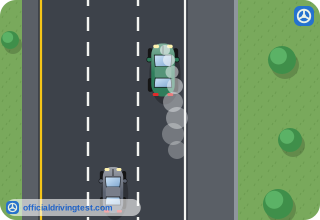
- Onto the grass median between the two directions of traffic
- Onto the left shoulder next to the fastest lane
- To the extreme right shoulder, away from moving traffic
- Into the right lane, close to the exit ramp
Show answer
Correct answer: To the extreme right shoulder, away from moving traffic
After signaling, you move to the extreme right shoulder, as far from moving traffic as is safe.
Source: Oklahoma Driver Manual (2025 (updated November 24, 2025)), page 34 · Open this page in the manual (Manual page 34)
-
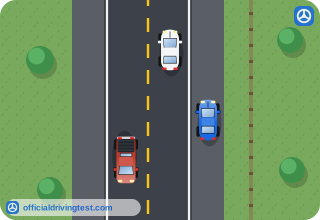
After you pull off the road because of a breakdown or an emergency, what should you turn on?
- Your high-beam headlights
- Your emergency flashers
- Your windshield wipers
- Your parking lights only
Show answer
Correct answer: Your emergency flashers
The manual tells a stopped driver to switch on the emergency flashers so others see the vehicle.
Source: Oklahoma Driver Manual (2025 (updated November 24, 2025)), page 34 · Open this page in the manual (Manual page 34)
-
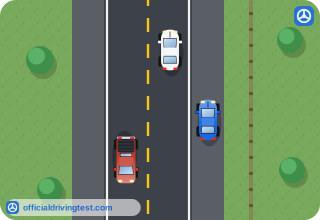
You have stopped because of an emergency and you are out of your car. What should you do?
- Walk along the edge of the road to find help
- Stand behind the car on the traffic side to wave down help
- Let children wait beside the road while you check the car
- Never walk near the roadway and keep children away from traffic
Show answer
Correct answer: Never walk near the roadway and keep children away from traffic
The manual says to stay away from the roadway when out of your car and to keep children away from the traffic.
Source: Oklahoma Driver Manual (2025 (updated November 24, 2025)), page 34 · Open this page in the manual (Manual page 34)
-
What should you do if you have a flat tire or blowout?
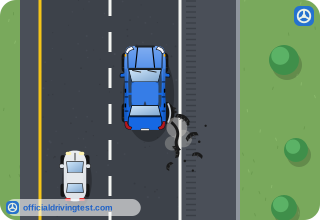
- Take your foot off the gas pedal and apply your brakes cautiously
- Brake hard right away so you stop as quickly as you can
- Press the gas pedal firmly to keep control of the car
- Shift to neutral and let the car coast to a stop
Show answer
Correct answer: Take your foot off the gas pedal and apply your brakes cautiously
The manual says to take your foot off the gas and brake cautiously, and never to brake suddenly.
Source: Oklahoma Driver Manual (2025 (updated November 24, 2025)), page 43 · Open this page in the manual (Manual page 43)
-
If you run off the pavement, how should you handle the steering wheel and brakes?
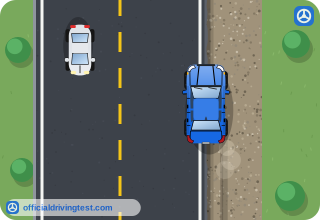
- Turn the wheel sharply back onto the pavement and brake hard
- Let go of the wheel and brake hard
- Hold the wheel loosely and apply your brakes suddenly
- Hold the steering wheel firmly and apply your brakes lightly
Show answer
Correct answer: Hold the steering wheel firmly and apply your brakes lightly
You hold the wheel firmly, brake lightly and reduce speed until you can safely return to the pavement.
Source: Oklahoma Driver Manual (2025 (updated November 24, 2025)), page 43 · Open this page in the manual (Manual page 43)
-
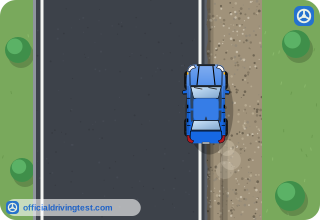
After running off the pavement, what should you do before steering back into your lane?
- Turn on your hazard lights
- Check traffic in both directions
- Come to a full stop on the shoulder
- Accelerate to get back quickly
Show answer
Correct answer: Check traffic in both directions
When it is safe, you steer carefully back into your lane after checking traffic in both directions.
Source: Oklahoma Driver Manual (2025 (updated November 24, 2025)), page 43 · Open this page in the manual (Manual page 43)
-
On ice, snow, sleet, gravel, sand and other loose surfaces, how should you brake in a car with standard brakes?
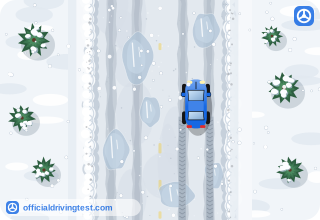
- Tap the brakes slightly, about one second apart
- Press the brake pedal hard and hold it down
- Tap the brakes quickly several times a second
- Tap the brakes about five seconds apart
Show answer
Correct answer: Tap the brakes slightly, about one second apart
On loose or slippery surfaces you tap the brakes about one second apart, because braking suddenly can make the car skid.
Source: Oklahoma Driver Manual (2025 (updated November 24, 2025)), page 43 · Open this page in the manual (Manual page 43)
-
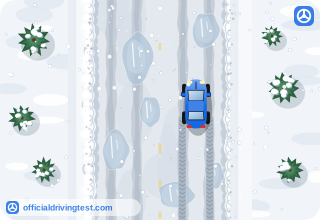
What does the manual say about tapping the brakes on loose or slippery surfaces if your car has antilock brakes?
- Tap them about two seconds apart
- Tap them twice as fast as standard brakes
- Never tap antilock brakes
- Tap them only on snow, not on ice
Show answer
Correct answer: Never tap antilock brakes
The tapping instruction is for standard brakes; the manual cautions never to tap antilock brakes.
Source: Oklahoma Driver Manual (2025 (updated November 24, 2025)), page 43 · Open this page in the manual (Manual page 43)
-
The manual's instructions for braking in an emergency (a blowout, running off the pavement, loose surfaces) are written for which kind of braking system?
- Antilock braking systems only
- Standard braking systems
- Vehicles with a manual transmission only
- Trucks and large vehicles only
Show answer
Correct answer: Standard braking systems
The manual notes that these emergency braking instructions are for standard braking systems.
Source: Oklahoma Driver Manual (2025 (updated November 24, 2025)), page 43 · Open this page in the manual (Manual page 43)
-
What can sudden over-correction do?
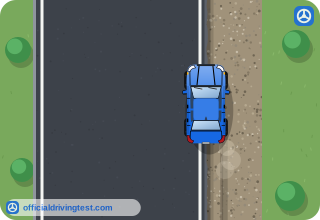
- Help straighten the car out faster
- Increase your traction on the road
- Shorten your stopping distance
- Make you lose control of your car
Show answer
Correct answer: Make you lose control of your car
Sudden over-correction can make you lose control, so changes should be made slowly and carefully.
Source: Oklahoma Driver Manual (2025 (updated November 24, 2025)), page 43 · Open this page in the manual (Manual page 43)
-
What is the best skid control according to the manual?
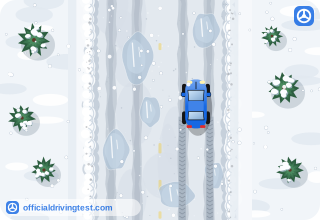
- Prevention
- Braking hard
- Using the clutch
- Steering sharply
Show answer
Correct answer: Prevention
There is very little you can do once a skid starts, so the best skid control is prevention.
Source: Oklahoma Driver Manual (2025 (updated November 24, 2025)), page 43 · Open this page in the manual (Manual page 43)
-
What does the manual say about the clutch when you are on ice and braking?
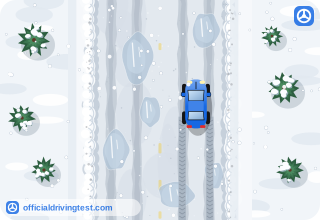
- Don't use the clutch
- Press the clutch to the floor to let the car roll
- Release the clutch slowly while braking
- Use the clutch to downshift as hard as you can
Show answer
Correct answer: Don't use the clutch
The manual says sudden braking increases a skid and not to use the clutch.
Source: Oklahoma Driver Manual (2025 (updated November 24, 2025)), page 43 · Open this page in the manual (Manual page 43)
-
As a general rule, what should you do if your car starts to skid?
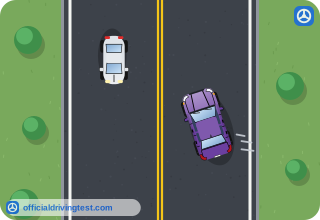
- Brake as hard as you can and steer away from the direction of the skid
- Press the clutch and the brake pedal down at the same time until the car stops
- Take your foot off the brake and steer in the direction of the skid if you safely can
- Accelerate gently and hold the steering wheel straight until it stops
Show answer
Correct answer: Take your foot off the brake and steer in the direction of the skid if you safely can
You take your foot off the brake and steer in the direction of the skid, unless that means leaving the road, hitting something or entering oncoming traffic.
Source: Oklahoma Driver Manual (2025 (updated November 24, 2025)), page 43 · Open this page in the manual (Manual page 43)
-
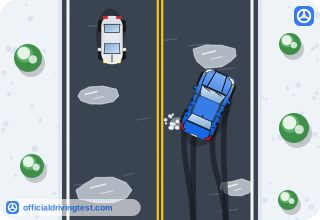
You are meeting other traffic and the rear of your car skids to the left. What does the manual say about steering into the skid?
- You should steer left into the oncoming lane to follow the skid
- You would not steer into the oncoming traffic
- You should brake as hard as you can until the car stops
- You should shift to a lower gear and accelerate
Show answer
Correct answer: You would not steer into the oncoming traffic
Steering in the direction of the skid is not always best; if it would take you into oncoming traffic, you do not do it.
Source: Oklahoma Driver Manual (2025 (updated November 24, 2025)), page 43 · Open this page in the manual (Manual page 43)
-
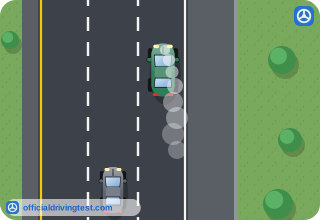
If your vehicle breaks down on a highway, what does the manual say to do?
- Leave it in the right lane and turn on your headlights
- Move it onto the pavement edge and wait for traffic to clear
- Stop in place and turn on your parking lights only
- Move it completely off the highway and turn on the emergency flashers
Show answer
Correct answer: Move it completely off the highway and turn on the emergency flashers
A disabled vehicle should be moved fully off the highway with the emergency flashers on.
Source: Oklahoma Driver Manual (2025 (updated November 24, 2025)), page 46 · Open this page in the manual (Manual page 46)
-
Which of these describes carbon monoxide gas from your engine?
- It has a sweet smell you can notice at once
- You cannot see, smell or taste it
- It looks like thin gray smoke
- It leaves a bitter taste in your mouth
Show answer
Correct answer: You cannot see, smell or taste it
Carbon monoxide cannot be seen, smelled or tasted, yet it can kill you.
Source: Oklahoma Driver Manual (2025 (updated November 24, 2025)), page 60 · Open this page in the manual (Manual page 60)
-
When is carbon monoxide most likely to leak into your car?
- When the air conditioner is on high
- When the windows are fully open
- When you drive on an empty highway
- When your exhaust system is faulty
Show answer
Correct answer: When your exhaust system is faulty
A faulty exhaust system is one of the situations the manual names for carbon monoxide leaking into the car.
Source: Oklahoma Driver Manual (2025 (updated November 24, 2025)), page 60 · Open this page in the manual (Manual page 60)
-
A faulty exhaust system can leak poisonous fumes into which part of the car where children may be sitting or sleeping?
- The back seat area
- The glove compartment
- The engine compartment
- The trunk only
Show answer
Correct answer: The back seat area
The manual warns that fumes from a faulty exhaust can reach the back seat area where children may sit or sleep.
Source: Oklahoma Driver Manual (2025 (updated November 24, 2025)), page 60 · Open this page in the manual (Manual page 60)
-
Which of these is a symptom of carbon monoxide poisoning?
- Your skin turns bright red
- Lights seem dimmer than usual
- Skin and lips take on a blue color
- You feel wide awake and full of energy
Show answer
Correct answer: Skin and lips take on a blue color
Blue skin and blue lips are listed symptoms, along with drowsiness, dizziness, brighter-looking lights and a tight forehead.
Source: Oklahoma Driver Manual (2025 (updated November 24, 2025)), page 60 · Open this page in the manual (Manual page 60)
-
What should you do if you notice symptoms of carbon monoxide poisoning while driving?
- Close the windows and keep driving
- Pull off the road, park and turn off the motor
- Turn the heater up and drive on
- Slow down and keep going to the next town
Show answer
Correct answer: Pull off the road, park and turn off the motor
The manual says to pull off the road, park, turn off the motor and open your windows.
Source: Oklahoma Driver Manual (2025 (updated November 24, 2025)), page 60 · Open this page in the manual (Manual page 60)
-
What may a child or passenger overcome with carbon monoxide require?
- Only a drink of water
- Only a few minutes of sleep
- Nothing, because the effects pass quickly
- Artificial respiration or medical attention
Show answer
Correct answer: Artificial respiration or medical attention
Someone overcome by carbon monoxide may need artificial respiration or medical attention.
Source: Oklahoma Driver Manual (2025 (updated November 24, 2025)), page 60 · Open this page in the manual (Manual page 60)
-
Who should check your exhaust system regularly to help avoid carbon monoxide poisoning?
- A reputable mechanic
- A police officer
- A tow truck operator
- A Service Oklahoma representative
Show answer
Correct answer: A reputable mechanic
Regular exhaust checks by a reputable mechanic are listed as a way to avoid carbon monoxide poisoning.
Source: Oklahoma Driver Manual (2025 (updated November 24, 2025)), page 60 · Open this page in the manual (Manual page 60)
-
Which unusual sign should you watch for to help avoid carbon monoxide poisoning?
- A squeal from the brake pedal
- A rattle from the glove box
- An unusual roar from under the car
- A hum from the radio
Show answer
Correct answer: An unusual roar from under the car
An unusual roar from under the car can signal an exhaust problem.
Source: Oklahoma Driver Manual (2025 (updated November 24, 2025)), page 60 · Open this page in the manual (Manual page 60)
-
What should you never do to avoid carbon monoxide poisoning?
- Park in an open driveway
- Run the engine in a closed garage
- Run the heater in cold weather
- Open the windows while parked
Show answer
Correct answer: Run the engine in a closed garage
Exhaust builds up in a closed garage, so the manual says never to let the engine run there.
Source: Oklahoma Driver Manual (2025 (updated November 24, 2025)), page 60 · Open this page in the manual (Manual page 60)
-
What does the manual say to do with the fresh-air vent in congested traffic?
- Open it
- Point it at the windshield
- Open it only halfway
- Close it
Show answer
Correct answer: Close it
In congested traffic the manual says to close the fresh-air vent.
Source: Oklahoma Driver Manual (2025 (updated November 24, 2025)), page 60 · Open this page in the manual (Manual page 60)
-
What does the manual say to do with the fresh-air vent on the highways in cold weather?
- Open it
- Close it
- Keep it closed to hold in the heat
- Open it only in the rain
Show answer
Correct answer: Open it
On highways in cold weather the manual says to open the fresh-air vent.
Source: Oklahoma Driver Manual (2025 (updated November 24, 2025)), page 60 · Open this page in the manual (Manual page 60)
-
What can carrying the listed emergency items in your car reduce?
- The cost of your auto insurance premium
- The delay and frustration of a roadside breakdown
- The chance of a tire blowing out on a trip
- Your fuel use on long highway trips
Show answer
Correct answer: The delay and frustration of a roadside breakdown
Being prepared for roadside emergencies reduces the delay and frustration of a breakdown and lets you help other drivers.
Source: Oklahoma Driver Manual (2025 (updated November 24, 2025)), page 62 · Open this page in the manual (Manual page 62)
-
Which of these items does the manual list for your car's emergency kit?
- A road atlas
- Spare fuses
- Extra washer fluid
- Emergency flares
Show answer
Correct answer: Emergency flares
Emergency flares are one of the items on the manual's emergency kit list.
Source: Oklahoma Driver Manual (2025 (updated November 24, 2025)), page 62 · Open this page in the manual (Manual page 62)
-
What does the manual list oil in the emergency kit for?
- Loosening lug nuts
- Topping off the engine
- Cleaning the windshield
- Lubricating the horn
Show answer
Correct answer: Loosening lug nuts
The kit includes oil for loosening lug nuts.
Source: Oklahoma Driver Manual (2025 (updated November 24, 2025)), page 62 · Open this page in the manual (Manual page 62)
-
Which emergency kit item does the manual list for letting other drivers know you need help?
- A small signal whistle
- A reflective safety vest
- A sign with "send help" on it
- A roll of duct tape for repairs
Show answer
Correct answer: A sign with "send help" on it
The kit lists a windshield sunscreen or a sign with "send help" on it.
Source: Oklahoma Driver Manual (2025 (updated November 24, 2025)), page 62 · Open this page in the manual (Manual page 62)
-
What does the "Stay Alert . . . Stay Alive!" message advise to avoid fatigue on long trips?
- Drive faster to arrive sooner
- Take a break occasionally
- Keep the windows closed
- Drink more coffee as you go
Show answer
Correct answer: Take a break occasionally
To avoid fatigue on long trips, the manual advises taking a break occasionally.
Source: Oklahoma Driver Manual (2025 (updated November 24, 2025)), page 62 · Open this page in the manual (Manual page 62)
-
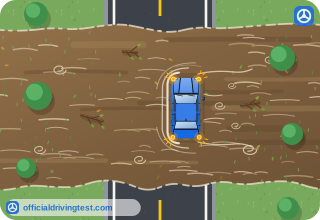
For each foot the water rises around a stalled vehicle, how much lateral force is applied to the car?
- 50 pounds
- 150 pounds
- 5,000 pounds
- 500 pounds
Show answer
Correct answer: 500 pounds
The manual says that for each foot the water rises, 500 pounds of lateral force are applied to the car.
Source: Oklahoma Driver Manual (2025 (updated November 24, 2025)), page 62 · Open this page in the manual (Manual page 62)
-
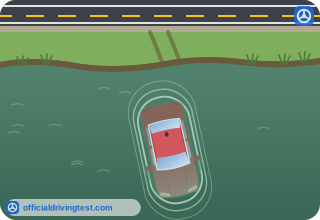
In effect, how much less does a car weigh for each foot the flood water rises?
- 1,500 pounds
- 150 pounds
- 750 pounds
- 3,000 pounds
Show answer
Correct answer: 1,500 pounds
The car displaces 1,500 pounds of water for each foot of rise, so it effectively weighs 1,500 pounds less.
Source: Oklahoma Driver Manual (2025 (updated November 24, 2025)), page 62 · Open this page in the manual (Manual page 62)
-
In about how little water will most vehicles float, even SUVs?
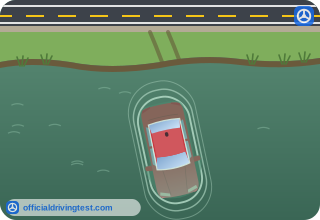
- 4 feet (48 inches)
- 5 feet (60 inches)
- 2 feet (24 inches)
- 6 feet (72 inches)
Show answer
Correct answer: 2 feet (24 inches)
The manual says most vehicles will float in just 2 feet (24 inches) of water, even SUVs.
Source: Oklahoma Driver Manual (2025 (updated November 24, 2025)), page 62 · Open this page in the manual (Manual page 62)
-
According to the Flood Safety Rules, what can easily happen to cars in the water?
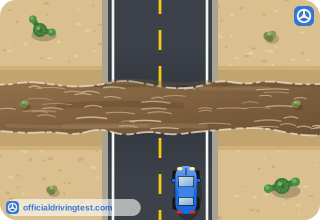
- They can float only in deep water
- They can stall and be carried away
- They can cross safely at low speed
- They can dry out the engine quickly
Show answer
Correct answer: They can stall and be carried away
Cars can easily stall in water and be carried away in any current.
Source: Oklahoma Driver Manual (2025 (updated November 24, 2025)), page 62 · Open this page in the manual (Manual page 62)
-
What does the manual say about trying to cross a flooded road or stream in your vehicle?
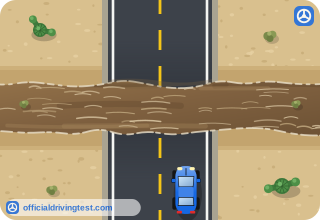
- Cross it only in an SUV
- Cross it only at low speed
- Cross it only in the daytime
- Do not try to cross it
Show answer
Correct answer: Do not try to cross it
The Flood Safety Rules say not to try to cross a flooded road or stream in your vehicle.
Source: Oklahoma Driver Manual (2025 (updated November 24, 2025)), page 62 · Open this page in the manual (Manual page 62)
-
What does the manual say to do about barricades at low-water crossings?
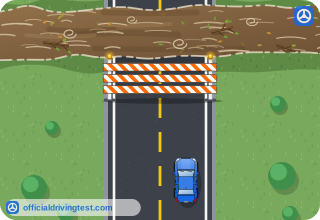
- Do not drive around them
- Drive around them slowly
- Move them aside if no one is near
- Drive around them if the water is shallow
Show answer
Correct answer: Do not drive around them
Do not drive around barricades at low-water crossings.
Source: Oklahoma Driver Manual (2025 (updated November 24, 2025)), page 63 · Open this page in the manual (Manual page 63)
-
When does the manual say you should be especially vigilant about flooded roadways?
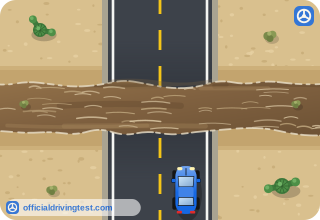
- Only at midday on familiar roads
- Only when it is not raining
- At night or on unfamiliar roads
- Only on freeways
Show answer
Correct answer: At night or on unfamiliar roads
The Flood Safety Rules say to be especially vigilant at night or on unfamiliar roads.
Source: Oklahoma Driver Manual (2025 (updated November 24, 2025)), page 63 · Open this page in the manual (Manual page 63)
-
How little water may be enough to cause you to lose control of your vehicle?
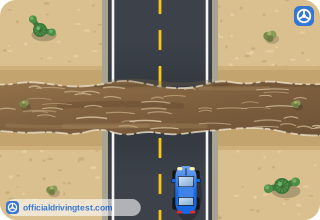
- 12 inches
- 6 inches
- 18 inches
- 2 feet
Show answer
Correct answer: 6 inches
The manual says 6 inches of water may be enough to cause you to lose control of your vehicle.
Source: Oklahoma Driver Manual (2025 (updated November 24, 2025)), page 63 · Open this page in the manual (Manual page 63)
-
What may have happened beneath the surface of water covering a road?
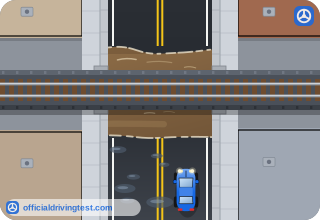
- The road surface is usually still safe
- The water is always shallow
- Traffic signs are still visible
- The roadbed may have been washed away
Show answer
Correct answer: The roadbed may have been washed away
The manual warns that roadbeds beneath the water may have been washed away.
Source: Oklahoma Driver Manual (2025 (updated November 24, 2025)), page 63 · Open this page in the manual (Manual page 63)
-
How little fast-moving water can knock you off your feet if you abandon your vehicle?
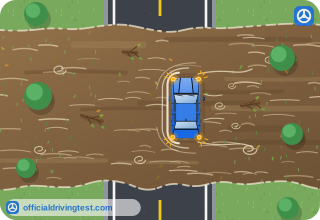
- 6 inches
- 1 foot
- 2 feet
- 3 feet
Show answer
Correct answer: 6 inches
The manual says you can be knocked off your feet by 6 inches of fast-moving water.
Source: Oklahoma Driver Manual (2025 (updated November 24, 2025)), page 63 · Open this page in the manual (Manual page 63)
-
What does the manual say to do if you encounter a flooded roadway?
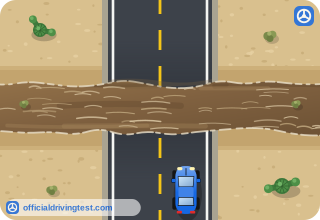
- Slow down and cross it
- Follow the car ahead through it
- Turn around
- Cross at the shallowest looking spot
Show answer
Correct answer: Turn around
The manual's slogan for a flooded roadway is "Turn around, don't drown."
Source: Oklahoma Driver Manual (2025 (updated November 24, 2025)), page 63 · Open this page in the manual (Manual page 63)
-
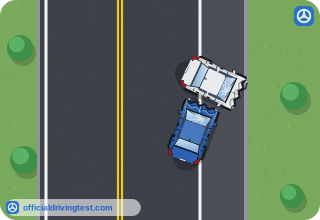
If you are in a collision that results in death, injury or property damage, what must you do first after remaining calm?
- Turn on your headlights and drive home
- Stop and call 911 or local law enforcement
- Take photos before you stop
- Exchange insurance cards before stopping
Show answer
Correct answer: Stop and call 911 or local law enforcement
The first listed step after a crash is to stop and call 911 or local law enforcement.
Source: Oklahoma Driver Manual (2025 (updated November 24, 2025)), page 63 · Open this page in the manual (Manual page 63)
-
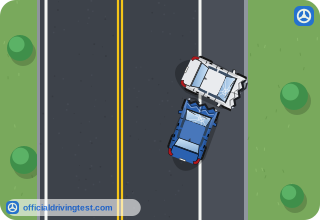
After a crash, which lights should you turn on?
- High beams
- Parking lights only
- Fog lights
- Hazard lights
Show answer
Correct answer: Hazard lights
Turning on hazard lights is the second step after a crash.
Source: Oklahoma Driver Manual (2025 (updated November 24, 2025)), page 63 · Open this page in the manual (Manual page 63)
-
If anyone is hurt in a crash, when should you try to move an injured person?
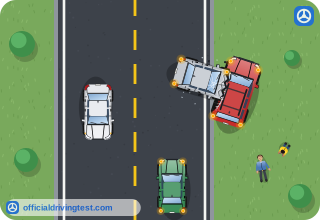
- Only if it is a life-or-death necessity
- As soon as the person asks
- Whenever the car is blocking traffic
- Only after taking photos
Show answer
Correct answer: Only if it is a life-or-death necessity
The manual says not to move an injured person unless it is a life-or-death necessity.
Source: Oklahoma Driver Manual (2025 (updated November 24, 2025)), page 63 · Open this page in the manual (Manual page 63)
-
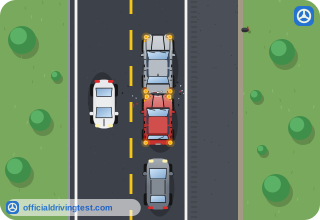
What must you do if a crash is minor and your vehicle is blocking the flow of traffic?
- Leave it exactly where it is
- Keep it in place until officers arrive
- Move it or have it moved
- Turn off the hazard lights and wait
Show answer
Correct answer: Move it or have it moved
For a minor crash blocking traffic you must move the vehicle or have it moved.
Source: Oklahoma Driver Manual (2025 (updated November 24, 2025)), page 63 · Open this page in the manual (Manual page 63)
-
Which of these must you exchange with the other driver after a crash?
- Employer name and address
- Vehicle registration number
- Social Security number
- Credit card number
Show answer
Correct answer: Vehicle registration number
The information to exchange includes name, address, phone number, driver license, vehicle registration number and insurance.
Source: Oklahoma Driver Manual (2025 (updated November 24, 2025)), page 63 · Open this page in the manual (Manual page 63)
-
What does the manual list among the steps to take after a crash, in addition to getting help and exchanging information?
- Post about it online
- Move the car to a new street
- Call the other driver's employer
- Take photos
Show answer
Correct answer: Take photos
Taking photos is one of the steps listed for after a crash.
Source: Oklahoma Driver Manual (2025 (updated November 24, 2025)), page 63 · Open this page in the manual (Manual page 63)
-
After a crash, what does the manual say about blame and discussing the accident?
- Do not blame anyone or accept blame, and do not discuss it
- Admit fault right away to speed up the report
- Blame the other driver if it was clearly their fault
- Discuss the details with every witness
Show answer
Correct answer: Do not blame anyone or accept blame, and do not discuss it
You should not blame anyone, accept blame or discuss the accident; wait for the officers instead.
Source: Oklahoma Driver Manual (2025 (updated November 24, 2025)), page 63 · Open this page in the manual (Manual page 63)
-
How should you answer the questions of law enforcement officers after a crash?
- Briefly and only when asked twice
- Only after speaking with your insurer
- Truthfully and calmly
- Only through the other driver
Show answer
Correct answer: Truthfully and calmly
The manual says to wait for the officers and answer questions truthfully and calmly.
Source: Oklahoma Driver Manual (2025 (updated November 24, 2025)), page 63 · Open this page in the manual (Manual page 63)
-
If a collision involves a parked car or property and you cannot locate the owner, what should you leave on the damaged property?
- Only your phone number and the date and time of the crash
- Names and addresses, plus insurance verification information
- A note saying the damage looks minor, with your first name
- Nothing, because no one saw the crash and no report is needed
Show answer
Correct answer: Names and addresses, plus insurance verification information
You leave the driver's and vehicle owner's names and addresses plus the insurance verification form information where the owner will find it.
Source: Oklahoma Driver Manual (2025 (updated November 24, 2025)), page 63 · Open this page in the manual (Manual page 63)
-
Who completes a report of the crash and places it on file?
- The investigation officer
- The other driver involved
- Your insurance agent
- The nearest witness
Show answer
Correct answer: The investigation officer
The investigation officer completes the report and places it on file.
Source: Oklahoma Driver Manual (2025 (updated November 24, 2025)), page 63 · Open this page in the manual (Manual page 63)