Ohio: Signals & vehicle controls
Turn signals, headlights, mirrors and seat adjustment, inspecting your vehicle and the controls you use. Split into 4 shorter tests so you're not stuck in one long quiz.
Independent educational site · not affiliated with any government agency or DMV
Choose a part
Signals & vehicle controls — Part 1
Questions in this part include: “Under Ohio law, no person shall drive a vehicle on any highway that is in such unsafe condition as to do what?”
StartSignals & vehicle controls — Part 2
Questions in this part include: “What do you use to search for safety recalls on the NHTSA website?”
StartSignals & vehicle controls — Part 3
Questions in this part include: “After you move the gear selector to "D" (drive), what should you check before moving off?”
StartSignals & vehicle controls — Part 4
Questions in this part include: “Headlights must be on when natural light does not make it possible to clearly see objects how far ahead?”
StartAll 71 Signals & vehicle controls questions with answers
Choose a part above to take a practice test, or study every question and answer here.
Show the questions and answersHide the questions
-
Under Ohio law, no person shall drive a vehicle on any highway that is in such unsafe condition as to do what?
- Reduce fuel economy
- Cause excessive noise
- Endanger any person
- Fail a yearly inspection
Show answer
Correct answer: Endanger any person
The law quoted in the manual bars driving a vehicle in such unsafe condition as to endanger any person.
Source: Ohio Driver Manual (HSY 7607 10/25 (October 2025)), page 4
-
Which of the following may a vehicle NOT be equipped with or permitted to have?
- Two red reflectors on the rear
- Protruding objects or broken sharp edges
- A horn audible from 200 feet
- A parking brake that holds on a grade
Show answer
Correct answer: Protruding objects or broken sharp edges
The manual says no vehicle is to have protruding objects, broken sharp edges, or parts dangerous to a person coming in contact with them.
Source: Ohio Driver Manual (HSY 7607 10/25 (October 2025)), page 4
-
What should the steering assembly of an average motor vehicle do?
- Lock in place whenever the engine is turned off
- Turn the wheels with some play for driver comfort
- Return automatically to center at every speed
- Operate normally with no excessive play
Show answer
Correct answer: Operate normally with no excessive play
The manual lists a steering assembly that operates normally with no excessive play in the wheel.
Source: Ohio Driver Manual (HSY 7607 10/25 (October 2025)), page 4
-
According to the vehicle equipment list, what is the minimum tire tread depth?
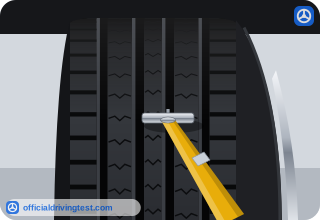
- 1/16 inch
- 1/4 inch
- 1/8 inch
- 1/32 inch
Show answer
Correct answer: 1/16 inch
The manual lists tires with a minimum of 1/16-inch tread depth.
Source: Ohio Driver Manual (HSY 7607 10/25 (October 2025)), page 4
-
What must the service brake be adequate to do?
- Hold the vehicle still on a steep grade
- Slow, stop, and control the vehicle
- Lock the rear wheels only in an emergency
- Warn the driver when the pads are worn
Show answer
Correct answer: Slow, stop, and control the vehicle
The manual says the service brake must be adequate to slow, stop, and control the vehicle.
Source: Ohio Driver Manual (HSY 7607 10/25 (October 2025)), page 4
-
What must the parking brake be adequate to do?
- Stop the vehicle from highway speed
- Slow the vehicle on wet pavement
- Keep the wheels turned toward the curb
- Hold the vehicle on a grade
Show answer
Correct answer: Hold the vehicle on a grade
The manual says the parking brake must be adequate to hold the vehicle on a grade.
Source: Ohio Driver Manual (HSY 7607 10/25 (October 2025)), page 4
-
How many headlights should a vehicle have in working order?
- Two, one on each side
- One, centered on the front
- Two, both on the driver side
- Four, two on each side
Show answer
Correct answer: Two, one on each side
The manual lists two headlights, one on each side, in working order.
Source: Ohio Driver Manual (HSY 7607 10/25 (October 2025)), page 4
-
From what distance must the two red reflectors on the rear of the vehicle be visible?
- 50 feet
- 200 feet
- 300 feet
- 500 feet
Show answer
Correct answer: 300 feet
The manual says the two red rear reflectors must be visible from 300 feet.
Source: Ohio Driver Manual (HSY 7607 10/25 (October 2025)), page 4
-
From what distance must the taillight that emits red light be visible?
- 100 feet
- 500 feet
- 300 feet
- 1,000 feet
Show answer
Correct answer: 500 feet
The manual says the taillight must be visible from 500 feet.
Source: Ohio Driver Manual (HSY 7607 10/25 (October 2025)), page 4
-
From what distance must the two red stop lights (brake lights) be visible when the brakes are applied?
- 50 feet
- 200 feet
- 300 feet
- 500 feet
Show answer
Correct answer: 500 feet
The manual says the stop lights must be visible from 500 feet when the brakes are applied.
Source: Ohio Driver Manual (HSY 7607 10/25 (October 2025)), page 4
-
From what distance must the white light that illuminates the rear license plate be visible?
- 50 feet
- 100 feet
- 200 feet
- 500 feet
Show answer
Correct answer: 50 feet
The manual says the white license plate light must be visible from 50 feet.
Source: Ohio Driver Manual (HSY 7607 10/25 (October 2025)), page 4
-
How many turn signals should a vehicle have, and from what distance must they be visible?
- One at the front and one at the rear, visible from 300 feet
- Two at the front and two at the rear, visible from 500 feet
- Two at the front and two at the rear, visible from 300 feet
- Two at the rear only, visible from 200 feet
Show answer
Correct answer: Two at the front and two at the rear, visible from 300 feet
The manual lists turn signals in working order, visible from 300 feet, two at the front and two at the rear.
Source: Ohio Driver Manual (HSY 7607 10/25 (October 2025)), page 4
-
What must the windshield wipers be able to do?
- Clean the rear window and the side mirrors
- Clear precipitation from the windshield
- Operate at three different speeds
- Wash dirt from the headlights as well
Show answer
Correct answer: Clear precipitation from the windshield
The manual says windshield wipers must be in good working condition, able to clear precipitation from the windshield.
Source: Ohio Driver Manual (HSY 7607 10/25 (October 2025)), page 4
-
What must the rear-view mirror provide?
- A clear view of both sides of the vehicle
- A tinted view that reduces headlight glare
- A full view of the trunk area behind you
- An unobstructed view to the rear of the vehicle
Show answer
Correct answer: An unobstructed view to the rear of the vehicle
The manual says the rear-view mirror must provide an unobstructed view to the rear.
Source: Ohio Driver Manual (HSY 7607 10/25 (October 2025)), page 4
-
From what distance must the horn be audible?
- 200 feet
- 50 feet
- 100 feet
- 500 feet
Show answer
Correct answer: 200 feet
The manual says the horn must be audible from 200 feet and identifiable as a motor vehicle horn.
Source: Ohio Driver Manual (HSY 7607 10/25 (October 2025)), page 4
-
What is the required condition of a vehicle’s exhaust system?
- Quiet enough that it cannot be heard at 50 feet
- Replaced every year
- In good working order and constant operation
- Fitted with a visible tailpipe extension
Show answer
Correct answer: In good working order and constant operation
The manual lists an exhaust system in good working order and constant operation.
Source: Ohio Driver Manual (HSY 7607 10/25 (October 2025)), page 4
-
What light transmission percentage is required for the windshield?
- 50%
- 70%
- 60%
- 80%
Show answer
Correct answer: 70%
The manual lists windshield light transmission of 70%.
Source: Ohio Driver Manual (HSY 7607 10/25 (October 2025)), page 4
-
What light transmission applies to the side windows of the front seat?
- 70%, plus or minus 3%
- 35%, plus or minus 5%
- 60%, plus or minus 10%
- 50%, plus or minus 3%
Show answer
Correct answer: 50%, plus or minus 3%
The manual lists front side windows at 50% light transmission, plus or minus 3%.
Source: Ohio Driver Manual (HSY 7607 10/25 (October 2025)), page 4
-
What do you use to search for safety recalls on the NHTSA website?
- Your vehicle’s Vehicle Identification Number (VIN)
- Your license plate number and registration year
- Your driver license number and expiration date
- Your insurance policy number and your address
Show answer
Correct answer: Your vehicle’s Vehicle Identification Number (VIN)
The manual says to search with your vehicle’s VIN for recalls on the NHTSA website.
Source: Ohio Driver Manual (HSY 7607 10/25 (October 2025)), page 4
-
Where is the vehicle manufacturer’s recommended tire pressure indicated?
- On the tire valve stem cap
- On the windshield
- On the door jamb
- On the glove box lid
Show answer
Correct answer: On the door jamb
The manual says the recommended pressure, measured in PSI, is indicated on the door jamb.
Source: Ohio Driver Manual (HSY 7607 10/25 (October 2025)), page 5
-
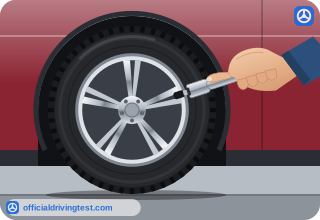
When should you check tire pressure?
- Right after a long trip when the tires are warm
- When the tires match the surrounding air temperature
- Immediately after the engine has been running
- Only when the tires look noticeably low on air
Show answer
Correct answer: When the tires match the surrounding air temperature
The manual says to check tire pressure when the tires are the same temperature as the surrounding air.
Source: Ohio Driver Manual (HSY 7607 10/25 (October 2025)), page 5
-
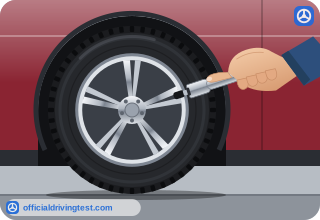
What should you do if your tire pressure reading is too high?
- Drive until the tire cools
- Add a small amount of air
- Replace the tire
- Release air from the tire valve
Show answer
Correct answer: Release air from the tire valve
The manual says that if the number is too high, release air from the tire valve.
Source: Ohio Driver Manual (HSY 7607 10/25 (October 2025)), page 5
-
In the penny test of tire tread depth, what does it mean if you see all of the President’s head?
- The tires are too worn and should not be driven on
- The tires are in safe condition to drive on
- The tires are overinflated and need air released
- The tires should be rotated to the front axle
Show answer
Correct answer: The tires are too worn and should not be driven on
The manual says if you see all of the President’s head, your tires are too worn, so do not drive on them and replace them.
Source: Ohio Driver Manual (HSY 7607 10/25 (October 2025)), page 5
-
In the penny test of tire tread depth, where do you place the coin?
- Flat against the tire sidewall
- On the flattest part of the tread
- Into the tire’s deepest groove
- Between the tire and the wheel rim
Show answer
Correct answer: Into the tire’s deepest groove
The manual says to place the coin with President Lincoln’s head into the tire’s deepest groove.
Source: Ohio Driver Manual (HSY 7607 10/25 (October 2025)), page 5
-
In Ohio, during what period are studded tires legal?
- October 1 through March 31
- November 1 through April 15
- December 1 through March 1
- November 15 through May 1
Show answer
Correct answer: November 1 through April 15
The manual says studded tires are legal from November 1 through April 15.
Source: Ohio Driver Manual (HSY 7607 10/25 (October 2025)), page 5
-
Ohio law requires headlights to be on during which period?
- 30 minutes after sunset to 30 minutes before sunrise
- 9 p.m. to 6 a.m.
- Only when it is completely dark
- Sunset to sunrise
Show answer
Correct answer: Sunset to sunrise
The manual says Ohio law requires headlights on from sunset to sunrise.
Source: Ohio Driver Manual (HSY 7607 10/25 (October 2025)), page 5
-
Besides sunset to sunrise, when does Ohio law require headlights to be on?
- Any time the wipers are on because of precipitation
- Only on highways with a posted speed limit above 55 mph
- Only when another vehicle is following you closely
- Only when driving through a tunnel or underpass
Show answer
Correct answer: Any time the wipers are on because of precipitation
The manual says headlights must be on when visibility is poor and any time the wipers are in use because of precipitation.
Source: Ohio Driver Manual (HSY 7607 10/25 (October 2025)), page 5
-
When may high beam headlights NOT be used, according to the manual?
- When driving on a highway at night
- When driving behind another vehicle that has its brake lights on
- When an oncoming vehicle is approaching
- When driving between sunset and sunrise
Show answer
Correct answer: When an oncoming vehicle is approaching
The manual says high beams can be used any time headlights are used except when an oncoming vehicle is approaching.
Source: Ohio Driver Manual (HSY 7607 10/25 (October 2025)), page 5
-
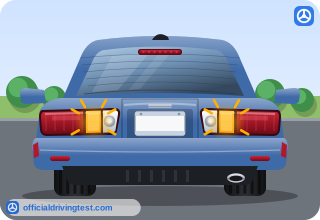
What is the purpose of hazard lights?
- To warn others that you are slowing down in heavy traffic
- To signal other drivers that you are about to pass them
- To show that you intend to turn right at the next corner
- To increase visibility of a vehicle stopped near a road
Show answer
Correct answer: To increase visibility of a vehicle stopped near a road
The manual says to use hazard lights to increase visibility of a vehicle stopped on or near a roadway.
Source: Ohio Driver Manual (HSY 7607 10/25 (October 2025)), page 5
-
How should your feet and heel be positioned when the driver’s seat is adjusted properly?
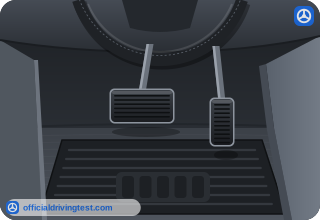
- Your foot pivots with your heel on the floor
- Your heel rests on the brake pedal at all times
- Your knee is fully straight when braking
- Your foot hovers above the floor between pedals
Show answer
Correct answer: Your foot pivots with your heel on the floor
The manual says your foot should pivot smoothly from brake to accelerator while your heel is kept on the floor.
Source: Ohio Driver Manual (HSY 7607 10/25 (October 2025)), page 5
-
Where should the top of the steering wheel be when the seat is adjusted properly?
- At eye level with the top of the windshield
- At the level of your elbows on the armrest
- Below chin level, no higher than your shoulders
- Above your shoulders and level with your chin
Show answer
Correct answer: Below chin level, no higher than your shoulders
The manual says the top of the steering wheel should be no higher than the top of your shoulders and below chin level.
Source: Ohio Driver Manual (HSY 7607 10/25 (October 2025)), page 5
-
How should head restraints be adjusted to avoid whiplash?
- Resting at the level of the top of your shoulders
- Tilted forward toward the back of your neck
- Positioned below the level of your ears
- Touching the back of your head, at ear level or higher
Show answer
Correct answer: Touching the back of your head, at ear level or higher
The manual says head restraints should contact the back of your head and not be below the level of your ears.
Source: Ohio Driver Manual (HSY 7607 10/25 (October 2025)), page 5
-
How should the inside rear-view mirror be adjusted?
- So it frames the rear window and shows traffic behind you
- So that it shows the left edge of your vehicle clearly
- So that it shows mostly the inside of the back seat
- So that it points toward the right-side outside mirror
Show answer
Correct answer: So it frames the rear window and shows traffic behind you
The manual says to adjust the rear-view mirror so it frames the rear window and traffic to the rear appears in it.
Source: Ohio Driver Manual (HSY 7607 10/25 (October 2025)), page 6
-
How should the left-side outside mirror be adjusted to reduce blind spots?
- With your head upright, until a large part of your vehicle’s side shows
- With your head centered, until the whole left side of the vehicle is visible
- With your head on the driver window, until your vehicle’s left edge barely shows
- With your head upright, until the road behind you is no longer visible
Show answer
Correct answer: With your head on the driver window, until your vehicle’s left edge barely shows
The manual says to rest your head against the closed driver-side window and adjust until the vehicle’s left edge is barely visible.
Source: Ohio Driver Manual (HSY 7607 10/25 (October 2025)), page 6
-
Where should your head be when adjusting the right-side outside mirror?
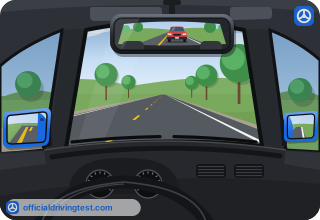
- Against the passenger window
- Directly above the center console
- Against the headrest
- Turned toward the driver-side window
Show answer
Correct answer: Directly above the center console
The manual says to lean to the right so your head is directly above the center console.
Source: Ohio Driver Manual (HSY 7607 10/25 (October 2025)), page 6
-
How much additional viewing area does the recommended outside mirror adjustment add to each side of the vehicle?
- 2 to 6 degrees
- 6 to 10 degrees
- 20 to 25 degrees
- 12 to 16 degrees
Show answer
Correct answer: 12 to 16 degrees
The manual says the adjustment adds 12 to 16 degrees of additional viewing area to each side.
Source: Ohio Driver Manual (HSY 7607 10/25 (October 2025)), page 6
-
When starting the engine, where should your right foot be?
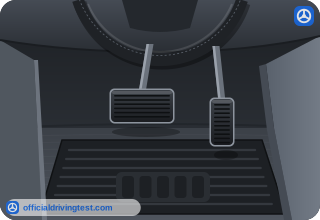
- On the brake pedal
- On the accelerator pedal
- Flat on the floor, away from the pedals
- On the parking brake pedal
Show answer
Correct answer: On the brake pedal
The manual says to place your right foot on the brake pedal before starting the engine.
Source: Ohio Driver Manual (HSY 7607 10/25 (October 2025)), page 15
-
Before you insert the key or push the Start button, what should you check the gear selector for?
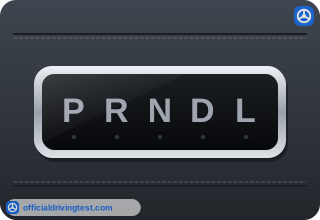
- Neutral
- Drive
- Park
- Reverse
Show answer
Correct answer: Park
The manual tells you to check that the gear selector is in park before starting the engine.
Source: Ohio Driver Manual (HSY 7607 10/25 (October 2025)), page 15
-
Which foot position does the manual describe for pressing the accelerator?
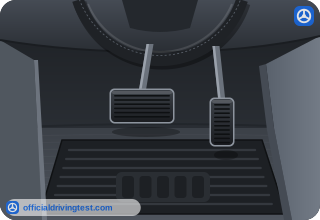
- Whole foot flat on the pedal with the heel raised
- Ball of the foot on the pedal and heel on the floor
- Heel on the pedal and toes on the floor
- Toes on the pedal and heel on the brake
Show answer
Correct answer: Ball of the foot on the pedal and heel on the floor
The manual says to accelerate gradually and smoothly with the ball of your foot on the pedal and your heel on the floor.
Source: Ohio Driver Manual (HSY 7607 10/25 (October 2025)), page 15
-
After you move the gear selector to "D" (drive), what should you check before moving off?
- Only for a safe path ahead of the vehicle, not the sides
- Only traffic to the sides and behind, not the path ahead
- Only the traffic approaching from the left and right
- Forward for a safe path, and traffic to the sides and behind
Show answer
Correct answer: Forward for a safe path, and traffic to the sides and behind
The manual says to check forward for a safe path and for traffic to the sides and behind before you signal and move off.
Source: Ohio Driver Manual (HSY 7607 10/25 (October 2025)), page 15
-
What should you check before moving your foot from the accelerator to the brake to stop the vehicle?
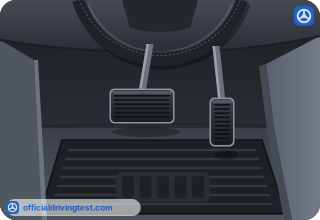
- Your speedometer, for the speed limit
- The gear selector, for park
- Your mirrors, for traffic to the rear
- The fuel gauge, for the fuel level
Show answer
Correct answer: Your mirrors, for traffic to the rear
The manual says to check your mirrors for traffic to the rear of your vehicle before braking to a stop.
Source: Ohio Driver Manual (HSY 7607 10/25 (October 2025)), page 15
-
How should you press the brake pedal when bringing your vehicle to a stop?
- With steady pressure until the vehicle stops
- With short, repeated pumps
- With hard pressure only at the very end
- With light taps as the vehicle slows
Show answer
Correct answer: With steady pressure until the vehicle stops
The manual says to press with steady pressure until your vehicle comes to a stop.
Source: Ohio Driver Manual (HSY 7607 10/25 (October 2025)), page 15
-
Which way should you turn the steering wheel when moving forward or in reverse?
- In the direction you want the vehicle to move
- Opposite to the direction you want to go
- Toward the center line in both cases
- Away from the curb in both cases
Show answer
Correct answer: In the direction you want the vehicle to move
The manual says to turn the steering wheel in the direction you want the vehicle to move, forward or in reverse.
Source: Ohio Driver Manual (HSY 7607 10/25 (October 2025)), page 16
-
At which positions should you place your hands on the steering wheel?
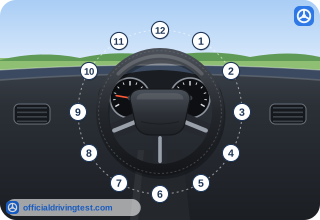
- The 9 and 3 o'clock positions
- The 10 and 2 o'clock positions
- The 12 and 6 o'clock positions
- The 4 and 8 o'clock positions
Show answer
Correct answer: The 4 and 8 o'clock positions
The manual says to place both hands on opposite sides of the wheel at the 4 and 8 o'clock positions to keep control and avoid air bags if they deploy.
Source: Ohio Driver Manual (HSY 7607 10/25 (October 2025)), page 16
-
Why should you check behind your vehicle before you get in to back up?
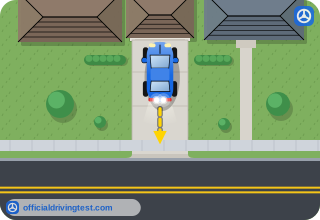
- The mirrors cannot be adjusted until you are in the seat
- Children and small objects cannot be seen from the driver's seat
- The rear window may be dirty or fogged from the inside
- The backup camera takes time to start after you shift gear
Show answer
Correct answer: Children and small objects cannot be seen from the driver's seat
The manual says children and small objects cannot be seen from the driver's seat.
Source: Ohio Driver Manual (HSY 7607 10/25 (October 2025)), page 16
-
When backing up, where should you place your left hand on the steering wheel?
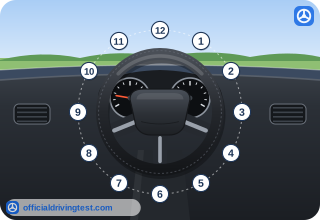
- At the 12 o'clock position
- At the 3 o'clock position
- At the 6 o'clock position
- At the 9 o'clock position
Show answer
Correct answer: At the 12 o'clock position
The manual says to grasp the steering wheel at the 12 o'clock position with your left hand.
Source: Ohio Driver Manual (HSY 7607 10/25 (October 2025)), page 16
-
While backing up, what should you do with your right arm and where should you look?
- Keep your right arm on the door and look only at the side mirror on that side
- Keep your arm on the steering wheel and look only at the inside rear-view mirror
- Put your arm on the back of the passenger seat and look directly through the rear window
- Rest your arm on the window ledge and look only at the backup camera screen
Show answer
Correct answer: Put your arm on the back of the passenger seat and look directly through the rear window
The manual says to place your right arm on the back of the passenger seat and look directly through the rear window.
Source: Ohio Driver Manual (HSY 7607 10/25 (October 2025)), page 16
-
What should you keep in mind when using your mirrors for backing up?
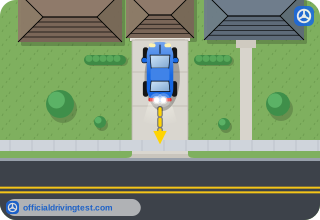
- They show everything behind the vehicle, including small objects
- They do not show the area immediately behind your vehicle
- They show the area behind the vehicle only during the daytime
- They are more accurate than looking through the rear window
Show answer
Correct answer: They do not show the area immediately behind your vehicle
The manual warns that mirrors do not show the area immediately behind your vehicle.
Source: Ohio Driver Manual (HSY 7607 10/25 (October 2025)), page 16
-
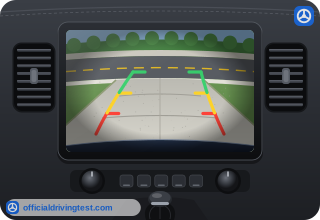
If your vehicle has a backup or rear-view camera, how should you use it when backing up?
- Rely on it alone, because it always shows the whole area behind
- Ignore it completely, because it is not a safe way to back up a vehicle
- Use it only at night, and look through the rear window during the day
- Use it, but do not rely on it alone because it may not show the whole area
Show answer
Correct answer: Use it, but do not rely on it alone because it may not show the whole area
The manual says to use the camera if applicable, but not to rely solely on it because it may not show the whole area.
Source: Ohio Driver Manual (HSY 7607 10/25 (October 2025)), page 16
-
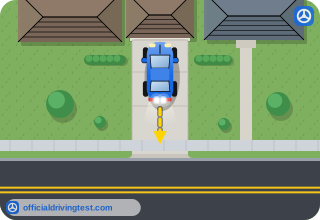
Why should you keep your speed slow when backing up?
- The brakes do not work as well when in reverse gear
- The mirrors stop working when the vehicle is in reverse
- The vehicle is much harder to steer while backing up
- Other drivers expect you to back up very slowly
Show answer
Correct answer: The vehicle is much harder to steer while backing up
The manual says to keep your speed slow because your vehicle is much harder to steer while you are backing up.
Source: Ohio Driver Manual (HSY 7607 10/25 (October 2025)), page 16
-
When backing up, in which direction should you steer?
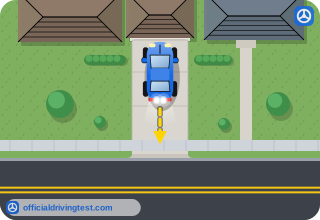
- Slightly in the direction the rear of the vehicle should move
- Slightly in the direction the front of the vehicle should move
- Fully toward the driver's side
- Away from the direction the rear should move
Show answer
Correct answer: Slightly in the direction the rear of the vehicle should move
The manual says to steer slightly in the direction the rear of the vehicle should move.
Source: Ohio Driver Manual (HSY 7607 10/25 (October 2025)), page 16
-
When backing up, how long should you keep looking to the rear?
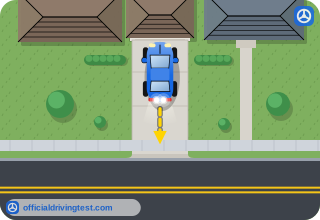
- Until the vehicle has moved one car length
- Until the wheels are straight
- Until you have passed the first driveway
- Until the vehicle comes to a complete stop
Show answer
Correct answer: Until the vehicle comes to a complete stop
The manual says to continue looking to the rear until coming to a complete stop.
Source: Ohio Driver Manual (HSY 7607 10/25 (October 2025)), page 16
-
When must headlights be on, according to the manual?
- Between sunset and sunrise
- Only after midnight
- Only when it is completely dark
- Only on roads without streetlights
Show answer
Correct answer: Between sunset and sunrise
Lights must be on between sunset and sunrise.
Source: Ohio Driver Manual (HSY 7607 10/25 (October 2025)), page 28
-
What does the manual say about headlights during rain, snow, fog, or other unfavorable atmospheric conditions?

- Lights are needed only after the sun has set
- Lights are needed only on highways and freeways
- Lights are optional if it is still daytime
- Lights must be on regardless of the time of day
Show answer
Correct answer: Lights must be on regardless of the time of day
Lights must be on during any period of rain, snow, fog or other unfavorable conditions, regardless of the time of day.
Source: Ohio Driver Manual (HSY 7607 10/25 (October 2025)), page 28
-
Headlights must be on when natural light does not make it possible to clearly see objects how far ahead?
- 100 feet
- 1,000 feet
- 500 feet
- 2,000 feet
Show answer
Correct answer: 1,000 feet
Lights must be on when natural light does not make it possible to clearly see objects 1,000 feet ahead.
Source: Ohio Driver Manual (HSY 7607 10/25 (October 2025)), page 28
-
What does the manual say about headlights when windshield wipers are in use?
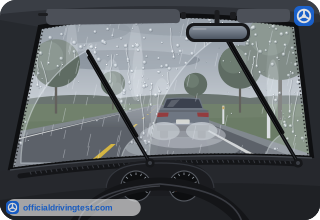
- Lights must be on any time wipers are used for precipitation
- Lights are needed only if the wipers are on high speed
- Lights are needed only when it is also after sunset
- Lights are optional if you are driving on a city street
Show answer
Correct answer: Lights must be on any time wipers are used for precipitation
Lights must be on any time windshield wipers are in use because of precipitation.
Source: Ohio Driver Manual (HSY 7607 10/25 (October 2025)), page 28
-
What limits the distance you can see in front of your vehicle when driving at night?
- The width of the road and the number of lanes
- The speed of the oncoming traffic on the same road
- The amount of lighting provided by your headlights
- The color and size of your vehicle and windows
Show answer
Correct answer: The amount of lighting provided by your headlights
At night the distance you can see is limited by the lighting your headlights provide.
Source: Ohio Driver Manual (HSY 7607 10/25 (October 2025)), page 28
-
What speed does the manual advise when driving at night?
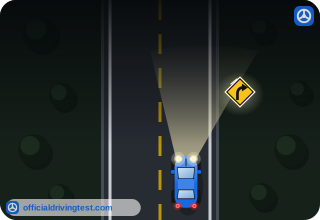
- The maximum posted speed at all times
- A cautious and reasonable speed
- A speed that keeps up with faster traffic
- A speed slightly above the flow of traffic
Show answer
Correct answer: A cautious and reasonable speed
To maintain safety at night, maintain a cautious and reasonable speed.
Source: Ohio Driver Manual (HSY 7607 10/25 (October 2025)), page 28
-
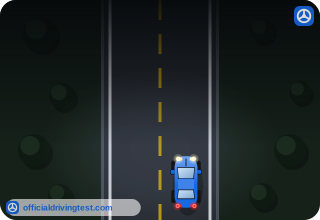
When should you use high beam headlights at night?
- Only on roads with a posted speed limit over 55 mph
- Only when following another vehicle
- Only in the rain
- Whenever there are no oncoming vehicles
Show answer
Correct answer: Whenever there are no oncoming vehicles
Use high beams whenever there are no oncoming vehicles.
Source: Ohio Driver Manual (HSY 7607 10/25 (October 2025)), page 28
-
What does Ohio law require you to do with your high beam headlights when traffic approaches?
- Leave them on
- Flash them twice
- Dim them
- Turn off all headlights
Show answer
Correct answer: Dim them
Ohio law requires you to dim your high beam headlights for approaching traffic.
Source: Ohio Driver Manual (HSY 7607 10/25 (October 2025)), page 28
-
To keep from being momentarily blinded by an approaching vehicle's headlights, where should you look?
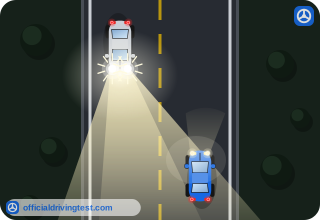
- Toward the right side of the road
- Directly at the approaching headlights
- Toward the center line
- Up at the sky
Show answer
Correct answer: Toward the right side of the road
The manual says to look toward the right side of the road.
Source: Ohio Driver Manual (HSY 7607 10/25 (October 2025)), page 28
-
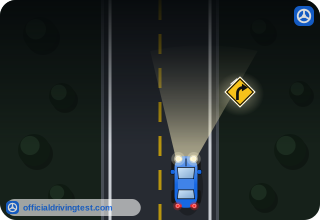
Why should you glance occasionally to the right and left when driving at night?
- To check your headlights for glare on the side mirrors
- To count the vehicles that are behind you on the road
- To read the road signs from a greater distance ahead
- To locate the edge of the pavement and hazards from the sides
Show answer
Correct answer: To locate the edge of the pavement and hazards from the sides
Glancing to the right and left helps you find the pavement edge and hazards coming from the sides.
Source: Ohio Driver Manual (HSY 7607 10/25 (October 2025)), page 28
-
What does the manual say about wearing sunglasses or colored lenses when driving?
- Wear them at night to reduce glare
- Do not wear them at night or on overcast days
- Wear them only on rainy days
- Wear them on overcast days to see better
Show answer
Correct answer: Do not wear them at night or on overcast days
The manual says tinted or colored lenses reduce your vision, so do not wear them at night or on overcast days.
Source: Ohio Driver Manual (HSY 7607 10/25 (October 2025)), page 28
-
Whose responsibility is it to make your vehicle visible to other roadway users?
- The responsibility of the other drivers
- The responsibility of the local police
- Your own responsibility as the driver
- The responsibility of the vehicle manufacturer
Show answer
Correct answer: Your own responsibility as the driver
The manual states it is your responsibility to make your vehicle visible to other roadway users.
Source: Ohio Driver Manual (HSY 7607 10/25 (October 2025)), page 32
-
How should you use your horn to get another road user's attention?
- Hold it down continuously
- Sound it twice in a row as loudly as possible
- Tap it lightly
- Use it only as a last resort after a crash
Show answer
Correct answer: Tap it lightly
A vehicle's horn, used properly, can get attention; the manual says to tap your horn lightly to communicate.
Source: Ohio Driver Manual (HSY 7607 10/25 (October 2025)), page 32
-
When does the manual say to tap your horn lightly?
- When passing a driver who starts to turn into your lane
- When another driver is driving slowly ahead of you
- When you want to greet a friend on the roadside
- When you are frustrated by heavy traffic
Show answer
Correct answer: When passing a driver who starts to turn into your lane
Tapping your horn lightly is appropriate when you are passing a driver who starts to turn into your lane.
Source: Ohio Driver Manual (HSY 7607 10/25 (October 2025)), page 32
-
What does the manual say about when to use your horn?
- Whenever traffic is moving slowly ahead of you
- To tell other drivers that they are in the wrong
- Each time that you pass another vehicle
- Only when you need to communicate with others
Show answer
Correct answer: Only when you need to communicate with others
The manual says to only use your horn when you need to communicate with other road users.
Source: Ohio Driver Manual (HSY 7607 10/25 (October 2025)), page 32
-
What could using your horn inappropriately do?
- Make your headlights dim
- Scare or anger another road user
- Reset your turn signal
- Lower your vehicle's stopping distance
Show answer
Correct answer: Scare or anger another road user
Using your horn inappropriately could scare or anger another road user.
Source: Ohio Driver Manual (HSY 7607 10/25 (October 2025)), page 32
-
Why should you make sure to cancel your turn signal after using it?
- To keep the battery from draining
- To keep your brake lights working
- To avoid confusing other drivers
- To let the next driver know you are parked
Show answer
Correct answer: To avoid confusing other drivers
The manual says to make sure you cancel your signal to avoid confusing other drivers.
Source: Ohio Driver Manual (HSY 7607 10/25 (October 2025)), page 32
-
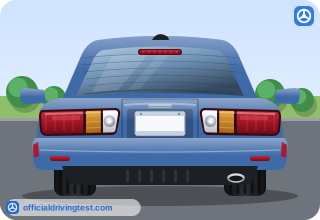
What do brake lights tell other roadway users?
- That the driver is about to change lanes
- That the vehicle is slowing down or stopping
- That the driver is backing up
- That the vehicle is parked
Show answer
Correct answer: That the vehicle is slowing down or stopping
Brake lights let other roadway users know that the vehicle is slowing down or stopping.
Source: Ohio Driver Manual (HSY 7607 10/25 (October 2025)), page 32
-
When should you use your turn signal before reducing speed?
- When driving straight ahead at a constant speed on the same road
- When passing a parked vehicle in the next lane over from yours
- When you stop because traffic ahead of you has already stopped
- When turning off a roadway with no separate turning or exiting lane
Show answer
Correct answer: When turning off a roadway with no separate turning or exiting lane
Use turn signals before reducing speed when turning off a roadway that does not have separate turning or exiting lanes, or when parking or turning before an intersection.
Source: Ohio Driver Manual (HSY 7607 10/25 (October 2025)), page 32