Ohio: Signals & vehicle controls — Part 4 Practice Test
Questions in this part include: “Headlights must be on when natural light does not make it possible to clearly see objects how far ahead?” · “How should you use your horn to get another road user's attention?”
Independent educational site · not affiliated with any government agency or DMV
Ready? Test yourself
- Instant feedback with an explanation
- Every answer cites its source in the manual
- Your best score is saved on this device
Questions are original and based on the official manual "Ohio Driver Manual" (HSY 7607 10/25 (October 2025)), Ohio Bureau of Motor Vehicles.
All 17 questions in this practice test
Take the test above first, then use this list to study. Tap “Show answer” to see the correct answer and explanation.
Show the questions and answersHide the questions
-
Headlights must be on when natural light does not make it possible to clearly see objects how far ahead?
- 100 feet
- 1,000 feet
- 500 feet
- 2,000 feet
Show answer
Correct answer: 1,000 feet
Lights must be on when natural light does not make it possible to clearly see objects 1,000 feet ahead.
Source: Ohio Driver Manual (HSY 7607 10/25 (October 2025)), page 28
-
What does the manual say about headlights when windshield wipers are in use?
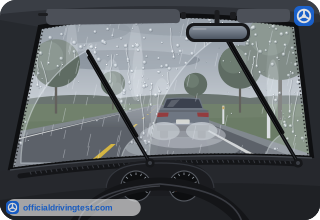
- Lights must be on any time wipers are used for precipitation
- Lights are needed only if the wipers are on high speed
- Lights are needed only when it is also after sunset
- Lights are optional if you are driving on a city street
Show answer
Correct answer: Lights must be on any time wipers are used for precipitation
Lights must be on any time windshield wipers are in use because of precipitation.
Source: Ohio Driver Manual (HSY 7607 10/25 (October 2025)), page 28
-
What limits the distance you can see in front of your vehicle when driving at night?
- The width of the road and the number of lanes
- The speed of the oncoming traffic on the same road
- The amount of lighting provided by your headlights
- The color and size of your vehicle and windows
Show answer
Correct answer: The amount of lighting provided by your headlights
At night the distance you can see is limited by the lighting your headlights provide.
Source: Ohio Driver Manual (HSY 7607 10/25 (October 2025)), page 28
-
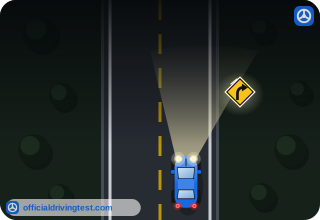
What speed does the manual advise when driving at night?
- The maximum posted speed at all times
- A cautious and reasonable speed
- A speed that keeps up with faster traffic
- A speed slightly above the flow of traffic
Show answer
Correct answer: A cautious and reasonable speed
To maintain safety at night, maintain a cautious and reasonable speed.
Source: Ohio Driver Manual (HSY 7607 10/25 (October 2025)), page 28
-
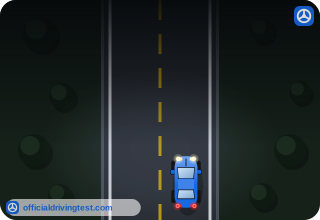
When should you use high beam headlights at night?
- Only on roads with a posted speed limit over 55 mph
- Only when following another vehicle
- Only in the rain
- Whenever there are no oncoming vehicles
Show answer
Correct answer: Whenever there are no oncoming vehicles
Use high beams whenever there are no oncoming vehicles.
Source: Ohio Driver Manual (HSY 7607 10/25 (October 2025)), page 28
-
What does Ohio law require you to do with your high beam headlights when traffic approaches?
- Leave them on
- Flash them twice
- Dim them
- Turn off all headlights
Show answer
Correct answer: Dim them
Ohio law requires you to dim your high beam headlights for approaching traffic.
Source: Ohio Driver Manual (HSY 7607 10/25 (October 2025)), page 28
-
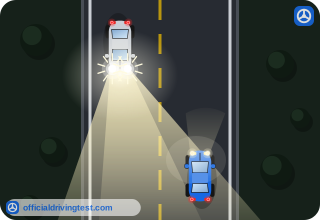
To keep from being momentarily blinded by an approaching vehicle's headlights, where should you look?
- Toward the right side of the road
- Directly at the approaching headlights
- Toward the center line
- Up at the sky
Show answer
Correct answer: Toward the right side of the road
The manual says to look toward the right side of the road.
Source: Ohio Driver Manual (HSY 7607 10/25 (October 2025)), page 28
-
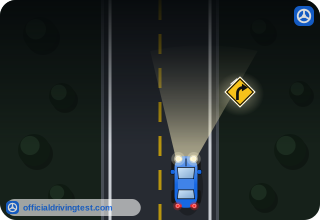
Why should you glance occasionally to the right and left when driving at night?
- To check your headlights for glare on the side mirrors
- To count the vehicles that are behind you on the road
- To read the road signs from a greater distance ahead
- To locate the edge of the pavement and hazards from the sides
Show answer
Correct answer: To locate the edge of the pavement and hazards from the sides
Glancing to the right and left helps you find the pavement edge and hazards coming from the sides.
Source: Ohio Driver Manual (HSY 7607 10/25 (October 2025)), page 28
-
What does the manual say about wearing sunglasses or colored lenses when driving?
- Wear them at night to reduce glare
- Do not wear them at night or on overcast days
- Wear them only on rainy days
- Wear them on overcast days to see better
Show answer
Correct answer: Do not wear them at night or on overcast days
The manual says tinted or colored lenses reduce your vision, so do not wear them at night or on overcast days.
Source: Ohio Driver Manual (HSY 7607 10/25 (October 2025)), page 28
-
Whose responsibility is it to make your vehicle visible to other roadway users?
- The responsibility of the other drivers
- The responsibility of the local police
- Your own responsibility as the driver
- The responsibility of the vehicle manufacturer
Show answer
Correct answer: Your own responsibility as the driver
The manual states it is your responsibility to make your vehicle visible to other roadway users.
Source: Ohio Driver Manual (HSY 7607 10/25 (October 2025)), page 32
-
How should you use your horn to get another road user's attention?
- Hold it down continuously
- Sound it twice in a row as loudly as possible
- Tap it lightly
- Use it only as a last resort after a crash
Show answer
Correct answer: Tap it lightly
A vehicle's horn, used properly, can get attention; the manual says to tap your horn lightly to communicate.
Source: Ohio Driver Manual (HSY 7607 10/25 (October 2025)), page 32
-
When does the manual say to tap your horn lightly?
- When passing a driver who starts to turn into your lane
- When another driver is driving slowly ahead of you
- When you want to greet a friend on the roadside
- When you are frustrated by heavy traffic
Show answer
Correct answer: When passing a driver who starts to turn into your lane
Tapping your horn lightly is appropriate when you are passing a driver who starts to turn into your lane.
Source: Ohio Driver Manual (HSY 7607 10/25 (October 2025)), page 32
-
What does the manual say about when to use your horn?
- Whenever traffic is moving slowly ahead of you
- To tell other drivers that they are in the wrong
- Each time that you pass another vehicle
- Only when you need to communicate with others
Show answer
Correct answer: Only when you need to communicate with others
The manual says to only use your horn when you need to communicate with other road users.
Source: Ohio Driver Manual (HSY 7607 10/25 (October 2025)), page 32
-
What could using your horn inappropriately do?
- Make your headlights dim
- Scare or anger another road user
- Reset your turn signal
- Lower your vehicle's stopping distance
Show answer
Correct answer: Scare or anger another road user
Using your horn inappropriately could scare or anger another road user.
Source: Ohio Driver Manual (HSY 7607 10/25 (October 2025)), page 32
-
Why should you make sure to cancel your turn signal after using it?
- To keep the battery from draining
- To keep your brake lights working
- To avoid confusing other drivers
- To let the next driver know you are parked
Show answer
Correct answer: To avoid confusing other drivers
The manual says to make sure you cancel your signal to avoid confusing other drivers.
Source: Ohio Driver Manual (HSY 7607 10/25 (October 2025)), page 32
-
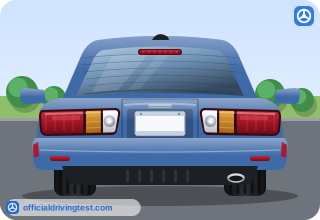
What do brake lights tell other roadway users?
- That the driver is about to change lanes
- That the vehicle is slowing down or stopping
- That the driver is backing up
- That the vehicle is parked
Show answer
Correct answer: That the vehicle is slowing down or stopping
Brake lights let other roadway users know that the vehicle is slowing down or stopping.
Source: Ohio Driver Manual (HSY 7607 10/25 (October 2025)), page 32
-
When should you use your turn signal before reducing speed?
- When driving straight ahead at a constant speed on the same road
- When passing a parked vehicle in the next lane over from yours
- When you stop because traffic ahead of you has already stopped
- When turning off a roadway with no separate turning or exiting lane
Show answer
Correct answer: When turning off a roadway with no separate turning or exiting lane
Use turn signals before reducing speed when turning off a roadway that does not have separate turning or exiting lanes, or when parking or turning before an intersection.
Source: Ohio Driver Manual (HSY 7607 10/25 (October 2025)), page 32