North Dakota: Signals and vehicle controls Practice Test
Hand signals, turn signals, mirrors and blind spots, headlights, backing and the equipment a vehicle needs for the road test.
Independent educational site · not affiliated with any government agency or DMV
Ready? Test yourself
- Instant feedback with an explanation
- Every answer cites its source in the manual
- Your best score is saved on this device
- Keyboard: press 1 to 4 to answer and Enter for the next question
Questions are original and based on the official manual "North Dakota Noncommercial Driver License Manual" (2025-2027), North Dakota Department of Transportation (NDDOT).
All 30 questions in this practice test
Take the test above first, then use this list to study. Tap “Show answer” to see the correct answer and explanation.
Show the questions and answersHide the questions
-
Which headlight equipment must be in proper working order to pass the road test vehicle inspection?
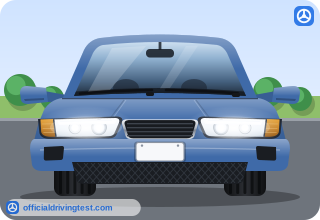
- Headlights with low beams only
- Headlights with high and low beams
- Headlights with high beams only
- Parking lights in place of headlights
Show answer
Correct answer: Headlights with high and low beams
The inspection list calls for headlights with high and low beams.
Source: North Dakota Noncommercial Driver License Manual (2025-2027), page 2 · Open this page in the manual (Manual page 2)
-
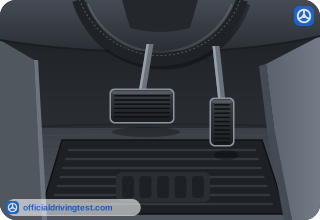
For what purposes must the brakes work on a vehicle presented for the road test?
- Stopping only
- Stopping and towing
- Parking only
- Stopping and parking
Show answer
Correct answer: Stopping and parking
The inspection list requires brakes that work for stopping and parking.
Source: North Dakota Noncommercial Driver License Manual (2025-2027), page 2 · Open this page in the manual (Manual page 2)
-
How clearly audible must the horn be on a vehicle presented for the road test?
- Clearly audible for 200 feet
- Clearly audible for 100 feet
- Clearly audible for 300 feet
- Clearly audible for 400 feet
Show answer
Correct answer: Clearly audible for 200 feet
The inspection requires a horn clearly audible for 200 feet.
Source: North Dakota Noncommercial Driver License Manual (2025-2027), page 2 · Open this page in the manual (Manual page 2)
-
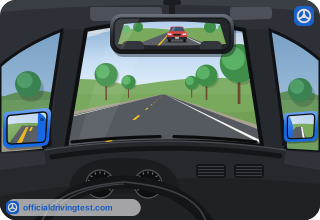
How far behind you must your mirrors let you see the road on a vehicle presented for the road test?
- 100 feet
- 300 feet
- 200 feet
- 400 feet
Show answer
Correct answer: 200 feet
The inspection requires one or more mirrors so that you can see the road 200 feet behind you.
Source: North Dakota Noncommercial Driver License Manual (2025-2027), page 2 · Open this page in the manual (Manual page 2)
-
Which of these is on the equipment list a vehicle must pass before the road test?
- A working rear-window defroster system
- A leak-free exhaust system, including a muffler
- A factory-installed air conditioning system
- A cruise control system that works properly
Show answer
Correct answer: A leak-free exhaust system, including a muffler
The inspection list includes a leak-free exhaust system, including a muffler.
Source: North Dakota Noncommercial Driver License Manual (2025-2027), page 2 · Open this page in the manual (Manual page 2)
-
How must the doors of a vehicle function to pass the road test inspection?
- From the inside of the vehicle only
- From the outside of the vehicle only
- Only while the vehicle is parked
- From inside and outside of the vehicle
Show answer
Correct answer: From inside and outside of the vehicle
The inspection list requires doors that function from inside and outside of the vehicle.
Source: North Dakota Noncommercial Driver License Manual (2025-2027), page 2 · Open this page in the manual (Manual page 2)
-
What is required of the windshield and windows of a vehicle presented for the road test?
- They must be intact, with no cracks that block vision
- They must be tinted to reduce glare for the driver
- They may have cracks if the wipers work
- Cracks are allowed on the passenger side
Show answer
Correct answer: They must be intact, with no cracks that block vision
The inspection list requires an intact windshield and windows without cracks that could interfere with the driver’s or examiner’s vision.
Source: North Dakota Noncommercial Driver License Manual (2025-2027), page 2 · Open this page in the manual (Manual page 2)
-
Motorists must be able to recognize hand signals given by whom?
- Pedestrians and railroad crew members
- Passengers and school bus drivers
- Flagpersons only
- Motorcyclists and bicyclists
Show answer
Correct answer: Motorcyclists and bicyclists
Motorists must recognize hand signals given by motorcyclists and bicyclists and give them sufficient space to carry out their signaled maneuvers.
Source: North Dakota Noncommercial Driver License Manual (2025-2027), page 19 · Open this page in the manual (Manual page 19)
-
When should you use your headlights?
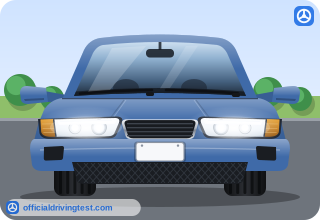
- From sunset to sunrise and whenever needed for safe driving
- Only from one hour after sunset until one hour before sunrise
- Only when it is raining or snowing heavily
- Only on roads that have no streetlights
Show answer
Correct answer: From sunset to sunrise and whenever needed for safe driving
The manual says to use your headlights from sunset to sunrise, and at any other time necessary for safe driving.
Source: North Dakota Noncommercial Driver License Manual (2025-2027), page 24 · Open this page in the manual (Manual page 24)
-
In bad weather, you should use your headlights when visibility is less than what distance?
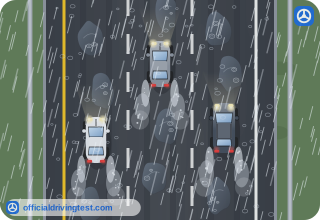
- 100 feet
- 500 feet
- 1,000 feet
- 2,000 feet
Show answer
Correct answer: 1,000 feet
Use your headlights during inclement weather when visibility is less than 1,000 feet due to rain, snow, sleet, hail, smoke, or fog.
Source: North Dakota Noncommercial Driver License Manual (2025-2027), page 24 · Open this page in the manual (Manual page 24)
-
Why should you clean your windshield inside and out when driving at night?
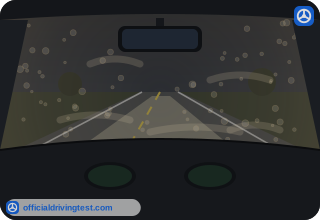
- It reduces the noise of the engine while driving
- It reduces the amount of fuel that your car uses
- It reduces the need to use your headlights
- It reduces the amount of glare from oncoming vehicles
Show answer
Correct answer: It reduces the amount of glare from oncoming vehicles
Cleaning the windshield inside and out reduces the amount of glare from oncoming vehicles.
Source: North Dakota Noncommercial Driver License Manual (2025-2027), page 24 · Open this page in the manual (Manual page 24)
-
Staring at the spot created by your headlights can cause eyestrain, fatigue, and lack of concentration. What should you do at night?
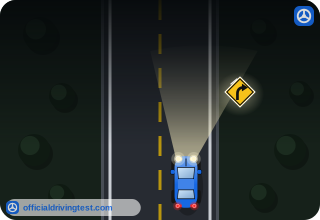
- Keep your eyes fixed on the lit spot
- Look only at the right edge of the road
- Keep your eyes moving
- Look only at the road directly ahead
Show answer
Correct answer: Keep your eyes moving
To avoid eyestrain, fatigue, and lack of concentration from staring at the headlight spot, keep your eyes moving, especially at night.
Source: North Dakota Noncommercial Driver License Manual (2025-2027), page 25 · Open this page in the manual (Manual page 25)
-
How far before meeting oncoming traffic should you dim your headlights?
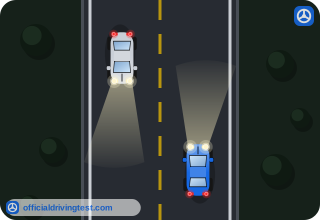
- At least 100 feet
- At least 500 feet
- At least 300 feet
- At least 1,000 feet
Show answer
Correct answer: At least 500 feet
You should dim your headlights at least 500 feet before meeting traffic.
Source: North Dakota Noncommercial Driver License Manual (2025-2027), page 25 · Open this page in the manual (Manual page 25)
-
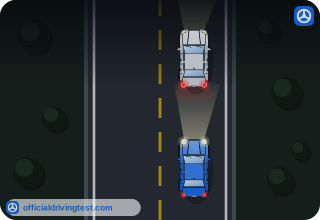
When following another vehicle at night, within what distance should you dim your headlights?
- Within 300 feet
- Within 100 feet
- Within 500 feet
- Within 1,000 feet
Show answer
Correct answer: Within 300 feet
You should dim your headlights within 300 feet when following another vehicle.
Source: North Dakota Noncommercial Driver License Manual (2025-2027), page 25 · Open this page in the manual (Manual page 25)
-
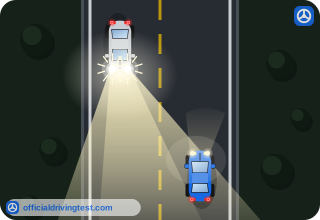
An oncoming vehicle does not dim its lights at night. What should you do to avoid being blinded?
- Look directly at the oncoming headlights
- Look to the left edge of the road
- Look to the right edge of the road
- Turn on your high beams
Show answer
Correct answer: Look to the right edge of the road
If you meet a vehicle that does not dim its lights, look to the right edge of the road to avoid being blinded.
Source: North Dakota Noncommercial Driver License Manual (2025-2027), page 25 · Open this page in the manual (Manual page 25)
-
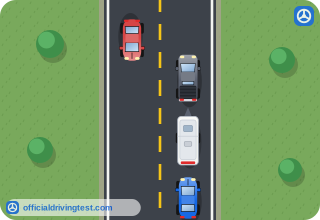
When traveling faster than 25 miles per hour while towing a trailer, what do you need?
- A second tow vehicle attached to the trailer
- Safety chains or brakes capable of holding the trailer
- A speed limiting device installed on the trailer
- A warning flag mounted on the rear of the trailer
Show answer
Correct answer: Safety chains or brakes capable of holding the trailer
When traveling faster than 25 miles per hour, you need safety chains or brakes capable of holding the trailer if the coupling breaks.
Source: North Dakota Noncommercial Driver License Manual (2025-2027), page 26 · Open this page in the manual (Manual page 26)
-
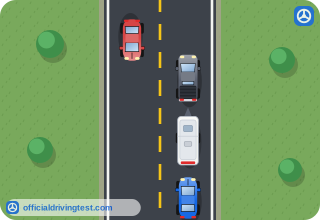
The rear of a trailer must have turn signals, stop lights, and which other equipment visible for a distance of 1,000 feet?
- Two white reflectors and two white lights
- One red reflector and one amber light
- Two amber reflectors and two red flags
- Two red reflectors and two red taillights
Show answer
Correct answer: Two red reflectors and two red taillights
A trailer needs turn signals, stop lights, two red reflectors, and two red taillights on the rear, visible for a distance of 1,000 feet.
Source: North Dakota Noncommercial Driver License Manual (2025-2027), page 26 · Open this page in the manual (Manual page 26)
-
What clearance lamps are needed on a trailer that is 80 inches or more in width?
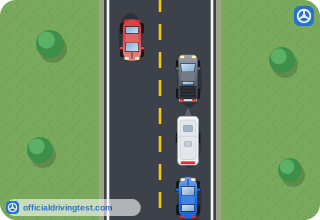
- Two red on the front and two amber on the back
- Two white on the front and two white on the back
- Two amber on the front and two red on the back
- One amber on the front and one red on the back
Show answer
Correct answer: Two amber on the front and two red on the back
A trailer that is 80 inches or more in width needs two amber clearance lamps on the front and two red clearance lights on the back.
Source: North Dakota Noncommercial Driver License Manual (2025-2027), page 26 · Open this page in the manual (Manual page 26)
-
Every vehicle must have a mirror that allows you to see at least how far to the rear?
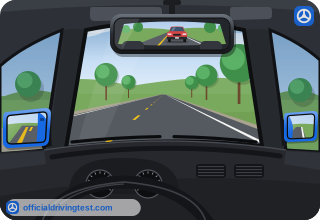
- 200 feet
- 100 feet
- 500 feet
- 1,000 feet
Show answer
Correct answer: 200 feet
Every vehicle must have a mirror allowing you to see at least 200 feet to the rear.
Source: North Dakota Noncommercial Driver License Manual (2025-2027), page 26 · Open this page in the manual (Manual page 26)
-
What is it better to do when towing a trailer in a strong wind?
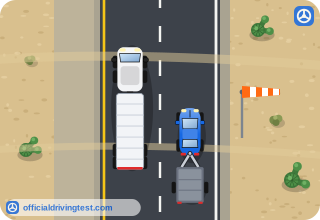
- Speed up
- Move to the center line
- Turn on your hazard lights
- Slow down
Show answer
Correct answer: Slow down
For your safety, it is better to slow down when you are towing a trailer in a strong wind.
Source: North Dakota Noncommercial Driver License Manual (2025-2027), page 26 · Open this page in the manual (Manual page 26)
-
When traveling on a downgrade, what may the driver of a motor vehicle not do?
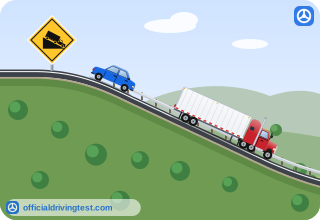
- Use a lower gear to hold back the vehicle
- Coast with the gears or transmission in neutral
- Keep the engine running while going downhill
- Use the brakes to control the speed
Show answer
Correct answer: Coast with the gears or transmission in neutral
The driver of any motor vehicle traveling on a downgrade may not coast with the gears or transmission in neutral.
Source: North Dakota Noncommercial Driver License Manual (2025-2027), page 26 · Open this page in the manual (Manual page 26)
-
When backing your vehicle is necessary, how must it be done?
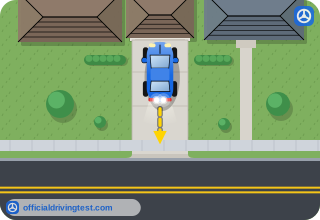
- Without interfering with other traffic
- Only on the left side of the road
- With your hazard lights off
- By using only your side mirrors
Show answer
Correct answer: Without interfering with other traffic
When backing is necessary, it must be done without interfering with other traffic, and you are responsible for backing onto a lane of traffic safely.
Source: North Dakota Noncommercial Driver License Manual (2025-2027), page 27 · Open this page in the manual (Manual page 27)
-
To be safe, what should you do before backing your vehicle?
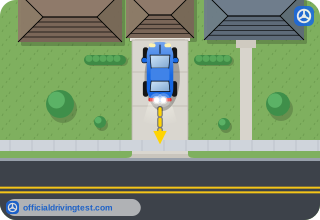
- Honk the horn twice before you start backing
- Turn on your hazard lights before backing
- Walk around your vehicle to check for clearance
- Roll down all the windows of your vehicle
Show answer
Correct answer: Walk around your vehicle to check for clearance
To be safe, before backing you should walk around your vehicle to check for clearance, so you do not back into children or other obstacles.
Source: North Dakota Noncommercial Driver License Manual (2025-2027), page 27 · Open this page in the manual (Manual page 27)
-
Why should you never turn your vehicle’s ignition to the “lock” position while it is still in motion?
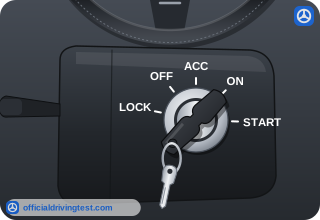
- The horn and turn signals will stop working at once
- The engine will overheat and shut itself down
- The headlights will go off and cannot be turned back on
- The steering will lock if you try to turn the steering wheel
Show answer
Correct answer: The steering will lock if you try to turn the steering wheel
The manual says turning the ignition to the “lock” position while moving will cause the steering to lock if you try to turn the steering wheel.
Source: North Dakota Noncommercial Driver License Manual (2025-2027), page 30 · Open this page in the manual (Manual page 30)
-
How does the manual say you should drive with regard to your hands on the steering wheel?
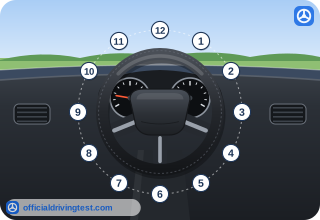
- With one hand on the wheel and one on the gear shift
- With both hands holding the steering wheel
- With both hands resting at the bottom of the wheel
- With one hand on the wheel and one hand free
Show answer
Correct answer: With both hands holding the steering wheel
The manual says to drive with both hands holding the steering wheel, because you never know when evasive action may be needed.
Source: North Dakota Noncommercial Driver License Manual (2025-2027), page 30 · Open this page in the manual (Manual page 30)
-
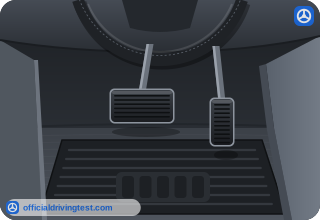
Why does the manual say to use one foot to operate both the gas pedal and the brake pedal?
- To keep your brake lights from flashing on and off
- To reduce wear on the accelerator pedal over time
- To make shifting gears smoother in heavy traffic
- To avoid riding the brakes, which can cause them to overheat
Show answer
Correct answer: To avoid riding the brakes, which can cause them to overheat
The manual says to use one foot for both pedals to avoid riding the brakes, which can cause them to overheat.
Source: North Dakota Noncommercial Driver License Manual (2025-2027), page 30 · Open this page in the manual (Manual page 30)
-
What should be adjusted before starting the vehicle each time you practice?
- The radio station, climate controls, and wipers
- Tire pressure, engine oil level, and washer fluid
- Mirrors, seat belts, seats, and steering wheel position
- Hazard lights, horn, and interior dome light
Show answer
Correct answer: Mirrors, seat belts, seats, and steering wheel position
The manual lists adjusting mirrors, seat belts, seats and steering wheel position before starting the vehicle.
Source: North Dakota Noncommercial Driver License Manual (2025-2027), page 41 · Open this page in the manual (Manual page 41)
-
How often does the manual say to use your mirrors to check around and behind the vehicle?
- Every 1-2 seconds
- Every 15-20 seconds
- Every 30 seconds
- Every 6-8 seconds
Show answer
Correct answer: Every 6-8 seconds
The manual says to keep your eyes moving and check around and behind the vehicle with your mirrors every 6-8 seconds.
Source: North Dakota Noncommercial Driver License Manual (2025-2027), page 41 · Open this page in the manual (Manual page 41)
-
In the blind-spot exercise, when does the teen in the driver's seat tap the horn?
- When the parent reaches the rear bumper
- When the parent stops walking backward
- When he or she can see the parent's feet
- When the parent touches the front bumper
Show answer
Correct answer: When he or she can see the parent's feet
The parent walks backward from the front bumper, and the teen taps the horn when he or she can see the parent's feet.
Source: North Dakota Noncommercial Driver License Manual (2025-2027), page 44 · Open this page in the manual (Manual page 44)
-
In the blind-spot exercise, what does the cone or cup placed in front of the car mark?
- The safe following distance ahead
- The point where a driver should stop
- The farthest point visible through the windshield
- The pavement area in front that cannot be seen
Show answer
Correct answer: The pavement area in front that cannot be seen
The cone marks the pavement area in front of the vehicle that cannot be seen when looking out of the windshield.
Source: North Dakota Noncommercial Driver License Manual (2025-2027), page 44 · Open this page in the manual (Manual page 44)