North Dakota: Pavement markings Practice Test
Yellow and white lines, solid and broken lines, no-passing zones and the markings on divided and undivided roads.
Independent educational site · not affiliated with any government agency or DMV
Ready? Test yourself
- Instant feedback with an explanation
- Every answer cites its source in the manual
- Your best score is saved on this device
- Keyboard: press 1 to 4 to answer and Enter for the next question
Questions are original and based on the official manual "North Dakota Noncommercial Driver License Manual" (2025-2027), North Dakota Department of Transportation (NDDOT).
All 14 questions in this practice test
Take the test above first, then use this list to study. Tap “Show answer” to see the correct answer and explanation.
Show the questions and answersHide the questions
-
What do pavement markings do?
- Direct and control the smooth and orderly movement of traffic
- Show drivers only where parking is allowed or prohibited
- Replace traffic signs and signals completely
- Warn drivers only about railroad crossings
Show answer
Correct answer: Direct and control the smooth and orderly movement of traffic
Pavement markings, like signs and signals, direct and control the smooth and orderly movement of traffic.
Source: North Dakota Noncommercial Driver License Manual (2025-2027), page 16 · Open this page in the manual (Manual page 16)
-
For what purposes may you cross a broken yellow center line on a two-lane, two-way road?
- Only to make a U-turn or park beside the road
- Only to avoid a pothole or turn right
- Only to turn left or to pass another vehicle
- Only to change lanes or stop for a pedestrian
Show answer
Correct answer: Only to turn left or to pass another vehicle
You may cross a broken yellow center line only to turn left or to pass another vehicle.
Source: North Dakota Noncommercial Driver License Manual (2025-2027), page 16 · Open this page in the manual (Manual page 16)
-
What does one solid line with one broken line mean when you are in the lane with the solid line?
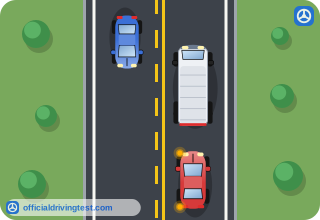
- Passing is allowed when no traffic is coming
- No passing
- Passing is allowed only at night
- Passing is allowed only on hills
Show answer
Correct answer: No passing
When you are in the lane with the solid line, one solid line with one broken line means no passing.
Source: North Dakota Noncommercial Driver License Manual (2025-2027), page 16 · Open this page in the manual (Manual page 16)
-
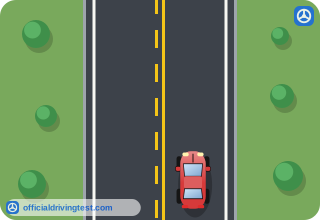
The solid line next to a broken line may be crossed only for what?
- To pass another vehicle
- To turn right
- To change lanes
- To turn left
Show answer
Correct answer: To turn left
The solid line may be crossed only to turn left.
Source: North Dakota Noncommercial Driver License Manual (2025-2027), page 16 · Open this page in the manual (Manual page 16)
-
What do two solid yellow lines on a two-lane road mean?
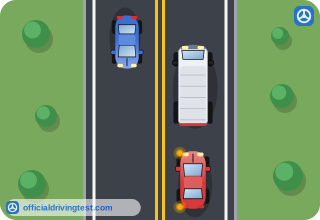
- Passing is allowed in one direction only
- Passing is allowed when the road ahead is clear
- Passing is allowed on the right side only
- No passing in either direction
Show answer
Correct answer: No passing in either direction
Two solid yellow lines on a two-lane road mean no passing in either direction.
Source: North Dakota Noncommercial Driver License Manual (2025-2027), page 16 · Open this page in the manual (Manual page 16)
-
On an undivided multi-lane, two-way roadway, when is crossing the centerline permitted?
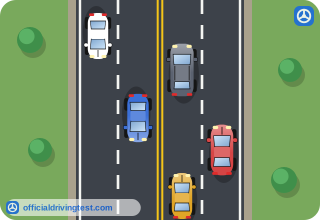
- Only to pass slower vehicles
- Only as part of a left-turn maneuver
- Only when no traffic is coming
- Whenever you change lanes
Show answer
Correct answer: Only as part of a left-turn maneuver
On a multi-lane, two-way roadway, crossing the centerline is permitted only as part of a left-turn maneuver.
Source: North Dakota Noncommercial Driver License Manual (2025-2027), page 16 · Open this page in the manual (Manual page 16)
-
What is a divided roadway?
- A two-lane road with a broken yellow line down the center
- A road where traffic travels in one direction only
- A multi-lane roadway with a divider separating the traffic flow
- A two-lane road where passing is never allowed
Show answer
Correct answer: A multi-lane roadway with a divider separating the traffic flow
A divided roadway is a multi-lane roadway with a divider separating the traffic flow.
Source: North Dakota Noncommercial Driver License Manual (2025-2027), page 17 · Open this page in the manual (Manual page 17)
-
What does the manual say about passing in the center lane of a two-way left turn lane?
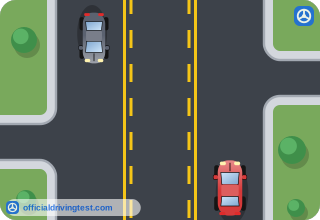
- Passing or overtaking is not permitted in it
- Passing is permitted when no vehicle is waiting to turn
- Passing is permitted at speeds below 25 miles per hour
- Passing is permitted only at night
Show answer
Correct answer: Passing or overtaking is not permitted in it
The center lane is reserved only for left-turning vehicles in either direction, and passing or overtaking is not permitted in it.
Source: North Dakota Noncommercial Driver License Manual (2025-2027), page 17 · Open this page in the manual (Manual page 17)
-
At a busy intersection with specially designated turn lanes, what must you do if you wish to turn right?
- Use the special right-turn lane
- Turn from the lane closest to the center of the road
- Turn from whichever lane has the least traffic
- Turn from the through lane after signaling early
Show answer
Correct answer: Use the special right-turn lane
Where specially designated turn lanes exist, you must use the special right-turn lane to turn right.
Source: North Dakota Noncommercial Driver License Manual (2025-2027), page 17 · Open this page in the manual (Manual page 17)
-
What are stop lines?
- Wide, yellow lines that show you where to stop your vehicle before entering an intersection
- Narrow, broken white lines that show you where to slow down before entering an intersection
- Wide, white lines that show you where to stop your vehicle before entering an intersection
- Wide, white lines that show you where to park your vehicle near an intersection
Show answer
Correct answer: Wide, white lines that show you where to stop your vehicle before entering an intersection
Stop lines are wide, white lines that show you where to stop your vehicle before entering an intersection.
Source: North Dakota Noncommercial Driver License Manual (2025-2027), page 17 · Open this page in the manual (Manual page 17)
-
Where there are no lines at an intersection, where must you stop your vehicle?
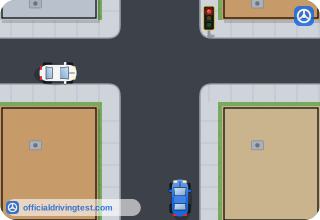
- Beyond the crosswalk, so that you can see cross traffic better
- Before entering the crosswalk or, if there is no crosswalk, before entering the intersection
- Wherever you can see traffic approaching, even if that is inside the intersection
- Just before the center of the intersection
Show answer
Correct answer: Before entering the crosswalk or, if there is no crosswalk, before entering the intersection
At an unmarked crosswalk you stop before entering the crosswalk or, if there is no crosswalk, before your vehicle enters the intersection.
Source: North Dakota Noncommercial Driver License Manual (2025-2027), page 17 · Open this page in the manual (Manual page 17)
-
What do crosswalk lines mark?
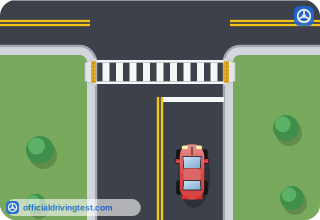
- Where vehicles must yield to oncoming traffic
- Where vehicles may park near an intersection
- Where a traffic lane ends
- Where pedestrians will walk
Show answer
Correct answer: Where pedestrians will walk
Crosswalk lines are a pair of white lines or longitudinal lines that mark where pedestrians will walk.
Source: North Dakota Noncommercial Driver License Manual (2025-2027), page 17 · Open this page in the manual (Manual page 17)
-
Which is the correct way to treat crosswalk lines?
- Stop with your front wheels on the lines so pedestrians can see you
- Pull onto the lines to let other traffic pass
- Park on the lines for short stops
- Do not block the crosswalk with your vehicle
Show answer
Correct answer: Do not block the crosswalk with your vehicle
The manual says not to block the crosswalk with your vehicle.
Source: North Dakota Noncommercial Driver License Manual (2025-2027), page 17 · Open this page in the manual (Manual page 17)
-
When stop lines and crosswalk lines are used together, where must you stop your vehicle?
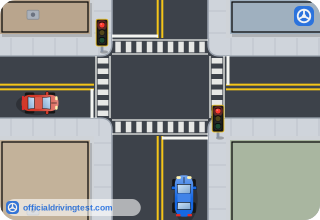
- Between the stop line and the crosswalk lines
- Before crossing the stop line
- On the crosswalk lines
- After the crosswalk lines
Show answer
Correct answer: Before crossing the stop line
When both are used, you must stop your vehicle before crossing the stop line.
Source: North Dakota Noncommercial Driver License Manual (2025-2027), page 17 · Open this page in the manual (Manual page 17)