North Carolina: Traffic signals Practice Test
Red, yellow and green lights, arrows, flashing signals and hybrid beacons.
Independent educational site · not affiliated with any government agency or DMV
Ready? Test yourself
- Instant feedback with an explanation
- Every answer cites its source in the manual
- Your best score is saved on this device
Questions are original and based on the official manual "North Carolina Driver Handbook" (Revised May 2025), North Carolina Division of Motor Vehicles (NCDMV).
All 26 questions in this practice test
Take the test above first, then use this list to study. Tap “Show answer” to see the correct answer and explanation.
Show the questions and answersHide the questions
-
What must a turning vehicle do when facing a circular green signal?
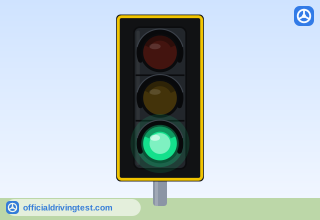
- Yield the right of way to oncoming traffic and pedestrians
- Stop and wait for a green arrow before turning
- Turn at once, because a green signal gives turning vehicles the right of way
- Stop completely, then turn when the way looks clear
Show answer
Correct answer: Yield the right of way to oncoming traffic and pedestrians
A circular green signal lets you proceed cautiously, but turning vehicles must yield to oncoming traffic and pedestrians.
Source: North Carolina Driver Handbook (Revised May 2025), page 80 · Open this page in the manual (Manual page 80)
-
What does a circular yellow signal mean?
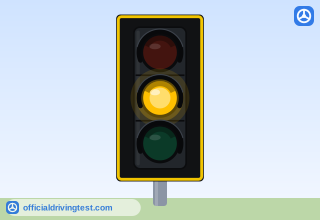
- Stop only if other vehicles are approaching
- The signal is about to turn green
- Caution; the signal is about to turn red
- Speed up and clear the intersection before the red signal
Show answer
Correct answer: Caution; the signal is about to turn red
The manual says a circular yellow signal means caution and that the signal is about to turn red.
Source: North Carolina Driver Handbook (Revised May 2025), page 80 · Open this page in the manual (Manual page 80)
-
What should you do when the signal turns yellow as you approach an intersection?
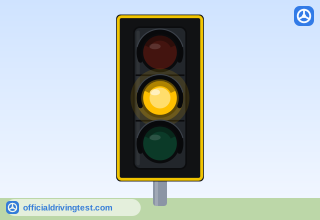
- Always continue through the intersection at the same speed
- Stop, unless you are too close to the intersection to stop safely
- Always stop immediately, wherever your vehicle is
- Speed up so that you clear the intersection before it turns red
Show answer
Correct answer: Stop, unless you are too close to the intersection to stop safely
You must stop for a yellow signal unless you are too close to stop safely, in which case you drive cautiously through.
Source: North Carolina Driver Handbook (Revised May 2025), page 80 · Open this page in the manual (Manual page 80)
-
Which action is never correct when a signal turns yellow?
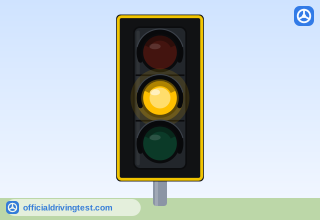
- Stopping if you can do so safely
- Driving cautiously through when too close to stop safely
- Slowing down as you approach the intersection
- Speeding up to “beat” the red signal
Show answer
Correct answer: Speeding up to “beat” the red signal
The manual says never to speed up for a yellow signal to beat the red signal.
Source: North Carolina Driver Handbook (Revised May 2025), page 80 · Open this page in the manual (Manual page 80)
-
When may you turn right at a steady red circular signal?
- After coming to a complete stop, unless a sign says NO TURN ON RED
- Never, because a red signal always means no turns
- Only when there are no pedestrians, without needing to stop
- Only when a green arrow is displayed together with the red signal
Show answer
Correct answer: After coming to a complete stop, unless a sign says NO TURN ON RED
A right turn is allowed after a complete stop unless a NO TURN ON RED sign is posted.
Source: North Carolina Driver Handbook (Revised May 2025), page 80 · Open this page in the manual (Manual page 80)
-
What is the penalty for failing to yield to a pedestrian when turning right on a steady red signal?
- A penalty of not more than $300 and not less than $50
- A penalty of not more than $1,000 and not less than $200
- A penalty of not more than $500 and not less than $100
- A penalty of not more than $750 and not less than $250
Show answer
Correct answer: A penalty of not more than $500 and not less than $100
The manual states the penalty is not more than $500 and not less than $100.
Source: North Carolina Driver Handbook (Revised May 2025), page 80 · Open this page in the manual (Manual page 80)
-
What does a green arrow signal mean?
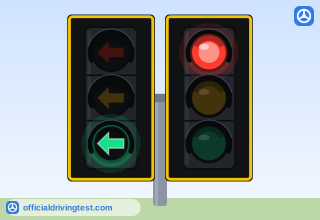
- Turns are allowed only after yielding to oncoming traffic
- A protected movement in the direction the arrow shows
- The signal is about to turn to a circular green
- Turns are allowed only after coming to a complete stop
Show answer
Correct answer: A protected movement in the direction the arrow shows
A green arrow is a protected movement that lets you cautiously make the movement the arrow shows.
Source: North Carolina Driver Handbook (Revised May 2025), page 80 · Open this page in the manual (Manual page 80)
-
When both movements have a green arrow at the same time, which traffic should yield?
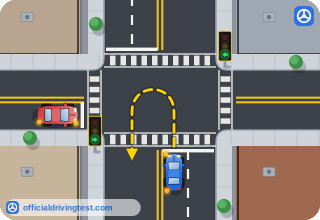
- Right-turning traffic should yield to opposing U-turning traffic
- Whichever vehicle is closer to the signal should yield
- Neither movement has to yield, because both arrows are green
- U-turning traffic should yield to opposing right-turning traffic
Show answer
Correct answer: U-turning traffic should yield to opposing right-turning traffic
When both have a green arrow, U-turning traffic yields to opposing right-turning traffic.
Source: North Carolina Driver Handbook (Revised May 2025), page 80 · Open this page in the manual (Manual page 80)
-
What does a red arrow signal mean?
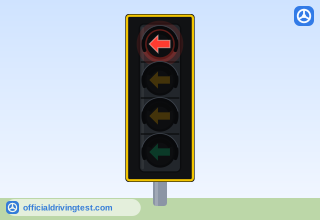
- Turning traffic must stop
- Turning traffic may proceed after yielding
- Through traffic must stop, but turns are allowed
- Turn only after a complete stop and a check for traffic
Show answer
Correct answer: Turning traffic must stop
The manual states that a red arrow means turning traffic must stop.
Source: North Carolina Driver Handbook (Revised May 2025), page 80 · Open this page in the manual (Manual page 80)
-
What does a steady yellow arrow signal indicate?
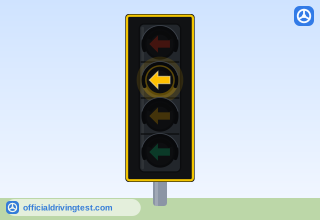
- Turns are allowed without yielding to oncoming traffic
- A “protected” turn arrow is about to begin
- The “protected” green arrow is about to end
- The intersection is about to become an all-way stop
Show answer
Correct answer: The “protected” green arrow is about to end
A yellow arrow warns that the protected green arrow is about to turn to a circular green, circular red or red arrow.
Source: North Carolina Driver Handbook (Revised May 2025), page 80 · Open this page in the manual (Manual page 80)
-
At an intersection where both arrow and circular signals are displayed, what controls the turning traffic?
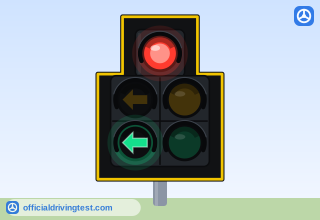
- The circular signals
- The arrow signals
- The signal for the cross street
- Whichever signal changed first
Show answer
Correct answer: The arrow signals
With both displayed, turning traffic follows the arrow signals and through traffic follows the circular signals.
Source: North Carolina Driver Handbook (Revised May 2025), page 81 · Open this page in the manual (Manual page 81)
-
How should you treat a traffic light that has malfunctioned because of a power outage?
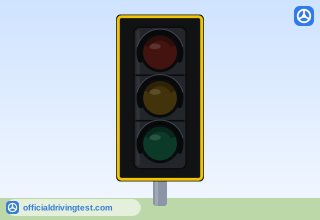
- As an intersection with a yield sign on all approaches
- As an intersection with a flashing yellow signal
- As an intersection where you may go if no vehicles are visible
- As an intersection with a stop sign on all approaches
Show answer
Correct answer: As an intersection with a stop sign on all approaches
The manual says to proceed as though the intersection is controlled by a stop sign on all approaches.
Source: North Carolina Driver Handbook (Revised May 2025), page 81 · Open this page in the manual (Manual page 81)
-
What does a flashing red signal mean?
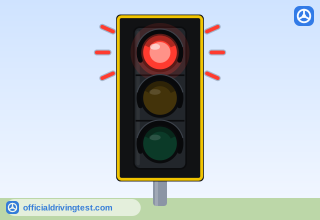
- The same as a stop sign
- Slow down and proceed with caution
- The signal is about to turn green
- Yield to oncoming traffic but do not stop
Show answer
Correct answer: The same as a stop sign
A flashing red signal has the same meaning as a stop sign.
Source: North Carolina Driver Handbook (Revised May 2025), page 81 · Open this page in the manual (Manual page 81)
-
What does a flashing yellow signal mean?
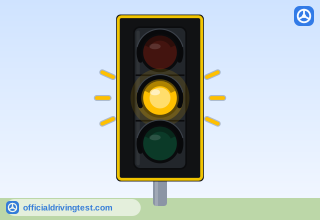
- Stop, then proceed when no traffic is approaching
- The signal is about to turn red
- Slow down and proceed with caution
- Stop and wait for a green signal
Show answer
Correct answer: Slow down and proceed with caution
A flashing yellow signal has the same meaning as a warning sign: slow down and proceed with caution.
Source: North Carolina Driver Handbook (Revised May 2025), page 81 · Open this page in the manual (Manual page 81)
-
What must drivers do when a flashing yellow arrow is shown for their turn?
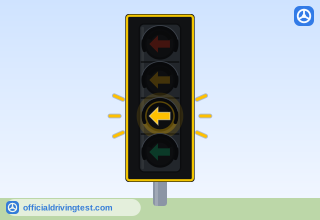
- Stop and wait for a solid green arrow
- Turn only after yielding to oncoming traffic and pedestrians
- Turn without yielding, because the turn is protected
- Stop, because no turns are allowed
Show answer
Correct answer: Turn only after yielding to oncoming traffic and pedestrians
A flashing yellow arrow permits the turn, but drivers must yield to oncoming traffic and pedestrians.
Source: North Carolina Driver Handbook (Revised May 2025), page 81 · Open this page in the manual (Manual page 81)
-
On a right-turn signal head, what may be provided instead of a red arrow?
- A flashing red circular signal
- A steady yellow circular signal
- A flashing yellow circular signal
- A steady red circular signal
Show answer
Correct answer: A steady red circular signal
The manual notes that right-turn signal heads may show a steady red circular signal rather than a red arrow.
Source: North Carolina Driver Handbook (Revised May 2025), page 81 · Open this page in the manual (Manual page 81)
-
What is a ramp meter signal used to control?
- Traffic entering a freeway from an interchange entrance ramp
- Traffic leaving a freeway by way of an interchange exit ramp
- Traffic crossing the freeway at a mid-block crosswalk
- The speed of vehicles traveling in the freeway through lanes
Show answer
Correct answer: Traffic entering a freeway from an interchange entrance ramp
A ramp meter signal controls traffic entering a freeway from an interchange entrance ramp.
Source: North Carolina Driver Handbook (Revised May 2025), page 82 · Open this page in the manual (Manual page 82)
-
What may you do when a ramp meter display is dark or shows neither red nor green?
- Stop and wait until the green display appears again
- Come to a full stop, then enter after yielding to all freeway traffic
- Enter without stopping, merging or yielding as conditions allow
- Wait for a law enforcement officer to direct you onto the freeway
Show answer
Correct answer: Enter without stopping, merging or yielding as conditions allow
A dark ramp meter lets you proceed without stopping and merge or yield as normal conditions allow.
Source: North Carolina Driver Handbook (Revised May 2025), page 82 · Open this page in the manual (Manual page 82)
-
Where may hybrid beacons be used to control traffic?
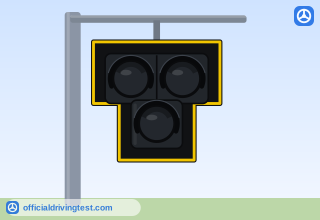
- At railroad crossings and interchange entrance ramps on freeways
- At mid-block crosswalks and entrances to emergency response facilities
- At school zone crossings and highway construction work zones
- At four-way stop intersections and highway interchange exits
Show answer
Correct answer: At mid-block crosswalks and entrances to emergency response facilities
Hybrid beacons may control traffic at mid-block crosswalks and entrances to emergency response facilities.
Source: North Carolina Driver Handbook (Revised May 2025), page 82 · Open this page in the manual (Manual page 82)
-
What is the state of a hybrid beacon before pedestrians or emergency personnel activate it?
- Flashing yellow
- Steady yellow
- Flashing red
- Dark
Show answer
Correct answer: Dark
Hybrid beacons remain dark until activated by pedestrians or emergency response personnel.
Source: North Carolina Driver Handbook (Revised May 2025), page 82 · Open this page in the manual (Manual page 82)
-
What is the first display of a hybrid beacon once it has been activated?
- Flashing yellow
- Steady red
- Steady yellow
- Alternating flashing red
Show answer
Correct answer: Flashing yellow
After activation the beacon flashes yellow for a few seconds, then goes steady yellow and steady red.
Source: North Carolina Driver Handbook (Revised May 2025), page 82 · Open this page in the manual (Manual page 82)
-
When may a driver begin moving while a hybrid beacon is flashing red?
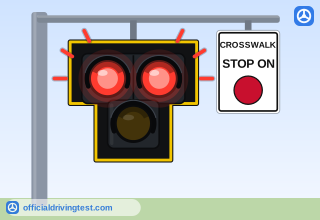
- As soon as the beacon starts to flash red
- Only after the beacon turns steady yellow again
- After the crossing is clear and you have stopped
- Only after the beacon has flashed red for one full minute
Show answer
Correct answer: After the crossing is clear and you have stopped
Vehicles stay stopped until the pedestrians or emergency vehicles have cleared, and after stopping may move on while the beacon flashes red.
Source: North Carolina Driver Handbook (Revised May 2025), page 82 · Open this page in the manual (Manual page 82)
-
What should you obey when a traffic officer is directing the flow of traffic?
- The normal traffic signals and signs unless the officer stops you
- The posted signs, and the officer’s signals only at night
- Only the traffic signals, because the officer’s signals are advisory
- The officer’s hand signals instead of the normal signals or signs
Show answer
Correct answer: The officer’s hand signals instead of the normal signals or signs
When an officer directs traffic, you obey the officer’s hand signals instead of the normal signals or signs.
Source: North Carolina Driver Handbook (Revised May 2025), page 88 · Open this page in the manual (Manual page 88)
-
How do most traffic officers signal drivers to stop?
- One hand held up, palm facing the vehicle, and a long blast on the whistle
- Both arms waved overhead and a series of short blasts on the whistle
- One hand motioning toward the vehicle and two short blasts on the whistle
- Pointing at the vehicle and giving one long blast on the whistle
Show answer
Correct answer: One hand held up, palm facing the vehicle, and a long blast on the whistle
Officers usually hold up one hand with the palm facing the vehicle and give a long whistle blast.
Source: North Carolina Driver Handbook (Revised May 2025), page 88 · Open this page in the manual (Manual page 88)
-
How does a traffic officer usually signal drivers to start or keep moving?
- Holding up one hand with the palm out and giving a long blast
- Pointing at the vehicle and giving two long blasts on the whistle
- Motioning with the hand and giving a series of short blasts on the whistle
- Holding up both hands and giving one short blast on the whistle
Show answer
Correct answer: Motioning with the hand and giving a series of short blasts on the whistle
Drivers are signaled to start or keep moving by a hand motion and a series of short whistle blasts.
Source: North Carolina Driver Handbook (Revised May 2025), page 88 · Open this page in the manual (Manual page 88)
-
How may a traffic officer signal drivers at night?
- By using flares placed on the road
- By using a flashlight
- By using only whistle blasts
- By using hazard lights on the patrol vehicle
Show answer
Correct answer: By using a flashlight
At night the traffic officer may signal by using a flashlight.
Source: North Carolina Driver Handbook (Revised May 2025), page 88 · Open this page in the manual (Manual page 88)