North Carolina: Speed & following distance — Part 5 Practice Test
Questions in this part include: “How much farther can stopping distances be on slippery pavement than on dry pavement?” · “A deer hit at which speed has a much lower fatality rate than one hit at 55+ mph?”
Independent educational site · not affiliated with any government agency or DMV
Ready? Test yourself
- Instant feedback with an explanation
- Every answer cites its source in the manual
- Your best score is saved on this device
Questions are original and based on the official manual "North Carolina Driver Handbook" (Revised May 2025), North Carolina Division of Motor Vehicles (NCDMV).
All 18 questions in this practice test
Take the test above first, then use this list to study. Tap “Show answer” to see the correct answer and explanation.
Show the questions and answersHide the questions
-
When driving at night, where should you look to avoid looking directly into oncoming headlights?
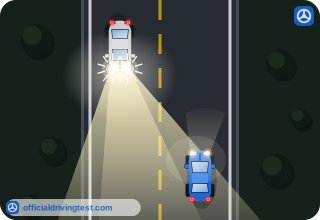
- Slightly to the left
- Slightly to the right
- Straight into the headlights
- Down at the hood of your vehicle
Show answer
Correct answer: Slightly to the right
The manual says to look slightly to the right so you will not be looking directly into the headlights of oncoming traffic.
Source: North Carolina Driver Handbook (Revised May 2025), page 71 · Open this page in the manual (Manual page 71)
-
At night, what is the guide to use while staying on the right side of the road?
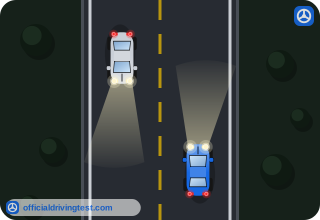
- The center line
- The taillights of the vehicle ahead
- The headlights of oncoming traffic
- The edge of the road
Show answer
Correct answer: The edge of the road
The manual says to stay on the right side of the road and use the edge of the road as a guide.
Source: North Carolina Driver Handbook (Revised May 2025), page 71 · Open this page in the manual (Manual page 71)
-
At what speed should you never drive at night?
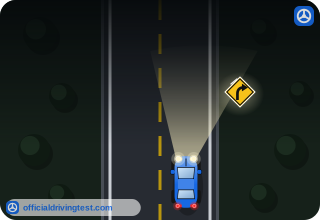
- A speed too fast to stop within the distance you can see
- A speed slower than the flow of the traffic around you
- A speed below 40 mph on any road at night
- A speed above 45 mph on any road at night
Show answer
Correct answer: A speed too fast to stop within the distance you can see
The manual says never to drive at a speed at which you cannot stop within the distance you can see on the road ahead.
Source: North Carolina Driver Handbook (Revised May 2025), page 71 · Open this page in the manual (Manual page 71)
-
Why should you keep a lookout at all times when driving at night?
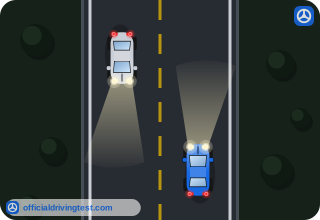
- Dim headlights make oncoming vehicles easier to see clearly
- Other drivers can always see your vehicle very clearly
- Bright headlights from another vehicle make it hard to see past them
- Oncoming lights make the road much brighter for you
Show answer
Correct answer: Bright headlights from another vehicle make it hard to see past them
The manual says bright headlights from another vehicle make it difficult to see beyond their source.
Source: North Carolina Driver Handbook (Revised May 2025), page 71 · Open this page in the manual (Manual page 71)
-
What should you do to reduce the problem of sun glare?
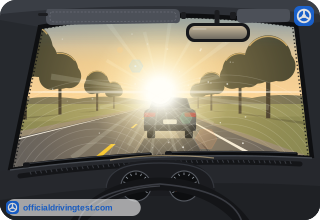
- Adjust your sun visor and wear sunglasses
- Turn on your high beams
- Look directly at the sun to adjust your eyes
- Drive faster to leave the glare behind
Show answer
Correct answer: Adjust your sun visor and wear sunglasses
The manual says to adjust your sun visor and wear sunglasses to reduce sun glare.
Source: North Carolina Driver Handbook (Revised May 2025), page 72 · Open this page in the manual (Manual page 72)
-
If a visor and sunglasses do not help with sun glare, what should you do?
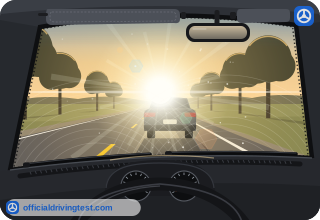
- Slow to 10 mph below the speed limit and continue
- Close your eyes for a few seconds
- Stop on the roadside until you can drive safely
- Continue driving while keeping to the center of the road
Show answer
Correct answer: Stop on the roadside until you can drive safely
The manual says if these do not help, stop on the roadside until you can drive safely.
Source: North Carolina Driver Handbook (Revised May 2025), page 72 · Open this page in the manual (Manual page 72)
-
What must you use when driving in the rain?
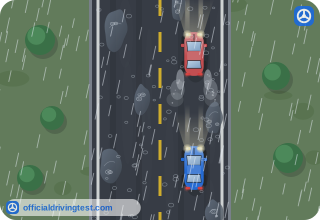
- Your high-beam headlights and your cruise control
- Your headlights and your windshield wipers
- Your emergency flashers and your parking lights only
- Your cruise control and your emergency flashers
Show answer
Correct answer: Your headlights and your windshield wipers
The manual says you must use your headlights and windshield wipers in rain.
Source: North Carolina Driver Handbook (Revised May 2025), page 72 · Open this page in the manual (Manual page 72)
-
How much farther can stopping distances be on slippery pavement than on dry pavement?
- One to two times farther
- Three to four times farther
- Twenty times farther
- Two to 10 times farther
Show answer
Correct answer: Two to 10 times farther
The manual says stopping distances on slippery pavement increase from two to 10 times farther than on dry pavement.
Source: North Carolina Driver Handbook (Revised May 2025), page 72 · Open this page in the manual (Manual page 72)
-
In the rain, how much following distance should you allow?
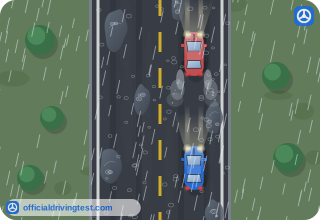
- At least twice the normal following distance
- The normal following distance
- At least half the normal following distance
- At least ten times the normal following distance
Show answer
Correct answer: At least twice the normal following distance
The manual says to slow down and allow yourself at least twice the normal following distance.
Source: North Carolina Driver Handbook (Revised May 2025), page 72 · Open this page in the manual (Manual page 72)
-
When are roads more dangerous during rain?
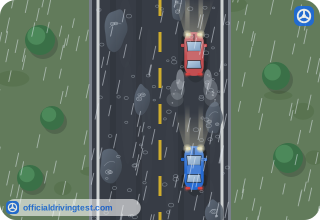
- After it has been raining steadily for several hours
- After the rain has stopped and a full day has passed
- Just after rain has begun to fall
- When the rain is very light and the road is only damp
Show answer
Correct answer: Just after rain has begun to fall
The manual says roads are more dangerous just after rain has begun, especially if it has not rained for a while.
Source: North Carolina Driver Handbook (Revised May 2025), page 72 · Open this page in the manual (Manual page 72)
-
For the first 10 to 15 minutes of rain, what combines to create a slick surface?
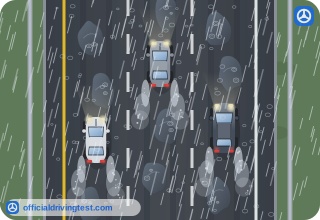
- Rain and snow that has piled up along the shoulder
- Rain, oil from asphalt and vehicles, dirt, dust and rubber
- Rain and fallen leaves that are on the pavement
- Rain and sand that has blown from the shoulder
Show answer
Correct answer: Rain, oil from asphalt and vehicles, dirt, dust and rubber
The manual says for the first 10 to 15 minutes rain combines with oil from asphalt and vehicles, and with dirt, dust and rubber to create a slick surface.
Source: North Carolina Driver Handbook (Revised May 2025), page 72 · Open this page in the manual (Manual page 72)
-
How much slower should you drive on wet pavement than on dry pavement?
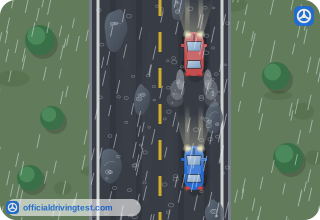
- At least one to two miles per hour slower
- At least 20 to 25 miles per hour slower
- At least 30 to 35 miles per hour slower
- At least five to 10 miles per hour slower
Show answer
Correct answer: At least five to 10 miles per hour slower
The manual says to drive at least five to 10 miles per hour slower on wet pavement than on dry pavement.
Source: North Carolina Driver Handbook (Revised May 2025), page 72 · Open this page in the manual (Manual page 72)
-
If you must drive during fog, what should you do about your speed?
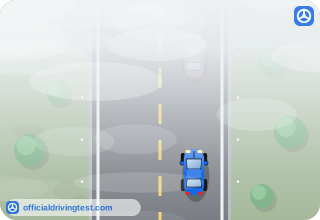
- Keep your speed steady and follow closely to stay in sight of the car ahead
- Slow down but pay no attention to vehicles behind you
- Speed up to get through the fog as quickly as possible
- Reduce your speed and watch for the tail lights of the vehicle ahead
Show answer
Correct answer: Reduce your speed and watch for the tail lights of the vehicle ahead
The manual advises reducing speed and staying alert for the tail lights of the vehicle in front of you.
Source: North Carolina Driver Handbook (Revised May 2025), page 73 · Open this page in the manual (Manual page 73)
-
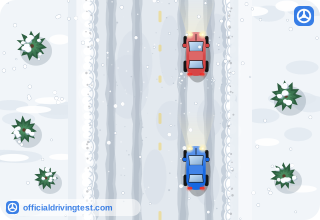
How much is it recommended that you reduce speed for packed snow?
- By more than half
- By about one tenth
- By about one quarter
- By 5 mph only
Show answer
Correct answer: By more than half
The manual recommends cutting your speed by more than half for packed snow.
Source: North Carolina Driver Handbook (Revised May 2025), page 73 · Open this page in the manual (Manual page 73)
-
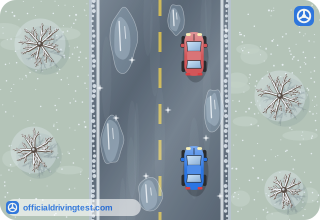
What speed does the manual recommend when you are driving on ice?
- Half of your normal speed
- Two thirds of your normal speed
- Slow to a crawl
- The posted speed limit
Show answer
Correct answer: Slow to a crawl
The manual recommends slowing to a crawl on ice.
Source: North Carolina Driver Handbook (Revised May 2025), page 73 · Open this page in the manual (Manual page 73)
-
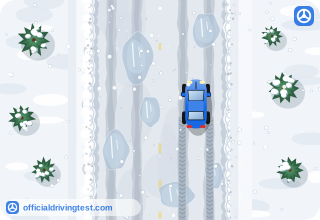
When slowing down on snowy or icy roads, how much stopping distance should you allow?
- Half of the normal stopping distance
- The same as the normal stopping distance
- At least one and a half times the normal stopping distance
- At least three times the normal stopping distance
Show answer
Correct answer: At least three times the normal stopping distance
The manual says to allow at least three times the normal stopping distance on snowy or icy roads.
Source: North Carolina Driver Handbook (Revised May 2025), page 73 · Open this page in the manual (Manual page 73)
-
A deer hit at which speed has a much lower fatality rate than one hit at 55+ mph?
- 60 mph
- 35 mph
- 45 mph
- 50 mph
Show answer
Correct answer: 35 mph
The manual says a deer hit at 35 mph has a much lower fatality rate than at 55+ mph, and so does the driver.
Source: North Carolina Driver Handbook (Revised May 2025), page 74 · Open this page in the manual (Manual page 74)
-
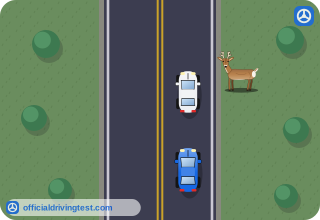
Why does the manual say to leave extra space between your vehicle and the one in front when wildlife may be nearby?
- It keeps animals from running between the two vehicles on the road
- It lets you pass the car ahead more easily
- It lowers the noise your engine makes near animals
- It gives you more time to stop if the car ahead brakes hard for an animal
Show answer
Correct answer: It gives you more time to stop if the car ahead brakes hard for an animal
Extra following distance gives you more time to stop if the car ahead brakes hard for an animal.
Source: North Carolina Driver Handbook (Revised May 2025), page 74 · Open this page in the manual (Manual page 74)