North Carolina: Speed & following distance — Part 4 Practice Test
Questions in this part include: “While checking the mirrors, how long may you take your eyes off the road?” · “How should you allow a margin of safety around your vehicle?”
Independent educational site · not affiliated with any government agency or DMV
Ready? Test yourself
- Instant feedback with an explanation
- Every answer cites its source in the manual
- Your best score is saved on this device
Questions are original and based on the official manual "North Carolina Driver Handbook" (Revised May 2025), North Carolina Division of Motor Vehicles (NCDMV).
All 18 questions in this practice test
Take the test above first, then use this list to study. Tap “Show answer” to see the correct answer and explanation.
Show the questions and answersHide the questions
-
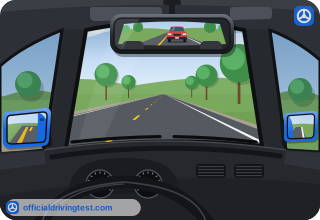
When is it especially important to check for traffic behind you and in your blind spots?
- When driving on a straight, flat road with no other traffic
- When changing lanes, backing, slowing down or going down a long hill
- When following another vehicle closely on a two-lane road
- When driving at a steady speed on an interstate highway
Show answer
Correct answer: When changing lanes, backing, slowing down or going down a long hill
The manual says to check for traffic from behind and in your blind spots when changing lanes, backing, slowing down or driving down a long hill.
Source: North Carolina Driver Handbook (Revised May 2025), page 68 · Open this page in the manual (Manual page 68)
-
While checking the mirrors, how long may you take your eyes off the road?
- No more than two seconds
- No more than five seconds
- As long as the road ahead is clear
- No more than an instant
Show answer
Correct answer: No more than an instant
The manual says not to take your eyes off the road for more than an instant while checking the mirrors.
Source: North Carolina Driver Handbook (Revised May 2025), page 68 · Open this page in the manual (Manual page 68)
-
What should you always leave yourself when scanning the road?
- An "out"
- A stopping distance of at least four seconds
- A clear view of the road behind you only
- A lane to your left for passing
Show answer
Correct answer: An "out"
The manual says to always leave yourself an “out.”
Source: North Carolina Driver Handbook (Revised May 2025), page 68 · Open this page in the manual (Manual page 68)
-
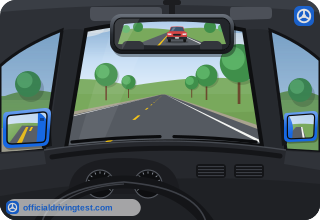
What are blind spots?
- The areas directly in front of the vehicle that you cannot see over the hood
- The areas behind the vehicle that show up in the rear-view mirror
- The areas near the left and right rear corners that the mirrors do not show
- The areas that are hidden by your headlights at night
Show answer
Correct answer: The areas near the left and right rear corners that the mirrors do not show
The manual defines blind spots as the areas near the left and right rear corners of the vehicle that you cannot see using the mirrors.
Source: North Carolina Driver Handbook (Revised May 2025), page 68 · Open this page in the manual (Manual page 68)
-
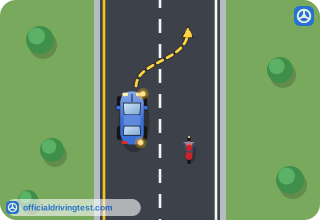
What should you do before you make any lane change or turn to check the blind spot?
- Rely on the side mirrors alone to see the blind spot
- Quickly turn your head and look over your shoulder
- Rely on the rear-view mirror alone to see the blind spot
- Slow down and sound the horn before you move over
Show answer
Correct answer: Quickly turn your head and look over your shoulder
The manual says to quickly turn your head and look over your shoulder to see what is in the blind spot.
Source: North Carolina Driver Handbook (Revised May 2025), page 68 · Open this page in the manual (Manual page 68)
-
Which of these can create additional blind spots?
- Clean windshields and properly adjusted mirrors on your vehicle
- Vehicles that are following you at a safe distance behind
- Empty lanes and wide shoulders on the roadway ahead
- Glaring lights, dirty windshields or bushes and buildings
Show answer
Correct answer: Glaring lights, dirty windshields or bushes and buildings
The manual says additional blind spots can be created by glaring lights, dirty windshields, vehicles parked too closely to an intersection, bushes and/or buildings.
Source: North Carolina Driver Handbook (Revised May 2025), page 68 · Open this page in the manual (Manual page 68)
-
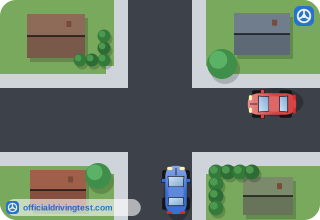
If your view is blocked by parked vehicles, bushes or buildings, what should you do?
- Ease your vehicle forward until you can see clearly
- Sound your horn and continue forward at your current speed
- Stop and wait for another driver to signal you to go
- Speed up to clear the intersection as quickly as you can
Show answer
Correct answer: Ease your vehicle forward until you can see clearly
The manual says in these cases to ease your vehicle forward until you can see clearly.
Source: North Carolina Driver Handbook (Revised May 2025), page 68 · Open this page in the manual (Manual page 68)
-
Where should you avoid driving with respect to other drivers?
- In the right-hand lane of the road
- In the left lane
- In other drivers' blind spots
- Beside parked vehicles
Show answer
Correct answer: In other drivers' blind spots
The manual says to avoid driving in other drivers' blind spots where it is more difficult for them to see you.
Source: North Carolina Driver Handbook (Revised May 2025), page 68 · Open this page in the manual (Manual page 68)
-
How should you allow a margin of safety around your vehicle?
- Stay close to other vehicles so that they can see you clearly at all times
- Drive next to other vehicles so that they cannot pass you
- Stay close behind the vehicle ahead to keep up with its pace
- Stay clear of other vehicles, with room ahead and behind to pass or stop safely
Show answer
Correct answer: Stay clear of other vehicles, with room ahead and behind to pass or stop safely
The manual says to allow a margin of safety by staying clear of other vehicles, with enough room ahead and behind to pass or stop safely.
Source: North Carolina Driver Handbook (Revised May 2025), page 69 · Open this page in the manual (Manual page 69)
-
To warn other drivers from following too closely, what should you do when slowing down or stopping?
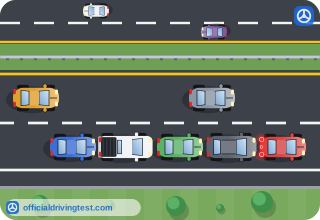
- Drive at a steady speed and signal well in advance
- Brake suddenly at the last moment and sound your horn
- Move to the shoulder and stop until traffic has cleared
- Slow down without using any signal so you do not confuse drivers
Show answer
Correct answer: Drive at a steady speed and signal well in advance
The manual says to drive at a steady speed and signal well in advance whenever slowing down or stopping.
Source: North Carolina Driver Handbook (Revised May 2025), page 69 · Open this page in the manual (Manual page 69)
-
If another vehicle follows you too closely, what should you do?
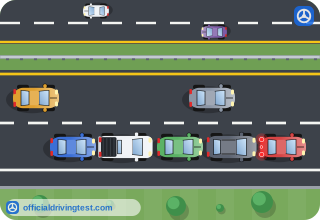
- Speed up to increase the distance
- Slow down to make the driver back off
- Move to another lane and signal for the driver to pass you
- Stop in your lane and wait for the driver to pass
Show answer
Correct answer: Move to another lane and signal for the driver to pass you
The manual says to move to another lane and signal for the driver to pass you.
Source: North Carolina Driver Handbook (Revised May 2025), page 69 · Open this page in the manual (Manual page 69)
-
Where should you stay within a lane to keep a margin of safety?
- Close to the left edge of the lane so you can see ahead
- In the middle of the lane, with space on both sides
- Close to the right edge of the lane to leave room for passing
- Over the center line to leave extra space for parked vehicles
Show answer
Correct answer: In the middle of the lane, with space on both sides
The manual says to stay in the middle of the lane and leave space on both sides of your vehicle.
Source: North Carolina Driver Handbook (Revised May 2025), page 69 · Open this page in the manual (Manual page 69)
-
According to the handbook, what is the key to successful driving?
- Driving faster than traffic
- Driving only on interstates
- Avoiding all night driving
- Adjusting to road conditions
Show answer
Correct answer: Adjusting to road conditions
The manual says adjusting to road conditions is the key to successful driving.
Source: North Carolina Driver Handbook (Revised May 2025), page 69 · Open this page in the manual (Manual page 69)
-
According to the manual, what is the most important thing to know about road conditions?
- When conditions are too dangerous to risk driving at all
- When conditions are safe enough to speed up
- When conditions allow you to use cruise control
- When conditions require the use of high beams
Show answer
Correct answer: When conditions are too dangerous to risk driving at all
The manual says most importantly you should know when conditions are too dangerous to risk driving at all.
Source: North Carolina Driver Handbook (Revised May 2025), page 69 · Open this page in the manual (Manual page 69)
-
If you face two or more unavoidable dangers at the same time, how should you adjust?
- Give an equal amount of room to each of the dangers
- Give the most room to whichever vehicle is nearest to you
- Give the most room to the greatest or most likely danger
- Speed up to pass both of the dangers as quickly as possible
Show answer
Correct answer: Give the most room to the greatest or most likely danger
The manual says to give the most room to the greatest or most likely danger.
Source: North Carolina Driver Handbook (Revised May 2025), page 69 · Open this page in the manual (Manual page 69)
-
Oncoming vehicles are to your left and a child on a bicycle is to your right. Whom should you give more room?
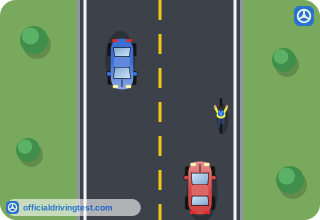
- The oncoming vehicles
- The child on the bicycle
- Both equally
- Neither, you should keep to the center of the road
Show answer
Correct answer: The child on the bicycle
The manual says the child is most likely to make a sudden move, so give the child more room, even if it means moving closer to the oncoming vehicles.
Source: North Carolina Driver Handbook (Revised May 2025), page 69 · Open this page in the manual (Manual page 69)
-
If two dangers are equally hazardous, such as oncoming vehicles and parked vehicles, what should you do?
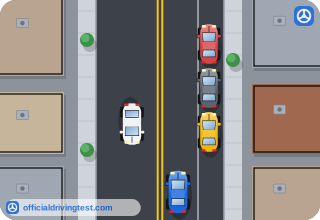
- Speed up and pass the parked vehicles before oncoming traffic arrives
- Continue at the same speed and use the horn to warn them
- Move into the oncoming lane to go around the parked vehicles
- Stop and let the oncoming vehicles pass safely before proceeding
Show answer
Correct answer: Stop and let the oncoming vehicles pass safely before proceeding
The manual says if the dangers are equally hazardous, you should stop and allow the oncoming vehicles to pass before proceeding.
Source: North Carolina Driver Handbook (Revised May 2025), page 69 · Open this page in the manual (Manual page 69)
-
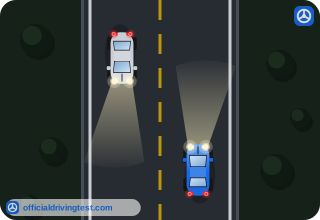
Why is night driving more dangerous than daytime driving?
- There are fewer drivers on the road to watch out for you
- Headlights make the road brighter than it is in the daytime
- Drivers tend to be more alert than they are in the daytime
- You cannot see as well and more impaired drivers are on the road
Show answer
Correct answer: You cannot see as well and more impaired drivers are on the road
The manual lists that you cannot see as well, more impaired drivers are on the road, and drivers tend to be tired and less alert.
Source: North Carolina Driver Handbook (Revised May 2025), page 71 · Open this page in the manual (Manual page 71)