North Carolina: Speed & following distance — Part 3 Practice Test
Questions in this part include: “On open roads, what should you scan for on the roadsides?” · “According to the driving tips, to which places should you give particular attention?”
Independent educational site · not affiliated with any government agency or DMV
Ready? Test yourself
- Instant feedback with an explanation
- Every answer cites its source in the manual
- Your best score is saved on this device
Questions are original and based on the official manual "North Carolina Driver Handbook" (Revised May 2025), North Carolina Division of Motor Vehicles (NCDMV).
All 18 questions in this practice test
Take the test above first, then use this list to study. Tap “Show answer” to see the correct answer and explanation.
Show the questions and answersHide the questions
-
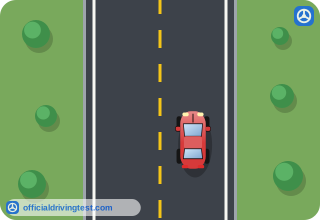
On open roads, what should you stay alert for?
- Drivers who are certain to travel above the posted speed limit
- Drivers who are certain to stop at every railroad crossing
- Vehicles that are always parked along the road at night
- Drivers who might be driving slower than the posted speed limit
Show answer
Correct answer: Drivers who might be driving slower than the posted speed limit
On open roads you should stay alert for drivers who might be driving slower than the posted speed limit.
Source: North Carolina Driver Handbook (Revised May 2025), page 63 · Open this page in the manual (Manual page 63)
-
On open roads, what should you scan for on the roadsides?
- Unpredictable wildlife
- Loose gravel or debris
- Broken-down vehicles
- Pedestrians on shoulders
Show answer
Correct answer: Unpredictable wildlife
The manual says to scan for unpredictable wildlife on roadsides.
Source: North Carolina Driver Handbook (Revised May 2025), page 63 · Open this page in the manual (Manual page 63)
-
For what is a paved secondary road not always designed?
- Light rain or wet weather conditions
- Vehicles under 4,000 pounds in weight
- Heavy traffic or regular highway speed
- Driving during daylight hours only
Show answer
Correct answer: Heavy traffic or regular highway speed
A paved secondary road is not always designed for heavy traffic or regular highway speed.
Source: North Carolina Driver Handbook (Revised May 2025), page 63 · Open this page in the manual (Manual page 63)
-
Most secondary roads are built for what?
- Main highway travel
- Heavy truck traffic
- Regular highway speed
- Local transportation
Show answer
Correct answer: Local transportation
Most secondary roads are built for local transportation, and not as main highways.
Source: North Carolina Driver Handbook (Revised May 2025), page 63 · Open this page in the manual (Manual page 63)
-
Compared with primary roads, what are hills and curves likely to be on secondary roads?
- Gentler hills and wider curves
- Steeper hills and sharper curves
- The same as on primary roads
- Fewer but longer hills and curves
Show answer
Correct answer: Steeper hills and sharper curves
On secondary roads, hills are likely to be steeper and curves likely to be sharper than on primary roads.
Source: North Carolina Driver Handbook (Revised May 2025), page 63 · Open this page in the manual (Manual page 63)
-
How are sight distances on secondary roads often described?
- Very long
- Unlimited
- Very short
- Better than on primary roads
Show answer
Correct answer: Very short
The manual says sight distances on secondary roads are often very short.
Source: North Carolina Driver Handbook (Revised May 2025), page 63 · Open this page in the manual (Manual page 63)
-
Secondary roads cannot be traveled safely at speeds that would be proper for what?
- Primary highways
- Rural interstates
- Residential streets
- School zones
Show answer
Correct answer: Primary highways
Secondary roads cannot be traveled safely at speeds that would be proper for primary highways.
Source: North Carolina Driver Handbook (Revised May 2025), page 63 · Open this page in the manual (Manual page 63)
-
What should you do to watch for crossing wildlife on secondary roads?
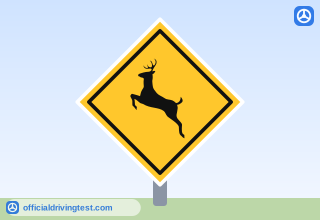
- Slow down and stay alert
- Speed up to pass the area quickly
- Use your horn continuously
- Drive on the shoulder
Show answer
Correct answer: Slow down and stay alert
The manual says to slow down and stay alert for crossing wildlife on secondary roads and all roads.
Source: North Carolina Driver Handbook (Revised May 2025), page 63 · Open this page in the manual (Manual page 63)
-
According to the driving tips, what should you do as your speed increases?
- Look closer to the front of your vehicle
- Watch only the vehicle directly in front of you
- Look farther ahead
- Check your mirrors more often than the road ahead
Show answer
Correct answer: Look farther ahead
The manual tells drivers to look farther ahead as their speed increases.
Source: North Carolina Driver Handbook (Revised May 2025), page 64 · Open this page in the manual (Manual page 64)
-
According to the driving tips, to which places should you give particular attention?
- Roadside billboards and business signs
- Hidden intersections and driveways
- Vehicles that are far behind you
- Empty parking lots and open fields
Show answer
Correct answer: Hidden intersections and driveways
The manual says to give particular attention to hidden intersections and driveways.
Source: North Carolina Driver Handbook (Revised May 2025), page 64 · Open this page in the manual (Manual page 64)
-
According to the driving tips, which vehicles should you watch for in particular?
- Vehicles with only one passenger
- Vehicles that are the same color as yours
- Vehicles that are parked beside the road
- Oversized and slow-moving vehicles
Show answer
Correct answer: Oversized and slow-moving vehicles
The manual says to watch for other vehicles, especially oversized and slow-moving ones.
Source: North Carolina Driver Handbook (Revised May 2025), page 64 · Open this page in the manual (Manual page 64)
-
Why should you be especially alert to oncoming vehicles on some two-lane, undivided highways?
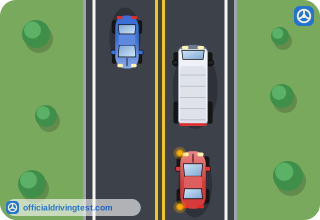
- They are only a few feet away
- They always travel faster than the posted speed limit
- They are hidden by the center line
- They are not required to use headlights
Show answer
Correct answer: They are only a few feet away
The manual says oncoming vehicles are only a few feet away on some two-lane, undivided highways.
Source: North Carolina Driver Handbook (Revised May 2025), page 64 · Open this page in the manual (Manual page 64)
-
If you see a line of vehicles approaching, what should you watch for?
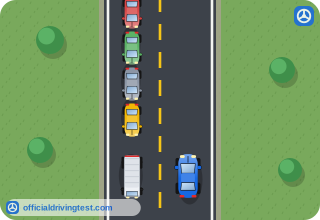
- Drivers who might be about to stop
- Drivers who might be about to park
- Drivers who might be trying to pass
- Drivers who might be lost
Show answer
Correct answer: Drivers who might be trying to pass
The manual says to watch for drivers who might be trying to pass when a line of vehicles approaches.
Source: North Carolina Driver Handbook (Revised May 2025), page 64 · Open this page in the manual (Manual page 64)
-
What should you always have in order to avoid colliding with an oncoming vehicle or crossing wildlife?
- A faster speed
- A possible escape route
- A wider following distance only
- A second driver in the vehicle
Show answer
Correct answer: A possible escape route
The manual says to always have a possible “escape route” to avoid colliding with an oncoming vehicle or crossing wildlife.
Source: North Carolina Driver Handbook (Revised May 2025), page 64 · Open this page in the manual (Manual page 64)
-
Which of these is one of the two important types of driving skills the handbook describes?
- Skills that let you drive faster than the other vehicles
- Skills to avoid a crash despite the driving errors of others
- Skills that let you avoid all contact with other drivers
- Skills that let you drive without using any mirrors
Show answer
Correct answer: Skills to avoid a crash despite the driving errors of others
The manual says driving involves skills for driving defensively and avoiding a crash despite errors by others, and skills for basic rules about turning, passing, backing and parking.
Source: North Carolina Driver Handbook (Revised May 2025), page 68 · Open this page in the manual (Manual page 68)
-
How far ahead on the roadway do good drivers try to see?
- 2 to 4 seconds ahead, about one car length
- 20 to 30 seconds ahead, about one mile
- 5 to 6 seconds ahead, about two car lengths
- 10 to 15 seconds ahead, about one city block
Show answer
Correct answer: 10 to 15 seconds ahead, about one city block
The manual says good drivers try to see 10 to 15 seconds ahead, about one city block.
Source: North Carolina Driver Handbook (Revised May 2025), page 68 · Open this page in the manual (Manual page 68)
-
Why is it good to look ahead 10 to 15 seconds on the roadway?
- You might avoid last minute moves such as sudden stops
- You can drive without checking the mirrors as often
- You can drive closer to the vehicle ahead of you
- You can pass other vehicles more often and more safely
Show answer
Correct answer: You might avoid last minute moves such as sudden stops
The manual says by looking ahead you might avoid last minute moves such as sudden stops or quick lane changes.
Source: North Carolina Driver Handbook (Revised May 2025), page 68 · Open this page in the manual (Manual page 68)
-
About how often should you check the mirrors to see if a vehicle is following too closely?
- About every 2 seconds
- About every 30 seconds
- About every 10 seconds
- About every 60 seconds
Show answer
Correct answer: About every 10 seconds
The manual says to check the mirrors about every 10 seconds to see whether any vehicle is following too closely.
Source: North Carolina Driver Handbook (Revised May 2025), page 68 · Open this page in the manual (Manual page 68)