North Carolina: Speed & following distance — Part 1 Practice Test
Questions in this part include: “What is the maximum speed limit for a school bus in North Carolina?” · “According to studies, which vehicle is much more likely to cause or be involved in a crash?”
Independent educational site · not affiliated with any government agency or DMV
Ready? Test yourself
- Instant feedback with an explanation
- Every answer cites its source in the manual
- Your best score is saved on this device
Questions are original and based on the official manual "North Carolina Driver Handbook" (Revised May 2025), North Carolina Division of Motor Vehicles (NCDMV).
All 18 questions in this practice test
Take the test above first, then use this list to study. Tap “Show answer” to see the correct answer and explanation.
Show the questions and answersHide the questions
-
What is the maximum speed limit for a school bus in North Carolina?
- 25 mph
- 35 mph
- 55 mph
- 45 mph
Show answer
Correct answer: 45 mph
The manual states that the maximum speed limit for a school bus is 45 mph.
Source: North Carolina Driver Handbook (Revised May 2025), page 47 · Open this page in the manual (Manual page 47)
-
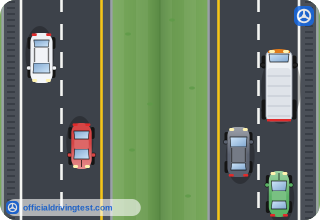
On a multi-lane highway, which lane should you use when moving slower than the posted speed limit, unless you are passing, turning left or avoiding an obstruction?
- The extreme left lane
- The center lane
- The extreme right lane
- Whichever lane has the least traffic
Show answer
Correct answer: The extreme right lane
A driver moving slower than the posted limit on a multi-lane highway should stay in the extreme right lane.
Source: North Carolina Driver Handbook (Revised May 2025), page 52 · Open this page in the manual (Manual page 52)
-
Why are stopping distances longer at higher speeds?
- Tires grip the road less firmly whenever the vehicle is moving quickly
- Drivers cannot see the brake lights of vehicles ahead as well
- The brakes take longer to heat up when traveling at high speeds
- The vehicle travels farther during reaction time and needs more braking distance
Show answer
Correct answer: The vehicle travels farther during reaction time and needs more braking distance
At higher speeds the vehicle covers more ground during the driver's reaction time and needs more braking distance to stop completely.
Source: North Carolina Driver Handbook (Revised May 2025), page 52 · Open this page in the manual (Manual page 52)
-
In ideal conditions, about how many feet does a vehicle traveling 55 miles per hour need to stop completely?
- Approximately 111 feet
- Approximately 211 feet
- Approximately 155 feet
- Approximately 311 feet
Show answer
Correct answer: Approximately 211 feet
The manual states that at 55 mph in ideal conditions a vehicle needs approximately 211 feet to stop completely.
Source: North Carolina Driver Handbook (Revised May 2025), page 53 · Open this page in the manual (Manual page 53)
-
What happens as each additional mile per hour is traveled?
- The stopping distance stays the same for the vehicle
- The driver's reaction time becomes shorter and quicker
- The driver's ability to control the vehicle is reduced
- The vehicle needs less room to turn in a curve
Show answer
Correct answer: The driver's ability to control the vehicle is reduced
Each additional mile per hour reduces the driver's ability to control the vehicle.
Source: North Carolina Driver Handbook (Revised May 2025), page 53 · Open this page in the manual (Manual page 53)
-
What does speed also increase, according to the manual?
- The likelihood that a crash will result in serious injury or death
- The distance at which other drivers can see your vehicle
- The traction available on a wet road
- The chance that other drivers will pass you safely
Show answer
Correct answer: The likelihood that a crash will result in serious injury or death
Higher speed makes a crash more likely to cause serious injury or death.
Source: North Carolina Driver Handbook (Revised May 2025), page 53 · Open this page in the manual (Manual page 53)
-
If you must drive slower than the traffic around you, what should you still observe?
- The posted minimum speed limit
- The advisory speed for the next curve
- The average speed of the vehicles behind you
- The speed limit for school buses
Show answer
Correct answer: The posted minimum speed limit
The manual says that if you must drive slower, you should still observe the posted minimum speed limit.
Source: North Carolina Driver Handbook (Revised May 2025), page 53 · Open this page in the manual (Manual page 53)
-
When is very slow driving especially dangerous?
- When you are driving on a straight, flat road with good sight
- When you are driving on a wide, straight highway in daylight
- Just after you have passed the crest of a hill or rounded a curve
- When the road is dry, well lit and free of any other traffic
Show answer
Correct answer: Just after you have passed the crest of a hill or rounded a curve
Faster vehicles can crash into a slow vehicle before they can slow down just after a hill crest or a curve.
Source: North Carolina Driver Handbook (Revised May 2025), page 53 · Open this page in the manual (Manual page 53)
-
What is wise to do if traffic is collecting behind you because you must drive slowly?
- Turn on your hazard lights and continue driving at the same speed
- Pull over to the side of the road, stop and allow the vehicles to pass
- Speed up until you reach the posted speed limit for the road
- Move toward the center of the road so no one can try to pass
Show answer
Correct answer: Pull over to the side of the road, stop and allow the vehicles to pass
When traffic collects behind a slow driver, it is wise to pull over, stop and let the vehicles pass.
Source: North Carolina Driver Handbook (Revised May 2025), page 53 · Open this page in the manual (Manual page 53)
-
According to studies, which vehicle is much more likely to cause or be involved in a crash?
- A vehicle moving at a normal speed for the road and conditions
- A vehicle traveling exactly at the posted limit at all times
- A vehicle following another at a distance of two seconds
- A vehicle moving at a speed considerably below the posted limit
Show answer
Correct answer: A vehicle moving at a speed considerably below the posted limit
The manual says studies show a vehicle moving well below the posted limit is much more likely to cause or be in a crash than one at a normal speed.
Source: North Carolina Driver Handbook (Revised May 2025), page 53 · Open this page in the manual (Manual page 53)
-
Besides driving faster than the posted speed limit, what speed must you never drive?
- A speed that is 5 mph below the posted limit on a clear day
- A speed that is lower than the speed of the vehicles behind you
- A speed that is unreasonable or unwise given the existing conditions
- A speed that is higher than the speed of the vehicle ahead of you
Show answer
Correct answer: A speed that is unreasonable or unwise given the existing conditions
One of the most important rules about speed is never to drive at a speed that is unreasonable or unwise for the conditions.
Source: North Carolina Driver Handbook (Revised May 2025), page 53 · Open this page in the manual (Manual page 53)
-
As your speed increases, how far ahead must you be able to see?
- Farther ahead, to allow enough distance for stopping
- The same distance, as long as you are under the speed limit
- Less far ahead, because you pass hazards more quickly
- Only as far as the vehicle directly in front of you
Show answer
Correct answer: Farther ahead, to allow enough distance for stopping
The faster you move, the farther ahead you must see to allow enough distance to stop.
Source: North Carolina Driver Handbook (Revised May 2025), page 53 · Open this page in the manual (Manual page 53)
-
Unless otherwise posted, what is the speed limit in cities and towns?
- 25 mph
- 45 mph
- 55 mph
- 35 mph
Show answer
Correct answer: 35 mph
The manual says the speed limit is 35 mph in cities and towns unless otherwise posted.
Source: North Carolina Driver Handbook (Revised May 2025), page 53 · Open this page in the manual (Manual page 53)
-
According to the Maximum Speed Limits table, what is the maximum speed limit for school buses?
- 35 mph
- 45 mph
- 55 mph
- 65 mph
Show answer
Correct answer: 45 mph
The Maximum Speed Limits table lists 45 mph for school buses.
Source: North Carolina Driver Handbook (Revised May 2025), page 53 · Open this page in the manual (Manual page 53)
-
According to the Maximum Speed Limits table, what is the maximum speed limit for school activity buses?
- 35 mph
- 55 mph
- 45 mph
- 70 mph
Show answer
Correct answer: 55 mph
The Maximum Speed Limits table lists 55 mph for school activity buses.
Source: North Carolina Driver Handbook (Revised May 2025), page 53 · Open this page in the manual (Manual page 53)
-
According to the Maximum Speed Limits table, what is the maximum speed limit outside cities and towns?
- 35 mph
- 45 mph
- 65 mph
- 55 mph
Show answer
Correct answer: 55 mph
The Maximum Speed Limits table lists 55 mph outside cities and towns.
Source: North Carolina Driver Handbook (Revised May 2025), page 53 · Open this page in the manual (Manual page 53)
-
According to the Maximum Speed Limits table, what is the maximum speed limit for interstates?
- 70 mph
- 55 mph
- 60 mph
- 65 mph
Show answer
Correct answer: 70 mph
The Maximum Speed Limits table lists 70 mph for interstates.
Source: North Carolina Driver Handbook (Revised May 2025), page 53 · Open this page in the manual (Manual page 53)
-
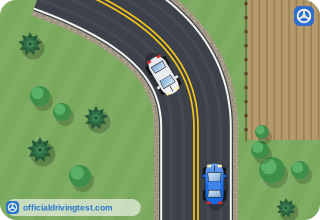
When approaching a curve, what should you do before you enter it?
- Brake firmly once you are in the middle of the curve to slow down
- Maintain your speed and brake only after you leave the curve
- Slow down, so that you will not need to brake while in the curve
- Speed up before the curve so the vehicle stays steady in it
Show answer
Correct answer: Slow down, so that you will not need to brake while in the curve
The first step for handling a curve is to slow down before entering so you will not need to brake in the curve.
Source: North Carolina Driver Handbook (Revised May 2025), page 53 · Open this page in the manual (Manual page 53)