North Carolina: Signals & vehicle controls — Part 5 Practice Test
Questions in this part include: “How do you signal a left turn with a hand signal?” · “How far before turning or stopping should you signal at least?”
Independent educational site · not affiliated with any government agency or DMV
Ready? Test yourself
- Instant feedback with an explanation
- Every answer cites its source in the manual
- Your best score is saved on this device
Questions are original and based on the official manual "North Carolina Driver Handbook" (Revised May 2025), North Carolina Division of Motor Vehicles (NCDMV).
All 17 questions in this practice test
Take the test above first, then use this list to study. Tap “Show answer” to see the correct answer and explanation.
Show the questions and answersHide the questions
-
How do you signal a left turn with a hand signal?
- Hold the arm straight out with the forearm and hand straight up
- Point the arm and hand down with the palm facing back
- Hold the arm out with the palm facing forward and fingers closed
- Hold the arm and hand straight out and point the first finger
Show answer
Correct answer: Hold the arm and hand straight out and point the first finger
The manual says to signal a left turn, hold the arm and hand straight out and point the first finger.
Source: North Carolina Driver Handbook (Revised May 2025), page 69 · Open this page in the manual (Manual page 69)
-
How do you signal a right turn with a hand signal?
- Hold the arm straight out with the forearm and hand straight up, palm forward
- Hold the arm and hand straight out and point the first finger
- Point the arm and hand down with the palm facing back
- Hold the arm straight out with the forearm pointing down, palm forward
Show answer
Correct answer: Hold the arm straight out with the forearm and hand straight up, palm forward
The manual says to signal a right turn, hold the arm straight out and the forearm and hand straight up, palm facing forward.
Source: North Carolina Driver Handbook (Revised May 2025), page 69 · Open this page in the manual (Manual page 69)
-
How do you signal stopping and slowing down with a hand signal?
- Hold the arm and hand straight out and point the first finger
- Hold the arm straight up with the palm facing forward
- Point the arm and hand down, palm facing back
- Hold the arm straight out and the forearm up, palm forward
Show answer
Correct answer: Point the arm and hand down, palm facing back
The manual says to signal stopping and slowing down, point the arm and hand down with the palm facing back.
Source: North Carolina Driver Handbook (Revised May 2025), page 69 · Open this page in the manual (Manual page 69)
-
Are flashing light signals for turns a legal substitute for hand signals?
- No, hand signals are required at all times
- Yes, they are legal substitutes
- No, they may be used only at night
- Yes, but only on interstate highways
Show answer
Correct answer: Yes, they are legal substitutes
The manual says flashing light signals for turns are legal substitutes for hand signals.
Source: North Carolina Driver Handbook (Revised May 2025), page 69 · Open this page in the manual (Manual page 69)
-
When are flashing turn signals hard to see?
- At night, when the lenses of the signals are brightly lit
- In heavy rain only, when the pavement is wet
- At noon, when the sun is directly overhead
- In late afternoon and early morning, when lenses reflect sunlight
Show answer
Correct answer: In late afternoon and early morning, when lenses reflect sunlight
The manual says in late afternoon and early morning the lenses may reflect sunlight, making it difficult to tell whether the signals are flashing.
Source: North Carolina Driver Handbook (Revised May 2025), page 69 · Open this page in the manual (Manual page 69)
-
At night, which is much easier to see, a flashing light signal or a hand signal?
- A flashing light signal
- A hand signal
- Both are equally easy to see
- Neither can be seen at night
Show answer
Correct answer: A flashing light signal
The manual says at night a flashing light signal is much easier to see than a hand signal and is sufficient.
Source: North Carolina Driver Handbook (Revised May 2025), page 69 · Open this page in the manual (Manual page 69)
-
How far before turning or stopping should you signal at least?
- The last 25 feet
- The last 50 feet
- The last 100 feet
- The last 75 feet
Show answer
Correct answer: The last 100 feet
The manual says to signal at least the last 100 feet before turning or stopping.
Source: North Carolina Driver Handbook (Revised May 2025), page 69 · Open this page in the manual (Manual page 69)
-
If the speed limit is 45 mph or more, how far before turning should you signal at least?
- The last 100 feet
- The last 200 feet
- The last 300 feet
- The last 500 feet
Show answer
Correct answer: The last 200 feet
The manual says if the speed limit is 45 mph or more, signal at least the last 200 feet before turning.
Source: North Carolina Driver Handbook (Revised May 2025), page 69 · Open this page in the manual (Manual page 69)
-
During what hours does the law require the use of headlights?
- From dusk to midnight
- From one hour before sunset to sunrise
- From sunrise to sunset
- From sunset to sunrise
Show answer
Correct answer: From sunset to sunrise
The manual says the law requires headlights from sunset to sunrise and when visibility is 400 feet or less.
Source: North Carolina Driver Handbook (Revised May 2025), page 71 · Open this page in the manual (Manual page 71)
-
At what visibility must headlights be used?
- When visibility is 400 feet or less
- When visibility is 100 feet or less
- When visibility is 200 feet or less
- When visibility is 1,000 feet or less
Show answer
Correct answer: When visibility is 400 feet or less
The manual says the law requires headlights when visibility is 400 feet or less.
Source: North Carolina Driver Handbook (Revised May 2025), page 71 · Open this page in the manual (Manual page 71)
-
Which headlights should you use when you drive at night in a city?
- High-beam headlights
- Parking lights only
- Low-beam headlights
- Fog lights only
Show answer
Correct answer: Low-beam headlights
The manual says to use low-beam headlights when you drive at night in a city.
Source: North Carolina Driver Handbook (Revised May 2025), page 71 · Open this page in the manual (Manual page 71)
-
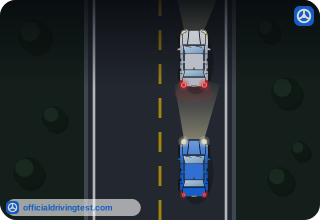
When driving at night on the open road, which headlights should you use?
- Low beams at all times, even on roads with no other traffic
- High beams, unless approaching or following another vehicle
- High beams at all times, even when following another vehicle
- Parking lights unless you are approaching another vehicle
Show answer
Correct answer: High beams, unless approaching or following another vehicle
The manual says on the open road use high-beam headlights unless you are approaching or following another vehicle.
Source: North Carolina Driver Handbook (Revised May 2025), page 71 · Open this page in the manual (Manual page 71)
-
When an approaching vehicle does not dim its headlights, what can you do to remind the driver?
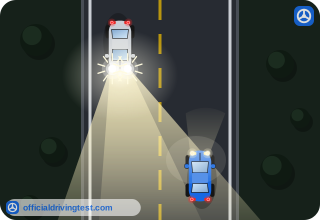
- Blink your high beams once
- Sound your horn
- Flash your high beams several times
- Turn on your emergency flashers
Show answer
Correct answer: Blink your high beams once
The manual says you can remind the driver by blinking your high beams once.
Source: North Carolina Driver Handbook (Revised May 2025), page 71 · Open this page in the manual (Manual page 71)
-
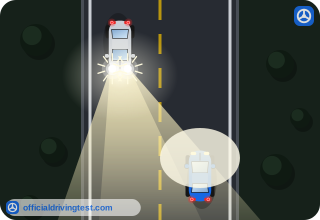
If the driver of an approaching vehicle still does not dim the lights, what should you do?
- Switch to high beams to match
- Turn off your lights
- Keep your lights on low beam
- Stop on the roadside
Show answer
Correct answer: Keep your lights on low beam
The manual says if the driver still does not dim the lights, keep your lights on low beam.
Source: North Carolina Driver Handbook (Revised May 2025), page 71 · Open this page in the manual (Manual page 71)
-
Why should you never leave your headlights on when you park at night?
- They can drain your battery
- They can make your vehicle harder to steal
- They can damage the taillights
- They can blind the drivers of oncoming vehicles
Show answer
Correct answer: They can blind the drivers of oncoming vehicles
The manual says never to leave your headlights on when you park at night because they can blind the drivers of oncoming vehicles.
Source: North Carolina Driver Handbook (Revised May 2025), page 71 · Open this page in the manual (Manual page 71)
-
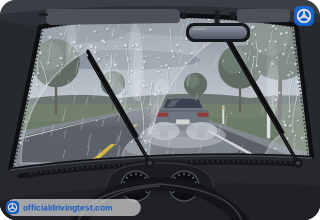
When are North Carolina motorists required to use headlights because of the weather?
- Only when fog is so thick that the road ahead cannot be seen
- Only when the wipers are on and it is after sunset
- Whenever they are using windshield wipers due to inclement weather
- Only on roads where the speed limit is above 45 mph
Show answer
Correct answer: Whenever they are using windshield wipers due to inclement weather
The manual requires headlights whenever windshield wipers are in use because of inclement weather.
Source: North Carolina Driver Handbook (Revised May 2025), page 73 · Open this page in the manual (Manual page 73)
-
When starting to move on snowy or icy roads in a vehicle with a manual shift, what should you do?
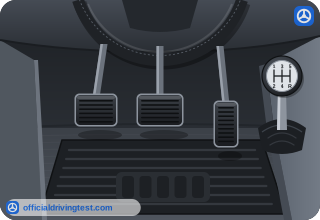
- Start in first gear and release the clutch quickly
- Start in second gear or higher and release the clutch slowly
- Start in reverse gear to gain traction
- Start in neutral and let the vehicle roll
Show answer
Correct answer: Start in second gear or higher and release the clutch slowly
For manual shifts on snow or ice, the manual says to start in second gear or higher and release the clutch slowly.
Source: North Carolina Driver Handbook (Revised May 2025), page 73 · Open this page in the manual (Manual page 73)