North Carolina: Signals & vehicle controls — Part 2 Practice Test
Questions in this part include: “For how far in normal daylight must the brake and turn signal lights be visible?” · “What should you do if your brakes squeak when you depress the brake pedal?”
Independent educational site · not affiliated with any government agency or DMV
Ready? Test yourself
- Instant feedback with an explanation
- Every answer cites its source in the manual
- Your best score is saved on this device
Questions are original and based on the official manual "North Carolina Driver Handbook" (Revised May 2025), North Carolina Division of Motor Vehicles (NCDMV).
All 17 questions in this practice test
Take the test above first, then use this list to study. Tap “Show answer” to see the correct answer and explanation.
Show the questions and answersHide the questions
-
What color must the lights be that engage when the brakes or turn signals are used on motor vehicles produced since 1955?
- Red or amber
- Red only
- White or amber
- Amber or blue
Show answer
Correct answer: Red or amber
The manual says vehicles produced since 1955 must have red or amber lights that engage when the brakes or turn signals are used.
Source: North Carolina Driver Handbook (Revised May 2025), page 66 · Open this page in the manual (Manual page 66)
-
For how far in normal daylight must the brake and turn signal lights be visible?
- At least 50 feet
- At least 200 feet
- At least 100 feet
- At least 500 feet
Show answer
Correct answer: At least 100 feet
The manual says these lights must be visible for at least 100 feet in normal daylight.
Source: North Carolina Driver Handbook (Revised May 2025), page 66 · Open this page in the manual (Manual page 66)
-
All motor vehicles produced since which year must have red or amber brake and turn signal lights?
- 1935
- 1955
- 1965
- 1975
Show answer
Correct answer: 1955
The manual says all motor vehicles produced since 1955 must have red or amber lights that engage with the brakes or turn signals.
Source: North Carolina Driver Handbook (Revised May 2025), page 66 · Open this page in the manual (Manual page 66)
-
Why is it important that a vehicle's lights have clean lenses and stay in proper working order?
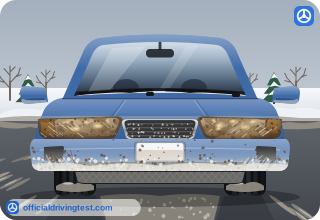
- Clean lenses make headlights use less fuel
- Lights are required to be washed every month
- Dirty lenses cause the horn to fail
- Hand signals are difficult to see at night
Show answer
Correct answer: Hand signals are difficult to see at night
The manual says hand signals are difficult to see at night, so a vehicle's lights must work and have clean lenses.
Source: North Carolina Driver Handbook (Revised May 2025), page 66 · Open this page in the manual (Manual page 66)
-
When should you check and adjust your mirrors?
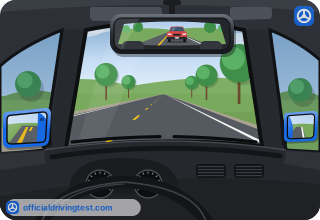
- Before you begin to drive
- After you have driven a few blocks
- Only when you change lanes
- Only at night
Show answer
Correct answer: Before you begin to drive
The manual says to check and adjust the mirrors before you begin to drive.
Source: North Carolina Driver Handbook (Revised May 2025), page 66 · Open this page in the manual (Manual page 66)
-
What should the rear-view mirror show?
- The scene to the left rear
- The blind spots on both sides
- What is directly behind you
- The rear corners of the vehicle
Show answer
Correct answer: What is directly behind you
The manual says the rear-view mirror should show what is directly behind you.
Source: North Carolina Driver Handbook (Revised May 2025), page 66 · Open this page in the manual (Manual page 66)
-
How should the side mirrors be adjusted?
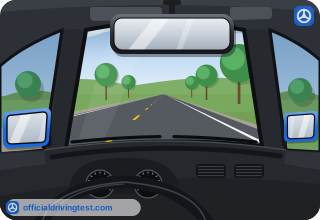
- To show mostly the side of your own vehicle, with the door handle in view
- To show the left and right rear scene, barely reflecting your vehicle's side
- To show only the lane directly behind you, the same as the rear-view mirror
- To point straight down at the pavement beside the vehicle
Show answer
Correct answer: To show the left and right rear scene, barely reflecting your vehicle's side
The manual says the side mirrors should show the scene to the left and right rear and barely reflect the side of the vehicle.
Source: North Carolina Driver Handbook (Revised May 2025), page 66 · Open this page in the manual (Manual page 66)
-
What must every motor vehicle on a public roadway be equipped with?
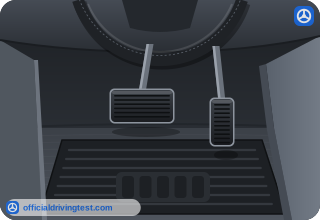
- A spare set of hand-operated brakes for emergencies only
- Brakes that operate only on the rear wheels of the vehicle
- Brakes that are used only when a passenger is aboard
- Brakes to adequately control, stop and hold the vehicle
Show answer
Correct answer: Brakes to adequately control, stop and hold the vehicle
The manual says every motor vehicle on a public roadway must have brakes to adequately control the movement of, stop and hold the vehicle.
Source: North Carolina Driver Handbook (Revised May 2025), page 66 · Open this page in the manual (Manual page 66)
-
How many separate means of applying the brakes should a vehicle's originally equipped brakes have?
- Two
- One
- Three
- Four
Show answer
Correct answer: Two
The manual says vehicles should have originally equipped brakes in good condition, having two separate means of applying the brakes.
Source: North Carolina Driver Handbook (Revised May 2025), page 66 · Open this page in the manual (Manual page 66)
-
When fully depressed, how far from the floor should the brake pedal be?
- At least one-half of its original distance from the floor
- No more than one-third of its original distance from the floor
- At least one-third of its original distance from the floor
- Touching the floor
Show answer
Correct answer: At least one-third of its original distance from the floor
The manual says the pedal should be at least one-third of its original distance from the floor when fully depressed, or the brakes must be checked.
Source: North Carolina Driver Handbook (Revised May 2025), page 66 · Open this page in the manual (Manual page 66)
-
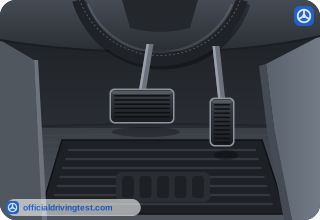
If the brake pedal gradually lowers under the pressure of your foot, what must be checked?
- The suspension system
- The hydraulic system
- The exhaust system
- The tire pressure
Show answer
Correct answer: The hydraulic system
The manual says a pedal that gradually lowers means the hydraulic system must be checked.
Source: North Carolina Driver Handbook (Revised May 2025), page 66 · Open this page in the manual (Manual page 66)
-
What should you do if your brakes squeak when you depress the brake pedal?
- Ignore it if the brakes still stop the vehicle
- Pump the brake pedal until it stops
- Wait until the pedal lowers to the floor
- Have them checked
Show answer
Correct answer: Have them checked
The manual says squeaking can indicate a problem and you should have the brakes checked.
Source: North Carolina Driver Handbook (Revised May 2025), page 66 · Open this page in the manual (Manual page 66)
-
What are three things that anti-lock brakes (ABS) can help improve?
- Stability, steerability and stopping capability
- Speed, acceleration and fuel economy
- Visibility, tire wear and horn volume
- Braking noise, tire grip and engine power
Show answer
Correct answer: Stability, steerability and stopping capability
The manual says ABS can help improve stability, steerability and stopping capability.
Source: North Carolina Driver Handbook (Revised May 2025), page 66 · Open this page in the manual (Manual page 66)
-
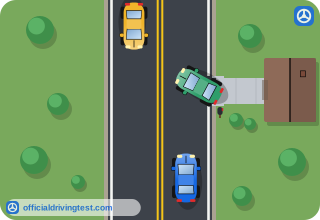
How should you brake in a vehicle equipped with ABS?
- Pump the brake pedal quickly and repeatedly
- Tap the brake pedal and release it several times
- Brake hard and keep firm, steady pressure on the pedal
- Press lightly and release the pressure as you slow
Show answer
Correct answer: Brake hard and keep firm, steady pressure on the pedal
The manual says to brake hard and keep firm and steady pressure; pumping or releasing the pressure reduces the effectiveness of ABS.
Source: North Carolina Driver Handbook (Revised May 2025), page 66 · Open this page in the manual (Manual page 66)
-
What does pumping the brake pedal do in a vehicle with ABS?
- It increases the stopping capability of the ABS
- It reduces the effectiveness of the ABS
- It turns off the anti-lock brakes for good
- It has no effect on the ABS
Show answer
Correct answer: It reduces the effectiveness of the ABS
The manual says pumping the brake pedal or releasing steady pressure will reduce the effectiveness of ABS.
Source: North Carolina Driver Handbook (Revised May 2025), page 66 · Open this page in the manual (Manual page 66)
-
What does the handbook say you should do to help prevent auto theft?
- Always leave the vehicle's windows fully open when parked
- Always park the vehicle facing the street when you leave it
- Leave the vehicle's lights on when it is parked at night
- Never leave the key in the ignition of an unattended vehicle
Show answer
Correct answer: Never leave the key in the ignition of an unattended vehicle
The manual says to never leave the key in the ignition switch of an unattended vehicle.
Source: North Carolina Driver Handbook (Revised May 2025), page 66 · Open this page in the manual (Manual page 66)
-
A tire is considered unsafe when it has less than what tread depth?
- 1/16 inch
- 1/32 inch
- 1/8 inch
- 1/4 inch
Show answer
Correct answer: 1/16 inch
The manual lists less than 1/16-inch tread depth among the conditions that make a tire unsafe.
Source: North Carolina Driver Handbook (Revised May 2025), page 66 · Open this page in the manual (Manual page 66)