North Carolina: Signals & vehicle controls — Part 1 Practice Test
Questions in this part include: “On a highway with multiple lanes, what should you check before changing lanes?” · “When you use low-beam headlights, how far away should you be able to see someone?”
Independent educational site · not affiliated with any government agency or DMV
Ready? Test yourself
- Instant feedback with an explanation
- Every answer cites its source in the manual
- Your best score is saved on this device
Questions are original and based on the official manual "North Carolina Driver Handbook" (Revised May 2025), North Carolina Division of Motor Vehicles (NCDMV).
All 18 questions in this practice test
Take the test above first, then use this list to study. Tap “Show answer” to see the correct answer and explanation.
Show the questions and answersHide the questions
-
If you encounter a curve while traveling downhill, what should you shift to before moving downhill?
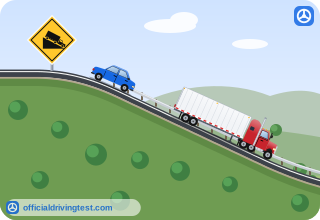
- A lower gear
- A higher gear
- Neutral
- Reverse
Show answer
Correct answer: A lower gear
For a downhill curve the manual says to shift to a lower gear before moving downhill.
Source: North Carolina Driver Handbook (Revised May 2025), page 54 · Open this page in the manual (Manual page 54)
-
On a highway with multiple lanes, what should you check before changing lanes?
- Only the lane you are moving into, not any other lane
- The lane you are changing to, as well as the lane beyond
- Only the lane behind you, using the rear-view mirror
- The lane you are leaving, as well as the lane behind it
Show answer
Correct answer: The lane you are changing to, as well as the lane beyond
You must check the lane you are changing to and the lane beyond, in case another vehicle plans to move into the same space.
Source: North Carolina Driver Handbook (Revised May 2025), page 54 · Open this page in the manual (Manual page 54)
-
How do you make sure the blind spot is clear before changing lanes?
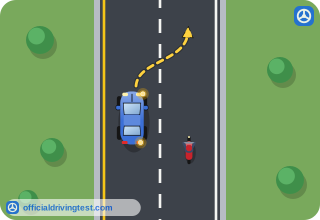
- Check only the side mirror
- Tap the horn twice
- Flash your brake lights
- Check over your shoulder
Show answer
Correct answer: Check over your shoulder
Changing lanes includes checking over your shoulder to be certain the blind spot is clear.
Source: North Carolina Driver Handbook (Revised May 2025), page 54 · Open this page in the manual (Manual page 54)
-
When should you signal your intended movement when changing lanes?
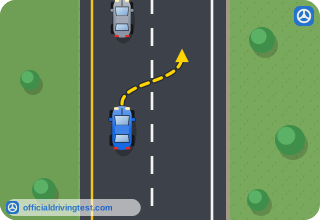
- In advance
- After you begin moving
- Only if another vehicle is near
- Only at night
Show answer
Correct answer: In advance
The manual says to signal your intended movement in advance before changing lanes.
Source: North Carolina Driver Handbook (Revised May 2025), page 54 · Open this page in the manual (Manual page 54)
-
Which mirrors should you check before changing lanes?
- Only the rear-view mirror
- Only the driver-side mirror
- The side and rear-view mirrors
- No mirrors, only over your shoulder
Show answer
Correct answer: The side and rear-view mirrors
The first rule for changing lanes is to check the side and rear-view mirrors.
Source: North Carolina Driver Handbook (Revised May 2025), page 54 · Open this page in the manual (Manual page 54)
-
Before you enter your vehicle to back it up, what should you check behind it for?
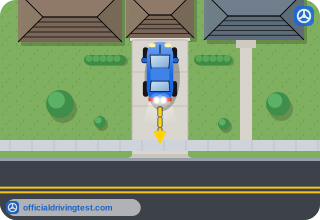
- Oil leaks or fluid spills
- Small objects or children
- Loose gravel and potholes
- Low-hanging tree branches
Show answer
Correct answer: Small objects or children
The manual says to check behind the vehicle for small objects or children before entering, because they are hard to see from the driver's seat.
Source: North Carolina Driver Handbook (Revised May 2025), page 56 · Open this page in the manual (Manual page 56)
-
To maintain a full view of what is behind the vehicle when backing, how should you steer and look?
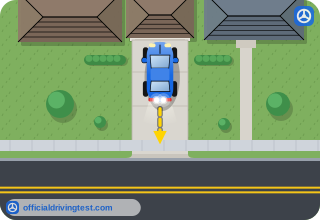
- Steer with your right hand and look over your left shoulder through the side window
- Steer with both hands and rely on the inside and outside mirrors alone
- Steer with your left hand and look only through the side window and mirrors
- Steer with your left hand and look over your right shoulder through the back window
Show answer
Correct answer: Steer with your left hand and look over your right shoulder through the back window
The manual says to steer with your left hand and look over your right shoulder through the back window, not depending on mirrors alone or the side window.
Source: North Carolina Driver Handbook (Revised May 2025), page 56 · Open this page in the manual (Manual page 56)
-
What is the maximum speed at which you should back your vehicle?
- 5 mph
- 15 mph
- 10 mph
- 25 mph
Show answer
Correct answer: 10 mph
The manual says to back very slowly, not more than 10 mph.
Source: North Carolina Driver Handbook (Revised May 2025), page 56 · Open this page in the manual (Manual page 56)
-
Why should you back very slowly?
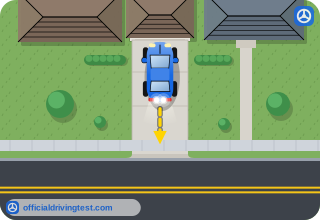
- Your vehicle is harder to control and to stop when it is backing
- Mirrors do not work properly when the vehicle is in reverse gear
- The brake lights do not work while you are backing up slowly
- Other drivers cannot see a vehicle that is backing up at all
Show answer
Correct answer: Your vehicle is harder to control and to stop when it is backing
A vehicle is harder to control and to stop when backing, so the manual says to back very slowly.
Source: North Carolina Driver Handbook (Revised May 2025), page 56 · Open this page in the manual (Manual page 56)
-
In city driving, what should you do about your intended movements?
- Communicate them to other drivers
- Make them without signaling in heavy traffic
- Avoid signaling because it distracts others
- Let others guess based on your speed
Show answer
Correct answer: Communicate them to other drivers
One of the city driving rules is to communicate your intended movements to other drivers.
Source: North Carolina Driver Handbook (Revised May 2025), page 63 · Open this page in the manual (Manual page 63)
-
According to the driving tips, when should you use your vehicle's headlights?
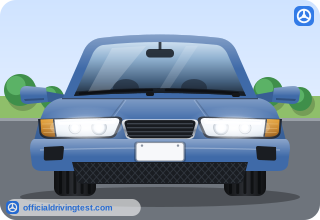
- Only when driving in a city
- Only when another vehicle is approaching
- Only when driving on an interstate
- When visibility becomes poor
Show answer
Correct answer: When visibility becomes poor
The manual tells drivers to use the vehicle's headlights when visibility becomes poor.
Source: North Carolina Driver Handbook (Revised May 2025), page 64 · Open this page in the manual (Manual page 64)
-
When you use high-beam headlights at night, what should you be able to see?
- A person who is 100 feet away
- A person who is 300 feet away
- A person who is 200 feet away
- A person who is 500 feet away
Show answer
Correct answer: A person who is 200 feet away
The manual says that with high beams you should be able to see a person 200 feet away.
Source: North Carolina Driver Handbook (Revised May 2025), page 65 · Open this page in the manual (Manual page 65)
-
When you use low-beam headlights, how far away should you be able to see someone?
- 25 feet
- 75 feet
- 150 feet
- 300 feet
Show answer
Correct answer: 75 feet
The manual says with low beams you should be able to see someone who is 75 feet away.
Source: North Carolina Driver Handbook (Revised May 2025), page 65 · Open this page in the manual (Manual page 65)
-
What can cause headlights to become out of adjustment?
- Driving on interstate highways
- Using low-beam headlights
- Washing the vehicle
- Vehicle vibration
Show answer
Correct answer: Vehicle vibration
The manual says vehicle vibration can cause the headlights to become out of adjustment.
Source: North Carolina Driver Handbook (Revised May 2025), page 65 · Open this page in the manual (Manual page 65)
-
What is the danger of headlights that are improperly adjusted?
- They can shine in the eyes of approaching drivers, bicyclists and pedestrians
- They can drain the vehicle's battery and shorten the life of the bulbs
- They can make the taillights harder for other drivers to see
- They can reduce the life of the tires and the shock absorbers
Show answer
Correct answer: They can shine in the eyes of approaching drivers, bicyclists and pedestrians
The manual says improperly adjusted headlights can shine in the eyes of approaching drivers, bicyclists and pedestrians.
Source: North Carolina Driver Handbook (Revised May 2025), page 65 · Open this page in the manual (Manual page 65)
-
What may overloading the rear of your vehicle do?
- Make the brake lights too dim for following drivers to see
- Make the tires wear out on the front edges of the tread
- Make the front tilt and cause glare for oncoming drivers
- Make the horn too quiet to be heard at a distance
Show answer
Correct answer: Make the front tilt and cause glare for oncoming drivers
The manual says overloading the rear may tilt the front of the vehicle and produce hazardous headlight glare for oncoming drivers.
Source: North Carolina Driver Handbook (Revised May 2025), page 65 · Open this page in the manual (Manual page 65)
-
What color must taillights be, and how far must they be visible?
- Red, visible for at least 100 feet
- Red, visible for at least 500 feet
- Amber, visible for at least 500 feet
- Amber, visible for at least 200 feet
Show answer
Correct answer: Red, visible for at least 500 feet
The manual says taillights must be red in color and visible for at least 500 feet.
Source: North Carolina Driver Handbook (Revised May 2025), page 65 · Open this page in the manual (Manual page 65)
-
The law requires a white light on the license plate. For what distance must it make the numbers visible?
- At least 25 feet
- At least 100 feet
- At least 200 feet
- At least 50 feet
Show answer
Correct answer: At least 50 feet
The manual says the white light must make the numbers visible for at least 50 feet.
Source: North Carolina Driver Handbook (Revised May 2025), page 65 · Open this page in the manual (Manual page 65)