North Carolina: Seat belts & child safety — Part 2 Practice Test
Questions in this part include: “At what speed, at most, does an air bag come out of the dashboard, according to the manual?” · “What thick inner liner should a legal motorcycle helmet have?”
Independent educational site · not affiliated with any government agency or DMV
Ready? Test yourself
- Instant feedback with an explanation
- Every answer cites its source in the manual
- Your best score is saved on this device
Questions are original and based on the official manual "North Carolina Driver Handbook" (Revised May 2025), North Carolina Division of Motor Vehicles (NCDMV).
All 21 questions in this practice test
Take the test above first, then use this list to study. Tap “Show answer” to see the correct answer and explanation.
Show the questions and answersHide the questions
-
Where must the shoulder portion of a lap/shoulder belt fall on a child?
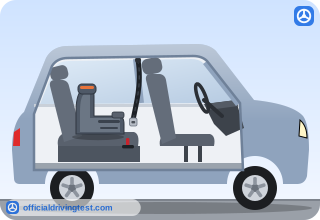
- Across the neck and chin, close to the child's face
- Across the shoulder and chest, not across the face or throat
- Under the child's arm and across the stomach or lap
- Behind the child's back and out of the way of the arm
Show answer
Correct answer: Across the shoulder and chest, not across the face or throat
The manual says the shoulder portion must fall across the shoulder and chest, not across the face or throat.
Source: North Carolina Driver Handbook (Revised May 2025), page 44 · Open this page in the manual (Manual page 44)
-
At what speed, at most, does an air bag come out of the dashboard, according to the manual?
- Up to 50 miles per hour
- Up to 100 miles per hour
- Up to 300 miles per hour
- Up to 200 miles per hour
Show answer
Correct answer: Up to 200 miles per hour
The manual says an air bag comes out of the dashboard at up to 200 miles per hour, faster than the blink of an eye.
Source: North Carolina Driver Handbook (Revised May 2025), page 44 · Open this page in the manual (Manual page 44)
-
Children of what age and under should ride buckled up in a rear seat, according to the manual's child safety points?
- 12 and under
- 8 and under
- 10 and under
- 16 and under
Show answer
Correct answer: 12 and under
The manual's child safety points say children age 12 and under should ride buckled up in a rear seat.
Source: North Carolina Driver Handbook (Revised May 2025), page 45 · Open this page in the manual (Manual page 45)
-
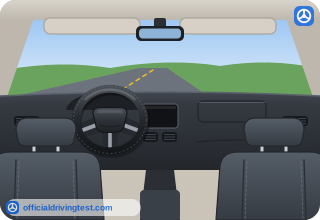
Which children should NEVER ride in the front seat of a vehicle with a passenger-side air bag?
- Children in booster seats
- Children older than 12
- Infants in rear-facing child safety seats
- Adults who wear both lap and shoulder belts
Show answer
Correct answer: Infants in rear-facing child safety seats
The manual says infants in rear-facing child safety seats should NEVER ride in the front seat of a vehicle with a passenger-side air bag.
Source: North Carolina Driver Handbook (Revised May 2025), page 45 · Open this page in the manual (Manual page 45)
-
How does the manual describe air bags in its adult safety points?
- As a replacement for seat belts
- As supplemental protection devices
- As protection for the driver only
- As unnecessary when a lap belt is worn
Show answer
Correct answer: As supplemental protection devices
The manual tells everyone to buckle up with both lap and shoulder belts on every trip, because air bags are supplemental protection devices.
Source: North Carolina Driver Handbook (Revised May 2025), page 45 · Open this page in the manual (Manual page 45)
-
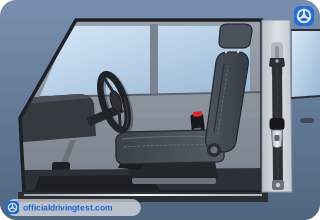
How should the shoulder portion of an adult's seat belt be positioned, according to the manual?
- Across the neck and the shoulder, snug against the throat
- Under the arm and across the ribs, low across the stomach
- Across the stomach and lap, well below the ribs and breastbone
- Over the collarbone, away from the neck, and across the breastbone
Show answer
Correct answer: Over the collarbone, away from the neck, and across the breastbone
The manual says the shoulder portion should come over the collarbone away from the neck and cross over the breastbone.
Source: North Carolina Driver Handbook (Revised May 2025), page 45 · Open this page in the manual (Manual page 45)
-
How should the lap belt be worn, according to the manual's adult safety points?
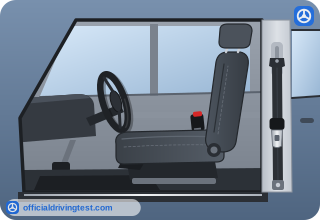
- Under the abdomen and low across the hips
- Across the stomach, well above the hips
- High across the ribs, near the shoulder belt
- Loosely across the lap, with some slack
Show answer
Correct answer: Under the abdomen and low across the hips
The manual says the lap belt should be worn under the abdomen and low across the hips.
Source: North Carolina Driver Handbook (Revised May 2025), page 45 · Open this page in the manual (Manual page 45)
-
Where should the driver and front passenger seats be positioned, according to the manual's adult safety points?
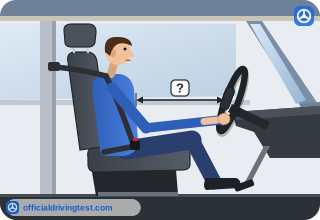
- As far forward as practical
- To the middle of the seat track
- As far back as practical
- Only far enough to reach the pedals
Show answer
Correct answer: As far back as practical
The manual says the driver and front passenger seats should be moved as far back as practical, particularly for shorter-statured people.
Source: North Carolina Driver Handbook (Revised May 2025), page 45 · Open this page in the manual (Manual page 45)
-
Who must wear a motorcycle safety helmet under North Carolina law?
- Only operators of motorcycles who are under age 21
- All operators and passengers on motorcycles and mopeds
- Only passengers who are riding behind the operator
- Only riders who are traveling on highways or interstates
Show answer
Correct answer: All operators and passengers on motorcycles and mopeds
The manual says all operators and passengers on motorcycles and mopeds must wear a helmet that complies with Federal Motor Vehicle Safety Standard 218.
Source: North Carolina Driver Handbook (Revised May 2025), page 45 · Open this page in the manual (Manual page 45)
-
Which federal standard must a motorcycle safety helmet comply with?
- FMVSS 208
- FMVSS 108
- FMVSS 500
- FMVSS 218
Show answer
Correct answer: FMVSS 218
The manual says helmets must be of a type that complies with Federal Motor Vehicle Safety Standard (FMVSS) 218.
Source: North Carolina Driver Handbook (Revised May 2025), page 45 · Open this page in the manual (Manual page 45)
-
What thick inner liner should a legal motorcycle helmet have?
- A firm polystyrene foam liner about one inch thick
- A thin soft foam padding under the outer shell
- A cloth lining that is about a quarter inch thick
- A hollow plastic liner with no foam inside
Show answer
Correct answer: A firm polystyrene foam liner about one inch thick
The manual says a legal helmet has a firm inner liner of polystyrene foam about one inch thick; non-compliant helmets normally have no liner or a thin soft foam padding.
Source: North Carolina Driver Handbook (Revised May 2025), page 45 · Open this page in the manual (Manual page 45)
-
If a motorcyclist places a separately purchased DOT sticker on a novelty helmet, what does that do?
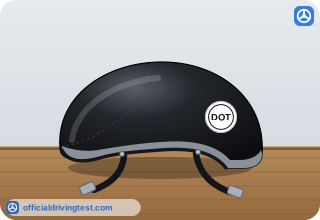
- It makes the helmet compliant
- It makes the helmet compliant if placed on the back
- It does not make the helmet compliant
- It makes the helmet compliant for passengers only
Show answer
Correct answer: It does not make the helmet compliant
The manual says the DOT symbol must be permanently installed by the manufacturer, and a separate sticker placed by the motorcyclist does not make a helmet compliant.
Source: North Carolina Driver Handbook (Revised May 2025), page 45 · Open this page in the manual (Manual page 45)
-
Which information is on the manufacturer's label permanently attached inside a legal helmet?
- The name of the first owner
- The month and year of manufacture
- The purchase price of the helmet
- The state where the helmet was sold
Show answer
Correct answer: The month and year of manufacture
The manual says the interior label includes the manufacturer's name, precise model, size, month and year of manufacture, and materials and care instructions.
Source: North Carolina Driver Handbook (Revised May 2025), page 45 · Open this page in the manual (Manual page 45)
-
North Carolina law prohibits children less than what age from riding in the open bed of a pick-up truck?
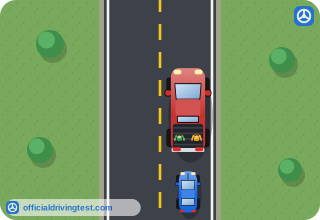
- 8
- 12
- 18
- 16
Show answer
Correct answer: 16
The manual states that North Carolina law prohibits children less than age 16 from riding in the open bed of a pick-up truck.
Source: North Carolina Driver Handbook (Revised May 2025), page 45 · Open this page in the manual (Manual page 45)
-
Who is responsible for compliance with the law on children riding in an open pick-up bed?
- The operator of the vehicle
- The child's parent, if not driving
- The owner of the vehicle, if not driving
- The child's school
Show answer
Correct answer: The operator of the vehicle
The manual says the operator of a vehicle with an open bed or open cargo area is responsible for compliance with this law.
Source: North Carolina Driver Handbook (Revised May 2025), page 45 · Open this page in the manual (Manual page 45)
-
How does the manual define an open bed or open cargo area of a pick-up truck?
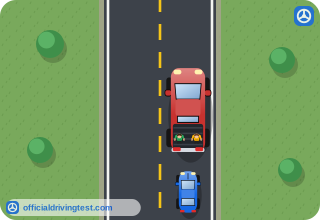
- Any truck bed that is being driven with the tailgate lowered
- Any truck bed that is carrying cargo of any kind or weight
- A cargo area without permanent overhead restraining construction
- Any truck bed that has no seat belts installed inside it
Show answer
Correct answer: A cargo area without permanent overhead restraining construction
The manual defines an open bed or open cargo area as one without permanent overhead restraining construction.
Source: North Carolina Driver Handbook (Revised May 2025), page 45 · Open this page in the manual (Manual page 45)
-
The provisions on securing children in an open pick-up bed do not apply in which situation?
- The truck is traveling at less than 25 mph on a local road
- An adult is present in the bed and is supervising the child
- The trip is less than five miles long and on local roads
- The child has written permission from a parent to ride there
Show answer
Correct answer: An adult is present in the bed and is supervising the child
The manual lists an adult being present in the bed or cargo area and supervising the child as an exemption.
Source: North Carolina Driver Handbook (Revised May 2025), page 46 · Open this page in the manual (Manual page 46)
-
The provisions on securing children in an open pick-up bed do not apply in which situation?
- The vehicle is being operated on a dirt road
- The vehicle is being operated at night
- The vehicle is being operated in a school zone
- The vehicle is being operated in a parade
Show answer
Correct answer: The vehicle is being operated in a parade
The manual lists a vehicle being operated in a parade as an exemption, along with emergencies and agricultural enterprise use.
Source: North Carolina Driver Handbook (Revised May 2025), page 46 · Open this page in the manual (Manual page 46)
-
What fine applies to violators of the law on children riding in the open bed of a pick-up truck?
- $25
- $100
- $50
- $250
Show answer
Correct answer: $25
The manual says violators are issued tickets and are subject to a fine of $25.
Source: North Carolina Driver Handbook (Revised May 2025), page 46 · Open this page in the manual (Manual page 46)
-
How does the manual describe violations of the law on children riding in the open bed of a pick-up truck?
- Misdemeanors that add three license points to the driver's record
- Infractions that add both court costs and insurance surcharges
- Infractions with no court costs, license points or insurance surcharges
- Infractions that carry two license points but no court costs
Show answer
Correct answer: Infractions with no court costs, license points or insurance surcharges
The manual says violations are defined as infractions and do not incur court costs, driver license points or insurance surcharges.
Source: North Carolina Driver Handbook (Revised May 2025), page 46 · Open this page in the manual (Manual page 46)
-
After sitting in the sun, about how much higher than the outside temperature can the temperature inside a parked vehicle rise?
- 10-15 degrees
- 40-50 degrees
- 20-25 degrees
- 60-70 degrees
Show answer
Correct answer: 40-50 degrees
The manual says the temperature inside a vehicle can rise approximately 40-50 degrees higher than the outside temperature.
Source: North Carolina Driver Handbook (Revised May 2025), page 46 · Open this page in the manual (Manual page 46)