North Carolina: Road signs Practice Test
Regulatory, warning and guide signs and what they require.
Independent educational site · not affiliated with any government agency or DMV
Ready? Test yourself
- Instant feedback with an explanation
- Every answer cites its source in the manual
- Your best score is saved on this device
Questions are original and based on the official manual "North Carolina Driver Handbook" (Revised May 2025), North Carolina Division of Motor Vehicles (NCDMV).
All 13 questions in this practice test
Take the test above first, then use this list to study. Tap “Show answer” to see the correct answer and explanation.
Show the questions and answersHide the questions
-
How far from an intersection is a stop sign usually posted?
- Six to 50 feet
- Two to 20 feet
- 25 to 100 feet
- 50 to 150 feet
Show answer
Correct answer: Six to 50 feet
The manual says a stop sign is usually posted six to 50 feet from the intersection.
Source: North Carolina Driver Handbook (Revised May 2025), page 83 · Open this page in the manual (Manual page 83)
-
What does the law require when you approach a stop sign?
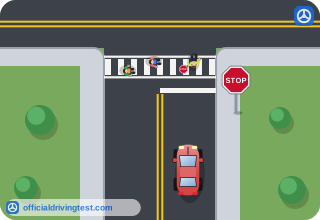
- Slow down and stop only if other vehicles are close to the intersection
- Stop only if a pedestrian or a vehicle is waiting to cross
- A full stop, and do not move again until you are sure the way is clear
- Slow down to a crawl and continue if the intersection looks clear
Show answer
Correct answer: A full stop, and do not move again until you are sure the way is clear
The law requires a full stop at a stop sign, and you must not move again until the way is clear.
Source: North Carolina Driver Handbook (Revised May 2025), page 83 · Open this page in the manual (Manual page 83)
-
Where must a driver stop when a stop sign or traffic light requires a stop and there is a marked stop line?
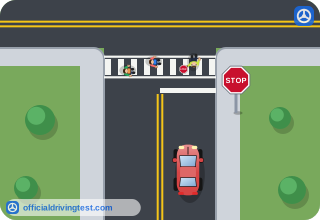
- Just past the stop line
- At the marked stop line
- In the middle of the crosswalk
- Beside the signal pole
Show answer
Correct answer: At the marked stop line
The driver must stop at the appropriately marked stop line.
Source: North Carolina Driver Handbook (Revised May 2025), page 83 · Open this page in the manual (Manual page 83)
-
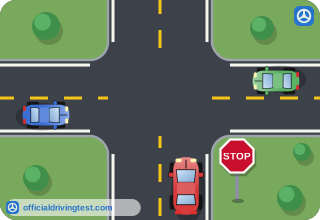
Where must a driver stop at an intersection that has no stop line or marked crosswalk?
- Just past the sign, in the middle of the intersection so that traffic is visible
- Next to the stop sign, even when the intersecting street cannot be seen
- At the point where the vehicle in front of you would have stopped
- Before entering the intersection, where the intersecting street can be seen
Show answer
Correct answer: Before entering the intersection, where the intersecting street can be seen
Without a stop line or marked crosswalk, you stop before entering the intersection where you have a view of the intersecting street.
Source: North Carolina Driver Handbook (Revised May 2025), page 83 · Open this page in the manual (Manual page 83)
-
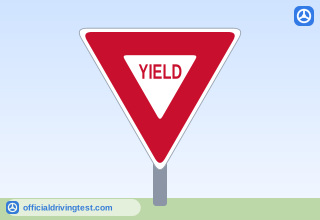
What must you do when you approach a yield sign?
- Come to a full stop every time
- Stop only if you see a pedestrian in the crosswalk
- Slow down and yield the right of way
- Keep your speed if the intersecting street looks empty
Show answer
Correct answer: Slow down and yield the right of way
At a yield sign you must slow down and yield the right of way.
Source: North Carolina Driver Handbook (Revised May 2025), page 83 · Open this page in the manual (Manual page 83)
-
At a yield sign, what determines whether you need to stop?
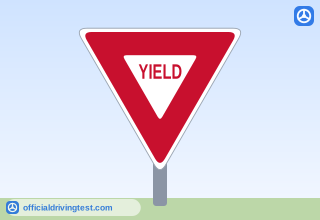
- The speed limit on the street you are on
- The traffic on the intersecting street
- The number of lanes at the intersection
- Whether a stop line is painted on the pavement
Show answer
Correct answer: The traffic on the intersecting street
Your need to stop at a yield sign depends on the traffic on the intersecting street.
Source: North Carolina Driver Handbook (Revised May 2025), page 83 · Open this page in the manual (Manual page 83)
-
Where is the pennant-shaped yellow warning sign located?
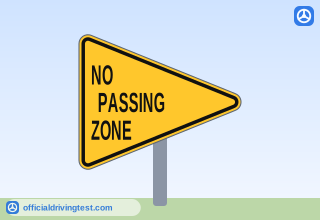
- On the right side of the road, at the beginning of a no-passing zone
- On the left side of the road, at the end of a no-passing zone
- On the left side of the road, at the beginning of a no-passing zone
- On the right side of the road, at the end of a no-passing zone
Show answer
Correct answer: On the left side of the road, at the beginning of a no-passing zone
The pennant sign is on the left side of the road and points to the beginning of the no-passing zone.
Source: North Carolina Driver Handbook (Revised May 2025), page 84 · Open this page in the manual (Manual page 84)
-
What does the pennant-shaped yellow warning sign emphasize?
- The diamond-shaped “STOP AHEAD” sign
- The rectangular “DO NOT PASS” regulatory sign
- The rectangular “KEEP RIGHT EXCEPT TO PASS” sign
- The circular railroad crossing warning sign
Show answer
Correct answer: The rectangular “DO NOT PASS” regulatory sign
The pennant sign emphasizes, rather than replaces, the rectangular regulatory DO NOT PASS sign.
Source: North Carolina Driver Handbook (Revised May 2025), page 84 · Open this page in the manual (Manual page 84)
-
When is a “STOP AHEAD” sign placed far ahead of a stop sign?
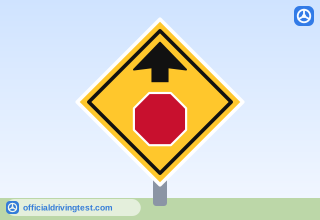
- When the stop sign is located on a road with a high speed limit
- When the intersection ahead is near a school zone or crossing
- When a curve or other objects block the driver’s view of the stop sign
- When the stop sign is at a railroad crossing with multiple tracks
Show answer
Correct answer: When a curve or other objects block the driver’s view of the stop sign
The STOP AHEAD sign is used when a curve or other objects block the driver’s view of the stop sign.
Source: North Carolina Driver Handbook (Revised May 2025), page 84 · Open this page in the manual (Manual page 84)
-
What is often true of the speed limit in school zones?
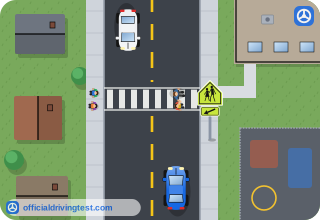
- It is raised during school hours
- It is reduced during certain school hours
- It is reduced only at night
- It is the same as on nearby roads all day
Show answer
Correct answer: It is reduced during certain school hours
In many school zones the speed limit is reduced during certain school hours.
Source: North Carolina Driver Handbook (Revised May 2025), page 85 · Open this page in the manual (Manual page 85)
-
In which directions do odd-numbered highways generally run?
- East and west
- Northeast and southwest
- Northwest and southeast
- North and south
Show answer
Correct answer: North and south
Odd-numbered highways generally run north and south.
Source: North Carolina Driver Handbook (Revised May 2025), page 85 · Open this page in the manual (Manual page 85)
-
In which directions do even-numbered highways generally run?
- East and west
- North and south
- Northeast and southwest
- Northwest and southeast
Show answer
Correct answer: East and west
Even-numbered highways generally run east and west.
Source: North Carolina Driver Handbook (Revised May 2025), page 85 · Open this page in the manual (Manual page 85)
-
What should you do if you are lost and need to read a sign?
- Stop in the middle of the road to read it
- Slow down and read it while driving in the travel lane
- Stop in the nearest traffic lane and wait for other drivers
- When safe, move to the shoulder and figure out where you are
Show answer
Correct answer: When safe, move to the shoulder and figure out where you are
Do not stop in the middle of the road; when it is safe, move to the shoulder until you know your route.
Source: North Carolina Driver Handbook (Revised May 2025), page 85 · Open this page in the manual (Manual page 85)