North Carolina: Parking rules Practice Test
Where you may not park or stop, and how to park safely.
Independent educational site · not affiliated with any government agency or DMV
Ready? Test yourself
- Instant feedback with an explanation
- Every answer cites its source in the manual
- Your best score is saved on this device
Questions are original and based on the official manual "North Carolina Driver Handbook" (Revised May 2025), North Carolina Division of Motor Vehicles (NCDMV).
All 16 questions in this practice test
Take the test above first, then use this list to study. Tap “Show answer” to see the correct answer and explanation.
Show the questions and answersHide the questions
-
On a two-way street, on which side of the road should you always park?
- The left side of the road
- Either side of the road
- The side with the most open space
- The right side of the road
Show answer
Correct answer: The right side of the road
The manual says to always park on the right side of the road, except on one-way streets.
Source: North Carolina Driver Handbook (Revised May 2025), page 56 · Open this page in the manual (Manual page 56)
-
Before pulling out from a parallel parking space, you check for approaching traffic and give which signal?
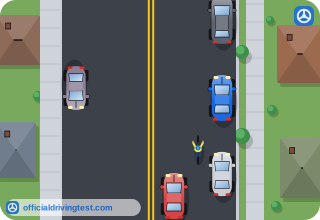
- A right-turn signal
- A left-turn signal
- A hazard signal
- No signal is required
Show answer
Correct answer: A left-turn signal
Before pulling out of a parallel parking space, check for traffic and give a left-turn signal (unless parked on the left side of a one-way street).
Source: North Carolina Driver Handbook (Revised May 2025), page 56 · Open this page in the manual (Manual page 56)
-
If a vehicle ahead of you is pulling out from a parallel parking space, what should you do?
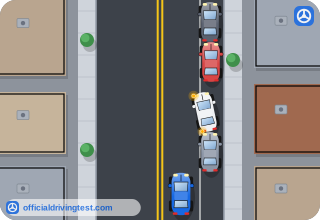
- Speed up and pass before it pulls out
- Slow down and be prepared to stop
- Sound your horn and continue at the same speed
- Pull up close behind it and wait for it to move
Show answer
Correct answer: Slow down and be prepared to stop
The manual says to slow down and be prepared to stop when a vehicle ahead is pulling out from a parallel parking space.
Source: North Carolina Driver Handbook (Revised May 2025), page 56 · Open this page in the manual (Manual page 56)
-
Within how many feet of the curb line of an intersecting street should you not park?
- 10 feet
- 20 feet
- 50 feet
- 25 feet
Show answer
Correct answer: 25 feet
The manual lists parking within 25 feet of the curb line of an intersecting street as a place where you should not park.
Source: North Carolina Driver Handbook (Revised May 2025), page 56 · Open this page in the manual (Manual page 56)
-
If there is no curb, within how many feet of the intersecting right of way lines should you not park?
- 15 feet
- 5 feet
- 25 feet
- 50 feet
Show answer
Correct answer: 15 feet
Where there is no curb, you should not park within 15 feet of the intersecting right of way lines.
Source: North Carolina Driver Handbook (Revised May 2025), page 56 · Open this page in the manual (Manual page 56)
-
Within how many feet of a fire hydrant or the entrance to a fire station should you not park?
- 5 feet
- 10 feet
- 15 feet
- 30 feet
Show answer
Correct answer: 15 feet
The manual says not to park within 15 feet of a fire hydrant or entrance to a fire station.
Source: North Carolina Driver Handbook (Revised May 2025), page 56 · Open this page in the manual (Manual page 56)
-
Parking on the shoulder is against the law unless the parked vehicle can be seen by approaching drivers from both directions for at least how far?
- 50 feet
- 100 feet
- 500 feet
- 200 feet
Show answer
Correct answer: 200 feet
Shoulder parking is only lawful if the parked vehicle can be seen from both directions for a distance of at least 200 feet.
Source: North Carolina Driver Handbook (Revised May 2025), page 56 · Open this page in the manual (Manual page 56)
-
Which is a place where you should not park?
- On the right side of a two-way street where parking is allowed
- On a crosswalk, sidewalk or bridge
- In a designated parking area within an interstate right of way
- On the left side of a one-way street
Show answer
Correct answer: On a crosswalk, sidewalk or bridge
The manual lists a crosswalk, sidewalk or bridge as places where you should not park.
Source: North Carolina Driver Handbook (Revised May 2025), page 56 · Open this page in the manual (Manual page 56)
-
Which is a place where you should not park?
- In a parallel parking space on the right side of the road
- On the left side of a one-way street
- At an intersection or in front of a driveway
- In a designated parking area along an interstate
Show answer
Correct answer: At an intersection or in front of a driveway
The manual says you should not park at an intersection or in front of a driveway.
Source: North Carolina Driver Handbook (Revised May 2025), page 56 · Open this page in the manual (Manual page 56)
-
What is parking on the roadway side of another vehicle called?
- Double parking
- Parallel parking
- Angle parking
- Shoulder parking
Show answer
Correct answer: Double parking
The manual lists parking on the roadway side of another vehicle, called double parking, as a place you should not park.
Source: North Carolina Driver Handbook (Revised May 2025), page 56 · Open this page in the manual (Manual page 56)
-
Which is a place where you should not park?
- Where there are “no-parking” signs
- On the right side of a two-way street
- On the left side of a one-way street
- In a designated parking area on an interstate
Show answer
Correct answer: Where there are “no-parking” signs
The manual lists places with no-parking signs as somewhere you should not park.
Source: North Carolina Driver Handbook (Revised May 2025), page 56 · Open this page in the manual (Manual page 56)
-
Within city limits, how close to a fire or fire truck should you not park?
- Within 25 feet
- Within 400 feet
- Within one block
- Within two blocks
Show answer
Correct answer: Within one block
In city limits you should not park within one block of a fire or fire truck.
Source: North Carolina Driver Handbook (Revised May 2025), page 56 · Open this page in the manual (Manual page 56)
-
Outside the city, how close to a fire or fire truck should you not park?
- Within 100 feet
- Within 400 feet
- Within 200 feet
- Within 300 feet
Show answer
Correct answer: Within 400 feet
Outside the city you should not park within 400 feet of a fire or fire truck.
Source: North Carolina Driver Handbook (Revised May 2025), page 56 · Open this page in the manual (Manual page 56)
-
When may you park within the right of way of an interstate highway?
- On the shoulder whenever you are not blocking traffic
- On the shoulder for up to one hour if traffic is light
- Only if your hazard lights are flashing and you stay in your car
- Only in designated parking areas or in cases of emergencies
Show answer
Correct answer: Only in designated parking areas or in cases of emergencies
You should not park anywhere within the right of way of an interstate highway, except in designated parking areas or in emergencies.
Source: North Carolina Driver Handbook (Revised May 2025), page 56 · Open this page in the manual (Manual page 56)
-
Under which condition may you park in a space designated for handicap/disabled use?
- You are stopped there for less than five minutes with your hazard lights on
- You have a valid driver license and no other space is open nearby
- Your vehicle displays a handicap license plate or a disability parking placard
- The space is empty and you stay with the vehicle at all times
Show answer
Correct answer: Your vehicle displays a handicap license plate or a disability parking placard
Designated handicap spaces are off limits unless the vehicle displays a handicap license plate or a disability parking placard.
Source: North Carolina Driver Handbook (Revised May 2025), page 56 · Open this page in the manual (Manual page 56)
-
What does a handicap parking sign indicate?
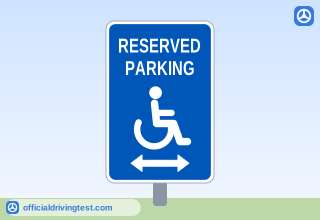
- A space reserved for people with a handicap plate or placard
- A space reserved for vehicles loading or unloading passengers
- A space reserved for drivers who are over 65 years of age
- A space where any vehicle may stop for up to 15 minutes
Show answer
Correct answer: A space reserved for people with a handicap plate or placard
The sign shows a space reserved for people who qualify and display a handicap plate or dashboard placard.
Source: North Carolina Driver Handbook (Revised May 2025), page 83 · Open this page in the manual (Manual page 83)