North Carolina: Freeway driving Practice Test
Entering, driving on and leaving interstates and other high-speed highways.
Independent educational site · not affiliated with any government agency or DMV
Ready? Test yourself
- Instant feedback with an explanation
- Every answer cites its source in the manual
- Your best score is saved on this device
Questions are original and based on the official manual "North Carolina Driver Handbook" (Revised May 2025), North Carolina Division of Motor Vehicles (NCDMV).
All 15 questions in this practice test
Take the test above first, then use this list to study. Tap “Show answer” to see the correct answer and explanation.
Show the questions and answersHide the questions
-
According to the handbook, why are interstate highways safer roads?
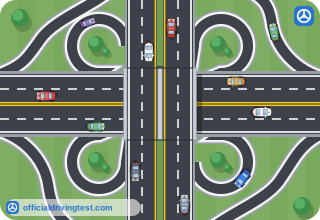
- They have separate lanes for opposite directions and fewer places to enter and exit
- They have wider shoulders, lower speed limits and gentler curves than other roads
- They have railroad crossings that are protected by gates at every exit
- They have police officers stationed at every entrance and exit ramp
Show answer
Correct answer: They have separate lanes for opposite directions and fewer places to enter and exit
The manual says interstates have separate traffic lanes for opposite directions and fewer entry and exit points.
Source: North Carolina Driver Handbook (Revised May 2025), page 64 · Open this page in the manual (Manual page 64)
-
Which of these does the handbook say interstate highways do not have?
- Acceleration lanes
- Deceleration lanes
- Railroad crossings
- Indicated rest areas
Show answer
Correct answer: Railroad crossings
The manual states that interstates do not have railroad crossings, sharp curves, stop signs or traffic signals.
Source: North Carolina Driver Handbook (Revised May 2025), page 64 · Open this page in the manual (Manual page 64)
-
When entering an interstate, how long should you use the acceleration lane?
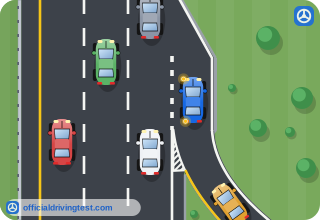
- Until you reach the posted minimum speed for the interstate
- Until your speed matches that of the other traffic, then merge safely
- Until the vehicle ahead of you has merged into traffic
- Until you have signaled for at least the last 200 feet
Show answer
Correct answer: Until your speed matches that of the other traffic, then merge safely
The manual says to use the acceleration lane until your speed matches the other traffic and then merge safely.
Source: North Carolina Driver Handbook (Revised May 2025), page 64 · Open this page in the manual (Manual page 64)
-
On an interstate, which lane should you keep to and which should you use for passing?
- Keep to the left and use the right lane or lanes for passing
- Stay in the middle lane and pass on either side
- Keep to the right and pass on the shoulder
- Keep to the right and use the left lane or lanes for passing
Show answer
Correct answer: Keep to the right and use the left lane or lanes for passing
The manual says to keep to the right and use the left lane(s) for passing.
Source: North Carolina Driver Handbook (Revised May 2025), page 64 · Open this page in the manual (Manual page 64)
-
Which type of crash is named as one of the most frequent on an interstate highway?
- The rear-end crash
- The head-on crash
- The crash at a railroad crossing
- The crash at a stop sign
Show answer
Correct answer: The rear-end crash
The manual says one of the most frequent types of crashes on an interstate is the rear-end crash, so it advises not tailgating.
Source: North Carolina Driver Handbook (Revised May 2025), page 64 · Open this page in the manual (Manual page 64)
-
Which rule does the handbook recommend for keeping a safe following distance on an interstate?
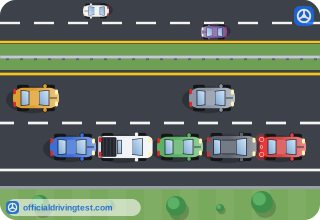
- The one-car-length rule
- The four-second rule
- The two-second rule
- The ten-second rule
Show answer
Correct answer: The two-second rule
The manual tells drivers not to tailgate and to use the “two-second rule” on the interstate.
Source: North Carolina Driver Handbook (Revised May 2025), page 64 · Open this page in the manual (Manual page 64)
-
How often does the handbook say you should preferably stop at rest areas on an interstate trip?
- At least once every 50 miles
- At least once every 100 miles
- At least once every 200 miles
- At least once every 300 miles
Show answer
Correct answer: At least once every 100 miles
The manual advises stopping at indicated rest areas frequently, preferably at least once every 100 miles.
Source: North Carolina Driver Handbook (Revised May 2025), page 64 · Open this page in the manual (Manual page 64)
-
Which of these should you never do when driving on an interstate?
- Use the left lane for passing
- Use the acceleration lane to enter
- Stop at an indicated rest area
- Stop in the travel lane
Show answer
Correct answer: Stop in the travel lane
The manual lists “Never stop in the travel lane” among the interstate rules.
Source: North Carolina Driver Handbook (Revised May 2025), page 64 · Open this page in the manual (Manual page 64)
-
How should you leave an interstate highway?
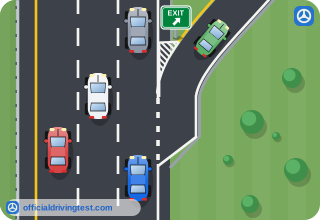
- Slow down in the travel lane, then signal and turn onto the exit ramp
- Signal only after you have entered the exit ramp
- Brake hard in the travel lane to reach the exit speed limit
- Signal well in advance and enter the deceleration lane without slowing down
Show answer
Correct answer: Signal well in advance and enter the deceleration lane without slowing down
The manual says to signal your turn well in advance and, without slowing down, enter the deceleration lane.
Source: North Carolina Driver Handbook (Revised May 2025), page 64 · Open this page in the manual (Manual page 64)
-
After you enter the deceleration lane to leave an interstate, at what speed should you proceed?
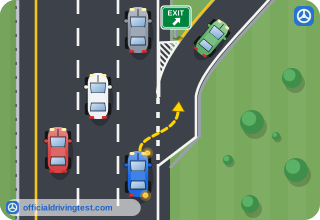
- At the posted exit speed limit
- At the posted speed limit of the interstate
- At the speed of the vehicle behind you
- At 10 mph below the interstate's speed limit
Show answer
Correct answer: At the posted exit speed limit
The manual says to proceed at the posted exit speed limit.
Source: North Carolina Driver Handbook (Revised May 2025), page 64 · Open this page in the manual (Manual page 64)
-
What should you do about the flow of traffic on an interstate?
- Follow it if you can do so without speeding
- Drive well below it to stay safe
- Drive above it to keep pace with faster drivers
- Ignore it and drive in the left lane
Show answer
Correct answer: Follow it if you can do so without speeding
The manual says to follow the flow of traffic if you can do so without speeding.
Source: North Carolina Driver Handbook (Revised May 2025), page 65 · Open this page in the manual (Manual page 65)
-
When are crashes more likely to occur on an interstate?
- When a vehicle stays in the right lane for a long time
- When a vehicle uses the acceleration lane to enter the interstate
- When a vehicle moves significantly slower than the flow of traffic
- When a vehicle follows the traffic ahead by two seconds or more
Show answer
Correct answer: When a vehicle moves significantly slower than the flow of traffic
The manual says crashes are more likely when a vehicle moves significantly slower than the flow of traffic.
Source: North Carolina Driver Handbook (Revised May 2025), page 65 · Open this page in the manual (Manual page 65)
-
If you enter an interstate headed in the wrong direction, what should you do?
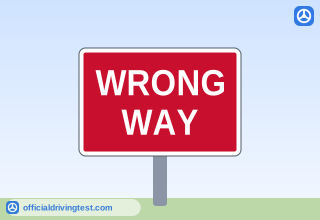
- Continue to the next exit and turn around there to head back
- Pull over to the right shoulder and stop, then turn around when clear
- Back up along the shoulder to the entrance ramp you just used
- Turn around at once in the nearest gap in the median
Show answer
Correct answer: Pull over to the right shoulder and stop, then turn around when clear
The manual says to pull over to the right shoulder and stop, and turn around when the way is clear.
Source: North Carolina Driver Handbook (Revised May 2025), page 65 · Open this page in the manual (Manual page 65)
-
Which signs should you watch for to avoid entering an interstate in the wrong direction?
- Rest area signs
- Exit number signs
- Minimum speed signs
- DO NOT ENTER signs
Show answer
Correct answer: DO NOT ENTER signs
The manual says you can avoid this error by watching for DO NOT ENTER signs.
Source: North Carolina Driver Handbook (Revised May 2025), page 65 · Open this page in the manual (Manual page 65)
-
If you miss your exit on an interstate, what should you do?
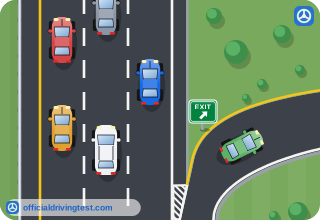
- Proceed to the next exit and leave there
- Slow down and stop on the shoulder
- Back up to the exit you missed
- Turn around at the nearest opening
Show answer
Correct answer: Proceed to the next exit and leave there
The manual says not to slow down, back up or turn around, but to proceed to the next exit.
Source: North Carolina Driver Handbook (Revised May 2025), page 65 · Open this page in the manual (Manual page 65)