North Carolina: Exam Simulator
40 random questions from every topic, like a mini exam.
Independent educational site · not affiliated with any government agency or DMV
Ready? Test yourself
40 questions; pass mark 80% (the state does not publish its test format).
- Instant feedback with an explanation
- Every answer cites its source in the manual
- Your best score is saved on this device
Questions are original and based on the official manual "North Carolina Driver Handbook" (Revised May 2025), North Carolina Division of Motor Vehicles (NCDMV).
Sample questions
The exam simulator picks 40 random questions from every topic each time you start. Here are a few examples.
Show the questions and answersHide the questions
-
When is the DMVdirectAccess automated telephone information service available?
- Only during DMV office hours
- Weekdays from 8 a.m. to 5 p.m.
- 24 hours a day, seven days a week
- Monday through Saturday, 7 a.m. to 7 p.m.
Show answer
Correct answer: 24 hours a day, seven days a week
The handbook says you can access DMVdirectAccess information 24 hours a day, seven days a week.
Source: North Carolina Driver Handbook (Revised May 2025), page 3 · Open this page in the manual (Manual page 3)
-
If you encounter a curve while traveling downhill, what should you shift to before moving downhill?
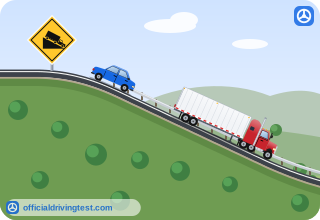
- A lower gear
- A higher gear
- Neutral
- Reverse
Show answer
Correct answer: A lower gear
For a downhill curve the manual says to shift to a lower gear before moving downhill.
Source: North Carolina Driver Handbook (Revised May 2025), page 54 · Open this page in the manual (Manual page 54)
-
What do yellow lines separate?
- Travel lanes moving in the same direction
- Travel lanes moving in opposite directions
- Bicycle lanes from travel lanes
- Parking areas from travel lanes
Show answer
Correct answer: Travel lanes moving in opposite directions
Yellow lines separate travel lanes moving in opposite directions.
Source: North Carolina Driver Handbook (Revised May 2025), page 88 · Open this page in the manual (Manual page 88)
-
According to the handbook, why are interstate highways safer roads?
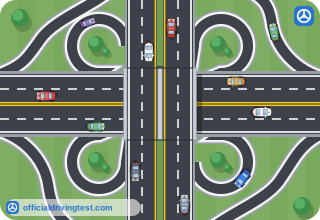
- They have separate lanes for opposite directions and fewer places to enter and exit
- They have wider shoulders, lower speed limits and gentler curves than other roads
- They have railroad crossings that are protected by gates at every exit
- They have police officers stationed at every entrance and exit ramp
Show answer
Correct answer: They have separate lanes for opposite directions and fewer places to enter and exit
The manual says interstates have separate traffic lanes for opposite directions and fewer entry and exit points.
Source: North Carolina Driver Handbook (Revised May 2025), page 64 · Open this page in the manual (Manual page 64)
-
On a two-way street, on which side of the road should you always park?
- The left side of the road
- Either side of the road
- The side with the most open space
- The right side of the road
Show answer
Correct answer: The right side of the road
The manual says to always park on the right side of the road, except on one-way streets.
Source: North Carolina Driver Handbook (Revised May 2025), page 56 · Open this page in the manual (Manual page 56)
-
Which sign shape is used for stop signs only?
- Pentagon (five-sided)
- Octagon (eight-sided)
- Diamond
- Circle
Show answer
Correct answer: Octagon (eight-sided)
The manual says the octagonal shape is used for stop signs only.
Source: North Carolina Driver Handbook (Revised May 2025), page 83 · Open this page in the manual (Manual page 83)
-
How far from an intersection is a stop sign usually posted?
- Six to 50 feet
- Two to 20 feet
- 25 to 100 feet
- 50 to 150 feet
Show answer
Correct answer: Six to 50 feet
The manual says a stop sign is usually posted six to 50 feet from the intersection.
Source: North Carolina Driver Handbook (Revised May 2025), page 83 · Open this page in the manual (Manual page 83)
-
What must a turning vehicle do when facing a circular green signal?
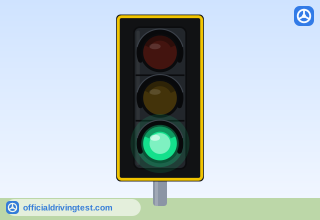
- Yield the right of way to oncoming traffic and pedestrians
- Stop and wait for a green arrow before turning
- Turn at once, because a green signal gives turning vehicles the right of way
- Stop completely, then turn when the way looks clear
Show answer
Correct answer: Yield the right of way to oncoming traffic and pedestrians
A circular green signal lets you proceed cautiously, but turning vehicles must yield to oncoming traffic and pedestrians.
Source: North Carolina Driver Handbook (Revised May 2025), page 80 · Open this page in the manual (Manual page 80)
-
During which hours does the manual say school buses are generally operating, so drivers should be especially careful?
- 7-9 a.m. and 2-4 p.m.
- 6-8 a.m. and 5-7 p.m.
- 9-11 a.m. and 12-2 p.m.
- 10 a.m.-12 noon and 4-6 p.m.
Show answer
Correct answer: 7-9 a.m. and 2-4 p.m.
The manual says school buses are generally operating from 7 to 9 a.m. and 2 to 4 p.m., so drivers should be especially careful.
Source: North Carolina Driver Handbook (Revised May 2025), page 47 · Open this page in the manual (Manual page 47)
-
When you must stop at a railroad crossing, how far from the nearest rail must you stop?
- Within 50 feet, but not less than 15 feet
- Within 100 feet, but not less than 50 feet
- Within 25 feet, but not less than 5 feet
- Within 30 feet, but not less than 10 feet
Show answer
Correct answer: Within 50 feet, but not less than 15 feet
G.S. 20-142.1 requires the driver to stop within 50 feet but not less than 15 feet from the nearest rail.
Source: North Carolina Driver Handbook (Revised May 2025), page 60 · Open this page in the manual (Manual page 60)