North Carolina: Emergency vehicles & work zones — Part 3 Practice Test
Questions in this part include: “What is unlawful to do while driving in a work zone?” · “How are black-on-orange signs used within a work zone?”
Independent educational site · not affiliated with any government agency or DMV
Ready? Test yourself
- Instant feedback with an explanation
- Every answer cites its source in the manual
- Your best score is saved on this device
Questions are original and based on the official manual "North Carolina Driver Handbook" (Revised May 2025), North Carolina Division of Motor Vehicles (NCDMV).
All 17 questions in this practice test
Take the test above first, then use this list to study. Tap “Show answer” to see the correct answer and explanation.
Show the questions and answersHide the questions
-
What is unlawful to do while driving in a work zone?
- Drive more than 5 mph below the speed limit set for the zone
- Drive above the speed limit that is set and posted
- Change lanes when the signs tell you that a lane is closed
- Use your headlights during the day while in the work zone
Show answer
Correct answer: Drive above the speed limit that is set and posted
The manual says it is unlawful to drive greater than the speed limit that is set and posted in a work zone.
Source: North Carolina Driver Handbook (Revised May 2025), page 70 · Open this page in the manual (Manual page 70)
-
What is a highway work zone?
- Only the area where workers are actually present at the time
- The area from the last sign back to the nearest intersection
- Any stretch of road within one mile of an orange sign
- The area between the first sign of the work zone and the last sign
Show answer
Correct answer: The area between the first sign of the work zone and the last sign
The manual defines a highway work zone as the area between the first sign indicating its beginning and the last sign indicating its end.
Source: North Carolina Driver Handbook (Revised May 2025), page 70 · Open this page in the manual (Manual page 70)
-
When is there a penalty for speeding in a work zone?
- If a sign at the beginning of the work zone lists the penalty
- Only when workers are actually present in the work zone
- Only if a flagger is standing at the work site
- Only when the speed limit in the work zone is below 45 mph
Show answer
Correct answer: If a sign at the beginning of the work zone lists the penalty
The manual says there is a penalty for speeding in a work zone if a sign at the beginning lists the penalty.
Source: North Carolina Driver Handbook (Revised May 2025), page 70 · Open this page in the manual (Manual page 70)
-
How does the work zone speeding penalty relate to other penalties for the speeding conviction?
- It replaces any other penalties
- It applies only if there are no other penalties
- It is in addition to any other penalties
- It is reduced if there are other penalties
Show answer
Correct answer: It is in addition to any other penalties
The manual says the work zone penalty is in addition to any other penalties for the speeding conviction.
Source: North Carolina Driver Handbook (Revised May 2025), page 70 · Open this page in the manual (Manual page 70)
-
How can a highway work zone be easily identified?
- By yellow and black striped barriers along the shoulder
- By unique orange warning signs just before the work zone
- By blue signs with white letters just before the work zone
- By green signs with white letters posted along the road
Show answer
Correct answer: By unique orange warning signs just before the work zone
The manual says a highway work zone can be easily identified by unique orange warning signs immediately preceding the work zone.
Source: North Carolina Driver Handbook (Revised May 2025), page 70 · Open this page in the manual (Manual page 70)
-
What are orange signs with messages in black letters reserved strictly for?
- Marking school zones
- Marking railroad crossings
- Marking detours around crashes
- Identifying work zones
Show answer
Correct answer: Identifying work zones
The manual says orange signs with black letters are reserved strictly to identify work zones.
Source: North Carolina Driver Handbook (Revised May 2025), page 70 · Open this page in the manual (Manual page 70)
-
How are black-on-orange signs used within a work zone?
- To give drivers specific information and directions inside the work zone
- To tell drivers to ignore the posted speed limit in the zone
- To mark the end of the work zone and nothing else
- To show drivers where the nearest rest area is located
Show answer
Correct answer: To give drivers specific information and directions inside the work zone
The manual says black-on-orange signs are used within the work zone to convey specific information and directions to drivers.
Source: North Carolina Driver Handbook (Revised May 2025), page 70 · Open this page in the manual (Manual page 70)
-
What does the "Flagger" sign warn of?
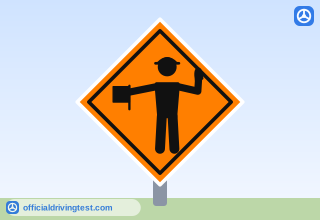
- A crossing guard who is helping students cross at a school ahead
- A police officer who is stopping vehicles for a checkpoint ahead
- Construction or maintenance ahead where a flagger controls traffic
- A railroad worker who is waving trains through a crossing ahead
Show answer
Correct answer: Construction or maintenance ahead where a flagger controls traffic
The manual says the Flagger sign warns of construction or maintenance ahead where a flagger in an orange vest controls traffic.
Source: North Carolina Driver Handbook (Revised May 2025), page 70 · Open this page in the manual (Manual page 70)
-
What does a flagger use to stop traffic or let it proceed?
- A red flashlight
- A "STOP/SLOW" paddle
- A white glove
- A whistle
Show answer
Correct answer: A "STOP/SLOW" paddle
The manual says the flagger uses a “STOP/SLOW” paddle to stop traffic or allow it to proceed.
Source: North Carolina Driver Handbook (Revised May 2025), page 70 · Open this page in the manual (Manual page 70)
-
What color of vest does a flagger wear?
- Yellow
- White
- Red
- Orange
Show answer
Correct answer: Orange
The manual says the flagger wears an orange vest.
Source: North Carolina Driver Handbook (Revised May 2025), page 70 · Open this page in the manual (Manual page 70)
-
What should you do when you see the "Flagger" sign?
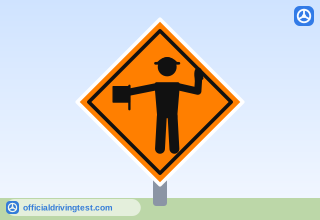
- Stay alert and be prepared to stop
- Speed up to pass the work site
- Move to the shoulder and wait
- Ignore it unless a flagger is visible
Show answer
Correct answer: Stay alert and be prepared to stop
The manual says when you see the Flagger sign, stay alert and be prepared to stop.
Source: North Carolina Driver Handbook (Revised May 2025), page 70 · Open this page in the manual (Manual page 70)
-
What does it mean when you see black-on-orange signs?
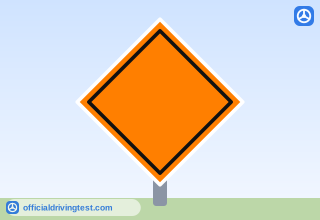
- You are leaving a work zone and may speed up again
- You must come to a complete stop at once and wait
- You are about to enter a work zone and should stay alert
- Speed limits are no longer in effect in this area
Show answer
Correct answer: You are about to enter a work zone and should stay alert
The manual says black-on-orange signs mean you are about to enter a work zone and should STAY ALERT.
Source: North Carolina Driver Handbook (Revised May 2025), page 71 · Open this page in the manual (Manual page 71)
-
What may advance work zone signs require you to do?
- Turn on your emergency flashers
- Take some action, such as shifting to another lane
- Stop and wait for a flagger
- Increase your speed to keep up with traffic
Show answer
Correct answer: Take some action, such as shifting to another lane
The manual says advance work zone signs may require you to take some action like shifting your vehicle to another lane.
Source: North Carolina Driver Handbook (Revised May 2025), page 71 · Open this page in the manual (Manual page 71)
-
When you are required to take action in a work zone, how does the manual say the signs will convey the message?
- Only at the last moment
- Only by a flagger's signal
- Only after you have entered the work zone
- Far in advance, so you have enough time to act
Show answer
Correct answer: Far in advance, so you have enough time to act
The manual says black-on-orange signs will convey the message far in advance, so you will have enough time to take the action.
Source: North Carolina Driver Handbook (Revised May 2025), page 71 · Open this page in the manual (Manual page 71)
-
When should you take action that a work zone sign requires?
- Do not wait until the last minute
- Only when other drivers ahead do
- After you pass the last sign
- At the last moment before the work area
Show answer
Correct answer: Do not wait until the last minute
The manual says not to wait until the last minute to take action because the signs provide sufficient time to react.
Source: North Carolina Driver Handbook (Revised May 2025), page 71 · Open this page in the manual (Manual page 71)
-
What is a major cause of rear-end crashes in work zones?
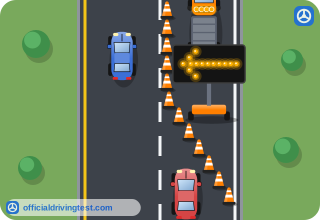
- Driving faster than the surrounding traffic
- Driving in the left lane
- Driving slower than the surrounding traffic
- Following the flow of traffic
Show answer
Correct answer: Driving slower than the surrounding traffic
The manual says driving slower than the surrounding traffic is a major cause of rear-end crashes in work zones.
Source: North Carolina Driver Handbook (Revised May 2025), page 71 · Open this page in the manual (Manual page 71)
-
Which devices are used in work zones to guide and direct drivers safely?
- Speed bumps and railroad gates
- Barricades, cones, drums and flaggers
- Stop signs and yield signs only
- Rumble strips and guardrails only
Show answer
Correct answer: Barricades, cones, drums and flaggers
The manual lists barricades, cones, drums, flaggers, etc. as traffic control devices used in work zones.
Source: North Carolina Driver Handbook (Revised May 2025), page 71 · Open this page in the manual (Manual page 71)