North Carolina: Emergency vehicles & work zones — Part 2 Practice Test
Questions in this part include: “Under state law, what are you required to do during a traffic stop?” · “If you disagree with the officer's decision to issue a traffic ticket, what should you do?”
Independent educational site · not affiliated with any government agency or DMV
Ready? Test yourself
- Instant feedback with an explanation
- Every answer cites its source in the manual
- Your best score is saved on this device
Questions are original and based on the official manual "North Carolina Driver Handbook" (Revised May 2025), North Carolina Division of Motor Vehicles (NCDMV).
All 18 questions in this practice test
Take the test above first, then use this list to study. Tap “Show answer” to see the correct answer and explanation.
Show the questions and answersHide the questions
-
Under state law, what are you required to do during a traffic stop?
- Answer every question that the officer asks you in detail
- Explain in detail why you committed the traffic violation
- Identify yourself and provide your drivers license and registration
- Allow the officer to search the inside and trunk of your vehicle
Show answer
Correct answer: Identify yourself and provide your drivers license and registration
The manual says you are required to identify yourself and provide your drivers license and registration; after that you may choose whether to respond verbally to additional questions.
Source: North Carolina Driver Handbook (Revised May 2025), page 50 · Open this page in the manual (Manual page 50)
-
After you have identified yourself to an officer during a traffic stop, what does the manual say about additional questions?
- You must answer all of them
- You may choose whether or not to verbally respond
- You must answer them in writing
- You must answer only if a passenger is present
Show answer
Correct answer: You may choose whether or not to verbally respond
The manual says that after establishing identification, you may choose whether or not to verbally respond to additional questions.
Source: North Carolina Driver Handbook (Revised May 2025), page 50 · Open this page in the manual (Manual page 50)
-
If the officer is not in uniform, what will happen or what may you do?
- You may refuse to stop until a uniformed officer arrives on scene
- You must exit the vehicle to inspect the officer's badge closely
- You must accept the officer's word without asking any questions
- They will show law enforcement credentials, or you may ask to see them
Show answer
Correct answer: They will show law enforcement credentials, or you may ask to see them
The manual says an officer not in uniform will show law enforcement credentials or you may ask to see them.
Source: North Carolina Driver Handbook (Revised May 2025), page 50 · Open this page in the manual (Manual page 50)
-
If there is a firearm or other weapon in the vehicle during a traffic stop, what should you do?
- Do not attempt to reach for it
- Move it to the glove box quietly
- Hand it to the officer through the window
- Place it in the back seat
Show answer
Correct answer: Do not attempt to reach for it
The manual says not to attempt to reach for the weapon; any weapon should be in plain view or securely locked away unless you have the proper permit.
Source: North Carolina Driver Handbook (Revised May 2025), page 50 · Open this page in the manual (Manual page 50)
-
If you or a passenger has a concealed weapon permit and a weapon is in the vehicle during a traffic stop, what must you do?
- Hide the weapon and permit
- Wait until the officer asks about weapons
- Inform the officer of that fact
- Remove the weapon and hand it to the officer
Show answer
Correct answer: Inform the officer of that fact
The manual says the person with a concealed weapon permit must inform the officer that a weapon is in the vehicle.
Source: North Carolina Driver Handbook (Revised May 2025), page 50 · Open this page in the manual (Manual page 50)
-
During a traffic stop, when may you or your passengers exit the vehicle?
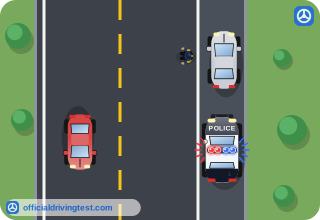
- Whenever you wish to speak with the officer
- Only when instructed to do so by the officer
- Any time after showing your license
- After turning off the engine
Show answer
Correct answer: Only when instructed to do so by the officer
The manual says not to exit the vehicle or allow passengers to exit unless instructed to do so by the officer.
Source: North Carolina Driver Handbook (Revised May 2025), page 50 · Open this page in the manual (Manual page 50)
-
If your license or registration is not readily accessible during a traffic stop, what should you avoid doing?
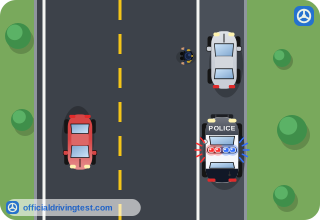
- Staying calm and refraining from any sudden or unneeded movement
- Keeping both of your hands in plain view of the officer at all times
- Telling the officer where your documents are kept inside the vehicle
- Reaching under the seats or searching the glove box unless asked by the officer
Show answer
Correct answer: Reaching under the seats or searching the glove box unless asked by the officer
The manual says not to reach under the seats or open the glove box or other compartments to search unless asked to do so by the officer.
Source: North Carolina Driver Handbook (Revised May 2025), page 50 · Open this page in the manual (Manual page 50)
-
Should you talk on a cell phone while interacting with the officer during a traffic stop?
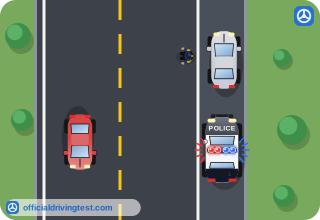
- No, the officer must be able to give you detailed instructions
- Yes, if you need to call someone to come and help you
- Yes, if the officer is not in uniform or in a marked car
- Yes, if a passenger holds the phone up to your ear for you
Show answer
Correct answer: No, the officer must be able to give you detailed instructions
The manual says not to talk on a cell phone while interacting with the officer, because the officer has to be able to give you and your passengers detailed instructions.
Source: North Carolina Driver Handbook (Revised May 2025), page 50 · Open this page in the manual (Manual page 50)
-
If you do not understand an officer's instruction during a traffic stop, what should you do?
- Follow your best guess about what the officer must have meant
- Get out of the vehicle so that you can ask the officer directly
- Calmly tell the officer you do not understand and ask them to repeat it
- Wait silently until the officer decides to repeat the instruction
Show answer
Correct answer: Calmly tell the officer you do not understand and ask them to repeat it
The manual says to calmly inform the officer that you do not understand the instruction and ask them to repeat or explain it.
Source: North Carolina Driver Handbook (Revised May 2025), page 50 · Open this page in the manual (Manual page 50)
-
Is your acceptance and signature on a traffic ticket an admission of guilt?
- Yes, it is a guilty plea
- No
- Yes, but only for a first offense
- Yes, unless you write a note
Show answer
Correct answer: No
The manual says your acceptance and signature on a traffic ticket is not an admission of guilt.
Source: North Carolina Driver Handbook (Revised May 2025), page 50 · Open this page in the manual (Manual page 50)
-
If you disagree with the officer's decision to issue a traffic ticket, what should you do?
- Argue at the roadside until the officer agrees you are right
- Refuse to accept the ticket and then drive away from the scene
- Ask the officer to cancel the ticket right there at the roadside
- Do not argue, and explain your point of view in court if you contest it
Show answer
Correct answer: Do not argue, and explain your point of view in court if you contest it
The manual says not to prolong the contact by arguing; if you wish to contest the ticket you will have the opportunity to explain your point of view in court.
Source: North Carolina Driver Handbook (Revised May 2025), page 50 · Open this page in the manual (Manual page 50)
-
Resisting, delaying or obstructing a law enforcement officer during a traffic stop is what class of offense?
- A class 2 misdemeanor
- A class 1 misdemeanor
- A class 3 misdemeanor
- An infraction with only a fine
Show answer
Correct answer: A class 2 misdemeanor
The manual says resisting, delaying or obstructing an officer during a traffic stop is a class 2 misdemeanor.
Source: North Carolina Driver Handbook (Revised May 2025), page 50 · Open this page in the manual (Manual page 50)
-
If you believe an officer acted inappropriately during a stop, what does the manual say to do?
- Argue with the officer at the roadside until the officer listens to you
- Refuse to sign the ticket and leave without taking your copy of it
- Document the officer's behavior and report it to the agency in a timely manner
- Wait at least a full year before you report the officer to the agency
Show answer
Correct answer: Document the officer's behavior and report it to the agency in a timely manner
The manual says to document the officer's behavior and report it to the officer's agency in a timely manner; the officer's name and agency will be on the ticket.
Source: North Carolina Driver Handbook (Revised May 2025), page 51 · Open this page in the manual (Manual page 51)
-
How does an officer initiate a traffic stop, according to the manual?
- By using a loudspeaker only
- By turning on the blue lights and/or siren
- By flashing the headlights only
- By turning on the red hazard lights only
Show answer
Correct answer: By turning on the blue lights and/or siren
The manual says the officer will initiate a traffic stop by turning on the blue lights and/or siren.
Source: North Carolina Driver Handbook (Revised May 2025), page 51 · Open this page in the manual (Manual page 51)
-
What should you never do when an emergency vehicle using flashing lights and sirens is passing through a roundabout?
- Enter the roundabout
- Use your turn signal
- Yield to pedestrians at the crosswalk
- Slow down
Show answer
Correct answer: Enter the roundabout
The manual says never to enter a roundabout while an emergency vehicle using flashing lights and sirens is passing through.
Source: North Carolina Driver Handbook (Revised May 2025), page 59 · Open this page in the manual (Manual page 59)
-
You are already in a roundabout when an emergency vehicle using flashing lights and sirens approaches. What should you do?
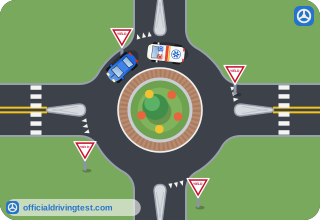
- Stop where you are inside the roundabout until the vehicle passes
- Speed up and stay ahead of the emergency vehicle in the circle
- Exit first, then pull over to let the emergency vehicle pass
- Pull over immediately onto the center island of the roundabout
Show answer
Correct answer: Exit first, then pull over to let the emergency vehicle pass
If drivers are already in the roundabout, they should exit first and then pull over to let the emergency vehicle pass.
Source: North Carolina Driver Handbook (Revised May 2025), page 59 · Open this page in the manual (Manual page 59)
-
What does a street or highway work zone warn of?
- Construction or maintenance activities on or next to the road
- Only an upcoming school zone with children crossing the road
- Only a lane that is closed because of a traffic crash
- Only a change in the posted speed limit on the road ahead
Show answer
Correct answer: Construction or maintenance activities on or next to the road
The manual says a work zone warns of construction or maintenance activities on or adjacent to the road used by vehicles.
Source: North Carolina Driver Handbook (Revised May 2025), page 70 · Open this page in the manual (Manual page 70)
-
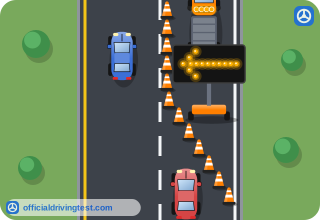
What is it very important to do in work zones?
- Drive faster than usual so you leave the work zone quickly
- Stay in the same lane at all times while in the work zone
- Stay alert and be ready to react safely to unexpected conditions
- Stop until the workers wave you on through the work zone
Show answer
Correct answer: Stay alert and be ready to react safely to unexpected conditions
The manual says it is very important to STAY ALERT in work zones and be ready to react safely to unexpected conditions.
Source: North Carolina Driver Handbook (Revised May 2025), page 70 · Open this page in the manual (Manual page 70)