North Carolina: Emergency vehicles & work zones — Part 1 Practice Test
Questions in this part include: “How close may you park to an emergency vehicle that has stopped to investigate an accident or give assistance?” · “According to the emergency-vehicle guidance, how close may you drive or park to fire trucks responding to a fire alarm?”
Independent educational site · not affiliated with any government agency or DMV
Ready? Test yourself
- Instant feedback with an explanation
- Every answer cites its source in the manual
- Your best score is saved on this device
Questions are original and based on the official manual "North Carolina Driver Handbook" (Revised May 2025), North Carolina Division of Motor Vehicles (NCDMV).
All 18 questions in this practice test
Take the test above first, then use this list to study. Tap “Show answer” to see the correct answer and explanation.
Show the questions and answersHide the questions
-
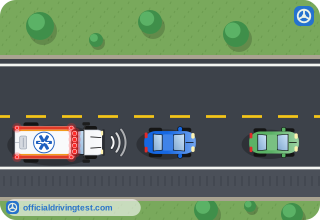
As an emergency vehicle approaches from ahead or behind, what should you do?
- Speed up so you can clear the way as fast as possible
- Stop in the middle of your lane and wait for it to pass
- Pull to the left edge of the road and slow down
- Drive to the right-hand curb or edge and stop completely
Show answer
Correct answer: Drive to the right-hand curb or edge and stop completely
The manual says to drive to the right-hand curb or edge of the road and stop completely as the emergency vehicle approaches from ahead or behind.
Source: North Carolina Driver Handbook (Revised May 2025), page 48 · Open this page in the manual (Manual page 48)
-
How long should you remain stopped after pulling over for an emergency vehicle?
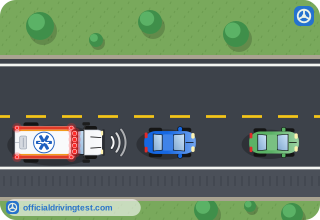
- Until it has passed or a traffic officer directs you to move
- Until you can no longer hear the siren of the vehicle
- For at least one full minute after it first passes
- Until the next traffic light in your direction turns green
Show answer
Correct answer: Until it has passed or a traffic officer directs you to move
The manual says to remain stopped until the emergency vehicle has passed, or until directed to move by a traffic officer.
Source: North Carolina Driver Handbook (Revised May 2025), page 48 · Open this page in the manual (Manual page 48)
-
How close may you park to an emergency vehicle that has stopped to investigate an accident or give assistance?
- Not within 25 feet
- Not within 50 feet
- Not within 100 feet
- Not within 500 feet
Show answer
Correct answer: Not within 100 feet
The manual says not to park within 100 feet of an emergency vehicle that has stopped to investigate an accident or to give assistance.
Source: North Carolina Driver Handbook (Revised May 2025), page 48 · Open this page in the manual (Manual page 48)
-
Vehicles traveling in the opposite direction of an emergency vehicle do NOT have to yield to it in which situation?
- On a two-lane road that has a double yellow center line
- On a four-lane limited-access highway with a center median
- On a residential street that has cars parked on both sides
- In a school zone during the hours that school is in session
Show answer
Correct answer: On a four-lane limited-access highway with a center median
The manual says all vehicles must yield to an approaching emergency vehicle, except vehicles traveling in the opposite direction on a four-lane limited-access highway with a center median.
Source: North Carolina Driver Handbook (Revised May 2025), page 48 · Open this page in the manual (Manual page 48)
-
According to the emergency-vehicle guidance, how close may you drive or park to fire trucks responding to a fire alarm?
- Not closer than 100 feet
- Not closer than two blocks
- Not closer than 25 feet
- Not closer than one block
Show answer
Correct answer: Not closer than one block
The manual says not to drive or park closer than one block from fire trucks responding to a fire alarm.
Source: North Carolina Driver Handbook (Revised May 2025), page 48 · Open this page in the manual (Manual page 48)
-
What should you never drive a motor vehicle over?
- A fire hose
- A painted crosswalk
- A speed bump
- A paved shoulder
Show answer
Correct answer: A fire hose
The manual says never to drive a motor vehicle over a fire hose.
Source: North Carolina Driver Handbook (Revised May 2025), page 48 · Open this page in the manual (Manual page 48)
-
The move-over rule applies to an authorized emergency vehicle parked or standing within how far of the roadway with its emergency or warning lights activated?
- 6 feet
- 25 feet
- 12 feet
- 50 feet
Show answer
Correct answer: 12 feet
The manual says the move-over requirements apply when an authorized emergency vehicle is parked or standing within 12 feet of the roadway with its lights activated.
Source: North Carolina Driver Handbook (Revised May 2025), page 49 · Open this page in the manual (Manual page 49)
-
Which of these is counted as an authorized emergency vehicle under the move-over rule?
- Any private vehicle that has its hazard lights on and is stopped on the roadside
- A public service vehicle assisting motorists or officers with wrecked or disabled vehicles
- A commercial delivery truck that has stopped beside the road to unload its cargo
- A school bus that is stopped on the shoulder of the road to let students off
Show answer
Correct answer: A public service vehicle assisting motorists or officers with wrecked or disabled vehicles
The manual lists police, fire department, ambulance, rescue squad, or a public service vehicle being used to assist motorists or law enforcement officers with wrecked or disabled vehicles.
Source: North Carolina Driver Handbook (Revised May 2025), page 49 · Open this page in the manual (Manual page 49)
-
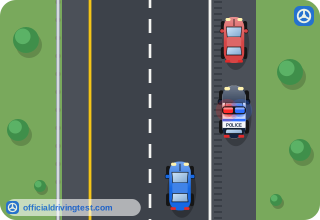
On a highway with at least two lanes in your direction, what must you do when approaching a parked or standing emergency vehicle with its lights activated?
- Stop in your current lane until the emergency vehicle has left the roadside
- Stay in your lane and sound your horn as you pass the emergency vehicle
- Move into the lane nearest the emergency vehicle so that you can slow down
- Move to a lane not nearest the emergency vehicle and stay there until safely clear
Show answer
Correct answer: Move to a lane not nearest the emergency vehicle and stay there until safely clear
The manual says to move into a lane that is not the lane nearest the parked or standing emergency vehicle and continue until safely clear of it.
Source: North Carolina Driver Handbook (Revised May 2025), page 49 · Open this page in the manual (Manual page 49)
-
On a highway with only one lane in your direction, what must you do when approaching a parked or standing emergency vehicle with its lights activated?
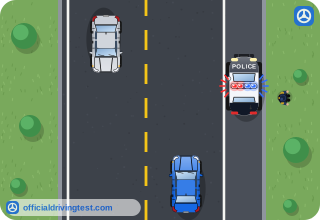
- Slow down and drive at a reduced, safe speed until completely past it
- Stop completely until the emergency vehicle has left the roadside
- Move onto the shoulder and stop until the emergency vehicle leaves
- Keep your current speed and sound your horn as you drive past
Show answer
Correct answer: Slow down and drive at a reduced, safe speed until completely past it
The manual says to slow your speed and drive at a reduced, safe speed until completely past the emergency vehicle.
Source: North Carolina Driver Handbook (Revised May 2025), page 49 · Open this page in the manual (Manual page 49)
-
When you see emergency lights or hear a siren behind you and are being stopped by law enforcement, what should you do?
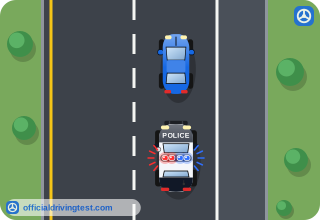
- Stop immediately in your lane of travel and wait for the officer to approach
- Speed up until you find a well-lit place where you can stop safely
- Stay calm, signal, and pull to the right, off the travel portion of the highway
- Pull to the left side of the road and turn your hazard lights on at once
Show answer
Correct answer: Stay calm, signal, and pull to the right, off the travel portion of the highway
The manual says to stay calm, activate your turn signal and pull to the right and off the travel portion of the highway at the nearest point where it is safe.
Source: North Carolina Driver Handbook (Revised May 2025), page 49 · Open this page in the manual (Manual page 49)
-
If there is not an obvious safe place to stop right away for a law enforcement officer, what does the manual say to do?
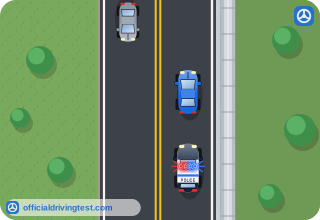
- Stop immediately in the travel lane and wait for the officer
- Turn on your 4 way flashers and reduce your speed by about 10 mph
- Keep driving at the same speed until the officer drives past you
- Turn off your lights and pull into the nearest private driveway
Show answer
Correct answer: Turn on your 4 way flashers and reduce your speed by about 10 mph
The manual says to turn on your 4 way flashers and reduce your speed (by about 10 mph) to signal that you are aware of the officer, then continue to the nearest safe area to stop.
Source: North Carolina Driver Handbook (Revised May 2025), page 49 · Open this page in the manual (Manual page 49)
-
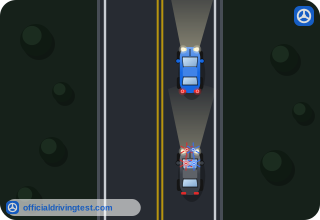
If an unmarked car is stopping you and you are unsure it is a real law enforcement officer, what may you do?
- Drive on until you reach your home, then call the police yourself
- Refuse to pull over under any circumstances, whoever is behind you
- Wait for the officer to show credentials through your car window
- Call 9-1-1 before pulling over to verify that it is an actual officer
Show answer
Correct answer: Call 9-1-1 before pulling over to verify that it is an actual officer
The manual says you may call 9-1-1 before pulling over and report your name and location to verify that an actual law enforcement officer is conducting the traffic stop.
Source: North Carolina Driver Handbook (Revised May 2025), page 49 · Open this page in the manual (Manual page 49)
-
After the vehicle stops for a law enforcement officer, what does the manual say the driver should do?
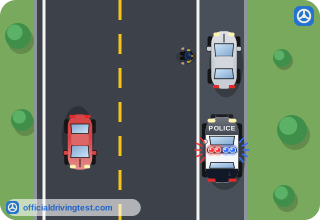
- Place the vehicle in Park, roll down the window, and turn off the engine
- Leave the engine running and keep the radio on so you stay calm
- Step out of the vehicle and walk back toward the officer's car
- Keep the window up until the officer knocks on the glass twice
Show answer
Correct answer: Place the vehicle in Park, roll down the window, and turn off the engine
The manual says to place the vehicle in Park, roll down the window, turn off the engine, and silence any electronic devices or radio so you can communicate with the officer.
Source: North Carolina Driver Handbook (Revised May 2025), page 49 · Open this page in the manual (Manual page 49)
-
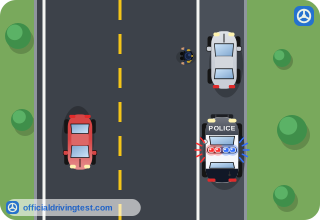
During a traffic stop, when should you remove your seat belt?
- As soon as the vehicle stops
- Before the officer reaches your window
- Only when asked to do so by the officer
- When you reach for your license
Show answer
Correct answer: Only when asked to do so by the officer
The manual says not to remove your seat belt unless asked to do so by the officer.
Source: North Carolina Driver Handbook (Revised May 2025), page 49 · Open this page in the manual (Manual page 49)
-
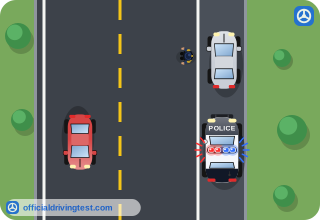
During a traffic stop, where should the driver place their hands?
- Resting on the dashboard in front of the driver
- Both hands on the steering wheel, in plain view
- Resting in the driver's lap out of the officer's view
- Reaching toward the glove box to get the registration
Show answer
Correct answer: Both hands on the steering wheel, in plain view
The manual says to place both hands on the steering wheel and keep your hands in plain view.
Source: North Carolina Driver Handbook (Revised May 2025), page 50 · Open this page in the manual (Manual page 50)
-
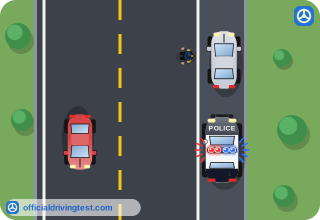
During a traffic stop, where should passengers in the back seat place their hands?
- Folded together in their laps
- Holding on to the door handles
- Clasped behind their heads
- On the back of the front seat
Show answer
Correct answer: On the back of the front seat
The manual says passengers in the back seat should place their hands on the back of the front seat.
Source: North Carolina Driver Handbook (Revised May 2025), page 50 · Open this page in the manual (Manual page 50)
-
If a traffic stop takes place at night, what should you do to help the officer see inside your vehicle?
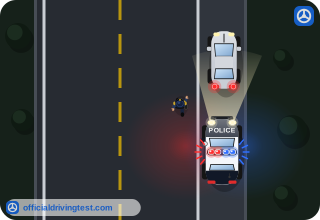
- Turn on your interior lights as soon as you stop
- Turn on your high beams and leave them on
- Turn off all of your lights including the headlights
- Keep only your parking lights on until the officer arrives
Show answer
Correct answer: Turn on your interior lights as soon as you stop
The manual says to turn on your interior lights as soon as you stop to help the officer see inside your vehicle.
Source: North Carolina Driver Handbook (Revised May 2025), page 50 · Open this page in the manual (Manual page 50)