North Carolina: Emergencies and special situations — Part 4 Practice Test
Questions in this part include: “How does light pressure on the brake pedal dry wet brakes?” · “After dealing with a sticking gas pedal, what should you do with the vehicle?”
Independent educational site · not affiliated with any government agency or DMV
Ready? Test yourself
- Instant feedback with an explanation
- Every answer cites its source in the manual
- Your best score is saved on this device
Questions are original and based on the official manual "North Carolina Driver Handbook" (Revised May 2025), North Carolina Division of Motor Vehicles (NCDMV).
All 18 questions in this practice test
Take the test above first, then use this list to study. Tap “Show answer” to see the correct answer and explanation.
Show the questions and answersHide the questions
-
How can you help to dry wet brakes?
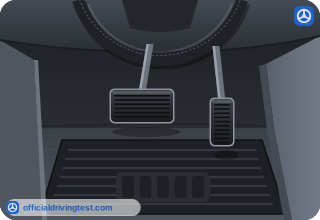
- Park and wait with the engine off for an hour
- Press the brake pedal down hard and hold it
- Drive fast for several miles without touching the brake pedal
- Drive a short distance while applying light pressure to the brake pedal
Show answer
Correct answer: Drive a short distance while applying light pressure to the brake pedal
The manual says to drive a short distance and apply light pressure to the brake pedal.
Source: North Carolina Driver Handbook (Revised May 2025), page 75 · Open this page in the manual (Manual page 75)
-
How does light pressure on the brake pedal dry wet brakes?
- The heat from the friction evaporates the water from the brake linings
- The pressure squeezes the water out of the brake fluid lines
- The pressure blows air through the wheels
- The brake pads absorb the water and store it
Show answer
Correct answer: The heat from the friction evaporates the water from the brake linings
The manual says the heat generated by the brakes' friction evaporates water from the linings.
Source: North Carolina Driver Handbook (Revised May 2025), page 75 · Open this page in the manual (Manual page 75)
-
How should you control your speed when moving down a long hill to prevent excessive wear on the brakes?
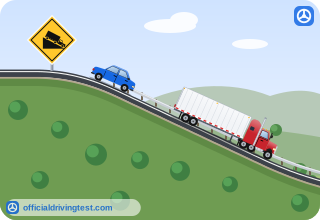
- Keep the brake pedal pressed lightly the whole way
- Shift into neutral and coast
- Use a lower gear instead of the brake pedal
- Turn the engine off to save fuel
Show answer
Correct answer: Use a lower gear instead of the brake pedal
The manual says to use a lower gear rather than the brake pedal on a long hill or steep grade.
Source: North Carolina Driver Handbook (Revised May 2025), page 75 · Open this page in the manual (Manual page 75)
-
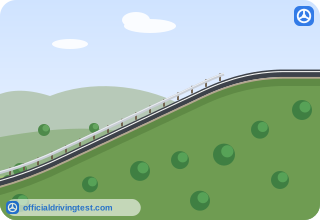
When is it best to shift to a lower gear for a long downhill grade?
- Halfway down the hill
- At the top of the hill before you descend
- Only when the brakes begin to overheat
- At the bottom of the hill
Show answer
Correct answer: At the top of the hill before you descend
The manual says it is best to shift to the lower gear at the top of the hill before you descend.
Source: North Carolina Driver Handbook (Revised May 2025), page 75 · Open this page in the manual (Manual page 75)
-
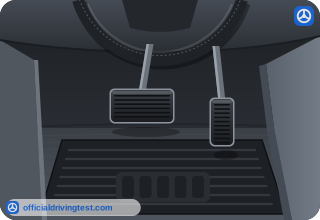
If your gas pedal sticks, what should you do with the gear control and the brakes?
- Shift into reverse and pump the brakes rapidly
- Turn the ignition to lock and press the brake lightly
- Stay in gear and lock the wheels to stop quickly
- Shift to neutral and brake firmly without locking the wheels
Show answer
Correct answer: Shift to neutral and brake firmly without locking the wheels
The manual says to shift to neutral and brake firmly without locking the wheels.
Source: North Carolina Driver Handbook (Revised May 2025), page 75 · Open this page in the manual (Manual page 75)
-
If your gas pedal sticks, what can you try first to free the throttle?
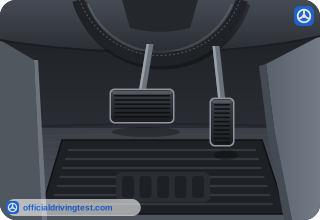
- Tap the gas pedal or lift it with your foot
- Press the clutch and the brake at the same time
- Turn the steering wheel sharply left and right
- Pull the parking brake all the way up
Show answer
Correct answer: Tap the gas pedal or lift it with your foot
The manual says to tap the gas pedal or lift it with your foot to try to unstick the throttle linkage.
Source: North Carolina Driver Handbook (Revised May 2025), page 75 · Open this page in the manual (Manual page 75)
-
After dealing with a sticking gas pedal, what should you do with the vehicle?
- Continue driving to the nearest repair shop
- Stop in the nearest travel lane and wait for help
- Find a safe place to move it completely off the road
- Drive on slowly with the flashers on
Show answer
Correct answer: Find a safe place to move it completely off the road
The manual says to find a safe place to move the vehicle completely off the road.
Source: North Carolina Driver Handbook (Revised May 2025), page 75 · Open this page in the manual (Manual page 75)
-
How can you tell that a blowout has occurred?
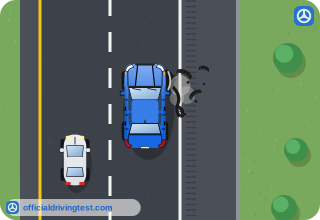
- A smell of burning rubber and a rise in engine noise
- A loud noise and the vehicle begins to swerve
- A warm steering wheel and a slowing engine
- A drop in speed and the horn sounding by itself
Show answer
Correct answer: A loud noise and the vehicle begins to swerve
The manual says a blowout is recognizable by a loud noise and the vehicle beginning to swerve.
Source: North Carolina Driver Handbook (Revised May 2025), page 76 · Open this page in the manual (Manual page 76)
-
What should you do if you feel a bumpy ride when there is no obvious reason?
- Speed up to smooth out the ride
- Check your mirrors and continue driving
- Shift into a lower gear
- Stop and check your tires
Show answer
Correct answer: Stop and check your tires
The manual says to stop and check your tires when the ride is bumpy for no obvious reason.
Source: North Carolina Driver Handbook (Revised May 2025), page 76 · Open this page in the manual (Manual page 76)
-
When changing a flat tire, what should you have all passengers do?
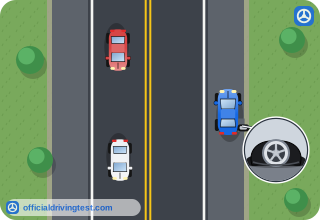
- Leave the vehicle by the passenger side and stay off the road
- Stay in the vehicle with their seat belts on
- Stand in front of the vehicle where they can be seen
- Wait behind the vehicle to warn approaching drivers
Show answer
Correct answer: Leave the vehicle by the passenger side and stay off the road
The manual says never to allow passengers to remain in the vehicle during a tire change.
Source: North Carolina Driver Handbook (Revised May 2025), page 76 · Open this page in the manual (Manual page 76)
-
Before changing a flat tire, what should you do to prevent the vehicle from rolling?
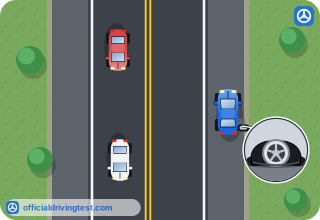
- Shift into neutral
- Leave the engine running
- Block the wheels
- Turn the steering wheel to the center
Show answer
Correct answer: Block the wheels
The manual says to block the wheels to prevent the vehicle from rolling.
Source: North Carolina Driver Handbook (Revised May 2025), page 76 · Open this page in the manual (Manual page 76)
-
What should you use to warn other drivers when you must change a flat tire, if you have them?
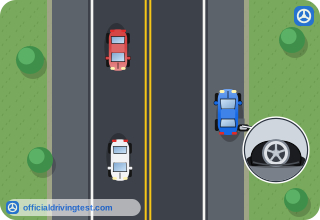
- Your high beam headlights
- Emergency flares
- A white cloth on the door handle
- Your horn, sounded repeatedly
Show answer
Correct answer: Emergency flares
The manual says to set the parking brake and use emergency flares if you have them.
Source: North Carolina Driver Handbook (Revised May 2025), page 76 · Open this page in the manual (Manual page 76)
-
If a blowout occurs, what should you do with the steering wheel?
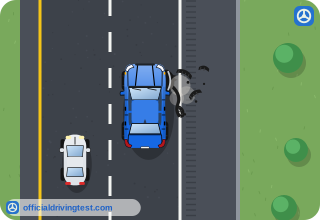
- Turn it sharply toward the shoulder right away to leave the road
- Let it move freely so the vehicle can settle
- Turn it toward the side of the flat tire
- Hold it tightly and keep the vehicle straight on your side of the road
Show answer
Correct answer: Hold it tightly and keep the vehicle straight on your side of the road
The manual says to hold the steering wheel tightly and keep the vehicle straight on your side of the road.
Source: North Carolina Driver Handbook (Revised May 2025), page 76 · Open this page in the manual (Manual page 76)
-
If a blowout occurs, how should you reduce your speed?
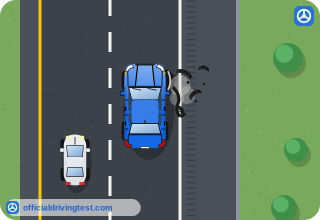
- By lifting your foot from the accelerator
- By pressing down firmly on the brake pedal
- By shifting into reverse
- By pulling the parking brake
Show answer
Correct answer: By lifting your foot from the accelerator
The manual says to reduce speed by lifting your foot from the accelerator during a blowout.
Source: North Carolina Driver Handbook (Revised May 2025), page 76 · Open this page in the manual (Manual page 76)
-
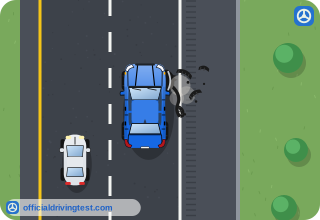
During a blowout, when may you apply the brakes?
- Immediately, with firm pressure
- Only after the vehicle has come off the road completely
- Only after the engine has slowed the vehicle enough for control
- Only after you have set the parking brake
Show answer
Correct answer: Only after the engine has slowed the vehicle enough for control
The manual says not to brake until the engine has slowed the vehicle enough for you to keep control.
Source: North Carolina Driver Handbook (Revised May 2025), page 76 · Open this page in the manual (Manual page 76)
-
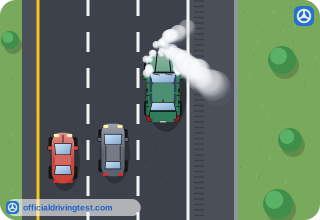
If your vehicle breaks down in an area exposed to other traffic, what should you do?
- Make quick repairs at the roadside
- Call a tow truck or mechanic instead of making repairs
- Ask a passing driver to help you make repairs
- Make repairs only during daylight hours
Show answer
Correct answer: Call a tow truck or mechanic instead of making repairs
The manual says not to make repairs in an area exposed to traffic and to call a tow truck or mechanic.
Source: North Carolina Driver Handbook (Revised May 2025), page 76 · Open this page in the manual (Manual page 76)
-
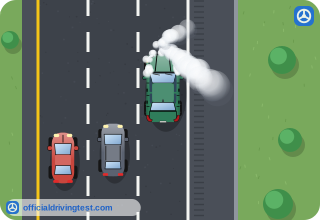
If your vehicle breaks down, where should you move it?
- Onto the shoulder with its rear still in the lane
- To the center of the road, in front of traffic
- Onto the shoulder with the front wheels in the lane
- Completely onto the shoulder of the road
Show answer
Correct answer: Completely onto the shoulder of the road
The manual says to move the vehicle completely onto the shoulder of the road.
Source: North Carolina Driver Handbook (Revised May 2025), page 76 · Open this page in the manual (Manual page 76)
-
If your vehicle breaks down, which side should you leave the vehicle from?
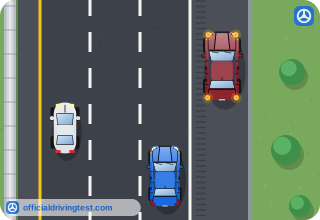
- The passenger side
- The driver side
- Whichever side is closer to the road
- The rear door only
Show answer
Correct answer: The passenger side
The manual says to leave the vehicle by the passenger side after a breakdown.
Source: North Carolina Driver Handbook (Revised May 2025), page 76 · Open this page in the manual (Manual page 76)